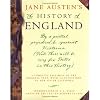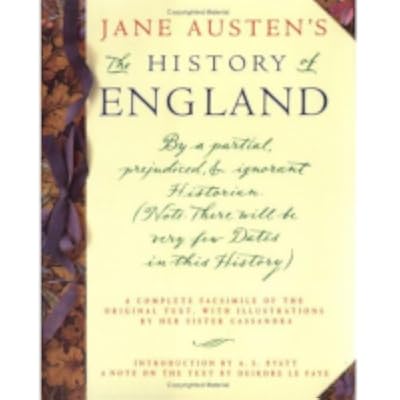
The History of England: By a Partial, Prejudiced and Ignorant Historian
by Jane Austen
On This Page
Description
Jane Austen, author of one of the greatest romance novels of all time, Pride and Prejudice, takes her readers on a satiric tour through England's history, from Henry IV to Charles I.Tags
Recommendations









Member Reviews
This delightful bit of juvenilia, written when Jane Austen was sixteen years old, is a hilarious and highly individual history of the English monarchy, from 1399 to 1649. Described by its author as being written "By a partial, prejudiced & ignorant Historian (Note: There will be very few Dates in this History)," this book more than lives up to its billing!
A facsimile of the original manuscript, with illustrations by Austen's sister, Cassandra, Jane Austen's The History of England, contains a host of amusing snippets about the various monarchs, from Henry VI, whom the author disliked for being a Lancastrian, to Mary, Queen of Scots, whom she felt was much maligned.
Truthfully, there isn't much to this little book, although it will show more certainly provide any Jane Austen aficionado with an hour's enjoyment. I myself value it for its evidence of Austen's boisterous high spirits - something that is sometimes lacking in her more sedate, adult literature. show less
A facsimile of the original manuscript, with illustrations by Austen's sister, Cassandra, Jane Austen's The History of England, contains a host of amusing snippets about the various monarchs, from Henry VI, whom the author disliked for being a Lancastrian, to Mary, Queen of Scots, whom she felt was much maligned.
Truthfully, there isn't much to this little book, although it will show more certainly provide any Jane Austen aficionado with an hour's enjoyment. I myself value it for its evidence of Austen's boisterous high spirits - something that is sometimes lacking in her more sedate, adult literature. show less
Jane Austen’s “History of England” is a delightful little work that reveals the wit, intelligence, and strong opinions of its young author. Miss Austen wrote it in 1791 at the age of 16, for the amusement of her sister and immediate family. Consisting of just 24 pages, it was never meant to be “published” but survived in notebook form along with many of Miss Jane’s other early writings.
The title page reveals its amusing tone: “A History of England from the reign of Henry the 4th to Charles the first, by a partial, prejudiced, & ignorant historian, with illustrations by her sister Cassandra.” A note warns the reader “There will be very few dates in this history.”
A few excerpts will reveal Miss Austen’s flippant, show more opinionated, and irreverent approach to her subject. Of Henry IV: “it is to be supposed that [he] was married, since he certainly had four sons, but it is not in my power to inform the reader as to who was his wife.” Of Edward IV: “One of Edward’s mistresses was Jane Shore, who has had a play written about her, but it is a tragedy, and therefore not worth reading.” Of Henry VIII: “The crimes and cruelties of this prince are too numerous to be mentioned… but his abolishing [of] religious houses and leaving them to the ruinous depredations of time has been of infinite use to the landscape of England in general, which probably was a principal motive for his doing it…” Of James I: “Though this king had some faults, among which and as the most principal, was his allowing his mother’s death, yet considered on the whole I cannot help liking him.”
Elizabeth arouses Miss Jane's particular dislike, for her execution of her cousin Mary, Queen of Scots: “wicked as she herself was, she could not have committed such extensive mischief had not these vile and abandoned men [her advisors]... connived at and encouraged her in her crimes.” And then “Elizabeth died so miserable that, were it not an injury to the memory of Mary, I should pity her.” Cassandra’s sketches are caricatures that reflect Jane’s opinions. Thus Elizabeth is represented as a hook- nosed shrew and Henry VIII as an unkempt ruffian, while Mary appears a rosy- cheeked beauty.
Readers interested in Jane Austen’s life and work have a wonderful opportunity to gain insight into her early development through this and other pieces of her juvenilia. All are available in a single, small volume published by the Collector’s Library, a book that bears the title “Sanditon, Lady Susan, & The History of England”. show less
The title page reveals its amusing tone: “A History of England from the reign of Henry the 4th to Charles the first, by a partial, prejudiced, & ignorant historian, with illustrations by her sister Cassandra.” A note warns the reader “There will be very few dates in this history.”
A few excerpts will reveal Miss Austen’s flippant, show more opinionated, and irreverent approach to her subject. Of Henry IV: “it is to be supposed that [he] was married, since he certainly had four sons, but it is not in my power to inform the reader as to who was his wife.” Of Edward IV: “One of Edward’s mistresses was Jane Shore, who has had a play written about her, but it is a tragedy, and therefore not worth reading.” Of Henry VIII: “The crimes and cruelties of this prince are too numerous to be mentioned… but his abolishing [of] religious houses and leaving them to the ruinous depredations of time has been of infinite use to the landscape of England in general, which probably was a principal motive for his doing it…” Of James I: “Though this king had some faults, among which and as the most principal, was his allowing his mother’s death, yet considered on the whole I cannot help liking him.”
Elizabeth arouses Miss Jane's particular dislike, for her execution of her cousin Mary, Queen of Scots: “wicked as she herself was, she could not have committed such extensive mischief had not these vile and abandoned men [her advisors]... connived at and encouraged her in her crimes.” And then “Elizabeth died so miserable that, were it not an injury to the memory of Mary, I should pity her.” Cassandra’s sketches are caricatures that reflect Jane’s opinions. Thus Elizabeth is represented as a hook- nosed shrew and Henry VIII as an unkempt ruffian, while Mary appears a rosy- cheeked beauty.
Readers interested in Jane Austen’s life and work have a wonderful opportunity to gain insight into her early development through this and other pieces of her juvenilia. All are available in a single, small volume published by the Collector’s Library, a book that bears the title “Sanditon, Lady Susan, & The History of England”. show less
In one of her early works, Austen offers short biographical sketches of the English monarchs from Henry IV to Charles I. These are not objective sketches. Indeed, Austen warns readers that the work is written by “a partial, prejudiced, and ignorant historian.” She concludes that “my principal reason for undertaking the History of England being to Prove the innocence of the Queen of Scotland, which I flatter myself to having effectually done, and to abuse Elizabeth, tho’ I am rather fearful of having fallen short in the latter part of my scheme.” The author reveals herself as a Yorkist with a partiality for the Roman Catholic religion. Readers with any familiarity with English history will learn more about Austen than they will show more about England’s kings and queens. show less
No matter how good you think you are at something, there's always some literal child out there doing it better. Austen's teenage writings are significantly more witty than I can hope to achieve and am trying to make peace with that
I don't love reading histories as much as I used to, but this was a hilarious read. It's so opinionated and pointed and done in the way only Jane could, thumbing her nose and complimenting in the same breath of truly gorgeous words.
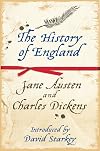
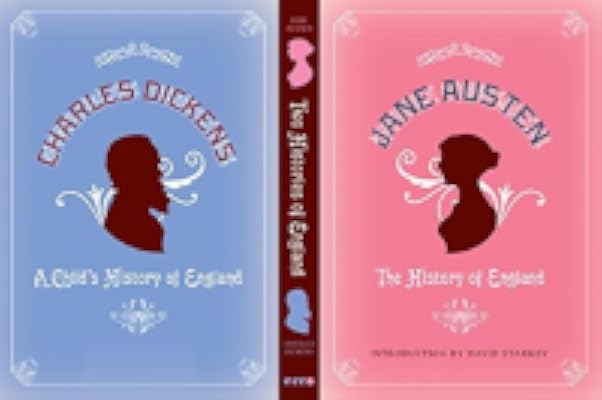
THIS book’s title is misleading: it is not a collaborative history written by two doyens of 19th-century English literature, but rather the entire text of The History of England from the Reign of Henry I to IV, to the Death of Charles I by Jane Austen, and an excerpt from Charles Dickens ’s A Child’s History of England .
Austen’s work, written when she was only 16, comprised a mere 20 pages, while Dickens ’s was far more substantial.
Hers was intended as an amusing satire but Dickens ’s work, although much of it seems tongue in cheek to the modern reader, was taken seriously enough to be a setwork for British schools until well into the 20th century.
How survivors of today’s dry-as-dust history syllabus must envy children show more who learned of the past by means of Dickens ’s fast-paced, gossipy and partisan prose!
In his introduction, David Starkey encourages us to read the histories as works of literature, pointing out how Dickens was true to the sentiments he expressed in his novels, and Austen developed themes here that she was later to master. “Austen’s opinionated frivolousness had a point. More than whimsy, her History of England is a satire on the style of history writing and pedagogy to which young girls of her class and station were routinely subjected,” Starkey says. “Austen’s implicit objection was to the vapidity of history education.”
In complete contrast, Dickens wrote a male-centred history bristling with dates, and with the names of the main characters capitalised. Despite using the standard and predictable tools of the sort of history book against which Austen had rebelled, his use of language, his irony, humanity, use of evocative detail and sardonic wit make his writing a pleasure.
“Throughout the book he shows himself wholly intolerant of the follies and arrogance of many of England’s rulers, at whose feet he lays much of the blame for the copious ‘turmoil and bloodshed’ of his nation’s history,” Starkey says.
After completing the entirely admirable and informative introduction, it is fascinating to examine the varied opinions of the two authors at face value, as might a schoolchild.
Austen condemns Elizabeth I as “wicked”, largely because she ordered the death of Mary Queen of Scots. Dickens judges her as “vain and jealous … a hard swearer and a coarse talker. She was clever, but cunning and deceitful.”
But while they may broadly agree on the subject of the so-called Virgin Queen, Mary Queen of Scots is another matter entirely.
Described as “amiable … this bewitching princess” and “entirely innocent” by Austen, Dickens argues that although she was “captivating”, she was also “deceitful … artful and treacherous”, and he had no doubt whatsoever that she was involved in plots to overthrow Elizabeth.
Strangely enough, given the levels of anti-Catholicism that persisted in England well into the 20th century, both writers were generally sympathetic to the Church of Rome, and respected Mary’s devotion to her religion. “Could you Reader have believed it possible that some hardened & zealous Protestants have even abused her for that Steadfastness in the Catholic Religion that reflected on her so much credit?” Austen asks plaintively.
In a milder vein, Dickens observes: “In their Protestant zeal, (they) made some very unnecessary speeches to her; to which she replied that she died in the Catholic religion, and they need not trouble themselves about that matter.”
Of James I, the teenaged Austen admits: “I cannot help liking him”, while the best Dickens can come up with is that “he was ugly, awkward, and shuffling both in mind and person”.
That might not seem very complimentary, but compared with the other things Dickens has to say about “his Sowship”, it is high praise indeed.
His loathing for James was such that he was almost sympathetic towards Guy Fawkes and the others involved in the Gunpowder Plot to assassinate King James I, although Austen comments sadly: “I am necessitated to say that in this reign the Roman Catholics of England did not behave like Gentlemen to the Protestants.”
The last monarch both writers examine is Charles I, whom they agree was “amiable”.
Dickens offers a far more detailed and informative account of Charles’s dispute with parliament, the civil war, and his execution. “With all my sorrow for him, I cannot agree with him that he died ‘the martyr of the people’; for the people had been martyrs to him, and to his ideas of a King’s rights, long before,” Dickens writes.
Austen dismisses “the disturbances, Distresses, & Civil Wars” in a single paragraph, and ends her history with the breath-taking candour of youth: “The Recital of any Events … is uninteresting to me; my principal reason for under taking the History of England being to prove the innocence of the Queen of Scotland, which I flatter myself with having effectively done, and to abuse Elizabeth, tho’ I am rather fearful of having fallen short in the latter part of my Scheme.”
Do not rely on these authors for a definitive account of the history of England . This is no textbook — it has been published for the enjoyment of fans of these two quintessentially British authors.
Austen and Dickens are refreshingly unselfconscious, witty without being deliberately clever or precious, non-PC, but never cheeky, and they are a true delight to read. show less
Austen’s work, written when she was only 16, comprised a mere 20 pages, while Dickens ’s was far more substantial.
Hers was intended as an amusing satire but Dickens ’s work, although much of it seems tongue in cheek to the modern reader, was taken seriously enough to be a setwork for British schools until well into the 20th century.
How survivors of today’s dry-as-dust history syllabus must envy children show more who learned of the past by means of Dickens ’s fast-paced, gossipy and partisan prose!
In his introduction, David Starkey encourages us to read the histories as works of literature, pointing out how Dickens was true to the sentiments he expressed in his novels, and Austen developed themes here that she was later to master. “Austen’s opinionated frivolousness had a point. More than whimsy, her History of England is a satire on the style of history writing and pedagogy to which young girls of her class and station were routinely subjected,” Starkey says. “Austen’s implicit objection was to the vapidity of history education.”
In complete contrast, Dickens wrote a male-centred history bristling with dates, and with the names of the main characters capitalised. Despite using the standard and predictable tools of the sort of history book against which Austen had rebelled, his use of language, his irony, humanity, use of evocative detail and sardonic wit make his writing a pleasure.
“Throughout the book he shows himself wholly intolerant of the follies and arrogance of many of England’s rulers, at whose feet he lays much of the blame for the copious ‘turmoil and bloodshed’ of his nation’s history,” Starkey says.
After completing the entirely admirable and informative introduction, it is fascinating to examine the varied opinions of the two authors at face value, as might a schoolchild.
Austen condemns Elizabeth I as “wicked”, largely because she ordered the death of Mary Queen of Scots. Dickens judges her as “vain and jealous … a hard swearer and a coarse talker. She was clever, but cunning and deceitful.”
But while they may broadly agree on the subject of the so-called Virgin Queen, Mary Queen of Scots is another matter entirely.
Described as “amiable … this bewitching princess” and “entirely innocent” by Austen, Dickens argues that although she was “captivating”, she was also “deceitful … artful and treacherous”, and he had no doubt whatsoever that she was involved in plots to overthrow Elizabeth.
Strangely enough, given the levels of anti-Catholicism that persisted in England well into the 20th century, both writers were generally sympathetic to the Church of Rome, and respected Mary’s devotion to her religion. “Could you Reader have believed it possible that some hardened & zealous Protestants have even abused her for that Steadfastness in the Catholic Religion that reflected on her so much credit?” Austen asks plaintively.
In a milder vein, Dickens observes: “In their Protestant zeal, (they) made some very unnecessary speeches to her; to which she replied that she died in the Catholic religion, and they need not trouble themselves about that matter.”
Of James I, the teenaged Austen admits: “I cannot help liking him”, while the best Dickens can come up with is that “he was ugly, awkward, and shuffling both in mind and person”.
That might not seem very complimentary, but compared with the other things Dickens has to say about “his Sowship”, it is high praise indeed.
His loathing for James was such that he was almost sympathetic towards Guy Fawkes and the others involved in the Gunpowder Plot to assassinate King James I, although Austen comments sadly: “I am necessitated to say that in this reign the Roman Catholics of England did not behave like Gentlemen to the Protestants.”
The last monarch both writers examine is Charles I, whom they agree was “amiable”.
Dickens offers a far more detailed and informative account of Charles’s dispute with parliament, the civil war, and his execution. “With all my sorrow for him, I cannot agree with him that he died ‘the martyr of the people’; for the people had been martyrs to him, and to his ideas of a King’s rights, long before,” Dickens writes.
Austen dismisses “the disturbances, Distresses, & Civil Wars” in a single paragraph, and ends her history with the breath-taking candour of youth: “The Recital of any Events … is uninteresting to me; my principal reason for under taking the History of England being to prove the innocence of the Queen of Scotland, which I flatter myself with having effectively done, and to abuse Elizabeth, tho’ I am rather fearful of having fallen short in the latter part of my Scheme.”
Do not rely on these authors for a definitive account of the history of England . This is no textbook — it has been published for the enjoyment of fans of these two quintessentially British authors.
Austen and Dickens are refreshingly unselfconscious, witty without being deliberately clever or precious, non-PC, but never cheeky, and they are a true delight to read. show less
A 14 page satire by Jane Austen. I found it amusing as she took the opposite stance on almost every person and event that is generally accepted today--like loving Bloody Mary and hating Good Queen Bess.
Members
- Recently Added By
Talk Discussions
Past Discussions
Folio Archives 7: The History of England by Jane Austen - 1993 in Folio Society Devotees (July 2017)
Author Information

Jane Austen's life is striking for the contrast between the great works she wrote in secret and the outward appearance of being quite dull and ordinary. Austen was born in the small English town of Steventon in Hampshire, and educated at home by her clergyman father. She was deeply devoted to her family. For a short time, the Austens lived in the show more resort city of Bath, but when her father died, they returned to Steventon, where Austen lived until her death at the age of 41. Austen was drawn to literature early, she began writing novels that satirized both the writers and the manners of the 1790's. Her sharp sense of humor and keen eye for the ridiculous in human behavior gave her works lasting appeal. She is at her best in such books as Pride and Prejudice (1813), Mansfield Park (1814), and Emma (1816), in which she examines and often ridicules the behavior of small groups of middle-class characters. Austen relies heavily on conversations among her characters to reveal their personalities, and at times her novels read almost like plays. Several of them have, in fact, been made into films. She is considered to be one of the most beloved British authors. (Bowker Author Biography) show less
Some Editions
Series
Belongs to Publisher Series
Work Relationships
Common Knowledge
- Canonical title
- The History of England: By a Partial, Prejudiced and Ignorant Historian
- Original publication date
- 1791
- Dedication
- To Miss Austen, eldest daughter of the Rev. George Austen, this work is
inscribed with all due respect by THE AUTHOR. - First words
- Henry the 4th ascended the throne of England much to his own
satisfaction in the year 1399, after having prevailed on his cousin and
predecessor Richard the 2nd, to resign it to him, and to retire for the
rest of his... (show all) life to Pomfret Castle, where he happened to be murdered. - Quotations
- Tho' I do not profess giving many dates,
yet as I think it proper to give some and shall of course make choice
of those which it is most necessary for the Reader to know, I think it
right to inform him that her lette... (show all)r to the King was dated on the 6th of
May. - Canonical DDC/MDS
- 823.7
- Disambiguation notice
- This does not include any history written by Charles Dickens.
Classifications
Statistics
- Members
- 727
- Popularity
- 38,818
- Reviews
- 14
- Rating
- (3.81)
- Languages
- Chinese, English, Italian
- Media
- Paper, Ebook
- ISBNs
- 15
- ASINs
- 11