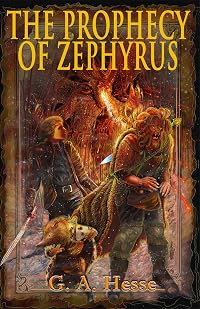
The Prophecy of Zephyrus
by G. A. Hesse 
On This Page
Tags
Recommendations


















Member Reviews
Two chapters into this delightful novel, a bit of literary magic occurs. Author G. Hesse's high flying fantasy suddenly turns real and absolutely believable. In part, it's the integrity of the characters, the page turning action, a brilliant rendering of arachnid monsters, and the beauty of the language that conjures the effect. But ultimately, it's the way the author blends her colorful palette so effortlessly that makes the read so compelling.
The Prophecy of Zephyrus is a rich, romantic and multi-layered adventure with an unusual trio of protagonists; each with a unique personality, hidden motivations and secret goals. Obie, the youth, an insecure earthling; Tau, his sidekick, a lion cursed to roam the forest as half man half beast; show more and Mole,a tiny warrior with wisdom enough for all three. Hesse endows this trio with spunky repartee which plays in sparkling counterpoint to the forces of evil they continually face.
Obie, in over his head from the start, is drawn towards an impossible romance, and caught up in nether world struggle for good and evil. To overcome the dark forces and extricate himself, he must develop confidence, wisdom, understanding and patience. As the dramatic climax of the tale approached, I found myself reading more and more slowly - unwilling for the story to end. In my experience, that's high praise for any author; in this case, the very talented first timer G. Hesse. show less
The Prophecy of Zephyrus is a rich, romantic and multi-layered adventure with an unusual trio of protagonists; each with a unique personality, hidden motivations and secret goals. Obie, the youth, an insecure earthling; Tau, his sidekick, a lion cursed to roam the forest as half man half beast; show more and Mole,a tiny warrior with wisdom enough for all three. Hesse endows this trio with spunky repartee which plays in sparkling counterpoint to the forces of evil they continually face.
Obie, in over his head from the start, is drawn towards an impossible romance, and caught up in nether world struggle for good and evil. To overcome the dark forces and extricate himself, he must develop confidence, wisdom, understanding and patience. As the dramatic climax of the tale approached, I found myself reading more and more slowly - unwilling for the story to end. In my experience, that's high praise for any author; in this case, the very talented first timer G. Hesse. show less
I enjoyed the colorful fantasy world G.A. Hesse creates in The Prophecy of Zephyrus so much that I read it twice. I found it a beautifully written, high-action story with many plot twists that kept me guessing. Answers to mysteries unfold naturally, creating a tight, well-crafted plot. One senses the author knows exactly what she’s doing every step of the way in the epic journey undertaken by the male protagonist, Obie Griffin. It’s a journey from boyhood to manhood, from insecure teenager to confident and competent warrior. Obie is swept into a physical battle between the forces of good and evil, as well as an inner battle with his own demons.
The author’s keen ear for the language enables her to create flowing sentences that show more easily draw the reader in. The eloquent simplicity of style reminds me of the writings of authors like Updike and Hemingway. Hesse’s prose is often poetic, especially in visual scenes such as Obie’s recurring nightmare, and the night he runs through an enchanted forest alongside the lion-man, and when, in a pensive mood, he observes snow falling on forest trees. Another treat is the entire scene where the black sorcerer King Torolf tries to win the love of the female protagonist, Gabrielle, who is a noblewoman, and Guardian of the Light Crystal. The entire scene of several pages is written in perfect iambic form---no small feat. Since Gabrielle is bewitched at the time, the author’s style here pulls the reader from everyday reality into Gabrielle’s mental realm of bewitchment. The scene is beautiful and poetic, yet the reader senses it is not quite real. It is subtle enough that many readers may be unaware of the literary craft behind the words; they are only aware of the falseness of Torolf’s conjured garden. To pull this off is an achievement for any writer. Although we know Torolf’s reason for wooing her is to acquire the Light Crystal with all its power, we view a side to him that surprises us. For although this evil black sorcerer is eaten up by hatred and a desire for revenge (the source of it is revealed earlier in the book by the character Andras), when he lays eyes on the now grown up Gabrielle, her beauty kindles in him feelings he has all but forgotten, and he falls prey to love---perverse though that love may be.
The book is filled with lively, credible characters, each having a unique voice. Sometimes the differences in voice are subtle and sometimes marked. In the beginning, for example, the differences between Obie and Josh’s voices, two modern-day teenagers, is not nearly as great as the contrast of voice between Obie and the aristocratic characters he encounters in the ancient Gaelic Kingdom of Windermere. While the author most likely did not wish to subject readers to a tiring task of unraveling the Gaelic tongue, one would expect the aristocrats to at least speak a more formal English than 21st century teenagers engage in. However, not all characters are high-born, as we note in the speech of the rough and ready soldiers of the queen, the bar maid at the Jolly Horse Inn, enemy soldiers (whose language differs according to their breed), and others. Tau, the lion-man, speaks rather formally because he has only acquired the ability to speak English (the common language) recently. show less
The author’s keen ear for the language enables her to create flowing sentences that show more easily draw the reader in. The eloquent simplicity of style reminds me of the writings of authors like Updike and Hemingway. Hesse’s prose is often poetic, especially in visual scenes such as Obie’s recurring nightmare, and the night he runs through an enchanted forest alongside the lion-man, and when, in a pensive mood, he observes snow falling on forest trees. Another treat is the entire scene where the black sorcerer King Torolf tries to win the love of the female protagonist, Gabrielle, who is a noblewoman, and Guardian of the Light Crystal. The entire scene of several pages is written in perfect iambic form---no small feat. Since Gabrielle is bewitched at the time, the author’s style here pulls the reader from everyday reality into Gabrielle’s mental realm of bewitchment. The scene is beautiful and poetic, yet the reader senses it is not quite real. It is subtle enough that many readers may be unaware of the literary craft behind the words; they are only aware of the falseness of Torolf’s conjured garden. To pull this off is an achievement for any writer. Although we know Torolf’s reason for wooing her is to acquire the Light Crystal with all its power, we view a side to him that surprises us. For although this evil black sorcerer is eaten up by hatred and a desire for revenge (the source of it is revealed earlier in the book by the character Andras), when he lays eyes on the now grown up Gabrielle, her beauty kindles in him feelings he has all but forgotten, and he falls prey to love---perverse though that love may be.
The book is filled with lively, credible characters, each having a unique voice. Sometimes the differences in voice are subtle and sometimes marked. In the beginning, for example, the differences between Obie and Josh’s voices, two modern-day teenagers, is not nearly as great as the contrast of voice between Obie and the aristocratic characters he encounters in the ancient Gaelic Kingdom of Windermere. While the author most likely did not wish to subject readers to a tiring task of unraveling the Gaelic tongue, one would expect the aristocrats to at least speak a more formal English than 21st century teenagers engage in. However, not all characters are high-born, as we note in the speech of the rough and ready soldiers of the queen, the bar maid at the Jolly Horse Inn, enemy soldiers (whose language differs according to their breed), and others. Tau, the lion-man, speaks rather formally because he has only acquired the ability to speak English (the common language) recently. show less
Disclosure: I received this book as part of the LibraryThing Member Giveaway program. Some people think this may bias a reviewer so I am making sure to put this information up front. I don't think it biases my reviews, but I'll let others be the judge of that.
I think that there are a substantial number of young girls who spin themselves imaginary fairy kingdoms they can populate with winged horses that fly to the moon, castles of brave knights, queens, and forests with elves. Since these little girls have probably read The Wind in the Willows and The Chronicles of Narnia, they probably also populate their fairy lands with talking animals. Because knights and elves need enemies to bravely face they put in some evil sorcerers, fire show more breathing dragons, and scary insect people. At the center of this fairy world is, of course, the beautiful princess, perhaps a stand-in for the little girl herself. Once in a while, a little girl like this grows up and writes a book using her fairy kingdom as the setting. G.A. Hesse appears to have been one of these little girls who grew up and decided to become a writer, and The Prophecy of Zephyrus is the result.
Unfortunately, fantasies spun in the daydreams of young girls don't seem to result in much more than a mediocre story. The primary problem that The Prophecy of Zephyrus has as a book is that this being a world spun in a daydream, there can't really be very many bad things that happen to the characters in the story. The villain in the book goes to great lengths to abduct the beautiful ingenue, but since this is a daydream-based fairy tale, she is never threatened with any harm as a result. In effect, the villain simply wants to get our heroine to his tower so he can try to woo her because he is awed by her beauty, which seems like a fantasy a twelve-year old girl might spin. The heroes who set out to rescue her from being courted don't kill their enemies (although their enemies are spider-men and ant-men who humanity is more or less at war with, and who would happily eat them), but knock them out and tie them up. Granted, the villain's spider-men ambush a group of soldiers and kill them all (and apparently eat them), but the soldiers are a faceless group that are eliminated off-stage, so the impact is pretty minor. On the other hand, the worst a supposedly scary fire-breathing dragon can do is shorten a small animal's tail.
The other central problem with the book is that it is just not that well-written. The first of these problems is that much of the writing itself is stilted, especially the dialogue. Much of the dialogue is incredibly stiff, although the style of dialogue lurches between stiff formality to very weak attempts to make the speech more colloquial (by having characters say "ya" instead of "you" a lot). One speech oddity that crops up over and over is characters addressing the person they are speaking with by name. In general, when two people are having a conversation at which no other person is present, they don't say things like this bit of text found on page 4 after a half page of dialogue: "What I want to know is, who wrote that on the rock, and why? Tell me what to do, Will. What's going on? How can I get rid of these bad dreams?" This sort of gratuitous insertion of character names into conversation is a fairly common pattern in the book, and it just grates on the reader's nerves. Another fairly annoying recurring writing foible is the tendency to italicize the names of places or things (although not always consistently). Names of places, translations of names, and so on get this treatment, although not every time, and there appears to be no rhyme or reason to what gets italicized and what doesn't, and when.
The second writing problem is a lack of attention to detail. The book itself is centered around the prophecy of the title. But the book never explains who Zephyrus was, or why anyone pays attention to his prophecy. Oddly, the writer seems to go out of her way to try to keep the exact nature of the prophecy a secret in the early part of the book, revealing it in full on page 91. But the text of the prophecy is found just before the table of contents, making the secrecy kind of moot, since any reader who looked at the beginning pages in the book will have already seen the prophecy. Making the entire prophecy element kind of silly is the fact that the prophecy doesn't actually contribute anything to the story. Characters don't make decisions based on the prophecy, no one consults it to guide their actions. They just see the male lead show up, decide he's the guy who is going to save everyone, and sit back to let it happen. The prophecy is sort of Nostradamus-like in that no one can use it to predict what is going to happen, as the meaning of the text only becomes clear after the predicted events have already happened. The hero has a horse that is telepathic, although why some animals can talk telepathically, some can talk normally, and some can do both is never explained. The horse pops into and out of the story-line, and eventually just drops out of the story. Early in the story we are introduced to malevolent trolls, and slightly more ambiguously evil goblins, but the villain doesn't recruit them as his soldiers for wholly unexplained reasons, instead making insects and lions into men. Once the spider-men, ant-men, and lion-men show up, the trolls and goblins vanish, never to be seen again. Over and over again, elements are introduced to the story, hang around for a bit, and are then dropped.
And this doesn't even begin to deal with the oddities of plot and characters featured in the book. The main character is Oberon Griffin, a character presumably from our modern day world who is whisked away to the fairy land of Windermere. Once there, he is tagged as the central figure in an all-important prophecy, and sets about his adventures. In keeping with the stiff dialogue, the various characters around him patiently spend copious amounts of text dumping information upon Oberon (or Obie, as he prefers to be called), making for some fairly tedious background scenes. This being a fairy tale story, everyone Obie meets immediately accepts his explanation of being transported by magic to the kingdom, and the Queen of Windermere takes a shine to him, giving him clothes, training and a horse. One thing Obie brings with him from the modern world is his "Raptor", a special and powerful slingshot, which the locals are improbably impressed with (as it is less effective as a weapon than, say, a bow, a weapon they seem to have plenty of, due to its non-lethal nature). Obie is more or less a wish-fulfillment character - once in Windermere he discovers that he can communicate via telepathy, discovers that he has elvish blood in his veins giving him superior abilities, loses the limp that has plagued him for his whole life, and falls in love with the princess.
The main problem facing Windermere is the "celestial dimming", meaning that the stars, the moon, and the sun are slowly fading. This is caused, apparently, by a cabal of six evil sorcerers, including the antagonist of this book, the evil Torolf. This seems to be a pretty stupid plan for the evildoers, since everyone pretty much accepts that once the various celestial lights go out, all life on Earth will end, which would seem to make the villainous plans amount to little more than an elaborate form of suicide. Instead of setting out to figure out how to prevent this inexplicably stupid plan, the good inhabitants of Windermere place all their hopes on flying to the moon to gather a crystal to pair with a hidden crystal they think they know the location of to somehow fix the problem. I say "somehow" because none of them actually know what the two crystals do, either individually or together. Meanwhile, Obie sets about learning swordplay, getting into arguments with the soldiers he spends his time with, and attending royal meals and festivals. As an aside, one thing that is odd about the book is the enormous verbiage spent discussing what everyone has for dinner. Despite the story supposedly taking place in the winter, with all the lights in the sky getting dimmer and colder (presumably making winter even harsher than normal), everyone almost always seems to have plenty to eat, and Hesse seems to feel the need to describe it all. Another oddity is that the horses and windlords (or winged horses) seem to eat nothing but clover in the book.
As noted before, the princess-figure is kidnapped, and Obie sets out with no one but his telepathic horse to rescue her. He comes across a lion-man to help him, but like most elements of the story, the fact that his companion is a lion-man turns out to be of little more than cosmetic consequence. Tau, as the lion-man calls himself, is more or less just a big strong guy. He fights with a sword, eats human food, acts like a normal man, and pretty much behaves more or less like Little John to Obie's Robin Hood. Along the way, they also pick up a mole named Mole to accompany them, who turns out to pretty much behave like a human in a mole suit. The odd thing about the quest is that almost all of the book is spent describing the travels of the characters, what they eat, and where they camp. The few times the heroes run across bad guys, they spend all their time running away from them. At one point they suffer through a blizzard and run out of food, but once they find some friends, that sort of privation is immediately forgotten. Once they reach their objective, they sort of run through the actual rescue in an almost perfunctory manner.
Of course, having rescued the damsel, the heroes have to foil the evil wizard. Once again, large volumes of space are spent on moving people about, until everyone is finally ready to confront the evil villain and his dragon, and then everything ends in a hurried deus ex machina ending. Adding insult to injury, after the villain's armies vanish in a puff of smoke (almost literally), he is killed, and all the bad things that happened to people are undone, the budding love triangle of the story is resolved in a Return of the Jedi type twist that is no less groan-inducing than George Lucas' original. Even the terrible memories of his own mother's death that haunt Obie are whisked away in a rather odd scene. Of course, after Obie returns to the real world, he's been changed for the better - where he was geeky, he becomes popular, where he was beset by a limp, he becomes a star athlete, where he fumbled over the girl of his dreams, he now confidently courts her, and so on. In effect, everything wraps up in a bow in the last ten or twenty pages of the book, as everything bad is basically washed away by overwhelming magical aid.
Although the book has serious problems, it does have some redeeming qualities. Though the book is mostly generic fantasy, the idea of having spider-men, called raks, and ant-men, called muks, as the villains' army is kind of unusual. Unfortunately, like many things in the book the fact that they are spider-men and ant-men is not particularly relevant (although the spider-men do have poisonous fangs). They don't seem to gain any particular advantage from having multiple limbs, and their one big advantage, the ability to climb sheer walls, never really comes into play, and they prove to have a huge weakness that makes them entirely useless as an army at the end of the book. The idea of the villain darkening the world is not a new one, featuring prominently in The Silmarillion for example, but it isn't a bad villainous plot (except for the fact that everyone on Earth, including the villain, will die as a result). Some opportunities seem to be missed - the "Shadow People" talked about in the book turn out to be little more than stereotypical Native American imitations that are really good at hiding, instead of people made of shadows, which would have been much more interesting.
In the end, this book seems like a missed opportunity. With a little more care, and a little more imagination, it could have been a pretty good young adult fantasy story. As it is, the unpolished nature of the setting, the extraordinarily slow movement of the plot, a wooden villain with an inexplicably dumb plan, the deus ex machina ending, coupled with some fairly stiff writing makes for a mediocre book. The fantasy elements are mostly bland and generic, which is not a failing in and of itself, but a book built on a fantasy world more or less interchangeable with a dozen others has to have a strong story, and this one simply does not. Perhaps because the book seems to be built on a child's daydream, nothing bad can happen, or seem like it is going to happen, and as a result, very little does happen other than a lot of walking around, a lot of exposition, and a lot of descriptions of dinner. This, unsurprisingly, does not make for a very interesting book.
This review has also been posted to my blog Dreaming About Other Worlds. show less
I think that there are a substantial number of young girls who spin themselves imaginary fairy kingdoms they can populate with winged horses that fly to the moon, castles of brave knights, queens, and forests with elves. Since these little girls have probably read The Wind in the Willows and The Chronicles of Narnia, they probably also populate their fairy lands with talking animals. Because knights and elves need enemies to bravely face they put in some evil sorcerers, fire show more breathing dragons, and scary insect people. At the center of this fairy world is, of course, the beautiful princess, perhaps a stand-in for the little girl herself. Once in a while, a little girl like this grows up and writes a book using her fairy kingdom as the setting. G.A. Hesse appears to have been one of these little girls who grew up and decided to become a writer, and The Prophecy of Zephyrus is the result.
Unfortunately, fantasies spun in the daydreams of young girls don't seem to result in much more than a mediocre story. The primary problem that The Prophecy of Zephyrus has as a book is that this being a world spun in a daydream, there can't really be very many bad things that happen to the characters in the story. The villain in the book goes to great lengths to abduct the beautiful ingenue, but since this is a daydream-based fairy tale, she is never threatened with any harm as a result. In effect, the villain simply wants to get our heroine to his tower so he can try to woo her because he is awed by her beauty, which seems like a fantasy a twelve-year old girl might spin. The heroes who set out to rescue her from being courted don't kill their enemies (although their enemies are spider-men and ant-men who humanity is more or less at war with, and who would happily eat them), but knock them out and tie them up. Granted, the villain's spider-men ambush a group of soldiers and kill them all (and apparently eat them), but the soldiers are a faceless group that are eliminated off-stage, so the impact is pretty minor. On the other hand, the worst a supposedly scary fire-breathing dragon can do is shorten a small animal's tail.
The other central problem with the book is that it is just not that well-written. The first of these problems is that much of the writing itself is stilted, especially the dialogue. Much of the dialogue is incredibly stiff, although the style of dialogue lurches between stiff formality to very weak attempts to make the speech more colloquial (by having characters say "ya" instead of "you" a lot). One speech oddity that crops up over and over is characters addressing the person they are speaking with by name. In general, when two people are having a conversation at which no other person is present, they don't say things like this bit of text found on page 4 after a half page of dialogue: "What I want to know is, who wrote that on the rock, and why? Tell me what to do, Will. What's going on? How can I get rid of these bad dreams?" This sort of gratuitous insertion of character names into conversation is a fairly common pattern in the book, and it just grates on the reader's nerves. Another fairly annoying recurring writing foible is the tendency to italicize the names of places or things (although not always consistently). Names of places, translations of names, and so on get this treatment, although not every time, and there appears to be no rhyme or reason to what gets italicized and what doesn't, and when.
The second writing problem is a lack of attention to detail. The book itself is centered around the prophecy of the title. But the book never explains who Zephyrus was, or why anyone pays attention to his prophecy. Oddly, the writer seems to go out of her way to try to keep the exact nature of the prophecy a secret in the early part of the book, revealing it in full on page 91. But the text of the prophecy is found just before the table of contents, making the secrecy kind of moot, since any reader who looked at the beginning pages in the book will have already seen the prophecy. Making the entire prophecy element kind of silly is the fact that the prophecy doesn't actually contribute anything to the story. Characters don't make decisions based on the prophecy, no one consults it to guide their actions. They just see the male lead show up, decide he's the guy who is going to save everyone, and sit back to let it happen. The prophecy is sort of Nostradamus-like in that no one can use it to predict what is going to happen, as the meaning of the text only becomes clear after the predicted events have already happened. The hero has a horse that is telepathic, although why some animals can talk telepathically, some can talk normally, and some can do both is never explained. The horse pops into and out of the story-line, and eventually just drops out of the story. Early in the story we are introduced to malevolent trolls, and slightly more ambiguously evil goblins, but the villain doesn't recruit them as his soldiers for wholly unexplained reasons, instead making insects and lions into men. Once the spider-men, ant-men, and lion-men show up, the trolls and goblins vanish, never to be seen again. Over and over again, elements are introduced to the story, hang around for a bit, and are then dropped.
And this doesn't even begin to deal with the oddities of plot and characters featured in the book. The main character is Oberon Griffin, a character presumably from our modern day world who is whisked away to the fairy land of Windermere. Once there, he is tagged as the central figure in an all-important prophecy, and sets about his adventures. In keeping with the stiff dialogue, the various characters around him patiently spend copious amounts of text dumping information upon Oberon (or Obie, as he prefers to be called), making for some fairly tedious background scenes. This being a fairy tale story, everyone Obie meets immediately accepts his explanation of being transported by magic to the kingdom, and the Queen of Windermere takes a shine to him, giving him clothes, training and a horse. One thing Obie brings with him from the modern world is his "Raptor", a special and powerful slingshot, which the locals are improbably impressed with (as it is less effective as a weapon than, say, a bow, a weapon they seem to have plenty of, due to its non-lethal nature). Obie is more or less a wish-fulfillment character - once in Windermere he discovers that he can communicate via telepathy, discovers that he has elvish blood in his veins giving him superior abilities, loses the limp that has plagued him for his whole life, and falls in love with the princess.
The main problem facing Windermere is the "celestial dimming", meaning that the stars, the moon, and the sun are slowly fading. This is caused, apparently, by a cabal of six evil sorcerers, including the antagonist of this book, the evil Torolf. This seems to be a pretty stupid plan for the evildoers, since everyone pretty much accepts that once the various celestial lights go out, all life on Earth will end, which would seem to make the villainous plans amount to little more than an elaborate form of suicide. Instead of setting out to figure out how to prevent this inexplicably stupid plan, the good inhabitants of Windermere place all their hopes on flying to the moon to gather a crystal to pair with a hidden crystal they think they know the location of to somehow fix the problem. I say "somehow" because none of them actually know what the two crystals do, either individually or together. Meanwhile, Obie sets about learning swordplay, getting into arguments with the soldiers he spends his time with, and attending royal meals and festivals. As an aside, one thing that is odd about the book is the enormous verbiage spent discussing what everyone has for dinner. Despite the story supposedly taking place in the winter, with all the lights in the sky getting dimmer and colder (presumably making winter even harsher than normal), everyone almost always seems to have plenty to eat, and Hesse seems to feel the need to describe it all. Another oddity is that the horses and windlords (or winged horses) seem to eat nothing but clover in the book.
As noted before, the princess-figure is kidnapped, and Obie sets out with no one but his telepathic horse to rescue her. He comes across a lion-man to help him, but like most elements of the story, the fact that his companion is a lion-man turns out to be of little more than cosmetic consequence. Tau, as the lion-man calls himself, is more or less just a big strong guy. He fights with a sword, eats human food, acts like a normal man, and pretty much behaves more or less like Little John to Obie's Robin Hood. Along the way, they also pick up a mole named Mole to accompany them, who turns out to pretty much behave like a human in a mole suit. The odd thing about the quest is that almost all of the book is spent describing the travels of the characters, what they eat, and where they camp. The few times the heroes run across bad guys, they spend all their time running away from them. At one point they suffer through a blizzard and run out of food, but once they find some friends, that sort of privation is immediately forgotten. Once they reach their objective, they sort of run through the actual rescue in an almost perfunctory manner.
Of course, having rescued the damsel, the heroes have to foil the evil wizard. Once again, large volumes of space are spent on moving people about, until everyone is finally ready to confront the evil villain and his dragon, and then everything ends in a hurried deus ex machina ending. Adding insult to injury, after the villain's armies vanish in a puff of smoke (almost literally), he is killed, and all the bad things that happened to people are undone, the budding love triangle of the story is resolved in a Return of the Jedi type twist that is no less groan-inducing than George Lucas' original. Even the terrible memories of his own mother's death that haunt Obie are whisked away in a rather odd scene. Of course, after Obie returns to the real world, he's been changed for the better - where he was geeky, he becomes popular, where he was beset by a limp, he becomes a star athlete, where he fumbled over the girl of his dreams, he now confidently courts her, and so on. In effect, everything wraps up in a bow in the last ten or twenty pages of the book, as everything bad is basically washed away by overwhelming magical aid.
Although the book has serious problems, it does have some redeeming qualities. Though the book is mostly generic fantasy, the idea of having spider-men, called raks, and ant-men, called muks, as the villains' army is kind of unusual. Unfortunately, like many things in the book the fact that they are spider-men and ant-men is not particularly relevant (although the spider-men do have poisonous fangs). They don't seem to gain any particular advantage from having multiple limbs, and their one big advantage, the ability to climb sheer walls, never really comes into play, and they prove to have a huge weakness that makes them entirely useless as an army at the end of the book. The idea of the villain darkening the world is not a new one, featuring prominently in The Silmarillion for example, but it isn't a bad villainous plot (except for the fact that everyone on Earth, including the villain, will die as a result). Some opportunities seem to be missed - the "Shadow People" talked about in the book turn out to be little more than stereotypical Native American imitations that are really good at hiding, instead of people made of shadows, which would have been much more interesting.
In the end, this book seems like a missed opportunity. With a little more care, and a little more imagination, it could have been a pretty good young adult fantasy story. As it is, the unpolished nature of the setting, the extraordinarily slow movement of the plot, a wooden villain with an inexplicably dumb plan, the deus ex machina ending, coupled with some fairly stiff writing makes for a mediocre book. The fantasy elements are mostly bland and generic, which is not a failing in and of itself, but a book built on a fantasy world more or less interchangeable with a dozen others has to have a strong story, and this one simply does not. Perhaps because the book seems to be built on a child's daydream, nothing bad can happen, or seem like it is going to happen, and as a result, very little does happen other than a lot of walking around, a lot of exposition, and a lot of descriptions of dinner. This, unsurprisingly, does not make for a very interesting book.
This review has also been posted to my blog Dreaming About Other Worlds. show less
This review was written for LibraryThing Member Giveaways.
"The Prophecy of Zephyrus", written by G.A. Hesse targets the young adult audience. I was excited to receive this book since it was my first free novel won through the LibraryThing review a book give-a-way program. Granted I am not a young adult, but I enjoy science fiction fantasy, so I figured why not give it a whirl. I didn't know anything about the author and had no preconceived notions on how good or bad the book might be. Nothing like opening a cover and taking a chance with something completely unknown.
I will say this; G. A. Hesse is an excellent writer. She can spin words in a way that transports you deep inside the story she so craftily tells. Her way with words, even the simplistic phrases targeting kids, helps you feel as if show more you were walking along with the characters. Sadly, at least in "The Prophecy of Zephyrus", her characters don't really go anywhere. I take that back. Travelling is about all they really do. Once they arrive at any said location nothing happens. The book was all about the travelling and very little about any adventure. Try taking the "Lord of the Rings" and throw in a bunch of ant/spider people, take out all of the action and intrigue, and you have the synopsis of what this book entails. It was such a disappointment since the quality if writing was actually enjoyable.
Obie Griffin is a normal boy. He has a limp, his brother is a star football player and he is just wandering through life waiting for something to happen. As luck would have it he comes across a rock on a mysterious camping trip, and is suddenly transported into a world of flying horses, elves and goblins. It would have read so much nicer if we could have come up some different species, besides ant and spider people in my opinion. The world is ending and Obie, according to the prophecy, is the one dude who has a chance at saving it.
He befriends a gorgeous girl, who then very quickly gets captured by the former prince charming turned evil sorcery, and he then travels to the dark tower in the hopes of rescuing her. Along the way he is befriended by a lion man and a talking mole, and the three of them set off on their quest. Sadly, that is the story. Nothing really happens on the quest. He doesn't turn into a hero as much as luckily escapes harm on several occasions. If I remember correctly he only actually uses his sword one time throughout the entire journey. On most occasions he avoids danger or somehow narrowly escapes it.
When they get to the dark tower they have one quick encounter with a guard and that is over in less than a page. Even the climactic battle is passed over as the details in the journey seem to be more important than any sort of epic confrontation. There was one entire paragraph devoted to a listing of food prepared for a banquet and not even a few words of any description surrounding the raging war between good versus evil. I realize this was geared toward young adults but it reads more like it was written for small children below the age of 10.
I will state for the record that I read the entire book. All 420 pages. It was very descriptive and intriguingly woven. It would have made for a very nice read had we managed to throw a few words around about some of the more interesting actions scenes. An epic adventure with no action is nothing more than a stroll through the woods avoiding the bad guys. So it would be hard for me to recommend reading this one. I now realize that I might even prefer mediocre writing with a heaping of adventure versus very nice descriptive writing where nothing really seems to occur.
The bottom line is the story feel far short of being interesting. I would rate it three stars for its technical excellence but I would highly suggest any sequel having a little more meat to the story, or I doubt I would be able to get through the entire thing. I do hope that A. G. Hess continues to write. If you tweaked this story you would have an absolutely excellent book. I am even afraid my review might be a little too negative. The book is so elequently written. I truly wish there would have been more to this story to enjoy. show less
I will say this; G. A. Hesse is an excellent writer. She can spin words in a way that transports you deep inside the story she so craftily tells. Her way with words, even the simplistic phrases targeting kids, helps you feel as if show more you were walking along with the characters. Sadly, at least in "The Prophecy of Zephyrus", her characters don't really go anywhere. I take that back. Travelling is about all they really do. Once they arrive at any said location nothing happens. The book was all about the travelling and very little about any adventure. Try taking the "Lord of the Rings" and throw in a bunch of ant/spider people, take out all of the action and intrigue, and you have the synopsis of what this book entails. It was such a disappointment since the quality if writing was actually enjoyable.
Obie Griffin is a normal boy. He has a limp, his brother is a star football player and he is just wandering through life waiting for something to happen. As luck would have it he comes across a rock on a mysterious camping trip, and is suddenly transported into a world of flying horses, elves and goblins. It would have read so much nicer if we could have come up some different species, besides ant and spider people in my opinion. The world is ending and Obie, according to the prophecy, is the one dude who has a chance at saving it.
He befriends a gorgeous girl, who then very quickly gets captured by the former prince charming turned evil sorcery, and he then travels to the dark tower in the hopes of rescuing her. Along the way he is befriended by a lion man and a talking mole, and the three of them set off on their quest. Sadly, that is the story. Nothing really happens on the quest. He doesn't turn into a hero as much as luckily escapes harm on several occasions. If I remember correctly he only actually uses his sword one time throughout the entire journey. On most occasions he avoids danger or somehow narrowly escapes it.
When they get to the dark tower they have one quick encounter with a guard and that is over in less than a page. Even the climactic battle is passed over as the details in the journey seem to be more important than any sort of epic confrontation. There was one entire paragraph devoted to a listing of food prepared for a banquet and not even a few words of any description surrounding the raging war between good versus evil. I realize this was geared toward young adults but it reads more like it was written for small children below the age of 10.
I will state for the record that I read the entire book. All 420 pages. It was very descriptive and intriguingly woven. It would have made for a very nice read had we managed to throw a few words around about some of the more interesting actions scenes. An epic adventure with no action is nothing more than a stroll through the woods avoiding the bad guys. So it would be hard for me to recommend reading this one. I now realize that I might even prefer mediocre writing with a heaping of adventure versus very nice descriptive writing where nothing really seems to occur.
The bottom line is the story feel far short of being interesting. I would rate it three stars for its technical excellence but I would highly suggest any sequel having a little more meat to the story, or I doubt I would be able to get through the entire thing. I do hope that A. G. Hess continues to write. If you tweaked this story you would have an absolutely excellent book. I am even afraid my review might be a little too negative. The book is so elequently written. I truly wish there would have been more to this story to enjoy. show less
This review was written for LibraryThing Member Giveaways.
Review from Badelynge
An American teenager is whisked off to a fantasy world. To get back home he has to set out on a quest to confront an all powerful sorcerer. On the way he befriends a lion man, encounters a witch and battles odd creatures in the woods. Add a few fantasy staples like goblins and elves and that is about it. This book is about as undemanding as books get. It's a shame because the first two chapters showed promise. Obie and his friend Josh seemed like real characters. Unfortunately things go awry as soon as he ends up in the fantasy world leaving Josh behind. From here on in Obie is surrounded by awfully nice people who are in conflict with some awfully bad people. G.A.Hesse's clean and flawless prose just seems to show more compound the lack of any rough edges to her world building. And you do need some rough edges in this genre. The dialogue is very odd indeed with characters interacting with pretty much the same voice and standpoint throughout. Things take an even more dire turn for the worse when Hesse introduces a cutesy character who seems to have taken a wrong turn on the way to Toad Hall. If I hadn't committed to doing the review I would have put the book down at about page 40. I think even in my younger, fantasy devouring days I'd have come to the same conclusion. By page 320 I had to admit defeat. Another 100 pages of The Prophecy of Zephyrus was just a bridge too far. I believe I'd read enough to justify still penning this review though. I think this was a case of an author who has fully mastered the technical side of the written word but has not even begun to learn how to become a storyteller. show less
An American teenager is whisked off to a fantasy world. To get back home he has to set out on a quest to confront an all powerful sorcerer. On the way he befriends a lion man, encounters a witch and battles odd creatures in the woods. Add a few fantasy staples like goblins and elves and that is about it. This book is about as undemanding as books get. It's a shame because the first two chapters showed promise. Obie and his friend Josh seemed like real characters. Unfortunately things go awry as soon as he ends up in the fantasy world leaving Josh behind. From here on in Obie is surrounded by awfully nice people who are in conflict with some awfully bad people. G.A.Hesse's clean and flawless prose just seems to show more compound the lack of any rough edges to her world building. And you do need some rough edges in this genre. The dialogue is very odd indeed with characters interacting with pretty much the same voice and standpoint throughout. Things take an even more dire turn for the worse when Hesse introduces a cutesy character who seems to have taken a wrong turn on the way to Toad Hall. If I hadn't committed to doing the review I would have put the book down at about page 40. I think even in my younger, fantasy devouring days I'd have come to the same conclusion. By page 320 I had to admit defeat. Another 100 pages of The Prophecy of Zephyrus was just a bridge too far. I believe I'd read enough to justify still penning this review though. I think this was a case of an author who has fully mastered the technical side of the written word but has not even begun to learn how to become a storyteller. show less
This review was written for LibraryThing Member Giveaways.
This is a quest book along the lines of "Lord of the Rings." The characters plod on and on and on and you are given tons of detail. Next there is a confrontation or they meet someone along the way with very little action or emotion. Back to the plodding away. I found the mole character very endearing and the last part of the book was entertaining. "Lord of the Rings" bored me to tears so if you liked that book, this one should please you too. I just didn't care for it. The author shows promise and I think, in another book or two, will be a fine author.
I received the books as part of the Member Giveaway program.
I received the books as part of the Member Giveaway program.
This review was written for LibraryThing Member Giveaways.
Had I read this book when I was in junior high, I probably would have loved it. Instead, I just kept noticing the stilted dialogue, the sudden and drastic mood swings of the characters, and the blatant, distracting over-describing of just about everything. The majority of the story was told rather than shown, which prevented any forward momentum from really getting off the ground.
Obie was an interesting, if not stereotypical, character. His mood swings were distracting and normally unnecessary. Every other character seemed to burst into tears at the drop of a hat and conflict between characters came out of nowhere rather than building organically.
There were some interesting qualities to the story, particularly in the black magic army show more made up on muks and raks. The magic shrinking Vale of Nepenthe was a trope well used. For a book that focused mostly on running after something, the pacing was pretty good after the major part of the plot began, though the ending was a little overlong, what with all of the "reveals" being quite obvious from early on in the story.
The dialogue really got to me at times that I had to stop reading before I got overly annoyed and gave up. It rarely sounds natural if spoken out loud and every character seemed to be the type of person that has no internal filter, saying anything and everything that comes to mind.
Despite having some interesting ideas, overall this book was not good. While I've definitely read worse and more stereotypical fantasy fiction, I won't be recommending this to anyone. show less
Obie was an interesting, if not stereotypical, character. His mood swings were distracting and normally unnecessary. Every other character seemed to burst into tears at the drop of a hat and conflict between characters came out of nowhere rather than building organically.
There were some interesting qualities to the story, particularly in the black magic army show more made up on muks and raks. The magic shrinking Vale of Nepenthe was a trope well used. For a book that focused mostly on running after something, the pacing was pretty good after the major part of the plot began, though the ending was a little overlong, what with all of the "reveals" being quite obvious from early on in the story.
The dialogue really got to me at times that I had to stop reading before I got overly annoyed and gave up. It rarely sounds natural if spoken out loud and every character seemed to be the type of person that has no internal filter, saying anything and everything that comes to mind.
Despite having some interesting ideas, overall this book was not good. While I've definitely read worse and more stereotypical fantasy fiction, I won't be recommending this to anyone. show less
This review was written for LibraryThing Member Giveaways.
Members
- Recently Added By
Author Information

1 Work 60 Members
G. A. Hesse is a LibraryThing Author, an author who lists their personal library on LibraryThing.
Common Knowledge
- Canonical title
- The Prophecy of Zephyrus
- Original publication date
- 2009-11-01
- People/Characters
- Oberon "Obie" Griffin; Josh; Will "The Old Man" Gray Eagle; Gabrielle of the House of Brynnen; Lord Andras Brynnen; Queen Olwen (show all 62); Ull; Tau; Mole; Prince Andor; King Torolf; Shannon Piper; Scott "Scottie" Griffin; Jabo; Dennis Murphy; Chad Pauley; Coach Barnes; Mara; Annwyl; Talbot; Mr. Griffin; Mrs. Griffin; Cyclone; Shadow; Lord Cadwallen of Wesley; King Cyneric; Phoebe; Lord Ilar Brynnen; Lord Gerallt of Barrington; Gwendina; Gaylen; Ivor; Rune; King Zephyrus; Magnus; King Ymir; King Vadar; Marduk; Prince Ulrik; Prince Urien; Arend; Lord Brighton; Lady Brighton; Lord Hastings; Lady Heatherwood; Awst; Wud; Squire Bigam; Jasper; Dylan; Thorkil; Silverclaw; Zelda; Kort; Rrguck; Lukvok; Mankato; Takoda; Chief Shappa; Kangi; Maka; Tashunka
- Important places
- Windermere; Gnarlwood Forest; Hundred Valleys Region; Witch River; Zelda's Grotto; Vale of Nepenthe (show all 13); Barren Plateau; Targus Dol; Isles of Eluthien; Long Wadi Road; High Country; Garret, Wyoming, USA; Ghostrise Valley, Wyoming, USA
- Dedication
- For my daughter Hilary, the light of my life, whose perceptive comments and good suggestions early on helped in shaping this tale, and my dear sister Oma, for believing in me.
- First words
- FEAR. TEETH-GNASHING, gut-wrenching fear ignited in him like a flash fire.
- Last words
- (Click to show. Warning: May contain spoilers.)He had much to learn.
Classifications
Statistics
- Members
- 60
- Popularity
- 514,278
- Reviews
- 23
- Rating
- (3.81)
- Languages
- English
- Media
- Paper
- ISBNs
- 1