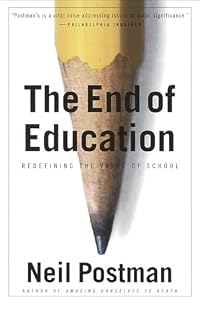
The End of Education: Redefining the Value of School
by Neil Postman
On This Page
Description
In this comprehensive response to the education crisis, the author of Teaching as a Subversive Activity returns to the subject that established his reputation as one of our most insightful social critics. Postman presents useful models with which schools can restore a sense of purpose, tolerance, and a respect for learning.Tags
Recommendations








Member Reviews
Review from 2008:
Finally! A book asking "What is education for?" not just "How can we do education better?" Postman gives a balanced treatment full of great insights. Just take a look at the beginning:
Pg. ix – “I began my career as an elementary school teacher and have not for a single moment abandoned the idea that many of our most vexing and painful social problems could be ameliorated if we knew how to school our young. You may conclude from this that I am a romantic, but not, I think, a fool. I know that education is not the same thing as schooling, and that, in fact, not much of education takes place in school… To the young, schooling seems relentless, but we know it is not. What is relentless is our education, which, for show more good or ill, gives us no rest. That is why poverty is a great educator. Having no boundaries and refusing to be ignored, it mostly teaches hopelessness. But not always. Politics is also a great educator. Mostly, it teaches, I am afraid, cynicism. But not always. Television is a great educator as well. Mostly it teaches consumerism. But not always.”
There's a big misconception today about what schools are. Most people believe that school = education, and that good grades/academic success = being well educated. But high schools today don't focus education; rather they mostly focus on allocating economic opportunities to those who are capable and eager to obey. And this is an important and remarkable function of schools; otherwise economic opportunities would be determined by inheritance and family connections, as in past generations. But I agree with Postman that this aspect of schooling has become dangerously overemphasized in our society; to the point where learning about society, the original "end" of education, has become nearly driven out of our classrooms. That's the danger of the whole No Child Left Behind and emphasis on standardized test scores. Education has to do with understanding how society works. This can hardly be said of too many schools today. show less
Finally! A book asking "What is education for?" not just "How can we do education better?" Postman gives a balanced treatment full of great insights. Just take a look at the beginning:
Pg. ix – “I began my career as an elementary school teacher and have not for a single moment abandoned the idea that many of our most vexing and painful social problems could be ameliorated if we knew how to school our young. You may conclude from this that I am a romantic, but not, I think, a fool. I know that education is not the same thing as schooling, and that, in fact, not much of education takes place in school… To the young, schooling seems relentless, but we know it is not. What is relentless is our education, which, for show more good or ill, gives us no rest. That is why poverty is a great educator. Having no boundaries and refusing to be ignored, it mostly teaches hopelessness. But not always. Politics is also a great educator. Mostly, it teaches, I am afraid, cynicism. But not always. Television is a great educator as well. Mostly it teaches consumerism. But not always.”
There's a big misconception today about what schools are. Most people believe that school = education, and that good grades/academic success = being well educated. But high schools today don't focus education; rather they mostly focus on allocating economic opportunities to those who are capable and eager to obey. And this is an important and remarkable function of schools; otherwise economic opportunities would be determined by inheritance and family connections, as in past generations. But I agree with Postman that this aspect of schooling has become dangerously overemphasized in our society; to the point where learning about society, the original "end" of education, has become nearly driven out of our classrooms. That's the danger of the whole No Child Left Behind and emphasis on standardized test scores. Education has to do with understanding how society works. This can hardly be said of too many schools today. show less
Postman's argument that American public schooling should create an American public made sense and yet seemed strangely novel. As an elementary school teacher (in another life) I felt swamped with meeting benchmarks, maintaining order, teaching the basics, etc -- none of which included fostering a love of country.
Postman, like Ken Robinson, roundly criticizes education for failing students; Postman, for lack of civic minded-ness, a sense of history, and understanding that each person on "space-ship earth" is connected, Robinson for lack of creative cultivation. Indeed, after reading these authors back to back I feel formal education is almost beyond the scope of reform. But it is what we have and somehow, most students that complete show more grade twelve emerge with tools enough to apply for school loans and college.
Dated, dense writing style. Curmudgeon-toned. show less
Postman, like Ken Robinson, roundly criticizes education for failing students; Postman, for lack of civic minded-ness, a sense of history, and understanding that each person on "space-ship earth" is connected, Robinson for lack of creative cultivation. Indeed, after reading these authors back to back I feel formal education is almost beyond the scope of reform. But it is what we have and somehow, most students that complete show more grade twelve emerge with tools enough to apply for school loans and college.
Dated, dense writing style. Curmudgeon-toned. show less
Neil Postman remains oddly prophetic regarding the progress(or regress) of the education system. Though this is almost 30 years old, he presents a disheartening view of the ways in which our system is failing our kids(and it doesn't end in 12th grade). He also presents several solutions that it would be interesting to try(particularly the no- textbook solution).
His disgust for the typical classroom makes me wonder if he practiced what he preached.
His disgust for the typical classroom makes me wonder if he practiced what he preached.
I don't think that I'll ever look at my own education quite same after reading this book. It was an incredibly enlightening book, but not one without faults. I decided to give this book a four instead of a five due to the last 60 pages or so of the book. While the earlier portion of the book held my attention very well and was engaging, the final portion of the book was a bit more difficult to get through. That is not to say that the last part of the book was bad in any way, just a bit more difficult. The ideas contained within the book are extremely interesting.
A breezy but enlightening over view of jarring analyses and suggestions for American's dysfunctional education system by one who writes and teaches
Original "The end of education"
Im Gegensatz zu Postmans anderen Büchern konnte mich dieses Werk nicht mehr so faszinieren. Ich bin sogar zweimal bei der Lektüre eingeschlafen.
Postman setzt dem Ende der großen Menschheitserzählungen eigene Ideen gegenüber, die sich v.a. in der Schule verwirklichen lassen würden. Ich denke, dass das so stimmt und finde seine Iden gut. Stilistisch vermisste ich bei dem Buch aber den roten Faden, die argumentative Brillianz und die Begeisterungsfähigkeit.
Postman setzt dem Ende der großen Menschheitserzählungen eigene Ideen gegenüber, die sich v.a. in der Schule verwirklichen lassen würden. Ich denke, dass das so stimmt und finde seine Iden gut. Stilistisch vermisste ich bei dem Buch aber den roten Faden, die argumentative Brillianz und die Begeisterungsfähigkeit.
Feb 26, 2010German
Members
- Recently Added By
Lists

Shaykh Hamza's Book Recommendations
439 works; 3 members

Books Read in 2010
631 works; 11 members
Author Information

32+ Works 12,784 Members
Born in Brooklyn, New York, and educated at the State University of New York and Columbia University, Neil Postman is a communications theorist, educator, and writer who has been deeply involved with the issue of the impact of the media and advanced communications technology on American culture. In his many books, Postman has strongly opposed the show more idea that technology will "save" humanity. In fact, he has focused on the negative ways in which television and computers alter social behavior. In his book Technopoly, Postman argues that the uncontrolled growth of technology destroys humanity by creating a culture with no moral structure. Thus, technology can be a dangerous enemy as well as a good friend. Postman, who is married and has three children, currently is a professor of media ecology at New York University and editor of Et Cetera, the journal of general semantics. In addition to his books, he has contributed to various magazines and periodicals, including Atlantic and The Nation. He has also appeared on the television program Sunrise Semester. Postman is the holder of the Christian Lindback Award for Excellence in Teaching from New YorkUniversity. (Bowker Author Biography) show less
Awards and Honors
Distinctions
Common Knowledge
Classifications
Statistics
- Members
- 902
- Popularity
- 29,579
- Reviews
- 7
- Rating
- (3.97)
- Languages
- 7 — Catalan, Dutch, English, German, Portuguese, Spanish, Swedish
- Media
- Paper, Ebook
- ISBNs
- 13
- ASINs
- 1