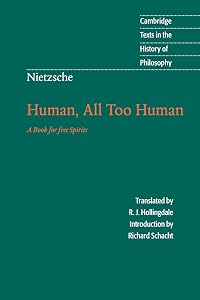
Human, All Too Human: A Book for Free Spirits
by Friedrich Nietzsche 
On This Page
Description
German scholar and thinker Friedrich Nietzsche began his career as a linguist and philologist, but over time, his work became increasingly philosophical in its scope. He came to embrace a radical point of view that prized personal freedom and choice over virtually everything else. In Human, All Too Human, Nietzsche explores the triumphs and tragic shortfalls of human nature in an eminently readable series of aphorisms and short vignettes..
Tags
Recommendations






Member Reviews
There are many generalizations and sweeping judgments made about Nietzsche and his philosophy. I find such remarks next to useless. For me, there is only one way to approach Nietzsche – read each paragraph and maxim and aphorism slowly and carefully and arrive at my own conclusions after seeing how his words apply to my own life. As by way of example, below are several of his shorter aphorisms from this book coupled with my comments.
“FROM CANNIBAL COUNTRY – In solitude the lonely man is eaten up by himself, among crowds by the many. Choose which you prefer.” ---------------- I’ve spent many hours in solitude, sometimes days or even weeks at a time. For me, solitude is pure gold: to live within, to mediate, to relax into the show more core of one’s body and inner light is most refreshing, a sheer joy, anything but an experience of being lonely. Matter of fact, any feelings of loneliness quickly poisons one’s solitude. If you feel lonely, perhaps it’s time to slow down and take a serious account of your life.
“AGAINST THE DISPARAGERS OF BREVITY – A brief dictum may be the fruit and harvest of long reflection. The reader, however, who is a novice in this field and has never considered the case in point, sees something embryonic in all brief dicta, not without a reproachful hint to the author, requesting him not to serve up such raw and ill-prepared food.” ---------------- I enjoy 800 page novels but I also enjoy reading aphorisms. The shorter, the better. Sometimes, one, two or three sentences is all that’s needed to spark probing reflection and sincere consideration.
“DEBAUCHERY – Not joy but joylessness is the mother of debauchery.” --------------- I recall college drinking parties with lots and lots of beer and hard liquor, where everyone drank themselves into numbness and a drunken stupor. Those memories are like a distant bad dream. Fortunately, it only took a party or two for me to realize that wasn’t my scene. I started practicing yoga and meditation and have had the good fortune to experience great joy for many years as a direct result of this practice.
“KNOWING HOW TO WASH ONESELF CLEAN – We must know how to emerge cleaner from unclean conditions, and, if necessary, how to wash ourselves even with dirty water.” ---------------When I encounter ugliness, whether in people or in my surroundings, I try to use such ugliness as a sting, a reminder to cherish experiences of kindness and beauty.
“THE FARCE OF MANY INDUSTRIOUS PERSONS - By an excess of effort they win leisure for themselves, and then they can do nothing with it but count the hours until the tale is ended.” -------------------- I recall Joseph Campbell relating how many workaholics and professionals spend many years climbing the ladder but when they get to the top they realize they are leaning against the wrong wall. From my own experience, I’ve had a couple professional careers but I’ve always enjoyed weekends more than weekdays. I think Nietzsche hits the bulls-eye here: If you are at a loss when you spend time away from your work-a-day world, ask yourself if you are really living life from your own creative and spiritual depth.
“SIGNS FROM DREAMS - What one sometimes does not know and feel accurately in waking hours whether one has a good or a bad conscience as regards some person is revealed completely and unambiguously by dreams.” --------------------- I just finished ‘The Kindly Ones’ by Jonathan Littell where the main character recalls his life as a Nazi SS officer when he had a series of vivid, horrific, hellish dreams. However, he refused to listen carefully to what he dreams were telling him; if he did, he probably wouldn’t have continued to engage in twisted, perverted practices and a number of senseless murders. For myself, for years I’ve kept a dream journal and practiced lucid dreaming. Most fruitful for self-discovery.
Since this is a review of one of Nietzsche’s books, Nietzsche gets the last word. And since we are all readers of books here, I thought this maxim most appropriate:
“A GOOD BOOK NEEDS TIME – Every good book tastes bitter when it first comes out, for it has the defect of newness. Moreover, it suffers damage from its living author, if he is well known and much talked about. For all the world is accustomed to confuse the author with his work. Whatever of profundity, sweetness, and brilliance the work may contain must be developed as the years go by, under the case of growing, then old, and lastly traditional reverence. Many hours must pass, many a spider must have woven its web about the book. A book is made better by good readers and clearer by good opponents.” show less
This is a really good read for those interested in the development of Nietzsche's thought, though it is not one to be taken alone. The reason being is that it makes a complete 180 from The Birth of Tragedy in a short period of time. The ideas found in this book indicate most importantly his change in direction from his original, moderate idealism, relatively speaking,for he was never so far gone as to metaphysics as we categorize philosophers as idealists such as men like Berkley, and so you get to begin to see the birth of Nietzsche as we know him.
The reason why I warn against this book as not being a compact aphoristic guide to Nietzsche is for two fundamental reasons. 1) His conception of art. Due to the 180 he was making at the show more time, I believe he became overly critical of his prior views. By lumping art together with religion I feel he makes an over-critical view due to his break with Wagner without giving it much thought other than as criticisms against his prior ideas, as well as him taking an overtly classical, philological view of it. This book is pre-Zarathustra, and one finds in his later work a much more refined conception of (the) art(ist) in relation to the over-man. And 2) as much as he renounced his earlier allegiance to Schopenhauer, many of the prejudices still come through. This is usually the volume that is cited for Nietzsche's misogyny, and rightly so. His section concerning women does not make him look very good. But one must consider Schopenhauer in this regard, who was unabashedly misogynistic and probably the most polemical of all philosophers against the female sex. That, combined with Nietzsche's own biographical experiences with women, I feel contributed much to those aphorisms. You do not find such remarks in his later, more developed works which is what we have come to love him for. In this regard one could consider the free spirit as a precursor to Zarathustra (from a plurality to a singular concrete entity), as is the last man to the over man (from the majority to the prevailing of a future minority. I would also like to add my own personal opinion to this parenthetical, which is to say, although Nietzsche uses the word the over-MAN, this could not be taken as a single salutary individual, just like the last-MAN is all men of his/our age. No one person can change the world, and I doubt that Nietzsche would have espoused it as such. The change may start with one man's ideas (which consequently would have been Nietzsche, who fundamentally declared that he was not the over-man - merely a step in the ladder towards his becoming. It takes the effort of many to actually make it happen). show less
The reason why I warn against this book as not being a compact aphoristic guide to Nietzsche is for two fundamental reasons. 1) His conception of art. Due to the 180 he was making at the show more time, I believe he became overly critical of his prior views. By lumping art together with religion I feel he makes an over-critical view due to his break with Wagner without giving it much thought other than as criticisms against his prior ideas, as well as him taking an overtly classical, philological view of it. This book is pre-Zarathustra, and one finds in his later work a much more refined conception of (the) art(ist) in relation to the over-man. And 2) as much as he renounced his earlier allegiance to Schopenhauer, many of the prejudices still come through. This is usually the volume that is cited for Nietzsche's misogyny, and rightly so. His section concerning women does not make him look very good. But one must consider Schopenhauer in this regard, who was unabashedly misogynistic and probably the most polemical of all philosophers against the female sex. That, combined with Nietzsche's own biographical experiences with women, I feel contributed much to those aphorisms. You do not find such remarks in his later, more developed works which is what we have come to love him for. In this regard one could consider the free spirit as a precursor to Zarathustra (from a plurality to a singular concrete entity), as is the last man to the over man (from the majority to the prevailing of a future minority. I would also like to add my own personal opinion to this parenthetical, which is to say, although Nietzsche uses the word the over-MAN, this could not be taken as a single salutary individual, just like the last-MAN is all men of his/our age. No one person can change the world, and I doubt that Nietzsche would have espoused it as such. The change may start with one man's ideas (which consequently would have been Nietzsche, who fundamentally declared that he was not the over-man - merely a step in the ladder towards his becoming. It takes the effort of many to actually make it happen). show less
In his writings, it is with Human, All Too Human, that Nietzsche begins his rebellious stint. For me, it is not that HATH doesn't have anything of substance, but breaks away from too many norms. With his health beginning to take a toll (he would get splitting headaches from reading or writing), Nietzsche couldn't sit down and hammer out a multivolume work on par with his intellect, or the demands from philologists and philosophers of the day. Very apparent in HATH is Nietzsche's use of aphorisms as opposed to essays. The writings in HATH are more of spurts of thought, rather than long, thought out essays. This is where I have my own critique. As an academic, and one who rebels outside Nietzsche's form of rebellion, I don't particularly show more care for this style of thought. While I suppose as an aesthetic, Nietzsche could carry an argument in a witty sentence, I must object to this form of thought, as Nietzsche contradicts himself, is an unreliable narrator, is flat-out wrong sometimes (see his misogynistic thoughts on women), and doesn't use evidence.
This malady seems to be partially cured in Nietzsche's later writings (even Daybreak, the next chronological work is better), but that is no excuse. As one who highly values things such as a well-structured essay, footnotes, and evidence, I can only criticise this form of Nietzsche. While his aphorisms may be witty and pointed, as someone who is looking for a worldview, you might not find much reasoning in HATH. Nietzsche constructs a wonderful formula for self liberation: 1) Read Nietzsche, 2) ????? 3) Be free my child! show less
This malady seems to be partially cured in Nietzsche's later writings (even Daybreak, the next chronological work is better), but that is no excuse. As one who highly values things such as a well-structured essay, footnotes, and evidence, I can only criticise this form of Nietzsche. While his aphorisms may be witty and pointed, as someone who is looking for a worldview, you might not find much reasoning in HATH. Nietzsche constructs a wonderful formula for self liberation: 1) Read Nietzsche, 2) ????? 3) Be free my child! show less
There are many generalizations and sweeping judgments made about Nietzsche and his philosophy. I find such remarks next to useless. For me, there is only one way to approach Nietzsche – read each paragraph and maxim and aphorism slowly and carefully and arrive at my own conclusions after seeing how his words apply to my own life. As by way of example, below are several of his shorter aphorisms from this book coupled with my comments.
“FROM CANNIBAL COUNTRY – In solitude the lonely man is eaten up by himself, among crowds by the many. Choose which you prefer.” ---------------- I’ve spent many hours in solitude, sometimes days or even weeks at a time. For me, solitude is pure gold: to live within, to mediate, to relax into the show more core of one’s body and inner light is most refreshing, a sheer joy, anything but an experience of being lonely. Matter of fact, any feelings of loneliness quickly poisons one’s solitude. If you feel lonely, perhaps it’s time to slow down and take a serious account of your life.
“AGAINST THE DISPARAGERS OF BREVITY – A brief dictum may be the fruit and harvest of long reflection. The reader, however, who is a novice in this field and has never considered the case in point, sees something embryonic in all brief dicta, not without a reproachful hint to the author, requesting him not to serve up such raw and ill-prepared food.” ---------------- I enjoy 800 page novels but I also enjoy reading aphorisms. The shorter, the better. Sometimes, one, two or three sentences is all that’s needed to spark probing reflection and sincere consideration.
“DEBAUCHERY – Not joy but joylessness is the mother of debauchery.” --------------- I recall college drinking parties with lots and lots of beer and hard liquor, where everyone drank themselves into numbness and a drunken stupor. Those memories are like a distant bad dream. Fortunately, it only took a party or two for me to realize that wasn’t my scene. I started practicing yoga and meditation and have had the good fortune to experience great joy for many years as a direct result of this practice.
“KNOWING HOW TO WASH ONESELF CLEAN – We must know how to emerge cleaner from unclean conditions, and, if necessary, how to wash ourselves even with dirty water.” ---------------When I encounter ugliness, whether in people or in my surroundings, I try to use such ugliness as a sting, a reminder to cherish experiences of kindness and beauty.
“THE FARCE OF MANY INDUSTRIOUS PERSONS - By an excess of effort they win leisure for themselves, and then they can do nothing with it but count the hours until the tale is ended.” -------------------- I recall Joseph Campbell relating how many workaholics and professionals spend many years climbing the ladder but when they get to the top they realize they are leaning against the wrong wall. From my own experience, I’ve had a couple professional careers but I’ve always enjoyed weekends more than weekdays. I think Nietzsche hits the bulls-eye here: If you are at a loss when you spend time away from your work-a-day world, ask yourself if you are really living life from your own creative and spiritual depth.
“SIGNS FROM DREAMS - What one sometimes does not know and feel accurately in waking hours whether one has a good or a bad conscience as regards some person is revealed completely and unambiguously by dreams.” --------------------- I just finished ‘The Kindly Ones’ by Jonathan Littell where the main character recalls his life as a Nazi SS officer when he had a series of vivid, horrific, hellish dreams. However, he refused to listen carefully to what he dreams were telling him; if he did, he probably wouldn’t have continued to engage in twisted, perverted practices and a number of senseless murders. For myself, for years I’ve kept a dream journal and practiced lucid dreaming. Most fruitful for self-discovery.
Since this is a review of one of Nietzsche’s books, Nietzsche gets the last word. And since we are all readers of books here, I thought this maxim most appropriate:
“A GOOD BOOK NEEDS TIME – Every good book tastes bitter when it first comes out, for it has the defect of newness. Moreover, it suffers damage from its living author, if he is well known and much talked about. For all the world is accustomed to confuse the author with his work. Whatever of profundity, sweetness, and brilliance the work may contain must be developed as the years go by, under the case of growing, then old, and lastly traditional reverence. Many hours must pass, many a spider must have woven its web about the book. A book is made better by good readers and clearer by good opponents.” show less
Human, All Too Human (A Book for Free Spirits) is a large collection of Nietzsche's aphorisms originally published from 1878-1879 in two separate volumes, combined in one edition in 1886. The material, which is his first in the aphoristic style, is vast and varied in content, and powerfully demonstrates Nietzsche's profound, expansive, and radical philosophical ideas with the brilliant energy and literary distinction which distinguishes his work in the world of philosophical literature.
"Where you see ideal things, I see what is -- human, alas, all-too-human. I know man better."
"Where you see ideal things, I see what is -- human, alas, all-too-human. I know man better."
This is the first work of philosophy I read, having been advised to begin with Nietzsche as a beginner reader. Beginner philosophy or not, I think this book was terrific and I related with Nietzsche on many of the things he was saying. In it, Nietzsche discusses his views on Christianity, the creation of a free thinker, his concept of a higher culture, among many other things. I would recommend this book to anyone looking to get into philosophy. It certainly served to cement my interest in it and to pursue further works of his.
A very contradictory, scathing, and surprisingly witty book. Goes on about 'free spirits'. Almost all of the remarkss are only too relevent now. Unconventional, but brilliant in its own way.
Members
- Recently Added By
Lists

German Literature
518 works; 56 members

Art of Reading
188 works; 5 members

In Our Time books
4,934 works; 2 members
Author Information

1,400+ Works 78,675 Members
The son of a Lutheran pastor, Friedrich Wilhelm Nietzsche was born in 1844 in Roecken, Prussia, and studied classical philology at the Universities of Bonn and Leipzig. While at Leipzig he read the works of Schopenhauer, which greatly impressed him. He also became a disciple of the composer Richard Wagner. At the very early age of 25, Nietzsche show more was appointed professor at the University of Basel in Switzerland. In 1870, during the Franco-Prussian War, Nietzsche served in the medical corps of the Prussian army. While treating soldiers he contracted diphtheria and dysentery; he was never physically healthy afterward. Nietzsche's first book, The Birth of Tragedy Out of the Spirit of Music (1872), was a radical reinterpretation of Greek art and culture from a Schopenhaurian and Wagnerian standpoint. By 1874 Nietzsche had to retire from his university post for reasons of health. He was diagnosed at this time with a serious nervous disorder. He lived the next 15 years on his small university pension, dividing his time between Italy and Switzerland and writing constantly. He is best known for the works he produced after 1880, especially The Gay Science (1882), Thus Spake Zarathustra (1883-85), Beyond Good and Evil (1886), On the Genealogy of Morals (1887), The Antichrist (1888), and Twilight of the Idols (1888). In January 1889, Nietzsche suffered a sudden mental collapse; he lived the last 10 years of his life in a condition of insanity. After his death, his sister published many of his papers under the title The Will to Power. Nietzsche was a radical questioner who often wrote polemically with deliberate obscurity, intending to perplex, shock, and offend his readers. He attacked the entire metaphysical tradition in Western philosophy, especially Christianity and Christian morality, which he thought had reached its final and most decadent form in modern scientific humanism, with its ideals of liberalism and democracy. It has become increasingly clear that his writings are among the deepest and most prescient sources we have for acquiring a philosophical understanding of the roots of 20th-century culture. (Bowker Author Biography) show less
Friedrich Nietzsche has a Legacy Library. Legacy libraries are the personal libraries of famous readers, entered by LibraryThing members from the Legacy Libraries group.
Some Editions
Awards and Honors
Notable Lists
Series
Belongs to Publisher Series
Work Relationships
Is contained in
Friedrich Nietzsche: Werke, 1: Menschliches, Allzumenschliches und andere Schriften by Friedrich Nietzsche
Common Knowledge
- Canonical title
- Human, All Too Human: A Book for Free Spirits
- Original title
- Menschliches, Allzumenschliches : ein Buch für freie Geister
- Original publication date
- 1878-05; 1886
- Dedication*
- Consacrato alla memoria di Voltaire in occasione della celebrazione dell’anniversario della sua morte, il 30 maggio 1778
- Original language
- German
*Some information comes from Common Knowledge in other languages. Click "Edit" for more information.
Classifications
Statistics
- Members
- 2,290
- Popularity
- 8,759
- Reviews
- 15
- Rating
- (4.04)
- Languages
- 16 — Czech, Danish, Dutch, English, French, German, Hebrew, Hungarian, Italian, Polish, Russian, Slovenian, Spanish, Swedish, Turkish, Portuguese (Portugal)
- Media
- Paper, Audiobook, Ebook
- ISBNs
- 131
- ASINs
- 44