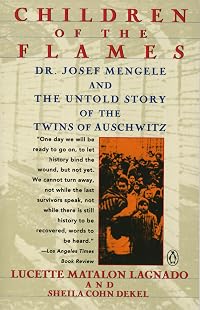
Children of the Flames: Dr. Josef Mengele and the Untold Story of the Twins of Auschwitz
by Lucette Lagnado, Sheila Cohn Dekel
On This Page
Description
Product Description: During World War II, Nazi doctor Josef Mengele subjected some 3,000 twins to medical experiments of unspeakable horror; only 160 survived. In this remarkable narrative, the life of Auschwitz's Angel of Death is told in counterpoint to the lives of the survivors, who until now have kept silent about their heinous death-camp ordeals.Tags
Recommendations

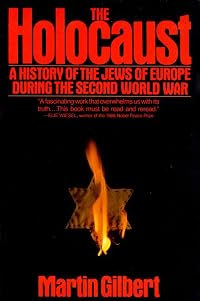
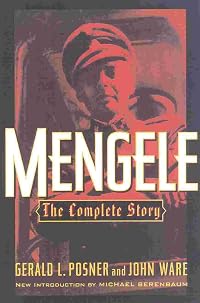
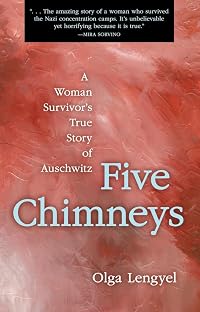
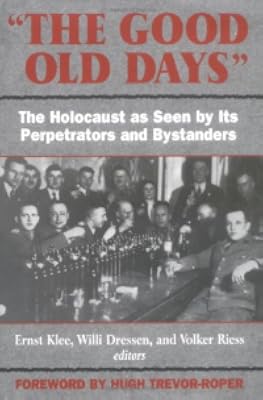










Member Recommendations
Member Reviews
This book takes us from the youths of of Josef Mengele and his victims (briefly) to Auschwitz to the Nazi-hunting of the post-war period to the late 1980s. It tells these stories in alternating voices, stressing how necessary it is to do so: these stories are inextricably linked.
The title is a bit misleading; this is perhaps weighed more on the side of a brief biography of Mengele, with emphasis on postwar activities. The stories of a group of twins break into the narrative in italicized bursts, fracturing it-- and thus reminding us all of how the horrific events of World War II fractured individuals, families, communities, nations.
The book is an oral history of Auschwitz, told by those who survived it. Certainly, it is well researched show more (especially when it comes to the information about Nazi hunting and war tribunals), but the information in the "spotlight," so to speak, are the unsilenced voices of the twins. Do not expect pages of historical detail about what types of experiments were performed, reviews of medical cases, lengthy discussions of what occured in labs; that information is not there. This is a book about a handful of people and their stories, and while the book tells Mengele's for him, the twins tell their own. Particularly on the part of the twins, it is more a psychological study than a historical one (we could go into how psychology and history are intertwined, but it would be best for the reader to reach his or her own conclusions after reading the book).
The text is deeply moving, often shattering. The voices that shatter the narrative of Mengele's life, denying the murderer any seamless biography, are vivid and alive. The authors picked a unique and, ultimately, extremely effective way to deliver biographies of oppresser and oppressed. show less
The title is a bit misleading; this is perhaps weighed more on the side of a brief biography of Mengele, with emphasis on postwar activities. The stories of a group of twins break into the narrative in italicized bursts, fracturing it-- and thus reminding us all of how the horrific events of World War II fractured individuals, families, communities, nations.
The book is an oral history of Auschwitz, told by those who survived it. Certainly, it is well researched show more (especially when it comes to the information about Nazi hunting and war tribunals), but the information in the "spotlight," so to speak, are the unsilenced voices of the twins. Do not expect pages of historical detail about what types of experiments were performed, reviews of medical cases, lengthy discussions of what occured in labs; that information is not there. This is a book about a handful of people and their stories, and while the book tells Mengele's for him, the twins tell their own. Particularly on the part of the twins, it is more a psychological study than a historical one (we could go into how psychology and history are intertwined, but it would be best for the reader to reach his or her own conclusions after reading the book).
The text is deeply moving, often shattering. The voices that shatter the narrative of Mengele's life, denying the murderer any seamless biography, are vivid and alive. The authors picked a unique and, ultimately, extremely effective way to deliver biographies of oppresser and oppressed. show less
“Children of the Flames” does not set out to be a bad book. It tries to follow the experiences of several Mengele twins chronologically from before the War throughout the lives of the interviewees. The style of chronicling the lives of many people in this way might work for a newspaper series that is broken into stages over many days, but for a book, it doesn’t quite work. Many of the people I spoke to who read the book found that they were referring back to the beginning to be sure they were reading about who they thought they were reading about. It’s as if the authors took a documentary film style of storytelling and put it in print. For a subject with players from so many different places, you would think it would still work. show more And yet, it doesn’t.
My own uncle is featured prominently in the book – Zvi the Sailor. The significant detail you need to know before you put down good money for this work is that it is not entirely accurate. A prominent Mengele twin who greatly assisted in the creation of the book disowns it for its inaccuracies and sub-par writing. My father, Zvi’s twin, was never interviewed for his account. In fact, the book contributed to a rift between the twins that did not resolve for many years.
The irony is that one of the authors is now a writer for the Wall Street Journal and Sami Rohr recipient. With credentials like hers, you would expect better in this book. Lucette Lagnado very kindly replied to me within 24 hours (during a book tour on New Year’s Eve, no less) when I asked her why she never interviewed my father. I told her of how the book added to the estrangement of my father and his twin. Her answer was a weak and disappointing one, if candid, for an investigative journalist: She couldn’t find him. If you read the book, Zvi the Sailor claims he sent his twin brother, my father, money from Israel to America. If true, she could have found my father. If not, she printed an unconfirmed statement as fact. Either way, she made the deliberate choice not to interview a living twin. (Remember, the chance of finding both twins alive was small because of the experimentation methods used by Mengele.) She did not find the juxtaposition of twin viewpoints as a compelling reason to seek out a living twin in the U.S. where she lived and worked.
As of the date of this post, Ms. Lagnado has yet to reply to my assertions on her journalistic decisions. show less
My own uncle is featured prominently in the book – Zvi the Sailor. The significant detail you need to know before you put down good money for this work is that it is not entirely accurate. A prominent Mengele twin who greatly assisted in the creation of the book disowns it for its inaccuracies and sub-par writing. My father, Zvi’s twin, was never interviewed for his account. In fact, the book contributed to a rift between the twins that did not resolve for many years.
The irony is that one of the authors is now a writer for the Wall Street Journal and Sami Rohr recipient. With credentials like hers, you would expect better in this book. Lucette Lagnado very kindly replied to me within 24 hours (during a book tour on New Year’s Eve, no less) when I asked her why she never interviewed my father. I told her of how the book added to the estrangement of my father and his twin. Her answer was a weak and disappointing one, if candid, for an investigative journalist: She couldn’t find him. If you read the book, Zvi the Sailor claims he sent his twin brother, my father, money from Israel to America. If true, she could have found my father. If not, she printed an unconfirmed statement as fact. Either way, she made the deliberate choice not to interview a living twin. (Remember, the chance of finding both twins alive was small because of the experimentation methods used by Mengele.) She did not find the juxtaposition of twin viewpoints as a compelling reason to seek out a living twin in the U.S. where she lived and worked.
As of the date of this post, Ms. Lagnado has yet to reply to my assertions on her journalistic decisions. show less
I will have to think long and hard about how I am going to review this very unusual book - not just subject matter but the way it is written and laid-out, although it is not in the least bit gimmicky. For now... it was brilliant, it is a lot to think over, it explains, if not excuses, why the Israelis are so very hard on their enemies.
It is perhaps the only book anyone need read to understand the Holocaust and to know that it wasn't over when it was over and that forgiving one's enemies might be just what they'd been counting on.
It is perhaps the only book anyone need read to understand the Holocaust and to know that it wasn't over when it was over and that forgiving one's enemies might be just what they'd been counting on.
A disappointing book - a fascinating and important subject, but written in such a disjointed style that the book is virtually unreadable. Told in approximately chronological order, the author cuts between stories from the Mengele Twins to the story of Mengele himself - one paragraph at a time. Far too choppy, this book would have been much better in two parts - one for the survivors, and one for Mengele.
The authors do a really good job exploring the life of Dr. Mengele with the twins he tortured while in the camps. This book does not hold back on what we’re done to them at such a young age and the ramifications it had on their entire lives. Really broke my heart reading this.
When I picked up this book I was excited to read about the Twins of Auschwitz. I have never seen any other book or information about them. However, this book is more about Mengele’s life, from birth to death, with brief quotations from the Twins thrown in. Only about 40 pages of the book actually took place in Auschwitz-Birkenau. If you are looking about information on Mengele, you may find this to be an interesting read. If you are interested in the Twins of Auschwitz or information about the concentration camp, this book offers little information.
This is one of those books that because of the subject matter you feel a little wrong in not giving it full stars. I have always had an interest in the WW2 and the Nazi's and because of this I have read a number of books on the subject of the holocaust.
I decided to buy Children of the Flames in order to get a little more information as to what really happened in the camps. The blurb promised to deal with the twins of the holocaust and how they were treated, this is something that other books seem to only skirt over and not go into too much detail.
This was the main issue for me. The writer has obviously researched their subject well, but the majority of the book deals with Dr Mengele. The twins stories are told at the beginning of each show more chapter, focussing firstly on their life before they were taken by the Nazi's. Each twin has a paragraph or so to tell a portion of their tale of that particular part of the story. For me this got quite confusing and even a little repetitive. I would have much preferred each set of twins to have a full chapter dedicated entirely to their journey and experiences.
The experiments that happened at the camps are only barely touched on, I know this may seem a little gruesome but I had hoped for a lot more factual information. What experiments were carried out? What was the result? Etc.
The majority of the book deals with Mengele and his life during and after the war. This is ok if you are not already familiar with him but again, I bought the book for more details of the atrocities committed.
My final gripe is that the last quarter is made up of notes that relate to the preceding text. This meant that they were a little disjointed and I didn't really want to read through them. I would have much preferred these to have been included as footnotes on the actual pages they relate to. This way the text would have been far more enriched.
As I have said, a really well researched book, just not what I was expecting or purchasing it for. It has many 5 * reviews so don't let this put you off. These are just my own thoughts. show less
I decided to buy Children of the Flames in order to get a little more information as to what really happened in the camps. The blurb promised to deal with the twins of the holocaust and how they were treated, this is something that other books seem to only skirt over and not go into too much detail.
This was the main issue for me. The writer has obviously researched their subject well, but the majority of the book deals with Dr Mengele. The twins stories are told at the beginning of each show more chapter, focussing firstly on their life before they were taken by the Nazi's. Each twin has a paragraph or so to tell a portion of their tale of that particular part of the story. For me this got quite confusing and even a little repetitive. I would have much preferred each set of twins to have a full chapter dedicated entirely to their journey and experiences.
The experiments that happened at the camps are only barely touched on, I know this may seem a little gruesome but I had hoped for a lot more factual information. What experiments were carried out? What was the result? Etc.
The majority of the book deals with Mengele and his life during and after the war. This is ok if you are not already familiar with him but again, I bought the book for more details of the atrocities committed.
My final gripe is that the last quarter is made up of notes that relate to the preceding text. This meant that they were a little disjointed and I didn't really want to read through them. I would have much preferred these to have been included as footnotes on the actual pages they relate to. This way the text would have been far more enriched.
As I have said, a really well researched book, just not what I was expecting or purchasing it for. It has many 5 * reviews so don't let this put you off. These are just my own thoughts. show less
Members
- Recently Added By
Lists

Holocaust
100 works; 13 members

Books Read in 2017
4,249 works; 129 members
Author Information

4 Works 1,364 Members
Lucette Lagnado is the coauthor of Children of the Flames: Dr. Josef Mengele and the Untold Story of the Twins of Auschwitz. She is a senior special writer and investigative reporter for the Wall Street Journal. She resides with her husband, Douglas Feiden, in Sag Harbor and New York City
1 Work 642 Members
All Editions
Some Editions
Series
Belongs to Publisher Series
rororo (9532)
Work Relationships
Common Knowledge
- Canonical title
- Children of the Flames: Dr. Josef Mengele and the Untold Story of the Twins of Auschwitz
- Original publication date
- 1990
- People/Characters
- Josef Mengele; Rolf Mengele; Karl Mengele; Irene Mengele; Martha Mengele
- Important places
- Oświęcim, Lesser Poland, Poland; Auschwitz concentration camp, Oświęcim, Lesser Poland, Poland
- Important events
- World War II (1939 | 1945); Holocaust (1933 | 1945)
- Dedication
- To my mother, Edith Matalon Lagnado, and to my doctor, Burton J. Lee III, M.D., who both saved me, each in their own way —L.M.L.
To the six million-and one... —S.C.D. - First words
- In the winter of 1984, I was asked by Parade magazine to seek out the long lost child survivors of Dr. Josef Mengele's experiments at Auschwitz during World War II. (Preface)
- Last words
- (Click to show. Warning: May contain spoilers.)As with everything else concerning Dr. Mengele, the analysis is proving difficult, the results elusive.
Classifications
- Genres
- Nonfiction, History, General Nonfiction, Biography & Memoir
- DDC/MDS
- 364.151092 — Society, government, & culture Social problems and social services Crime Criminal offenses Offenses against the person War crimes and genocide
- LCC
- DD247 .M46 .M38 — History of Europe, Asia, Africa and Oceania Germany History of Germany History By period Modern, 1519- 19th-20th centuries Revolution and Republic, 1918-
- BISAC
Statistics
- Members
- 642
- Popularity
- 45,401
- Reviews
- 12
- Rating
- (3.95)
- Languages
- English, German, Swedish
- Media
- Paper
- ISBNs
- 8
- ASINs
- 3