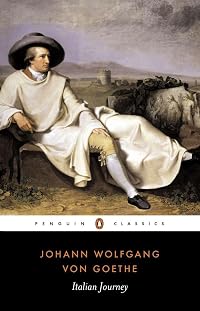
Italian Journey: 1786-1788
by Johann Wolfgang von Goethe
On This Page
Description
In 1786, when he was already the acknowledged leader of the Sturm und Drang literary movement, Goethe set out on a journey to Italy to fulfil a personal and artistic quest and to find relief from his responsibilities and the agonies of unrequited love. As he travelled to Venice, Rome, Naples and Sicily he wrote many letters, which he later used as the basis for the Italian Journey. A journal full of fascinating observations on art and history, and the plants, landscape and the character of show more the local people he encountered, this is also a moving account of the psychological crisis from which Goethe emerged newly inspired to write the great works of his mature years. show lessTags
Recommendations
















Member Recommendations


Member Reviews
The title-page was enough to correct a couple of my misconceptions about this book: I had the idea that this would be the young Goethe backpacking around Italy with the 18th-century equivalent of an Inter-Rail pass, amazed to discover the richness of classical and renaissance art, and rushing his experiences into print to encourage a generation of young poets to do the same. Totally wrong: he was in his late thirties, a famous literary figure and securely established in his ministerial post in Weimar. And he had already spent a lot of time and effort learning about Roman and Italian art in German collections before he set off, and he took with him the works of previous travellers like Winckelmann. So he knew what he was looking at. show more
Moreover, these travel-diaries weren't prepared for publication until Goethe got to the age where writers are expected to produce memoirs, about thirty years on (the description of the second stay in Rome didn't appear until 1829). Europe had changed quite a bit between 1786 and 1816 - this is probably the ultimate "don't mention the war" book. Goethe obviously did a fair bit of tidying up to prepare it for publication, but at no point does he make any reference (even indirect) to the intervening wars and revolutions. You'd have to be a pretty stony conservative to get away with that. Just imagine someone publishing a travel diary from 1913 in 1946 and pretending that the world was still the same...
Having said that, Goethe is mostly an entertaining travel-companion, because he's interested in absolutely everything from geology and botany to street-cleaning (predictably, he seems to think the last of these is better organised in Germany than Italy...). In Sicily he takes time off from art and architecture to visit the family of a famous bandit; in Naples he parties with Lady Hamilton and an unnamed princess; he climbs Vesuvius and is disappointed not to be able to climb Etna as well. There is a great description of the Roman Carnival, and entertaining looks at street-life in Naples.
Of course the trip is mostly about art, and there's a lot of description of the things he's seen and his reaction to them. Some of this is just lists, and he's often careful not to sound as though he's giving objective critical opinions - at one point he has a rant about "English-style" guidebooks that classify all artworks as good or bad, and have the temerity to point out "faults" in the work of Raphael and Michelangelo. That doesn't stop him giving his own reactions to what he sees, of course, but he doesn't set himself up as anything more than an amateur art-historian.
Sometimes there are interesting glimpses into the practicalities of tourism in the age before photography and electric light - Goethe can sketch reasonably well, but still takes pains to find an artist to travel with him to make sure that he can get a visual record of the things he has seen. And there are descriptions of how the interest of sculptures changes when you get to see them in torchlight.
I was also struck by the difference between Goethe's approach to the Italian Church and what I've seen in travel writings by British writers of the 18th or early 19th century. His comments about what he sees are simply those of a curious, Enlightened observer: he never adopts a partisan position, as British writers would have felt their readers expected them to. Sketching in the Sistine Chapel he enjoys telling us that he took a nap on the Papal throne, but when he is there for an Easter service he is impressed by the pomp and Palestrina.
Fun, and a nice book to dip in and out of, but it's a bit too random and unstructured to read in one go. show less
Moreover, these travel-diaries weren't prepared for publication until Goethe got to the age where writers are expected to produce memoirs, about thirty years on (the description of the second stay in Rome didn't appear until 1829). Europe had changed quite a bit between 1786 and 1816 - this is probably the ultimate "don't mention the war" book. Goethe obviously did a fair bit of tidying up to prepare it for publication, but at no point does he make any reference (even indirect) to the intervening wars and revolutions. You'd have to be a pretty stony conservative to get away with that. Just imagine someone publishing a travel diary from 1913 in 1946 and pretending that the world was still the same...
Having said that, Goethe is mostly an entertaining travel-companion, because he's interested in absolutely everything from geology and botany to street-cleaning (predictably, he seems to think the last of these is better organised in Germany than Italy...). In Sicily he takes time off from art and architecture to visit the family of a famous bandit; in Naples he parties with Lady Hamilton and an unnamed princess; he climbs Vesuvius and is disappointed not to be able to climb Etna as well. There is a great description of the Roman Carnival, and entertaining looks at street-life in Naples.
Of course the trip is mostly about art, and there's a lot of description of the things he's seen and his reaction to them. Some of this is just lists, and he's often careful not to sound as though he's giving objective critical opinions - at one point he has a rant about "English-style" guidebooks that classify all artworks as good or bad, and have the temerity to point out "faults" in the work of Raphael and Michelangelo. That doesn't stop him giving his own reactions to what he sees, of course, but he doesn't set himself up as anything more than an amateur art-historian.
Sometimes there are interesting glimpses into the practicalities of tourism in the age before photography and electric light - Goethe can sketch reasonably well, but still takes pains to find an artist to travel with him to make sure that he can get a visual record of the things he has seen. And there are descriptions of how the interest of sculptures changes when you get to see them in torchlight.
I was also struck by the difference between Goethe's approach to the Italian Church and what I've seen in travel writings by British writers of the 18th or early 19th century. His comments about what he sees are simply those of a curious, Enlightened observer: he never adopts a partisan position, as British writers would have felt their readers expected them to. Sketching in the Sistine Chapel he enjoys telling us that he took a nap on the Papal throne, but when he is there for an Easter service he is impressed by the pomp and Palestrina.
Fun, and a nice book to dip in and out of, but it's a bit too random and unstructured to read in one go. show less
First, I have to say that the other students in my class seemed quite enthused about this book, and it did generate lots of fairly interesting discussion. There were some really well-written, though-provoking bits.
But I disliked the absence of a story—this is, for the most part, just a series of events of his time in Italy made up of letters, diary entries and memories. There are moments of splendid finesse, but over all, I found it rather a bore and was quite annoyed with Goethe by the end. Reading this was like listening to some pompous distant relative go on and on about himself. So I had to laugh when the next writer I had to read, the grouchy historian and fellow-German Barthold George Niebuhr, dissed Goethe’s musings on Rome. show more Writing 30 years later, he says that Goethe wrote “in a fit of intoxication,” and he was “doubtless infected by the spirit of his age.” He goes on to say that Goethe “has no inward, native insight” and writes “with an air of patronizing superiority.” Never mind that Niebuhr writes with an air of patronizing superiority himself. It just felt good to know that I wasn’t the only one to find Goethe’s Italian Journey to be a snooze-fest.
That said, it was an unintimidating read, and I look forward to reading other works by Goethe as long as I’m assured that they have a narrative.
Recommended for: Readers who are interested in first-hand accounts of the Grand Tour. show less
But I disliked the absence of a story—this is, for the most part, just a series of events of his time in Italy made up of letters, diary entries and memories. There are moments of splendid finesse, but over all, I found it rather a bore and was quite annoyed with Goethe by the end. Reading this was like listening to some pompous distant relative go on and on about himself. So I had to laugh when the next writer I had to read, the grouchy historian and fellow-German Barthold George Niebuhr, dissed Goethe’s musings on Rome. show more Writing 30 years later, he says that Goethe wrote “in a fit of intoxication,” and he was “doubtless infected by the spirit of his age.” He goes on to say that Goethe “has no inward, native insight” and writes “with an air of patronizing superiority.” Never mind that Niebuhr writes with an air of patronizing superiority himself. It just felt good to know that I wasn’t the only one to find Goethe’s Italian Journey to be a snooze-fest.
That said, it was an unintimidating read, and I look forward to reading other works by Goethe as long as I’m assured that they have a narrative.
Recommended for: Readers who are interested in first-hand accounts of the Grand Tour. show less
This book records Goethe's 2 years travelling in Italy in the company of different artists, where he "refinds" himself, He spends more lot more time reviewing artworks than he does describing his actual travels, although he does give some interesting insites in to the eruption of Mt Vesuvius and Roman carnivals. Overall it was a very informatiive book but he wasn't the only one ready for him to go home after two years!
Some wonderful perspectives, by a "Northern" author who is both fascinated and -- at times -- alienated from the romantic atmosphere of Italy. The latter leads to a few dull patches, where he just isn't gettng the place or the people. But at other times he recounts some simply wonderful anecdotes. Not to be missed are the reason the young aristocratic woman took him upstairs during a party in Naples (not what you think -- even as you are reading up to it), or the coachman's protest when Goethe and a fellow German admonished him to stop all that distracting singing. If you love Italy, you will probably enjoy this.
This book give a great description of the "Grand Tour" that was a staple of the educated class. Travel to Roma before the advent of tourism and chain hotels, where having dinner with the Pope in not the high point of the trip.
Goethe in the Tyrol - excerpt from Italian Journey
Trento, the 11th of September [1786], morning.
After wholly fifty hours of life and continual occupation I arrived here yesterday at eight o’clock, went soon to rest, and now find myself again prepared to continue my story. On the evening of the ninth, when I had brought the first portion of my journal to a close, I still wanted to draw my lodging, the post office, in its place in the Brenner pass, but it was unsuccessful, I missed its character and went home half annoyed. My host asked whether I should like to leave, by moonlight was the best way, and whether I knew that he needed the horses in the morning to take in the hay, he would like to have them back by then.Read the rest of show more this excerpt » show less
Trento, the 11th of September [1786], morning.
After wholly fifty hours of life and continual occupation I arrived here yesterday at eight o’clock, went soon to rest, and now find myself again prepared to continue my story. On the evening of the ninth, when I had brought the first portion of my journal to a close, I still wanted to draw my lodging, the post office, in its place in the Brenner pass, but it was unsuccessful, I missed its character and went home half annoyed. My host asked whether I should like to leave, by moonlight was the best way, and whether I knew that he needed the horses in the morning to take in the hay, he would like to have them back by then.Read the rest of show more this excerpt » show less
Naar Italië! Meerdere eeuwen lang deed deze oproep de fine fleur van de Noord-Europese jeugd naar het Zuiden reizen voor een grand tour van zinnelijk genot waarmee de jeugdjaren werden afgesloten om nadien in de voetsporen van hun ernstige vaders te treden. Niet zo voor Goethe die in 1786 zonder iemand vooraf in te lichten voor een tweejarige reis naar het land van de renaissance trok. Voor Goethe was deze reis meer een vlucht weg van Weimar om op zoek te gaan naar zichzelf, een soort van persoonlijke renaissance. "Er is trouwens niets te vergelijken met het nieuwe leven waartoe de aanblik van een nieuw land een contemplatief mens in staat stelt. Hoewel ik nog altijd dezelfde ben, meen ik toch dat ik tot in het merg ben veranderd" (p. show more 143). "... want bij dit oord knoopt heel de wereldgeschiedenis aan, en ik reken mijn tweede geboorte, een ware wedergeboorte, vanaf de dag waarop ik Rome betrad" (p.144). "De reiziger uit het Noorden gelooft dat hij naar Rome komt om een aanvulling voor zijn bestaan te vinden, zijn lacunes op te vullen; maar pas gaandeweg wordt hij met een groot gevoel van onbehagen gewaar dat hij zijn opvattingen geheel moet veranderen en van voren af aan moet beginnen" (p. 432). "In Rome heb ik mezelf voor het eerst gevonden, ik ben hier voor het eerst in harmonie met mezelf gelukkig en verstandig geworden" (p. 528).
Italiaanse Reis is een prachtige en met veel zorg uitgegeven kluif van 554 pagina's met 100 extra pagina's van aantekeningen en verwijzingen. Het is zeker geen reisgids met weetjes of anecdotes maar een erg persoonlijk document van een literaire grootheid. Het is als het ware een 'Bildung' dagboek met Napels en Rome als zwaartepunten in Goethes verblijf en ontwikkeling. Dat hij zo weinig tijd heeft doorgebracht in Firenze heeft hij zich later wel beklaagd. Je kan de man alleen maar benijden om zijn persoonlijke grand tour langs zovele steden en kunstwerken, en om zijn ontmoetingen met zovele kunstenaars (hij hoopte en oefende erg om zelf schilder te worden maar moest uiteindelijk vaststellen dat hij hiertoe niet het nodige talent had). Goethe observeert en beschrijft helder alles rondom hem: steden, gebouwen, kunstwerken, landschappen, planten, natuurverschijnselen, mensen en hun gewoonten. show less
Italiaanse Reis is een prachtige en met veel zorg uitgegeven kluif van 554 pagina's met 100 extra pagina's van aantekeningen en verwijzingen. Het is zeker geen reisgids met weetjes of anecdotes maar een erg persoonlijk document van een literaire grootheid. Het is als het ware een 'Bildung' dagboek met Napels en Rome als zwaartepunten in Goethes verblijf en ontwikkeling. Dat hij zo weinig tijd heeft doorgebracht in Firenze heeft hij zich later wel beklaagd. Je kan de man alleen maar benijden om zijn persoonlijke grand tour langs zovele steden en kunstwerken, en om zijn ontmoetingen met zovele kunstenaars (hij hoopte en oefende erg om zelf schilder te worden maar moest uiteindelijk vaststellen dat hij hiertoe niet het nodige talent had). Goethe observeert en beschrijft helder alles rondom hem: steden, gebouwen, kunstwerken, landschappen, planten, natuurverschijnselen, mensen en hun gewoonten. show less
Jul 15, 2011Dutch
2
Members
- Recently Added By
Lists

Books Set in Italy
167 works; 19 members

Harold Bloom - The Western Canon: B. The Aristocratic Age
231 works; 13 members

Books Set in Rome
98 works; 2 members

Mustich's 1000 Books to Read Before You Die: A Life Changing List
1,001 works; 19 members
Author Information

3,046+ Works 51,470 Members
Johann Wolfgang von Goethe, 1749-1832 Johann Wolfgang von Goethe was born in Frankfurt am Main. He was greatly influenced by his mother, who encouraged his literary aspirations. After troubles at school, he was taught at home and gained an exceptionally wide education. At the age of 16, Goethe began to study law at Leipzig University from 1765 to show more 1768, and he also studied drawing with Adam Oeser. After a period of illness, he resumed his studies in Strasbourg from 1770 to 1771. Goethe practiced law in Frankfurt for two years and in Wetzlar for a year. He contributed to the Frankfurter Gelehrte Anzeigen from 1772 to 1773, and in 1774 he published his first novel, self-revelatory Die Leiden des Jungen Werthers. In 1775 he was welcomed by Duke Karl August into the small court of Weimar, where he worked in several governmental offices. He was a council member and member of the war commission, director of roads and services, and managed the financial affairs of the court. Goethe was released from day-to-day governmental duties to concentrate on writing, although he was still general supervisor for arts and sciences, and director of the court theatres. In the 1790s Goethe contributed to Friedrich von Schiller´s journal Die Horen, published Wilhelm Meister's Apprenticeship, and continued his writings on the ideals of arts and literature in his own journal, Propyläen. The first part of his masterwork, Faust, appeared in 1808, and the second part in 1832. Goethe had worked for most of his life on this drama, and was based on Christopher Marlowe's Faust. From 1791 to 1817, Goethe was the director of the court theatres. He advised Duke Carl August on mining and Jena University, which for a short time attracted the most prominent figures in German philosophy. He edited Kunst and Altertum and Zur Naturwissenschaft. Goethe died in Weimar on March 22, 1832. He and Duke Schiller are buried together, in a mausoleum in the ducal cemetery. (Bowker Author Biography) show less
Some Editions
Awards and Honors
Series
Belongs to Publisher Series
Work Relationships
Is contained in
Contains
Is abridged in
Common Knowledge
- Canonical title
- Italian Journey: 1786-1788
- Original title
- Italienische Reise
- Original publication date
- 1816
- People/Characters
- Johann Wolfgang von Goethe; Emma, Lady Hamilton; Johann Heinrich Wilhelm Tischbein
- Important places
- Italy; Karlsbad; Rome, Italy; Eger; Naples, Campania, Italy; Regensburg, Bavaria, Germany (show all 53); Sicily, Italy; Munich, Bavaria, Germany; Bologna, Emilia Romagna, Italia; Mittenwald, Bavaria, Germany; Venice, Veneto, Italy; Scharnitz, Österreich; Verona, Veneto, Italy; Seefeld in Tirol, Tyrol, Austria; Lago di Garda, Lombardia, Italia; Zirl, Österreich; Umbria, Italy; Innsbruck, Tyrol, Austria; Assisi, Umbria, Italy; Bozen, Südtirol, Italien; Trient, Trentino-Südtirol, Italien; Gardasee; Verona, Venetien, Italien; Vicenza, Venetien, Italien; Padua, Venetien, Italien; Venedig, Venetien, Italien; Ferrara, Emilia-Romagna, Italien; Cento, Emilia-Romagna, Italien; Bologna, Emilia-Romagna, Italien; Loiano, Emilia-Romagna, Italien; Perugia, Umbrien, Italien; Terni, Umbrien, Italien; Città Castellana, Latium, Italien; Rom, Latium, Italien; Velletri, Latium, Italien; Fondi, Latium, Italien; Neapel, Kampanien, Italien; Palermo, Sizilien, Italien; Alcamo, Sizilien, Italien; Castelvetrano, Sizilien, Italien; Sciacca, Sizilien, Italien; Girgenti, Sizilien, Italien; Caltanissetta, Sizilien, Italien; Catania, Sizilien, Italien; Taormina, Sizilien, Italien; Messina, Sizilien, Italien; Siena, Toskana, Italien; Florenz, Toskana, Italien; Modena, Emilia-Romagna, Italien; Parma, Emilia-Romagna, Italien; Piacenza, Emilia-Romagna, Italien; Mailand, Lombardei, Italien; Weimar, Herzogtum Sachsen-Weimar-Eisenach
- Important events
- 18th century; Enlightenment; 1780s
- Blurbers
- Connolly, Cyril
- Original language
- German
- Canonical DDC/MDS
- 838.603
Classifications
- Genres
- Travel, Nonfiction, Biography & Memoir
- DDC/MDS
- 838.603 — Literature & rhetoric German & related literatures German miscellaneous writings 1750–1832 : 18th century; classical period; romantic period Diaries, journals, notebooks, reminiscences
- LCC
- PT2027 .I7 .A85 — Language and Literature German, Dutch and Scandinavian literatures German literature Individual authors or works 1700-ca. 1860/70 Goethe Translations
- BISAC
Statistics
- Members
- 1,261
- Popularity
- 19,417
- Reviews
- 13
- Rating
- (3.84)
- Languages
- 16 — Catalan, Czech, Dutch, English, Finnish, French, German, Italian, Korean, Norwegian (Nynorsk), Norwegian (Bokmål), Polish, Slovenian, Spanish, Swedish, Portuguese (Portugal)
- Media
- Paper, Audiobook, Ebook
- ISBNs
- 88
- ASINs
- 29