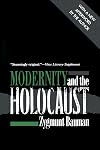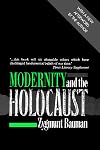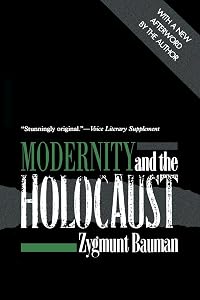
Modernity and the Holocaust
by Zygmunt Bauman
On This Page
Description
Zygmunt Bauman's 'Modernity and the Holocaust' examines the Holocaust as a 'Jewish tragedy' within the context of modern rational society. Bauman argues that the Holocaust should not be seen merely as a historical event but as a pivotal moment that reveals the nature and character of modern civilization. The book explores the interplay between modernity, racism, and genocide, highlighting the bureaucratic and rational processes that facilitated the Holocaust. Bauman challenges the perception show more of the Holocaust's uniqueness and normality, positioning it as a test of modernity that raises questions about morality and rationality. Intended for sociologists, historians, and scholars, this work has been recognized for its profound sociological insights and has contributed significantly to the understanding of late modernity. It was awarded the Amalfi Prize for the best European sociological work in 1990. show lessTags
Recommendations













Member Recommendations
davidgn "I regret I was not acquainted with Christie's finding at the time I wrote Modernity and the Holocaust. ... Engaging with Christie's argument is a must for any social scientist struggling to comprehend the present of our modern world. Even more so for all those wishing to do something about its future." --Zygmunt Bauman, review in Sociology

Member Reviews
"Even so, the Holocaust was not simply a Jewish problem, and not an event in Jewish history alone. The Holocaust was born and executed in our modern rational society, at the high stage of our civilization and at the peak of human cultural achievement, and for this reason it is a problem of that society." (Bauman 2001, p. X)
In situating the Holocaust not only within modernity, but as a historical fact of that modernity, one surely has to feel compelled by that past presence of murder and cruelty, which stands in the intermediaries to the rise of post-modern culture in Europe. Bauman takes further steps in assimilating the lessons of the events of the Holocaust in the mainstream of the theory of modernity and of the civilizing process and show more its effects. By showing, how social rationalization and the development of cold bureaucracies and inhuman administration has led to these somehow unbelievable events, Bauman steps into the path, which was once pursued by Hannah Arendt and Theodor W. Adorno. He is not, however, tempted to construe once again the irrational monsters of the Nazi-thugs, but takes his stance in simply knowing that the ones responsible for these cruel deeds were mostly - even if cold-blooded - very normal, and seemingly moral people.
Morality is, for Bauman, a pre-social feeling, rather than something which is produced within societal development itself; once considering the effects of modern social engineering, one cannot but assume that it is society itself which represses moral feelings. With the growing distance between the actor in this society and the effects of his actions, which he sometimes doesn't even recognize, morality gets more and more useless and finally vanishes.
Bauman's book about the embedment of the Holocaust in modernity is a well reflected plea for the moral issues that nowadays are at stake: humanity and freedom. He finishes his book:
"This is by far the most important lesson of the Holocaust which needs to be learned and remembered. If Orwell is right that control of the past allows control of the future, it is imperative, for the sake of that future, that those who control the present are not allowed to manipulate the past in a fashion likely to render the future inhospitable to humanity and uninhabitable." (p. 250) show less
In situating the Holocaust not only within modernity, but as a historical fact of that modernity, one surely has to feel compelled by that past presence of murder and cruelty, which stands in the intermediaries to the rise of post-modern culture in Europe. Bauman takes further steps in assimilating the lessons of the events of the Holocaust in the mainstream of the theory of modernity and of the civilizing process and show more its effects. By showing, how social rationalization and the development of cold bureaucracies and inhuman administration has led to these somehow unbelievable events, Bauman steps into the path, which was once pursued by Hannah Arendt and Theodor W. Adorno. He is not, however, tempted to construe once again the irrational monsters of the Nazi-thugs, but takes his stance in simply knowing that the ones responsible for these cruel deeds were mostly - even if cold-blooded - very normal, and seemingly moral people.
Morality is, for Bauman, a pre-social feeling, rather than something which is produced within societal development itself; once considering the effects of modern social engineering, one cannot but assume that it is society itself which represses moral feelings. With the growing distance between the actor in this society and the effects of his actions, which he sometimes doesn't even recognize, morality gets more and more useless and finally vanishes.
Bauman's book about the embedment of the Holocaust in modernity is a well reflected plea for the moral issues that nowadays are at stake: humanity and freedom. He finishes his book:
"This is by far the most important lesson of the Holocaust which needs to be learned and remembered. If Orwell is right that control of the past allows control of the future, it is imperative, for the sake of that future, that those who control the present are not allowed to manipulate the past in a fashion likely to render the future inhospitable to humanity and uninhabitable." (p. 250) show less
Sociology is concerned with modern society, but seems never to have come to terms with one of the most distinctive and horrific aspects of modernity - the Holocaust. This work examines what sociology can teach us about the Holocaust, but more particularly concentrates on the lesson which the Holocaust has for sociology. Baumann's work argues that the Holocaust has to be understood as deeply involved with the nature of modernity.
Muy interesante su lectura, se tiene una visión diferente de lo que fue el Holocausto, no desde el punto de lo que supuso si no desde los mecanismos sociales que pudieron llevar al mismo. Se analiza como el concepto de la modernidad (industrialización y tareas empresariales) se aplican para la aniquilación de los judíos. También se analiza el papel que los propios judíos jugaron en lo que fue el Holocausto.
Mar 2, 2024Spanish
El Holocausto no fue un acontecimiento singular, ni una manifestación terrible pero puntual de un "barbarismo" persistente, fue un fenómeno estrechamente relacionado con las características de la modernidad. El Holocausto se gestó y se puso en práctica en nuestra sociedad moderna y racional en una fase avanzada de nuestra civilización y en un momento culminante de nuestra cultura; es por tanto, un problema de esa sociedad, de esa civilización y de esa cultura.
Aug 27, 2011Spanish
Sia la memoria collettiva sia la letteratura scientifica hanno tentato di eludere il significato più profondo dell'olocausto, riducendolo a un episodio della storia millenaria dell'antisemitismo o considerandolo un incidente di percorso, una barbara ma temporanea deviazione dalla via maestra della civilizzazione.(fonte: Google Books)
May 15, 2020Italian
Ratings
Members
- Recently Added By
Published Reviews
ThingScore 100
"Intellectually rich and provocative. . . . This is a text which belongs in our classrooms as well as on our shelves. Exceptionally well written."
added by davidgn
"Such is the concentrated brilliance of Modernity and the Holocaust that it is sure to find an appreciative audience in every field of research which touches on the Holocaust (or which has been touched by it). Above all, to those who still hold faith with the notions of civilization, progress, and reason, this book will sit alongside others which have challenged fundamental beliefs of our time."
added by davidgn
'The book should be widely read by students of the social sciences, since it is, apart from a provocative analysis of explanations of genocide, a critique of sociology, which Bauman claims has neglected the ethical dilemmas posed by the destruction of the Jews.'
added by davidgn
Lists

Reading list
170 works; 1 member
Author Information

160+ Works 6,871 Members
Zygmunt Bauman is Emeritus Professor of Sociology at the University of Leeds and the University of Warsaw.
All Editions
Some Editions
Awards and Honors
Series
Belongs to Publisher Series
Common Knowledge
- Canonical title
- Modernity and the Holocaust
- Original title
- Modernity and the Holocaust
- Original publication date
- 1989
- Important events
- Holocaust
Classifications
- Genres
- Sociology, Nonfiction, History, General Nonfiction
- DDC/MDS
- 940.5318 — History & geography History of Europe History of Europe 1918- World War II, 1939-1945 Social, political, economic history; Holocaust Holocaust
- LCC
- D804.3 .B377 — History of Europe, Asia, Africa and Oceania History (General) World War II (1939-1945)
- BISAC
Statistics
- Members
- 501
- Popularity
- 60,276
- Reviews
- 5
- Rating
- (4.33)
- Languages
- 13 — Czech, Danish, Dutch, English, French, German, Italian, Norwegian (Bokmål), Norwegian, Polish, Portuguese, Spanish, Swedish
- Media
- Paper, Ebook
- ISBNs
- 36
- UPCs
- 1
- ASINs
- 5