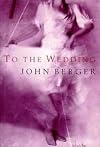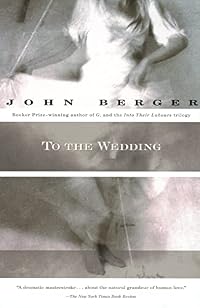
To the Wedding
by John Berger
On This Page
Description
A mother and father are travelling across Europe to their daughter's wedding. They meet for the first time in many years near the estuary of the river Po. Many people cross the pages of their story, from their future son-in-law to an Italian scrap merchant and a band of computer hackers.Tags
Recommendations

















Member Reviews
After making a false start with this work, I tried again. This time I was determined to be open and not resist its non-linear story, its mystical narration. And this time it was easy.
Well, not easy, but by reading more attentively I could make clear sense of it. The novel is anything but an easy experience. From the beginning, we know that Ninon (we don't know her name yet) will die of AIDS, yet there is talk of a wedding. The book title says even To the Wedding. How will that fit? And why is it that a blind man tells us what can be seen?
God, I could just cry again.
Berger takes us on several journeys through the heights of living with its ecstatic joys to the gulping gasps of drowning rage. Peopled by characters who lived through the show more oppressive struggles of Eastern Europe and now in 1995 have dreams for their children, like Ninon, that won't be realized even after the fall of the USSR. We travel through Europe, through Time, and meet strangers that are sometimes poison, some are a part of Chorus that offer solace through understanding, and some souls that rebel against the unfamiliar changes of Time.
Yes, Berger does take us to the wedding. And it is the most beautiful wedding ever, a magnum opus of humanity joining to rejoice for love! Pages and pages of music, dancing, rich food, intoxicating drink, sweet wedding cake, little gate-crasher boys, tears, cheers, and of course, the most beautiful bride and the most loving groom. All thanks to the blind Greek (Berger) who, beyond the little tin tamata of a heart, offers the glorious visions he sees.
It's a story with a theme that encompasses time as a prism of past, present, and future, and all the vast things we can't predict, and the simple things we can, usually, take for granted. It gives voice to desperation's accompanying prayer/wish/hope that we could bend even just a small fraction of the prism to our will for those we love.
But early in the story, there's this
"My new sandals-look!...Maybe I bought them for my wedding, the one that didn't happen."
and this, the last comment by the blind Greek,
"The tama of a heart in tin was not sufficient. ...Another tama was needed, made this time not in tin but with voices."
Those lines changed the sad but wonderful story into a sad story wrapped in a bitterly sadder truth.
From the beginning I wondered why Berger elected to tell this story as a blind man's visions, rejecting any other narrator he could have chose. Berger himself was a lifetime thinker of the "black mountains" that blocked "the world from light." He was a philosophical realist who dedicated his life (and money and reputation) to effecting changes for humanity, a realist who knew his vision for a more just world was always against all odds.
I don't believe Ninon got her wedding. I don't believe the story was meant to be more than a creative vision of a how a wedding might take place for Ninon under those insurmountable circumstances but in a more humane world. It was a prayer to go along with the tama bought by her father. It was an empathetic response of a blind man's brief and profoundly sad conversation with Ninon's father and another snippet he overheard from Ninon herself. The extra prayer, no matter how vivid and earnestly desired, would have been as effective against AIDS as the tin tama, which is to say not at all.
The power of "To the Wedding" for me wasn't as some kind of overcome-all-odds romance that ends tragically, which many read that way. Instead, I found it was a shouting (throat tama) into humanity's ears, hearts, eyes, torso, and for the children (we are all children) about the suffering by those among us who made an ordinary miscalculation during a particular time of an unforgiving virus and when humanity at large wasn't known for its compassion (if it ever has been) to them.
And I could cry all over again. show less
Well, not easy, but by reading more attentively I could make clear sense of it. The novel is anything but an easy experience. From the beginning, we know that Ninon (we don't know her name yet) will die of AIDS, yet there is talk of a wedding. The book title says even To the Wedding. How will that fit? And why is it that a blind man tells us what can be seen?
God, I could just cry again.
Berger takes us on several journeys through the heights of living with its ecstatic joys to the gulping gasps of drowning rage. Peopled by characters who lived through the show more oppressive struggles of Eastern Europe and now in 1995 have dreams for their children, like Ninon, that won't be realized even after the fall of the USSR. We travel through Europe, through Time, and meet strangers that are sometimes poison, some are a part of Chorus that offer solace through understanding, and some souls that rebel against the unfamiliar changes of Time.
Yes, Berger does take us to the wedding. And it is the most beautiful wedding ever, a magnum opus of humanity joining to rejoice for love! Pages and pages of music, dancing, rich food, intoxicating drink, sweet wedding cake, little gate-crasher boys, tears, cheers, and of course, the most beautiful bride and the most loving groom. All thanks to the blind Greek (Berger) who, beyond the little tin tamata of a heart, offers the glorious visions he sees.
It's a story with a theme that encompasses time as a prism of past, present, and future, and all the vast things we can't predict, and the simple things we can, usually, take for granted. It gives voice to desperation's accompanying prayer/wish/hope that we could bend even just a small fraction of the prism to our will for those we love.
"My new sandals-look!...Maybe I bought them for my wedding, the one that didn't happen."
and this, the last comment by the blind Greek,
"The tama of a heart in tin was not sufficient. ...Another tama was needed, made this time not in tin but with voices."
Those lines changed the sad but wonderful story into a sad story wrapped in a bitterly sadder truth.
From the beginning I wondered why Berger elected to tell this story as a blind man's visions, rejecting any other narrator he could have chose. Berger himself was a lifetime thinker of the "black mountains" that blocked "the world from light." He was a philosophical realist who dedicated his life (and money and reputation) to effecting changes for humanity, a realist who knew his vision for a more just world was always against all odds.
I don't believe Ninon got her wedding. I don't believe the story was meant to be more than a creative vision of a how a wedding might take place for Ninon under those insurmountable circumstances but in a more humane world. It was a prayer to go along with the tama bought by her father. It was an empathetic response of a blind man's brief and profoundly sad conversation with Ninon's father and another snippet he overheard from Ninon herself. The extra prayer, no matter how vivid and earnestly desired, would have been as effective against AIDS as the tin tama, which is to say not at all.
The power of "To the Wedding" for me wasn't as some kind of overcome-all-odds romance that ends tragically, which many read that way. Instead, I found it was a shouting (throat tama) into humanity's ears, hearts, eyes, torso, and for the children (we are all children) about the suffering by those among us who made an ordinary miscalculation during a particular time of an unforgiving virus and when humanity at large wasn't known for its compassion (if it ever has been) to them.
And I could cry all over again. show less
This is a breathtakingly beautiful book. I love the way Berger captures life, all its little scenes, all its little details. He doesn’t pry too far into his characters’ minds but the way he sets out their experiences and their reactions lays them open for us.
Another lovely gift from my friend Jim (thanks). Many years ago I read John Berger’s [b:Ways of Seeing|2784|Ways of Seeing|John Berger|https://i.gr-assets.com/images/S/compressed.photo.goodreads.com/books/1464018308l/2784._SY75_.jpg|2507145]. It was a revelation to me that he was also a fine novelist. I was immediately, enthralled at this story’s lyrical trajectory, as well as by its insightful passages.
There is a clever magic to Berger's writing which led to many pauses for thinking. Always a sense of the past and how it reverberates within us all. As if we are all dancing to some primal music of humanity. As if the past travels up through our feet into our bodies.
Looking at my bookshelves, I see I have John Berger's Booker Prize winning [b:G.|15943771|G.|John Berger|https://i.gr-assets.com/images/S/compressed.photo.goodreads.com/books/1483851739l/15943771._SY75_.jpg|295874]. I think that might be next... show less
Certain men are born hosts and they find it difficult to be either guests or spectators. Such men often lead rather solitary lives – gangsters, deep-sea fishermen, cattle dealers. p. 176But I was also (at first) confused about whose voice I was hearing. Was it the blindman or Ninon or..? Soon, I just relaxed and went with it as I show more realised this voice was everywhere. I love it when the depth of writer's knowledge make cross-references that lead to treats like the poems of Marina Tsvetaeva.
There is a clever magic to Berger's writing which led to many pauses for thinking. Always a sense of the past and how it reverberates within us all. As if we are all dancing to some primal music of humanity. As if the past travels up through our feet into our bodies.
The guests start to touch each other more often, the jokes pass quicker. When someone forgets, someone else remembers for him or her. They hold hands when they laugh. p.185.
She fixes her eyes on the drummer called Fats. He has the striking leanness that sometimes goes with percussion. To play a battery well, a man listens all the time to silence, until it splits itself open into rhythms, eventually into every conceivable rhythm. It does this because time is not a flow but a sequence of pulses. Listening to that silence often makes a man's body thin. p. 192.
Looking at my bookshelves, I see I have John Berger's Booker Prize winning [b:G.|15943771|G.|John Berger|https://i.gr-assets.com/images/S/compressed.photo.goodreads.com/books/1483851739l/15943771._SY75_.jpg|295874]. I think that might be next... show less
A stunningly beautiful meditation on love and death told in multiple voices, like a choir. The sensual details are intoxicating, as is Berger's tenderness and hope for us frail humans, even in the face of a terrible, unchangeable fate.
Ninon’s estranged parents travel across Europe to see their daughter, who is dying of AIDS, married to Gino. This book is beautifully simple in its premise, and very well written. The plot is minimal in action, but there is a beguiling sense of pace, and I loved the wedding scene at the end. Berger is a great writer – definitely one to watch.
Poetic, lyrical in some ways...completely emotional. Probably the best review of this book is on the back cover, a quote from Michael Ondaatje "Wherever I live in the world, I know I will have this book with me." It's important to carry around the books you love and this one definitely made an impression on me both times I read it.
Sorry but I disagree...: I am going to be the lone voice in the wilderness... I could not get into this book, could not make it past the first thirty pages. The narrative voice rambles from first person to third person, often it is not clear what is going on... I think this is a challenging book and most certainly is not a novel for somebody who is looking for a light read.
Members
- Recently Added By
Lists

A Novel Cure
742 works; 23 members
Author Information

149+ Works 17,139 Members
John Peter Berger was born in London, England on November 5, 1926. After serving in the British Army from 1944 to 1946, he enrolled in the Chelsea School of Art. He began his career as a painter and exhibited work at a number of London galleries in the late 1940s. He then worked as an art critic for The New Statesman for a decade. He wrote fiction show more and nonfiction including several volumes of art criticism. His novels include A Painter of Our Time, From A to X, and G., which won both the James Tait Black Memorial Prize and the Booker Prize in 1972. His other works include an essay collection entitled Permanent Red, Into Their Labors, and a book and television series entitled Ways of Seeing. In the 1970s, he collaborated with the director Alain Tanner on three films. He wrote or co-wrote La Salamandre, The Middle of the World, and Jonah Who Will Be 25 in the Year 2000. He died on January 1, 2017 at the age of 90. (Bowker Author Biography) show less
Awards and Honors
Awards
Notable Lists
Common Knowledge
- Canonical title*
- Auf dem Weg zur Hochzeit
- Original title
- To the wedding
- Original publication date
- 1995
- First words
- I like quoting ancient verses when the occasion is apt.
- Last words
- (Click to show. Warning: May contain spoilers.)Place it by the candle when you pray...
- Original language*
- Englisch
*Some information comes from Common Knowledge in other languages. Click "Edit" for more information.
Classifications
Statistics
- Members
- 596
- Popularity
- 48,922
- Reviews
- 13
- Rating
- (3.88)
- Languages
- 8 — Dutch, English, French, German, Norwegian (Bokmål), Spanish, Swedish, Turkish
- Media
- Paper, Audiobook, Ebook
- ISBNs
- 26
- ASINs
- 5