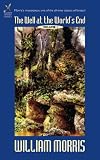
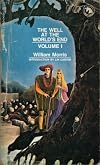
The Well at the World's End: Volume I
by William Morris 
The Well at the World's End (Collections and Selections — )
On This Page
Description
In the land of the Upmeads, King Peter's sons thirst for adventure and the King agrees that all except Ralph, the youngest, may go forth. But Ralph secretly makes his way to Wulstead, and here learns about the Well at the World's End, beginning a journey which will eventually lead him there.Tags
Recommendations









Member Reviews
This, the first half of William Morris's longest medieval romance pastiche, is as fine as anything he wrote, save perhaps some of his best poetry. Told in a deliberately (but lightly) archaic style, this first volume is a work of suggestive mystery. It is the mystery and romance of Place new to the protagonist and new to the reader, but very old, otherwise. That feeling of being lost? It's shot through on every page of this great work. For that alone, it's worth reading at least once. I am considering reading it again. Once every quarter century seems about right.
William Morris was the epitome of a Renaissance man. He was an architect, sculptor and artist. He designed furniture and fabrics and invented labour saving devices. "The Well at the World's End, his literary masterwork, is a commentary on life. The Well itself is a chimera, a test, indeed, the final deadly test for those few who find it. But it is the Journey that matters, the Road to the Well, the quest that encounters all the diversions of life itself and gets there despite the adventures, the threats, the dangers and the temptations." (from the frontispiece) Fascinating stuff.
ORIGINALLY POSTED AT Fantasy Literature.
William Morris, a textile artist, was enamored of medieval chivalric romances, so The Well at the World's End, published in 1896, is his contribution to that dying literary genre. Thus, you’ll find heroic knights on quests, damsels in distress, and scary beasts to slay. The novel is even written in archaic language. What’s different and noteworthy about The Well at the World's End, though, is that it’s set in an entirely made-up world. For this reason, William Morris is often considered the father of high fantasy literature and, not surprisingly, both J.R.R. Tolkien and C.S. Lewis credit him as a major influence on their own writing.
In The Well at the World's End, Ralph of Upmeads, youngest show more son of the King of Upmeads, leaves home (where nothing exciting ever happens) without permission and sets out looking for adventure. When he hears rumors of a well that exudes water with magical properties, he is intrigued and begins his quest. Along the way, he travels through various towns and wildernesses and meets — and is sometimes led astray by — a host of interesting people including a mysterious knight, a beautiful woman who may be a goddess, a treacherous servant, a brave tavern wench, a barbarian warrior, a solitary sage, and a sadistic king. Many exciting adventures occur and by the end of his two-year journey, Ralph is a different person and anxious to return home, for “him seemed the world was worse than he had looked to find it.”
Forsooth, The Well at the World's End takes a bit of getting used to whereas it’s written in archaic prose:
What is amiss, fair damsel, that thou art in such a plight; and what may I for thine avail? Doth any pursue thee, that thou fleest thus?
But meseemeth to adapt, I wot not how, and thou mayst also if thou persevere thereat. I’m not too fond of this style, but it wasn’t long before I got into the rhythm of Morris’s prose and it didn’t hamper my speed or enjoyment. I did have to look up a few words, but Morris used these same unfamiliar words so many times that I was soon comfortable with them. He also had the strange habit of sometimes changing, inexplicably, from past to present tense in the narrative.
Ralph of Upmeads makes a great hero — he’s strong, handsome, brave, and good. His adventures are entertaining, and so are the places (there is some beautiful scenery) and people (the women, especially, were surprisingly strong characters) he meets on his quest. The Well at the World's End is not likely to completely satisfy if you’re in the mood for something deep, dark, complex, or sexy, but it’s a fun story and, since it was written by the first fantasy world builder, it’s an important piece of fantasy literature history. show less
William Morris, a textile artist, was enamored of medieval chivalric romances, so The Well at the World's End, published in 1896, is his contribution to that dying literary genre. Thus, you’ll find heroic knights on quests, damsels in distress, and scary beasts to slay. The novel is even written in archaic language. What’s different and noteworthy about The Well at the World's End, though, is that it’s set in an entirely made-up world. For this reason, William Morris is often considered the father of high fantasy literature and, not surprisingly, both J.R.R. Tolkien and C.S. Lewis credit him as a major influence on their own writing.
In The Well at the World's End, Ralph of Upmeads, youngest show more son of the King of Upmeads, leaves home (where nothing exciting ever happens) without permission and sets out looking for adventure. When he hears rumors of a well that exudes water with magical properties, he is intrigued and begins his quest. Along the way, he travels through various towns and wildernesses and meets — and is sometimes led astray by — a host of interesting people including a mysterious knight, a beautiful woman who may be a goddess, a treacherous servant, a brave tavern wench, a barbarian warrior, a solitary sage, and a sadistic king. Many exciting adventures occur and by the end of his two-year journey, Ralph is a different person and anxious to return home, for “him seemed the world was worse than he had looked to find it.”
Forsooth, The Well at the World's End takes a bit of getting used to whereas it’s written in archaic prose:
What is amiss, fair damsel, that thou art in such a plight; and what may I for thine avail? Doth any pursue thee, that thou fleest thus?
But meseemeth to adapt, I wot not how, and thou mayst also if thou persevere thereat. I’m not too fond of this style, but it wasn’t long before I got into the rhythm of Morris’s prose and it didn’t hamper my speed or enjoyment. I did have to look up a few words, but Morris used these same unfamiliar words so many times that I was soon comfortable with them. He also had the strange habit of sometimes changing, inexplicably, from past to present tense in the narrative.
Ralph of Upmeads makes a great hero — he’s strong, handsome, brave, and good. His adventures are entertaining, and so are the places (there is some beautiful scenery) and people (the women, especially, were surprisingly strong characters) he meets on his quest. The Well at the World's End is not likely to completely satisfy if you’re in the mood for something deep, dark, complex, or sexy, but it’s a fun story and, since it was written by the first fantasy world builder, it’s an important piece of fantasy literature history. show less
This book truly does have everything you'd want from a medieval romance of this sort. The denoument was pretty long and hard to get into after the climax at the Well, but it got better as I went along, and I just reminded myself how Tolkien's LOTR finished in a similar way and no doubt owed such to the end of The Well.
Definitely think I'll try some other Morris.
Definitely think I'll try some other Morris.
William Morris's 3rd and final fantasy novel has been described as his masterpiece. Maybe so, although I prefer his 2nd effort in the genre, The Water Of The Wondrous Isles. (What was it with Morris and his penchant for W's in his titles? Preceding his 1st fantasy novel The Wood Beyond The World was a historical novel The House Of The Wulfings)
The longest fantasy novel until the publication of The Lord Of The Rings about 60 years later, Well is rich and expansive and further develops the imaginary world ideas begun in Wood and honed in Water.
As with the earlier books, Morris's style is deliberately archaic and modern readers may struggle.
The longest fantasy novel until the publication of The Lord Of The Rings about 60 years later, Well is rich and expansive and further develops the imaginary world ideas begun in Wood and honed in Water.
As with the earlier books, Morris's style is deliberately archaic and modern readers may struggle.
This is volume one of a two volume edition by Ballantine Books. The tale is moderately long, but readable enough. Our hero goes forth in search of adventure and finding it, returns, a wiser man, to free his home from threats. And, of course, he finds true love. it seems a little flat to my jaded eyes.
It wasn't my cup of tea. I didn't care for the writing style and frankly, the story was like my mp3 player when the repeat button gets stuck.
Members
- Recently Added By
Lists

Ballantine Adult Fantasy Series
85 works; 8 members

Favourite 19th century fiction
257 works; 62 members
Author Information

355+ Works 7,969 Members
Morris was the Victorian Age's model of the Renaissance man. Arrested in 1885 for preaching socialism on a London street corner (he was head of the Hammersmith Socialist League and editor of its paper, The Commonweal, at the time), he was called before a magistrate and asked for identification. He modestly described himself upon publication show more (1868--70) as "Author of "The Earthly Paradise,' pretty well known, I think, throughout Europe." He might have added that he was also the head of Morris and Company, makers of fine furniture, carpets, wallpapers, stained glass, and other crafts; founder of the Society for the Protection of Ancient Buildings; and founder, as well as chief designer, for the Kelmscott Press, which set a standard for fine book design that has carried through to the present. His connection to design is significant. Morris and Company, for example, did much to revolutionize the art of house decoration and furniture in England. Morris's literary productions spanned the spectrum of styles and subjects. He began under the influence of Dante Gabriel Rossetti with a Pre-Raphaelite volume called The Defence of Guenevere and Other Poems (1858); he turned to narrative verse, first in the pastoral mode ("The Earthly Paradise") and then under the influence of the Scandinavian sagas ("Sigurd the Volsung"). After "Sigurd," his masterpiece, Morris devoted himself for a time exclusively to social and political affairs, becoming known as a master of the public address; then, during the last decade of his life, he fused these two concerns in a series of socialist romances, the most famous of which is News from Nowhere (1891). (Bowker Author Biography) show less
William Morris has a Legacy Library. Legacy libraries are the personal libraries of famous readers, entered by LibraryThing members from the Legacy Libraries group.
Some Editions
Awards and Honors
Awards
Series

Belongs to Publisher Series
Work Relationships
Is contained in
Common Knowledge
- Canonical title
- The Well at the World's End: Volume I
- Original publication date
- 1970 (Two-volume edition) (Two-volume edition); 1896 (Original single-volume edition) (Original single-volume edition)
- Original language
- English
- Canonical DDC/MDS
- 823.087661
- Disambiguation notice
- This is Volume 1.
Individual volumes should NOT be combined with different volumes in the same set nor with the complete set.
Classifications
- Genres
- Fiction and Literature, Fantasy
- DDC/MDS
- 823.087661 — Literature & rhetoric English & Old English literatures English fiction By type Genre fiction Adventure fiction Speculative fiction Fantasy fiction High fantasy
- LCC
- PR5079 .W4 .W — Language and Literature English English Literature 19th century , 1770/1800-1890/1900
- BISAC
Statistics
- Members
- 424
- Popularity
- 72,885
- Reviews
- 7
- Rating
- (3.65)
- Languages
- Dutch, English, French, Greek
- Media
- Paper
- ISBNs
- 17
- UPCs
- 1
- ASINs
- 4