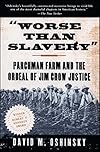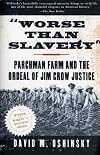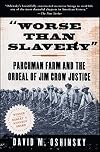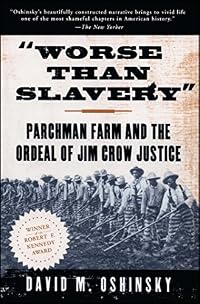
Worse than Slavery: Parchman Farm and the Ordeal of Jim Crow Justice
by David M. Oshinsky
On This Page
Description
"Worse Than Slavery" is an epic history of race and punishment in the deepest South from emancipation to the civil rights era - and beyond. Southern prisons have been immortalized in convict work songs, in the blues, and in movies such as Cool Hand Luke and The Defiant Ones. Mississippi's Parchman Penitentiary was the grandfather of them all, an immense, isolated plantation with shotguns, whips, and bloodhounds, where inmates worked the cotton fields in striped clothing from dawn to dusk. show more William Faulkner described Parchman as "destination doom." Its convicts included bluesmen like "Son" House and "Bukka" White, who featured the prison in the legendary "Midnight Special" and "Parchman Farm Blues." Noted historian David M. Oshinsky draws on prison records, pardon files, folklore, oral history, and the blues to offer an unforgettable portrait of Parchman and Jim Crow justice - from the horrors of convict leasing in the late nineteenth century to the struggle for black equality in the 1960s, when Parchman was used to break the spirit of civil rights workers who journeyed south on the Freedom Rides. In Mississippi, the criminal justice system often proved that there could be something worse than slavery. The "old" Parchman is gone, a casualty of federal court orders in the 1970s. What it tells us about our past is well worth remembering in a nation deeply divided by race. show lessTags
Recommendations






Member Reviews
The subtitle of this book mentions Parchman Farm, which the book definitely covers, but only for the last half and only as the extreme example of the Jim Crow "justice". And while the main title refers to the treatment that blacks have suffered in the South since the Civil War, one can still imagine someone debating the title on being accurate or not. After all, is anything worse than slavery? I would hold that the author does a very credible job of proving that yes, there definitely is something worse. In fact, I would contend that a more dramatic but reasonable alternative title of this book could have been "1001 Reasons Why the State of Mississippi Should Have Been Burned to the Ground a Long Time Ago". I've read a lot about the show more Holocaust, the Khmer Rouge genocide in Cambodia, and the Rwandan genocide, and I've asked myself why this book disturbed me even more than the others. I suspect that it's for two reasons. First, that South's mistreatment of the blacks has lasted for many, many more years. And secondly, as this book so aptly shows, the mistreatment has been so purely mean-spirited. The white South's behavior in this book is equivalent to that of the emotionally disturbed youngster caught torturing cats and dogs for sport. That this is the same area that is at the very heart of the current Republican Party's base should cause us all to pause and reflect. show less
A simply told and simply devastating account of life for African Americans in Reconstruction and Jim Crow-era Mississippi, and of the state's penal labor practices in particular. The depth of hatred and violence of Southern racism never ceases to stun me. When it comes to things like black people being rounded up as vagrants to be sent off to malarial swamps to labor and die in their hundreds, you have to accept that in some ways the racial oppression in the South, even after slavery was abolished(!), approached the Holocaust for horror.
A simply told and simply devastating account of life for African Americans in Reconstruction and Jim Crow-era Mississippi, and of the state's penal labor practices in particular. The depth of hatred and violence of Southern racism never ceases to stun me. When it comes to things like black people being rounded up as vagrants to be sent off to malarial swamps to labor and die in their hundreds, you have to accept that in some ways the racial oppression in the South, even after slavery was abolished(!), approached the Holocaust for horror.
excellant book. the author is a great storyteller.
From Booklist
Historian Oshinsky uses Mississippi as a paradigm for the shameful history of black injustice in the South between the post^-Civil War demise of slavery and the post^-World War II rise of the civil rights movement. Since its admission to the Union, Mississippi had been a violent place, as the author relates; and brutality to blacks was simply a part of Mississippian culture. After the abolition of slavery, in most white Mississippians' minds, something else had to be arrived at for "keeping the ex-slaves in line." Thus laws were passed designed to maintain white supremacy, particularly when it came to controlling black labor. After a discussion of the deplorable practice of convict leasing, a system whereby people could show more "hire" prisoners for physical labor outside the walls of prison, the author turns his attention to Parchman Farm, the state penitentiary, "a sprawling 20,000-acre plantation in the rich cotton land of the Yazoo Delta." What transpired behind the fences of Parchman Farm since its founding in the early part of this century is a horror story told here through a rigorous study that should be accorded an important place on the U.S. history shelf. --Brad Hooper show less
Historian Oshinsky uses Mississippi as a paradigm for the shameful history of black injustice in the South between the post^-Civil War demise of slavery and the post^-World War II rise of the civil rights movement. Since its admission to the Union, Mississippi had been a violent place, as the author relates; and brutality to blacks was simply a part of Mississippian culture. After the abolition of slavery, in most white Mississippians' minds, something else had to be arrived at for "keeping the ex-slaves in line." Thus laws were passed designed to maintain white supremacy, particularly when it came to controlling black labor. After a discussion of the deplorable practice of convict leasing, a system whereby people could show more "hire" prisoners for physical labor outside the walls of prison, the author turns his attention to Parchman Farm, the state penitentiary, "a sprawling 20,000-acre plantation in the rich cotton land of the Yazoo Delta." What transpired behind the fences of Parchman Farm since its founding in the early part of this century is a horror story told here through a rigorous study that should be accorded an important place on the U.S. history shelf. --Brad Hooper show less
David Oshinsky - soul brother of Howard Zinn and Eric Foner and David Israel Kertzer and Eric Hobsbawm - where would we be without them? - Their group is ever ready to attack the people who rule in the country in which they reside - to lay open old wounds, they underscore, emphasize, exaggerate, and denounce the conduct of people who were neither as groovy nor as well fed and safe as are they - in their host countries - all of these guys are arm-chair social snipers dedicated to smearing their host countries and creating societal dissension and discord - they love to fan the flame of white/black discontent but, really, it is still, always has been, and always will be, a rich/poor issue - Vernon Jordan - Oprah - Tiger Woods - Magic show more Johnson - Dr. Dre are doing just fine, thank you - whatever happened in 1875 (and we all already know that it was very bad for black people) is in the distant past - this country has for the last 50 years done everything in its power - and spent prodigious amounts of its wealth - to rectify the consequences of the past, John Brown, John Quincy Adams, William Seward, William Wilberforce, Harriet Beecher Stowe - Henry David Thoreau, Cassius Marcellus Clay, Richmond Flowers, Sr., - its not like members of Mr. Oshinsky's group were not involved in the Atlantic slave trade when it was lucrative - the Marranos of Spain created, orchestrated and greatly profited from the black flesh trade - what about the 30,000 confederate prisoners who died in Yankee prisons during the Civil War? - look, we can't all just be friends as long as these foreign elements actively and relentlessly play us off against one another - wake up American people - wake up right now. Mr. Oshinsky is a Jew leftist as are or were his co-critics of American society: Foner, Zinn, Kertzer, and Hobsbawm (England). If you are interested in the current and ongoing subjugation and humiliation and mistreatment of a group of people, start reading about how the Israelis savage the Palestinians - you might start with "Eyes on Gaza" by Mads Gilbert and Erik Fosse then go to the websites for B'Tselem (https://www.btselem.org/) and Mondoweiss (https://mondoweiss.net/) and read about something you can actually do something about. Please do not forget to read everything ever written by Norman G. Finkelstein (a good start is with "The Holocaust Industry") and Israel Shahak: "Jewish History, Jewish Religion: ..." show less
Ratings
Members
- Recently Added By
Lists

Books Read in 2014
2,341 works; 89 members
Author Information

11+ Works 1,973 Members
He is also an associate editor of the American National Biography. Oshinsky writes about the brutality of penitentiary life in his book, Worse Than Slavery: Parchman Farm and the Ordeal of Jim Crow Justice. He earned a Senior Fellowship from the National Endowment for the Humanities and an appointment as Distinguished Professor of History at the show more University of Texas, Austin for his work on the penitentiary project. Oshinsky also received the 17th Annual Robert F. Kennedy Book Award for his novel. (Bowker Author Biography) show less
Awards and Honors
Awards
Common Knowledge
- Important places
- Mississippi State Penitentiary, Mississippi, USA
Classifications
- Genres
- Nonfiction, History, General Nonfiction, Politics and Government
- DDC/MDS
- 365.9762 — Society, Government, and Culture Social problems and social services Punishment History, geographic treatment, biography North America South Central U.S. Mississippi
- LCC
- HV9475 .M72 .M576 — Social sciences Social pathology. Social and public welfare. Criminology Social pathology. Social and public welfare. Criminal justice administration Penology. Prisons. Corrections By region or country
- BISAC
Statistics
- Members
- 340
- Popularity
- 92,753
- Reviews
- 6
- Rating
- (4.08)
- Languages
- English
- Media
- Paper, Ebook
- ISBNs
- 3
- ASINs
- 2