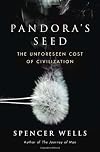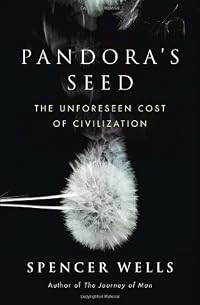
Pandora's Seed: The Unforeseen Cost of Civilization
by Spencer Wells
On This Page
Description
History. Science. Sociology. Nonfiction. HTML:Ten thousand years ago, our species made a radical shift in its way of life: We became farmers rather than hunter-gatherers. Although this decision propelled us into the modern world, renowned geneticist and anthropologist Spencer Wells demonstrates that such a dramatic change in lifestyle had a downside that we’re only now beginning to recognize. Growing grain crops ultimately made humans more sedentary and unhealthy and made the planet more show more crowded. The expanding population and the need to apportion limited resources created hierarchies and inequalities. Freedom of movement was replaced by a pressure to work that is the forebear of the anxiety millions feel today. Spencer Wells offers a hopeful prescription for altering a life to which we were always ill-suited. Pandora’s Seed is an eye-opening book for anyone fascinated by the past and concerned about the future. show lessTags
Recommendations





Member Reviews
Spencer Wells provides a discussion of the differences between our hunter gatherer past and our more recent farming based lifestyle. He covers a plethora of implications and follows the changes in disease development, social patterns, and environmental impacts. He also comments on the future of mankind in a world with increasing population and dwindling resources. He also comments on the recent developments in global warming. I liked the book since Spencer appears educated on a variety of topics from DNA biology, abnormal psychology, anthropology, and paleontology. Spencer also is aware of others writings on similar topics such as Diamond's book on guns, germs, and steel.
The author suggests that civilization is the problem not the solution. He offers a hopeful prescription for altering a life to which we were always ill-suited.
Pandora’s Seed, while containing all the essential ingredients to make me giddy - Natufians, evolutionary history, the rise and fall of empires - never quite congealed into a focused or inventive text. Because of its breadth, it skipped quickly between topics without any of the depth and insight that a reader expects from an expert-in-his-field like Spencer Wells. The overall effect of such a scatter-shot tour of the agriculture revolution, is that of a mash-up of the works other more inspired texts of authors such as Jared Diamond, Michael Pollan and Karen Armstrong. Still though - Natufians!
Pandora’s Seed, while containing all the essential ingredients to make me giddy - Natufians, evolutionary history, the rise and fall of empires - never quite congealed into a focused or inventive text. Because of its breadth, it skipped quickly between topics without any of the depth and insight that a reader expects from an expert-in-his-field like Spencer Wells. The overall effect of such a scatter-shot tour of the agriculture revolution, is that of a mash-up of the works other more inspired texts of authors such as Jared Diamond, Michael Pollan and Karen Armstrong. Still though - Natufians!
After reading Wells’ The Journey of Man and loving it, I couldn’t wait to dig into Pandora’s Seed, which promised to illuminate how “advanced” the hunter-gatherer societies were and what modern man can learn from these times for sustainability. Where there were a plethora of interesting ideas and facts, I must admit the book never grabbed me for a couple of reasons.
As I said, there are fascinating ideas and much to learn from this book for sure. Who wouldn’t be interested in discovering how the world’s population explosion today has its root in the ending of the hunter-gatherer lifestyle and the dawn of agricultural society? Whose ears (or eyes in this case) wouldn’t perk up at the contention that modern society is a show more breeding ground for illness and disease that was totally foreign to the Paleolithic era. I know I was grabbed by Wells’ claim that our modern style of living fosters conflict and war unheard of in hunter-gatherer societies. These were just a few of the gems in this book, but getting to those gems is where the problem lay for me.
One issue I had with Pandora’s Seed was the feeling of reading for long stretches not quite sure why I was reading about whatever the current topic was or what point the author was trying to make. In all fairness, the point always became clear eventually, but throughout the book, I had a constant nagging feeling of being just the tiniest bit lost.
This disoriented feeling seemed to be compounded by another feature of the book. Throughout, Wells raises another topic and tells us that to learn more about the topic, he (and the reader) must go here – here being either another time, another place, or both. The ‘tale’ jumps around so frequently, the reader could be excused for claiming jet lag. He skips between centuries and parts of the world, saying in order to understand one idea, we have to go…halfway around the world or back 70,000 years. I was dizzy sometimes wondering where I was or when it was, but more importantly, why I was there. The text seemed disjointed, perhaps, too ambitious, and I ended up confused a lot of the time as to the author’s point. Eventually, he would make it, but by that time, I didn’t care.
In addition, I think I was expecting some grand ideas on how to deal with the fix modern humans have gotten themselves into, and there also, I was a felt a letdown from a lack of concrete solutions. I mean, let’s face it – if put to a vote, who would opt for returning to hunting for game and scavenging for berries after they’ve seen Whole Foods and Safeway? Certainly, we can want less, which is Wells’ ultimate advice, but I already knew this without reading this book.
So, in the end, while the book has some interesting ideas, its conclusions and solutions are hardly groundbreaking show less
As I said, there are fascinating ideas and much to learn from this book for sure. Who wouldn’t be interested in discovering how the world’s population explosion today has its root in the ending of the hunter-gatherer lifestyle and the dawn of agricultural society? Whose ears (or eyes in this case) wouldn’t perk up at the contention that modern society is a show more breeding ground for illness and disease that was totally foreign to the Paleolithic era. I know I was grabbed by Wells’ claim that our modern style of living fosters conflict and war unheard of in hunter-gatherer societies. These were just a few of the gems in this book, but getting to those gems is where the problem lay for me.
One issue I had with Pandora’s Seed was the feeling of reading for long stretches not quite sure why I was reading about whatever the current topic was or what point the author was trying to make. In all fairness, the point always became clear eventually, but throughout the book, I had a constant nagging feeling of being just the tiniest bit lost.
This disoriented feeling seemed to be compounded by another feature of the book. Throughout, Wells raises another topic and tells us that to learn more about the topic, he (and the reader) must go here – here being either another time, another place, or both. The ‘tale’ jumps around so frequently, the reader could be excused for claiming jet lag. He skips between centuries and parts of the world, saying in order to understand one idea, we have to go…halfway around the world or back 70,000 years. I was dizzy sometimes wondering where I was or when it was, but more importantly, why I was there. The text seemed disjointed, perhaps, too ambitious, and I ended up confused a lot of the time as to the author’s point. Eventually, he would make it, but by that time, I didn’t care.
In addition, I think I was expecting some grand ideas on how to deal with the fix modern humans have gotten themselves into, and there also, I was a felt a letdown from a lack of concrete solutions. I mean, let’s face it – if put to a vote, who would opt for returning to hunting for game and scavenging for berries after they’ve seen Whole Foods and Safeway? Certainly, we can want less, which is Wells’ ultimate advice, but I already knew this without reading this book.
So, in the end, while the book has some interesting ideas, its conclusions and solutions are hardly groundbreaking show less
I just read Al Gore's 'The Future' before reading this. The two books are closely aligned aligned, although Pandora's Seed uses memorable examples and a voice that captures the reader and carries it along. Many of the same examples are sited. I actually prefer this to the other...
Sort of a mixed bag this book. Part of it was looking at the DNA of very early human populations, and other parts considered climate change, oil and commodity prices and genetic disorders.
What he said was very good, but didn't hang together.
What he said was very good, but didn't hang together.
Members
- Recently Added By
Author Information

3+ Works 1,493 Members
Series
Belongs to Publisher Series
Common Knowledge
- Original publication date
- 2010
- Epigraph
- The gods presented her with a box into which each had put something harmful, and forbade her ever to open it. Then they sent her to Epimetheus, who took her gladly although Prometheus had warned him never to accept anythin... (show all)g from Zeus. He took her, and afterward, when that dangerous thing, a woman, was his, he understood how good his brother's advice had been. For Pandora, like all women, was possessed of a lively curiosity. She had to know what was in the box. One day she lifted the lid and out flew plagues innumerable, sorrow and mischief for mankind. In terror Pandora clapped the lid down, but too late. One good thing, however, was there -- Hope. It was the only good the casket had held among the many evils, and it remains to this day mankind's sole comfort in misfortune.
(AS RETOLD BY EDITH HAMILTON) - Dedication
- To Pam, for peace, love, and understanding
- First words
- As I write this, I am 36,000 feet above the Arabian Sea, sipping a glass of wine and typing on my laptop.
- Quotations
- Most countries, however, concerned about the dangers of another Chernobyl-like disaster, as well as the political difficulties of waste disposal (who wants to live near a nuclear waste storage facility?), have not been as ... (show all)pro-nuclear, and overall only around 15 percent of the world's electricity comes from nuclear power.
This looks set to change over the next century, as nuclear waste disposal methods become increasingly sophisticated and power plants become safer and more efficient.
-- p. 176 - Last words
- (Click to show. Warning: May contain spoilers.)It will mean learning from peoples that retain a link back to the way we lived for virtually our entire evolutionary history. And it might allow us to stick around for the next two million years.
- Publisher's editor
- Porter, Susanna
- Blurbers
- Diamond, Jared; McKibben, Bill; Gates, Henry Louis, Jr.; Fagan, Brian
Classifications
- Genres
- Anthropology, Science & Nature, Nonfiction, General Nonfiction, History
- DDC/MDS
- 304.2 — Society, Government, and Culture Social sciences, sociology & anthropology Factors affecting social behavior Human ecology
- LCC
- GF75 .W46 — Geography, Anthropology and Recreation Human ecology. Anthropogeography Human ecology. Anthropogeography Human influences on the environment
- BISAC
Statistics
- Members
- 354
- Popularity
- 88,725
- Reviews
- 10
- Rating
- (3.58)
- Languages
- Chinese, Dutch, English, Italian
- Media
- Paper, Audiobook, Ebook
- ISBNs
- 14
- ASINs
- 4