On This Page
Description
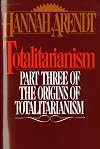
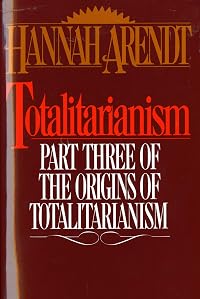
The great twentieth-century political philosopher examines how Hitler and Stalin gained and maintained power, and the nature of totalitarian states. In the final volume of her classic work The Origins of Totalitarianism, Hannah Arendt focuses on the two genuine forms of the totalitarian state in modern history: the dictatorships of Bolshevism after 1930 and of National Socialism after 1938. Identifying terror as the very essence of this form of government, she discusses the transformation of show more classes into masses and the use of propaganda in dealing with the no totalitarian world-and in her brilliant concluding chapter, she analyzes the nature of isolation and loneliness as preconditions for total domination. show lessTags
Recommendations































Member Reviews
the culmination and main event of arendts trilogy. features the most insightful, original analysis and best writing by far
there are ofc a few issues -- arendts analysis of totalitarianism in power, and its distinction from mere fascism, is hampered by her conception of state domination as being distinctly separate from that form of domination conducted via party offices (which from an anarchist perspective is merely a superficial legalistic distinction)
her assertion that extermination camp victims were passive has been met w criticism, but i believe it parallels the argument e.g. in "Mauss" -- there was active resistance in the extermination camps, but such was not the most commonly observed norm for the camps' inhabitants
her concluding show more argument abt loneliness is simultaneously deep and inspiring, and somehow also shallow and evasive. but stimulating and provocative either way show less
there are ofc a few issues -- arendts analysis of totalitarianism in power, and its distinction from mere fascism, is hampered by her conception of state domination as being distinctly separate from that form of domination conducted via party offices (which from an anarchist perspective is merely a superficial legalistic distinction)
her assertion that extermination camp victims were passive has been met w criticism, but i believe it parallels the argument e.g. in "Mauss" -- there was active resistance in the extermination camps, but such was not the most commonly observed norm for the camps' inhabitants
her concluding show more argument abt loneliness is simultaneously deep and inspiring, and somehow also shallow and evasive. but stimulating and provocative either way show less
Reading an e-version of this book, it was quite a while before I realised I was reading volume 3 without having read the first 2.
It was, nevertheless, fascinating material - very grim, very interesting. Will of course read the other volumes as soon as possible.
It was, nevertheless, fascinating material - very grim, very interesting. Will of course read the other volumes as soon as possible.
Den grundigste og mest dybdeborende analyse af de totalitære bevægelser, som jeg nogensinde har læst. Historisk, filosofisk, moralsk, politisk bliver begrebet analyseret. En formidabel præstation. Skønt bogen er skrevet i 1951, er den uhyggelig aktuel som en tidssvarende analyse af Trump og hans støtte i befolkningen.
Apr 6, 2021Danish
In Totalitarisme beschrijft Hannah Arendt de oorsprong en dynamiek van totalitaire systemen. Al enkele jaren na de Tweede Wereldoorlog analyseerde zij haarscherp de opkomst van nazi-Duitsland en de stalinistische Sovjet-Unie als manifestaties van het politieke kwaad. Met het veranderende politieke landschap in de westerse wereld is dit boek, meer dan een historische analyse, een waarschuwing: Arendts beschrijving van de opkomst van dictators en de rol van de massa's is schrikbarend actueel. Na de verkiezing van Trump was het boek terug te vinden in internationale bestsellerslijsten.
'Het zou wel een vergissing zou kunnen zijn te veronderstellen dat de wispelturigheid en de vergeetachtigheid van de massa erop wijst dat ze genezen is van show more de totalitaire begoocheling, die bij gelegenheid gelijkgesteld wordt met de Hitler- of Stalincultus; het omgekeerde zou wel eens waar kunnen zijn. show less
'Het zou wel een vergissing zou kunnen zijn te veronderstellen dat de wispelturigheid en de vergeetachtigheid van de massa erop wijst dat ze genezen is van show more de totalitaire begoocheling, die bij gelegenheid gelijkgesteld wordt met de Hitler- of Stalincultus; het omgekeerde zou wel eens waar kunnen zijn. show less
Apr 7, 2022Dutch
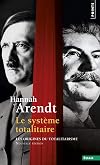
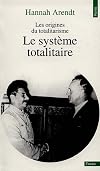
Dans « Le système totalitaire », Arendt analyse le régime stalinien en URSS de 1945 à 1953 et le nazisme de 1929 à 1941. Dans l'introduction de son livre, elle précise : « Dans ce contexte, le point décisif est que le régime totalitaire diffère des dictatures et des tyrannies ; de distinguer entre celui-là et celles-ci n'est nullement un point d'érudition qu'on pourrait tranquillement abandonner aux "théoriciens", car la domination totale est la seule forme de régime avec laquelle la coexistence ne soit plus possible. » Les interrogations qu'Arendt formule dans son introduction et auxquelles elle répond tout au long de son oeuvre sont : Que s'est-il passé ? Pourquoi cela s'est-il passé ? Comment cela a-t-il été show more possible ? show less
Aug 14, 2010French
Ratings
Members
- Recently Added By
Author Information

260+ Works 26,244 Members
Born in Hanover, Germany, Hannah Arendt received her doctorate from Heidelberg University in 1928. A victim of naziism, she fled Germany in 1933 for France, where she helped with the resettlement of Jewish children in Palestine. In 1941, she emigrated to the United States. Ten years later she became an American citizen. Arendt held numerous show more positions in her new country---research director of the Conference on Jewish Relations, chief editor of Schocken Books, and executive director of Jewish Cultural Reconstruction in New York City. A visiting professor at several universities, including the University of California, Columbia, and the University of Chicago, and university professor on the graduate faculty of the New School for Social Research, in 1959 she became the first woman appointed to a full professorship at Princeton. She also won a number of grants and fellowships. In 1967 she received the Sigmund Freud Prize of the German Akademie fur Sprache und Dichtung for her fine scholarly writing. Arendt was well equipped to write her superb The Origins of Totalitarianism (1951) which David Riesman called "an achievement in historiography." In his view, "such an experience in understanding our times as this book provides is itself a social force not to be underestimated." Arendt's study of Adolf Eichmann at his trial---Eichmann in Jerusalem (1963)---part of which appeared originally in The New Yorker, was a painfully searching investigation into what made the Nazi persecutor tick. In it, she states that the trial of this Nazi illustrates the "banality of evil." In 1968, she published Men in Dark Times, which includes essays on Hermann Broch, Walter Benjamin, and Bertolt Brecht (see Vol. 2), as well as an interesting characterization of Pope John XXIII. (Bowker Author Biography) show less

Hannah Arendt has a Legacy Library. Legacy libraries are the personal libraries of famous readers, entered by LibraryThing members from the Legacy Libraries group.
Series

Work Relationships
Is contained in
Is a (non-series) sequel to
Common Knowledge
- Canonical title
- Totalitarianism
- Original publication date
- 1948
- Original language*
- Duits
- Disambiguation notice
- 上・中・下巻にわかれているこの本を、原著(全1巻)と結合しないでください。
[This book is one of the 3 volumes divided from 1 original volume. Please do not combine this with the original.... (show all) ]
*Some information comes from Common Knowledge in other languages. Click "Edit" for more information.
Classifications
- Genres
- Philosophy, Nonfiction, General Nonfiction, History, Politics and Government
- DDC/MDS
- 321.9 — Society, government, & culture Political science Systems of governments and states Authoritarian government: Despotism, dictatorship, totalitarianism [formerly : Anarchism as political system]
- LCC
- JC481 .A62 — Political Science Political theory Political theory. The state. Theories of the state Forms of the state
- BISAC
Statistics
- Members
- 384
- Popularity
- 81,418
- Reviews
- 5
- Rating
- (3.91)
- Languages
- 8 — Danish, Dutch, English, French, German, Japanese, Portuguese, Spanish
- Media
- Paper, Ebook
- ISBNs
- 18
- ASINs
- 5