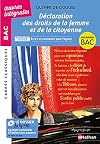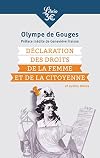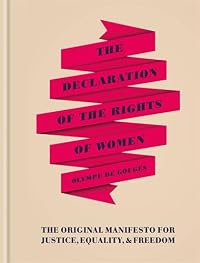
The Declaration of the Rights of Women
by Olympe de Gouges
On This Page
Description
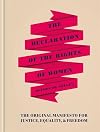
People often consider feminism to be a modern idea and assume that women of the past simply accepted the life carved out for them. In fact, women's rights have been at the forefront of political and social debate for centuries. Written over 200 years ago, The Declaration of the Rights of Women by Olympe de Gouges started a chain reaction in history that went on to inspire other women to fight against the lives society had imposed upon them. Written with a sarcastic tone and militant spirit, show more the arguments still remain true today. This book also includes articles from The UN Declaration On The Elimination of Discrimination Against Women. How can you fight if you don't know what you're still fighting for or even who you're fighting against? The UN has already established a vast range of women's rights that are constantly being chipped away at by organisations. This book presents the texts to you in an engaging way. Articles are broken up by artist's interpretations of each point along with quotes from a range of feminists throughout history including Emmeline Pankurst and Hilary Clinton. So rediscover some of the key texts that helped shape feminism today in time for International Women's Day on March 8th! show lessTags
Recommendations





















Member Recommendations
Amelsfort Olympe the Gouges firmly believed men and women should have equal rights. She was executed during the French revolution for this belief. Her Declaration of the Rights of Women was out of sight for almost 200 years, until the document was discovered in the national library in Paris. It is of enormous historical value.
Member Reviews
I was looking at the Declaration of the Rights of Woman and the Female Citizen by Olympe de Gouges over breakfast--not long at all, just a pamphlet, but a seriously influential one. De Gouges was a merchant's widow, playwright and saloniste (heh) in Paris in the 1780s, a friend of Sophie de Condorcet, and a huge revolutionary enthusiast who saw great and amazing things coming out of the ferment. Article 1 echoes the Declaration of the Rights of Man: "Social distinctions can be based only on the common utility". It's so jiu jutsu of her.
She is practically minded--the rights of woman are to own property, participate in the public administration, etc.--but she also knows the effectiveness of highminded brave-new-world rhetoric--the show more preamble is ringing and aggressive. There is much appeal to the "laws of nature", and much that is echoic of Rousseau (who was himself not much into rights for the women, however). She sees marriage as an oppression of women and men both from a reproductive perspective--married women are able to make cuckolds of their husbands and pawn off their bastards as legitimate children; unmarried women with children are shunned by all. (It's tempting, of course, to be biographical about it--she came to Paris with her son after her husband's death, and had several prominent lovers, and one wonders, if one knew more about her life, what kind of romantic misadventures took place therein.)
There's this interesting thing of women sort of having to buy their rights by giving up protections, much the same as the argument that says if 18-year-olds can go die for their country they should also be able to drink--Article 9 says "Once any woman is declared guilty, complete rigour is exercised by law", and Article 10 " ... woman has the right to mount the scaffold; she must equally have the right to mount the rostrum ... ". Gouges was in fact an opponent of capital punishment; she spoke up in favour of keeping Louis XIV around as a tame king, and was eventually executed during the Terror--explicitly for being against the death penalty, but in light of her work it still carries a mythic oomph. Justice's harbinger untimely silenced, that sort of thing. show less
She is practically minded--the rights of woman are to own property, participate in the public administration, etc.--but she also knows the effectiveness of highminded brave-new-world rhetoric--the show more preamble is ringing and aggressive. There is much appeal to the "laws of nature", and much that is echoic of Rousseau (who was himself not much into rights for the women, however). She sees marriage as an oppression of women and men both from a reproductive perspective--married women are able to make cuckolds of their husbands and pawn off their bastards as legitimate children; unmarried women with children are shunned by all. (It's tempting, of course, to be biographical about it--she came to Paris with her son after her husband's death, and had several prominent lovers, and one wonders, if one knew more about her life, what kind of romantic misadventures took place therein.)
There's this interesting thing of women sort of having to buy their rights by giving up protections, much the same as the argument that says if 18-year-olds can go die for their country they should also be able to drink--Article 9 says "Once any woman is declared guilty, complete rigour is exercised by law", and Article 10 " ... woman has the right to mount the scaffold; she must equally have the right to mount the rostrum ... ". Gouges was in fact an opponent of capital punishment; she spoke up in favour of keeping Louis XIV around as a tame king, and was eventually executed during the Terror--explicitly for being against the death penalty, but in light of her work it still carries a mythic oomph. Justice's harbinger untimely silenced, that sort of thing. show less
This attractive, compact book provides a challenging and inspirational read. Each article of the declaration appears on a single page with a current artist’s illustration on the facing page. The next two pages following each article include relevant quotes from a wide variety of individuals from across the centuries. The same format is followed for the “United Nations Declaration on the Elimination of Discrimination against Women” included at the end of the book. The quotations, which include the source and date, make one realize how long activists have been advocating for equal rights for women. The quotes provide food for thought and can be used to initiate group discussions. But the passages also challenge us to take action. show more This is a book that will interest those concerned about gender inequality. It may also prove enlightening for those who have not thought much about the issue. The book is attractive enough to give as a gift and compact enough to carry around easily. show less
This was a good and thought-provoking read, especially given everything happening in the US right now.
Ratings
Members
- Recently Added By
Lists

Autodidacts
15 works; 4 members

Books Read in 2014
2,341 works; 89 members

Fières de lettres
85 works; 1 member
Author Information

53+ Works 241 Members
Awards and Honors
Common Knowledge
- Canonical title
- The Declaration of the Rights of Women
- Original title
- Déclaration des droits de la femme et de la citoyenne
- Original publication date
- 1791
Classifications
- Genres
- Sexuality and Gender Studies, Nonfiction, General Nonfiction, History, Politics and Government
- DDC/MDS
- 305.42 — Social sciences Social sciences, sociology & anthropology Groups of people Women Social role and status of women
- LCC
- HQ1236 — Social sciences The family. Marriage, Women and Sexuality The Family. Marriage. Women Women. Feminism
- BISAC
Statistics
- Members
- 139
- Popularity
- 234,227
- Reviews
- 3
- Rating
- (3.68)
- Languages
- Dutch, English, French, Italian
- Media
- Paper, Ebook
- ISBNs
- 14
- ASINs
- 4