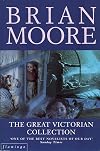
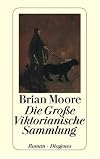
The Great Victorian Collection
by Brian Moore
On This Page
Description
An accumulation of Victorian artifacts, literally dreamed up by young, obscure historian Anthony Maloney has crucial effects on his private and public lives as it draws him nearer and nearer to the border between creative nightmare and deadly wakefulness.Tags
Recommendations
























Member Reviews
Brian Moore's novel The Great Victorian Collection tells the wonderfully bizarre story of Anthony Maloney, a 29-year-old assistant professor of history at Canada's McGill University in Montreal, and an expert in Victoriana. One morning, while on a trip to San Francisco to attend a seminar at Berkeley, Maloney wakes up to find that a dream he's had has come true: Outside his hotel window a vast, magnificent collection of exquisite and rare Victorian objects has magically appeared in the hotel parking lot.
From that moment, Maloney's life is completely taken over by the care and maintenance of the collection. The mass of objects is so large it can't be moved, so the hotel management has to be placated. Security has to be seen to. The press show more and TV journalists are soon clamoring for interviews. Maloney acquires an agent and an assistant (and promptly falls in love with his assistant's young girl friend). Debates develop between rival academic camps – some claim the collection is the real thing, others believe the objects to be very skillful fakes; although no one seems able to explain how Maloney might have pulled off such a "hoax." And Maloney finds, somewhat to his dismay, that when he goes to sleep at night, he can only dream about the collection – he conjured it up, and he's destined to guard it – even in his dreams.
Throughout the book, Maloney himself struggles with the problem of just how real or unreal the collection might be. Was it actually created by his dream? Or is there some other mystery involved? And if it is just a manifestation of his imaginings, what exactly is allowing it to exist in the real world? Is it here to stay, or likely to disappear just as suddenly as it came into being? At one point, Maloney experiments with trying to remove an object – an antique toy train engine – from the collection only to find the engine seriously altered when he inspects it afterward.
In the end, the collection causes Maloney nothing but grief, and his attempts to maintain it in its pristine condition fail miserably. But that's all I'll say about the ending because there are twists and surprises I don't really want to reveal (including a strange subplot involving Mary Ann, the young companion of Maloney's assistant, and a road trip to Los Angeles).
This stunningly inventive, and deliciously weird novel won both the James Tait Black Memorial Prize and the Canadian Governor General's Award for Fiction in 1975, but seems to be out of print now. And that's too bad. It really deserves to be rediscovered. show less
From that moment, Maloney's life is completely taken over by the care and maintenance of the collection. The mass of objects is so large it can't be moved, so the hotel management has to be placated. Security has to be seen to. The press show more and TV journalists are soon clamoring for interviews. Maloney acquires an agent and an assistant (and promptly falls in love with his assistant's young girl friend). Debates develop between rival academic camps – some claim the collection is the real thing, others believe the objects to be very skillful fakes; although no one seems able to explain how Maloney might have pulled off such a "hoax." And Maloney finds, somewhat to his dismay, that when he goes to sleep at night, he can only dream about the collection – he conjured it up, and he's destined to guard it – even in his dreams.
Throughout the book, Maloney himself struggles with the problem of just how real or unreal the collection might be. Was it actually created by his dream? Or is there some other mystery involved? And if it is just a manifestation of his imaginings, what exactly is allowing it to exist in the real world? Is it here to stay, or likely to disappear just as suddenly as it came into being? At one point, Maloney experiments with trying to remove an object – an antique toy train engine – from the collection only to find the engine seriously altered when he inspects it afterward.
In the end, the collection causes Maloney nothing but grief, and his attempts to maintain it in its pristine condition fail miserably. But that's all I'll say about the ending because there are twists and surprises I don't really want to reveal (including a strange subplot involving Mary Ann, the young companion of Maloney's assistant, and a road trip to Los Angeles).
This stunningly inventive, and deliciously weird novel won both the James Tait Black Memorial Prize and the Canadian Governor General's Award for Fiction in 1975, but seems to be out of print now. And that's too bad. It really deserves to be rediscovered. show less
Bought a copy of this book at one of those "95% off!" temporary stores in a vacant store-front. You know, where they're trying to dump publishers' remainders rather than pulping them straight away... This was OK, and I'm only luke-warm primarily for the ending, otherwise I might have given it 3.5 stars or more. In my opinion only, of course. I really enjoyed the writing and have no quibble with the prose -- in fact, it was charming. The premise is delightful, and the execution is marvelous... Up to a point. And then... I don't know, I was disappointed at the end. I suppose you could say, oh, well that's life it's not all happily ever after, blah blah, and this is "Literature". My recommendation, for those who might possibly care, would show more be to tear out the last 15 pages of this book and toss 'em. Then read the first three quarters of the book, and when you're done, conveniently lose it in the subway. Trust me; you'll be happier that way, and so will the reader who picks up the book as a time-filler... And I do apologize for spending this many words, and your time, on something that I couldn't lavish with more starry love. show less
I've read a certain amount of Science Fiction, and Fantasy so this book as a work of creation, doesn't strike me as surrealistic, or strange. But it does deal with the basic relation between the writer and his creation. Once you've written a piece, it has a life of its own, and you may be very surprized abut what the rest of the world thinks you've written. The suspicion that the rest of the world is more perceptive can be crushing.
A man sees a phenomenon, a great collection of Victoriana, some other people can see it, most can't understand how it appeared. The Collection survives but it is changed by contact with sensible people. It is, it seems, more than its parts and more than one thing. Moore leaves us with a counsel of well, show more "Let's get on with whatever life serves up...it's what's for dinner." Wanna starve? That's the other option. show less
A man sees a phenomenon, a great collection of Victoriana, some other people can see it, most can't understand how it appeared. The Collection survives but it is changed by contact with sensible people. It is, it seems, more than its parts and more than one thing. Moore leaves us with a counsel of well, show more "Let's get on with whatever life serves up...it's what's for dinner." Wanna starve? That's the other option. show less
This is really a disappointment, but can't be a 2-star book because both the quality of prose and my expectations were so high. I'd been convinced this might just turn out to be one of my favourites (love the title and premise), but such a let down. I suppose I wanted more plot--how to protect the Collection, why did this happen, etc., and instead most of the plot was about some dreary non-girlfriend with all the effervescent personality of a dishcloth, and the highest stakes were about whether to go dancing or dreaming instead.
I'd love someone to take the premise and really run with it, the way that Buffy the Vampire Slayer the TV show ended up 1,000 times better than Buffy the movie.
(Note: 5 stars = amazing, wonderful, 4 = very good show more book, 3 = decent read, 2 = disappointing, 1 = awful, just awful. I'm fairly good at picking for myself so end up with a lot of 4s). show less
I'd love someone to take the premise and really run with it, the way that Buffy the Vampire Slayer the TV show ended up 1,000 times better than Buffy the movie.
(Note: 5 stars = amazing, wonderful, 4 = very good show more book, 3 = decent read, 2 = disappointing, 1 = awful, just awful. I'm fairly good at picking for myself so end up with a lot of 4s). show less
Ratings
Members
- Recently Added By
Lists

Governor General of Canada's English Fiction Awards
89 works; 3 members

David Pringle's Modern Fantasy: The 100 Best Novels
100 works; 5 members
Author Information

31+ Works 5,937 Members
Brian Moore, 1921 - 1999 Brian Moore was born in Belfast on August 25, 1921 to Doctor James Bernard Moore and Eileen McFadden. He attended St. Malachy's College, a Catholic school, where the students where beaten on the hands daily. He left the college without a School Leaving Certificate because he failed Math. In 1941, a bomb damaged the family show more home, so they moved to a house on Camden Street. A year later, his father died. In 1942, he joined the National Fire Service, but knew that he wanted to be a writer. Moore knew some French, so he was hired by the British Ministry of War Transport to go as a port official to Algiers, North Africa. Afterwards, he traveled to Italy, France, and after the war, Warsaw (1945), Spain, Canada (1948), the United States and England, finally settling in California. Moore immigrated to Canada in 1948, where he worked as a proofreader and reporter for the Montreal Gazette. In 1951, he published his first story in the Northern Review and married Jacqueline Sirois, a fellow journalist. His only child, Michael, was born on November 24, 1953. He split with his wife in 1964 and then married Jean Denney, who he stayed married to until his death. Moore published "The Lonely Passion of Judith Hearne" (1955), "The Feast of Lupercal" (1957) and "The Emperor of Ice Cream" (1966), which is his most autobiographical novel. He recounts his school experiences, as well as what is was like during the bombing. In the 1990's, he wrote political fables and four novels. "Lies of Silence" is a thriller set in Belfast and was a more political statement than the previous novels. It was nominated for the Booker Prize and was his bestselling book. Several of his books were made into films such as "The Luck of Ginger Coffey," "Catholics," "The Lonely Passion of Judith Hearne" and "The Temptation of Eileen Hughes" was adapted for television. Moore received many awards, which included the Governor General's Award in 1961 for "The Luck of Ginger Coffey" and again in 1975 for "The Great Victorian Collection," which also won the James Tait Black Award in England. He was short listed for the Booker Prize in 1987 for "The Colour of Blood" and again in 1990 for "Lies of Silence." In July 1987, he conferred an honorary doctorate by Queen's University, Belfast. His film "Catholics" received the W.H. Smith Award in 1973 and the Peabody Award in 1974. In 1999, Brian Moore died at his home in Malibu, California. (Bowker Author Biography) show less
Awards and Honors
Work Relationships
Is contained in
Common Knowledge
- People/Characters
- Anthony Maloney
- Important places
- California, USA; Carmel-by-the-Sea, California, USA; Monterey County, California, USA
- Dedication
- For Jean
- First words
- There is still some confusion as to when Anthony Maloney first saw the Great Victorian Collection.
- Last words
- (Click to show. Warning: May contain spoilers.)The extent to which it will outlive the man who created it, or its interest to succeeding generations, is, of course, beyond the range of our predictions.
- Blurbers
- Greene, Graham; Didion, Joan
Classifications
Statistics
- Members
- 155
- Popularity
- 211,837
- Reviews
- 5
- Rating
- (3.39)
- Languages
- English, German
- Media
- Paper, Ebook
- ISBNs
- 8
- ASINs
- 3