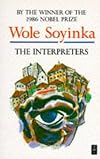
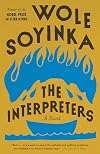
The Interpreters
by Wole Soyinka
On This Page
Description
"Drawn together by their hopes, loves, dissatisfactions, and the daily lives and deaths around them, five young Nigerian intellectuals attempt to define their identity in a world where their cultural past and Western-influenced present are brought into conflict"--Tags
Recommendations











Member Reviews
The Interpreters probably came over as a very African novel when it first appeared, but the first thing that strikes you reading it now is what a very 1960s novel it is. A group of intelligent young men (and their girlfriends) are struggling against the dull, conventional and corruptly self-interested way of life of the older generation, a struggle that mostly takes the form of long, earnest discussions about politics, philosophy and religion, all punctuated by drink, sex and subversive music and undermined by a series of absurd accidents and social embarrassments that leave them more-or-less back where they started.
But it is African as well, of course: the young characters are caught between the temptations of aspiring to one of the show more competing value-systems of western capitalism (most of them have studied abroad) and "old Africa" - where the tribal gods are competing with Christianity and Islam. At the same time, they are confronted with the unholy compromises that the current postcolonial ruling classes have made to protect their own interests.
Soyinka knows very well that adopting the form of the novel means that he's committing himself to the metropolitan mechanisms of production and distribution that go with that - he has to get it published in London, and he knows that the audience he can deliver it to is restricted by language, the written medium, access to books, and the leisure to read. Unlike plays and poems - accessible to everyone because they can be delivered orally over the radio, or live wherever actors can find a space to perform - novels are read only by people-who-read-novels, which for Soyinka in 1965 means students, foreigners, and the wealthy middle classes. That's presumably why he's only written one other novel. And why this is such a complicated, literary novel, full of direct and implied references to other books of the time, mostly at least slightly mocking: One of the characters keeps talking flippantly about cultivating his negritude (by going out in the sun); another has mapped out a pastiche existentialist philosophical system based on the pleasures of defecation; there's an American refugee from a James Baldwin novel who also happens to be a James Baldwin fan; there is a faculty party given by a pompous professor and subverted by one of the drunken characters, who is gatecrashing - to make sure we don't miss the Lucky Jim allusions there, we keep overhearing someone in the background talking about the Madrigal Group. And so on.
The nasty portrayal of the gay Baldwin-fan, Joe Golder, was probably offensive at the time, and of course feels doubly so now, when we know about the ways that the notion of homosexuality as an "unafrican" import has been used to whip up anger against LGBT people in so many African countries. We keep expecting Soyinka as narrator to step back from his characters' disgust with the fact of Golder's homosexuality and put it in perspective, but he never does, and it's difficult to avoid the conclusion that (at least when he wrote this) he shared their views.
Soyinka is a magnificent writer with a great feel for surprising and devastating images (often in very unexpected places, e.g. Like two halves of a broad bean, the pachydermous radiogram and the Managing Director.). He is also a dramatist who knows exactly how to place a major speech or a deflating incident where it can have the most impact, so this is never a dull book. But it is a complicated book, with a very heavy load of symbolism that never quite gets resolved, and many people who read it seem to feel afterwards that they aren't much further on. Given that it was published on the eve of a terrible civil war, it's perhaps not surprising that there is no neat ending with a vision for the future of Nigeria. show less
But it is African as well, of course: the young characters are caught between the temptations of aspiring to one of the show more competing value-systems of western capitalism (most of them have studied abroad) and "old Africa" - where the tribal gods are competing with Christianity and Islam. At the same time, they are confronted with the unholy compromises that the current postcolonial ruling classes have made to protect their own interests.
Soyinka knows very well that adopting the form of the novel means that he's committing himself to the metropolitan mechanisms of production and distribution that go with that - he has to get it published in London, and he knows that the audience he can deliver it to is restricted by language, the written medium, access to books, and the leisure to read. Unlike plays and poems - accessible to everyone because they can be delivered orally over the radio, or live wherever actors can find a space to perform - novels are read only by people-who-read-novels, which for Soyinka in 1965 means students, foreigners, and the wealthy middle classes. That's presumably why he's only written one other novel. And why this is such a complicated, literary novel, full of direct and implied references to other books of the time, mostly at least slightly mocking: One of the characters keeps talking flippantly about cultivating his negritude (by going out in the sun); another has mapped out a pastiche existentialist philosophical system based on the pleasures of defecation; there's an American refugee from a James Baldwin novel who also happens to be a James Baldwin fan; there is a faculty party given by a pompous professor and subverted by one of the drunken characters, who is gatecrashing - to make sure we don't miss the Lucky Jim allusions there, we keep overhearing someone in the background talking about the Madrigal Group. And so on.
The nasty portrayal of the gay Baldwin-fan, Joe Golder, was probably offensive at the time, and of course feels doubly so now, when we know about the ways that the notion of homosexuality as an "unafrican" import has been used to whip up anger against LGBT people in so many African countries. We keep expecting Soyinka as narrator to step back from his characters' disgust with the fact of Golder's homosexuality and put it in perspective, but he never does, and it's difficult to avoid the conclusion that (at least when he wrote this) he shared their views.
Soyinka is a magnificent writer with a great feel for surprising and devastating images (often in very unexpected places, e.g. Like two halves of a broad bean, the pachydermous radiogram and the Managing Director.). He is also a dramatist who knows exactly how to place a major speech or a deflating incident where it can have the most impact, so this is never a dull book. But it is a complicated book, with a very heavy load of symbolism that never quite gets resolved, and many people who read it seem to feel afterwards that they aren't much further on. Given that it was published on the eve of a terrible civil war, it's perhaps not surprising that there is no neat ending with a vision for the future of Nigeria. show less
Difficult, but incredibly interesting. Soyinka's characters are both believable and surreal, and his vision of artists and politics provokes a careful critique of the spaces we expect (or hope) to change society. This is one of those books that may need to be read two-three times for a full understanding or impact, but the writing is fascinating, and makes the first journey well worth the while in terms of thought and entertainment. I have no doubt that the second read, and beyond, will be just as worth the time. With such beautiful writing, and fascinating turns, it goes quickly. Recommended.
The interpreters are a group of friends in newly independent Nigeria who have returned from study abroad (in England and the US) to take up positions in the new environment: one is a journalist, one a descendent of village chiefs, one a sculptor, one a painter, one (the only woman in the group) some kind of minor government worker). There isn't much plot; in Soyinka's dense, often allusive prose, the reader learns about the individuals in turn, often returning to their pasts before coming back to the present. Soyinka introduces other characters to give a fuller picture of life in the new country, and thoroughly satirizes many of them, including those who are corrupt and those who are still imbued with British traditions. Religion plays show more a part in the novel as well, both the traditional Yoruban gods and Christianity. In addition, parts of the novel are quite funny, and parts are quite scatological, including a theory held by the journalist character.
I had a hard time knowing what to make of this novel, which I read thanks to a suggestion by another LTer. Clearly Soyinka is trying to paint a broad picture of both the challenges of a postcolonial society and the conflicts encountered by young men eager to find their way in a changing world. I found the women not as well developed as the male characters, and when a character reveals his homosexuality (a character who is already "confused" because he is an American in Nigeria and because, although he appears white, he is a quarter black and yearns to be thought of as black), other characters are disgusted. A lot that happens in this novel is symbolic in some way, especially the appearance in the second part of a strange church leader and his "apostles," including a young former thief re-named Noah. I would probably have to read this book again to make more sense of it, but it remains an interesting portrait of a time and place, including a vivid feeling for the waterways around Lagos before the environmental disaster caused by oil drilling.
Soyinka was the first African to receive the Nobel Prize for literature and is mostly known for his plays and memoirs; this is one of only two novels he wrote. show less
I had a hard time knowing what to make of this novel, which I read thanks to a suggestion by another LTer. Clearly Soyinka is trying to paint a broad picture of both the challenges of a postcolonial society and the conflicts encountered by young men eager to find their way in a changing world. I found the women not as well developed as the male characters, and when a character reveals his homosexuality (a character who is already "confused" because he is an American in Nigeria and because, although he appears white, he is a quarter black and yearns to be thought of as black), other characters are disgusted. A lot that happens in this novel is symbolic in some way, especially the appearance in the second part of a strange church leader and his "apostles," including a young former thief re-named Noah. I would probably have to read this book again to make more sense of it, but it remains an interesting portrait of a time and place, including a vivid feeling for the waterways around Lagos before the environmental disaster caused by oil drilling.
Soyinka was the first African to receive the Nobel Prize for literature and is mostly known for his plays and memoirs; this is one of only two novels he wrote. show less
Il marchio editoriale Calabuig propone titoli di qualità delle letterature del mondo. "Gli interpreti" è la seconda opera di Soyinka che ha ripescato dai fuori catalogo Jaca Book (dopo "L’uomo è morto"). Si tratta del primo romanzo (1965) dell’autore – all’epoca già noto in campo poetico e soprattutto teatrale – che mette in campo cinque giovani uomini da poco rientrati in Nigeria dopo gli studi all’estero. Già serpeggia la disillusione dopo la recente indipendenza.
È un “romanzo” con le virgolette, perché non è palese la struttura di una storia che si sviluppa. Abbiamo piuttosto un mosaico di azioni e di dialoghi, con registri diversi e non sempre afferrabili di primo acchito (molto utile, per questo, show more l’Introduzione di Marco Grampa). Un’opera la cui lettura non va certo relegata ai… ritagli di tempo. show less
È un “romanzo” con le virgolette, perché non è palese la struttura di una storia che si sviluppa. Abbiamo piuttosto un mosaico di azioni e di dialoghi, con registri diversi e non sempre afferrabili di primo acchito (molto utile, per questo, show more l’Introduzione di Marco Grampa). Un’opera la cui lettura non va certo relegata ai… ritagli di tempo. show less
Sep 25, 2017Italian
1990 regal ETeixidor
Nov 24, 2021Catalan
Ratings
Members
- Recently Added By
Lists

Best African Books
126 works; 46 members
Best African and African diaspora books
111 works; 4 members

TML 200 Best Books 1950-1999
202 works; 10 members

The Modern Library (The Two Hundred Best Novels....
202 works; 1 member
Author Information

139+ Works 5,072 Members
Wole Soyinka was born in Abeokuta, Ogun State of Nigeria on July 13, 1934. He attended Government College and University College in Ibadan before receiving a degree in English from the University of Leeds in England in 1958. He has held research and teaching appointments at several universities including the University of Ibadan, the University of show more Ife, Cornell University, Emory University, the University of Nevada, Las Vegas, and Loyola Marymount. He is a distinguished playwright, poet, novelist, essayist, social critic, political activist, and literary scholar. His plays include The Swamp Dwellers, The Lion and the Jewel, A Dance of the Forests, The Bacchae of Euripides, A Play for Giants, Death and the King's Horsemen, From Zia with Love, The Beatification of Area Boy, and King Baabu. His collections of poetry include Idanre and Other Poems, A Shuttle in the Crypt, and Mandela's Earth and Other Poems. His novels include The Interpreters, which won the 1968 Jock Campbell Literary Award, and Season of Anomy. His autobiographical works include Ake: The Years of Childhood, Isara: A Voyage Around Essay, The Open Sore of a Continent: A Personal Memoir of the Nigerian Crisis, and You Must Set Forth at Dawn. His literary essays collections include Myth, Literature and the African World and Art, Dialogue and Outrage. During the civil war in Nigeria, he appealed for cease-fire in an article. Accused of treason, he was held in solitary confinement for 22 months. Two of his works, The Man Died: Prison Notes of Wole Soyinka and Poems from Prison, were secretly written on toilet paper and smuggled out of prison. He won the Nobel Prize for Literature in 1986. (Bowker Author Biography) show less
Some Editions
Awards and Honors
Series
Belongs to Publisher Series
Common Knowledge
- Original title
- The Interpreters
- Original publication date
- 1965
- People/Characters
- Joe Golden; Noah; Sagoe; Egbo; Bandele; Sekoni
- Important places
- Lagos, Nigeria; Ibadan, Nigeria
- Original language
- English
Classifications
Statistics
- Members
- 364
- Popularity
- 86,347
- Reviews
- 5
- Rating
- (3.36)
- Languages
- 11 — Catalan, Dutch, English, Finnish, French, German, Italian, Malay, Portuguese, Spanish, Swedish
- Media
- Paper, Ebook
- ISBNs
- 30
- ASINs
- 5