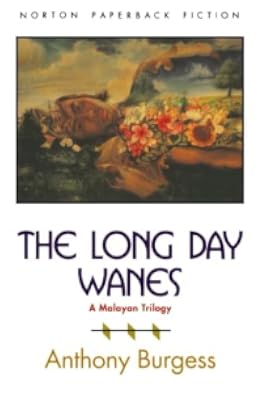
The Long Day Wanes: A Malayan Trilogy
by Anthony Burgess 
The Long Day Wanes : A Malayan Trilogy (Collections and Selections — Omnibus)
On This Page
Description
A sweetly satiric look at the twilight days of colonialism.Tags
Recommendations




























Member Recommendations
Member Reviews
These three novels, Burgess's first attempt at fiction, came out of his time as a teacher in Malaya in the mid-1950s. Taken together, they form an enjoyably caustic, satirical account of the transition from colonialism to independence, following the career of a British expat teacher, Victor Crabbe, who has come to Malaya partly to try to get away from memories of a tragedy in his personal life, and partly through an altruistic, liberal desire to use his teaching skills to improve the lives of young people in Malaya. Needless to say, he finds that neither of these things is as straightforward as he had hoped.
In Time for a Tiger, colonialism is beginning to wind down, and Malaya has become a kind of dumping-ground for British officials no show more longer wanted in newly-independent countries elsewhere, but who for one reason or another can't or won't return to the UK. Not least Nabby Adams, a policeman who has served so long in India that he speaks better Urdu than English, and who has long since given up the fight against alcoholism, and who illuminates the narrative with gloriously Kiplingesque passages whenever he appears. Meanwhile, Victor Crabbe is trying to cope with his incompetent headmaster, Boothby, whilst his wife Fenella (a Bohemian poet when they met) is starting to act like a memsahib and showing clear signs of "expat spouse syndrome".
The enemy in the blanket is set in a different Malay state on the verge of independence: Crabbe is now a principal himself, his marriage is in even more trouble than it was in the last book, and the place of Adams as tragicomic plot relief is taken by Hardman, a lawyer down on his luck who has taken the decision to secure his future by converting to Islam and marrying a rich Malay widow (...who has had her previous two husbands killed).
Finally, in Beds in the East, Crabbe is in a third fictitious Malay state after independence as Education Officer, in the process of training up and handing over to a Malay successor, and the second viewpoint character is Rosemary, a beautiful-but-still-unhappily-single Tamil woman with a strong Anglophile tendency and twelve cats. Crabbe's wife is now back in London and he keeps getting asked whether he is related to "the poet Fenella Crabbe". Disappointed personally and professionally, he takes a journey up-river in the final chapters. And we all know how that has to end in a colonial novel...
As a satire set in a society and a time where people saw each other chiefly through the filter of the ethnic groups they belonged to, and written by somebody who enjoys shocking the reader and wants us to imagine that he's telling it "like it is", with no concessions to our liberal aspirations, this is a book that can't help being full of what we would now call racial stereotyping. Part of that is probably fair. Obviously you can't make sense of 1950s Malaya without knowing that there were tensions and distrust between Malays, Indians, Chinese and British, and those stereotypes that Burgess exaggerates and parodies were part of the structure that led to those tensions. But part of it is also obviously Burgess enjoying himself, venting his own prejudices and resentments and playing up to the readers "at home" who rather felt that the former colonies were simply exposing themselves to further exploitation by the devious Americans and Chinese in getting rid of the yoke of empire. You can tell yourself "that's how people thought in 1958" and laugh at the book within that limitation, or avoid it altogether if that's not your thing.
Even though this is very early Burgess, it's entirely characteristic of him - hardly a page goes by without the author trying out some delightfully obscure scientific or rhetorical term or an implausibly recondite swearword. Every so often we get some unnecessarily technical phonetic description of the speech-sounds characters are making, or we go far deeper into the cultural background of some trivial circumstance than the situation could ever demand. In those days, publishers' editors were still going through manuscripts in detail with their blue pencils, so we can take it for granted that what they allowed Burgess to keep is a tiny fraction of the obscurity and excess that he had in his first draft.
Fun, and an interesting time-capsule. show less
In Time for a Tiger, colonialism is beginning to wind down, and Malaya has become a kind of dumping-ground for British officials no show more longer wanted in newly-independent countries elsewhere, but who for one reason or another can't or won't return to the UK. Not least Nabby Adams, a policeman who has served so long in India that he speaks better Urdu than English, and who has long since given up the fight against alcoholism, and who illuminates the narrative with gloriously Kiplingesque passages whenever he appears. Meanwhile, Victor Crabbe is trying to cope with his incompetent headmaster, Boothby, whilst his wife Fenella (a Bohemian poet when they met) is starting to act like a memsahib and showing clear signs of "expat spouse syndrome".
The enemy in the blanket is set in a different Malay state on the verge of independence: Crabbe is now a principal himself, his marriage is in even more trouble than it was in the last book, and the place of Adams as tragicomic plot relief is taken by Hardman, a lawyer down on his luck who has taken the decision to secure his future by converting to Islam and marrying a rich Malay widow (...who has had her previous two husbands killed).
Finally, in Beds in the East, Crabbe is in a third fictitious Malay state after independence as Education Officer, in the process of training up and handing over to a Malay successor, and the second viewpoint character is Rosemary, a beautiful-but-still-unhappily-single Tamil woman with a strong Anglophile tendency and twelve cats. Crabbe's wife is now back in London and he keeps getting asked whether he is related to "the poet Fenella Crabbe". Disappointed personally and professionally, he takes a journey up-river in the final chapters. And we all know how that has to end in a colonial novel...
As a satire set in a society and a time where people saw each other chiefly through the filter of the ethnic groups they belonged to, and written by somebody who enjoys shocking the reader and wants us to imagine that he's telling it "like it is", with no concessions to our liberal aspirations, this is a book that can't help being full of what we would now call racial stereotyping. Part of that is probably fair. Obviously you can't make sense of 1950s Malaya without knowing that there were tensions and distrust between Malays, Indians, Chinese and British, and those stereotypes that Burgess exaggerates and parodies were part of the structure that led to those tensions. But part of it is also obviously Burgess enjoying himself, venting his own prejudices and resentments and playing up to the readers "at home" who rather felt that the former colonies were simply exposing themselves to further exploitation by the devious Americans and Chinese in getting rid of the yoke of empire. You can tell yourself "that's how people thought in 1958" and laugh at the book within that limitation, or avoid it altogether if that's not your thing.
Even though this is very early Burgess, it's entirely characteristic of him - hardly a page goes by without the author trying out some delightfully obscure scientific or rhetorical term or an implausibly recondite swearword. Every so often we get some unnecessarily technical phonetic description of the speech-sounds characters are making, or we go far deeper into the cultural background of some trivial circumstance than the situation could ever demand. In those days, publishers' editors were still going through manuscripts in detail with their blue pencils, so we can take it for granted that what they allowed Burgess to keep is a tiny fraction of the obscurity and excess that he had in his first draft.
Fun, and an interesting time-capsule. show less
Somewhat surreal, brutally comical, a fascinating insight into pre-independence Malaysia. The third book in the trilogy class somewhat flat, but still worth a read.
Consists of Burgess first three novels: Time for a Tiger 1956, The Enemy in the Blanket 1958 and Beds in the East 1959. I read them as one longer novel and found that it held my interest all the way through. One of the characters the Englishman Victor Crabbe is present in all three novels; a resident teacher in the first, a headmaster in the second and then an Education officer in the third, however the novels do stand alone, I just happened to have them in one single volume on my bookshelf.
In the first novel the British seem to be in control of the Malayan Peninsula and and the book focuses on two British officials trying to come to terms with life in the colony. Burgess introduces his readers to the vibrant nationalities who are show more struggling to make their mark, there are the Sikhs, The Tamils, the indigenous Malays and the Chinese. Burgess writes on all these differing cultures from a British perspective but it is a perspective from first hand knowledge as he spent some time in the colonial service in Malaya as a teacher and education officer. The novels are satirical in as much as they "probably" exaggerate racial characteristics and incidents, however the satire does not become nasty or denigrating, so much different from William Boyd's first novel [A Good Man in Africa that I read recently and which I found insidiously racist. The difference is that Burgess satire is based on strong characterisation of many of the people in his book, whereas Boyd only really bothers with the English characters.
Each of the books has a main theme or plot thread which is also present in the others, but which does not feature so strongly. The first novel is concerned with alcoholism. Nabby Adams is a police lieutenant in charge of transport and spends all his waking hours trying to get another drink. He is in debt to all the bar owners and so he resorts to petty thieving and some extortion to feed his habit. This has consequences for the muslim Malays who work for and with him and puts his friends and colleagues lives in danger. Victor Crabbe is a resident teacher and his problems relate to his Tamil pupils who may be inciting a revolt, there are guerilla's in the jungle.
The theme of the second book is betrayal, Victor has found a job as headmaster in another town, a town further into the Malayan heartland. There are fewer British administrators and those that are there are thinking of leaving. the theme of betrayal is also twinned with marriage. The struggling British lawyer Rupert Hardman, can only survive by marrying a muslim divorcee who has money, Victor Crabbe is fighting a losing battle to keep his wife from returning to England and he is under attack at his school because the Tamil staff are plotting against him. By the time we get to the third book Victor is about the only British representative still standing, he is another town as an Education officer preparing to hand over the reins to his Malay subordinate. His wife has left him, but Victor is still trying to do his job and he has discovered a Chinese musical prodigy. The main theme of this last novel is the disintegration of British rule and the jockeying for positions of power between the other racial groups.
Burgess describes the difficulties of living in a tropical climate in a way that made me appreciate the rising emotions of some of his characters. Some are on a short fuse especially in the final novel when any attempt at seeing a bigger picture has been reduced to isolated squabbles between the racial groups. The setting of the novels provides the continuity with the movement towards shaking off colonial rule which progresses through each book, but this movement is at a local level and Burgess is good at bringing out the effects on his characters. It is a book where characters are larger than life and they seem to break out of their stereotypes.
Burgess was familiar with how some of the financially challenged British lived in Malaya and he was familiar with local customs, this feeling for the country permeates the book and the atmosphere is set so that when returning to read the final novel I felt at home with the daily living conditions of Burgesses people. I enjoyed the final novel very much, but there is much good reading to be had in them all. There is some word play particularly at start of the first novel and Burgess is able to indulge his passion for classical music in the last book. Amusing certainly, funny in places, but not laugh out loud and so for the enjoyment value 4 stars. show less
In the first novel the British seem to be in control of the Malayan Peninsula and and the book focuses on two British officials trying to come to terms with life in the colony. Burgess introduces his readers to the vibrant nationalities who are show more struggling to make their mark, there are the Sikhs, The Tamils, the indigenous Malays and the Chinese. Burgess writes on all these differing cultures from a British perspective but it is a perspective from first hand knowledge as he spent some time in the colonial service in Malaya as a teacher and education officer. The novels are satirical in as much as they "probably" exaggerate racial characteristics and incidents, however the satire does not become nasty or denigrating, so much different from William Boyd's first novel [A Good Man in Africa that I read recently and which I found insidiously racist. The difference is that Burgess satire is based on strong characterisation of many of the people in his book, whereas Boyd only really bothers with the English characters.
Each of the books has a main theme or plot thread which is also present in the others, but which does not feature so strongly. The first novel is concerned with alcoholism. Nabby Adams is a police lieutenant in charge of transport and spends all his waking hours trying to get another drink. He is in debt to all the bar owners and so he resorts to petty thieving and some extortion to feed his habit. This has consequences for the muslim Malays who work for and with him and puts his friends and colleagues lives in danger. Victor Crabbe is a resident teacher and his problems relate to his Tamil pupils who may be inciting a revolt, there are guerilla's in the jungle.
The theme of the second book is betrayal, Victor has found a job as headmaster in another town, a town further into the Malayan heartland. There are fewer British administrators and those that are there are thinking of leaving. the theme of betrayal is also twinned with marriage. The struggling British lawyer Rupert Hardman, can only survive by marrying a muslim divorcee who has money, Victor Crabbe is fighting a losing battle to keep his wife from returning to England and he is under attack at his school because the Tamil staff are plotting against him. By the time we get to the third book Victor is about the only British representative still standing, he is another town as an Education officer preparing to hand over the reins to his Malay subordinate. His wife has left him, but Victor is still trying to do his job and he has discovered a Chinese musical prodigy. The main theme of this last novel is the disintegration of British rule and the jockeying for positions of power between the other racial groups.
Burgess describes the difficulties of living in a tropical climate in a way that made me appreciate the rising emotions of some of his characters. Some are on a short fuse especially in the final novel when any attempt at seeing a bigger picture has been reduced to isolated squabbles between the racial groups. The setting of the novels provides the continuity with the movement towards shaking off colonial rule which progresses through each book, but this movement is at a local level and Burgess is good at bringing out the effects on his characters. It is a book where characters are larger than life and they seem to break out of their stereotypes.
Burgess was familiar with how some of the financially challenged British lived in Malaya and he was familiar with local customs, this feeling for the country permeates the book and the atmosphere is set so that when returning to read the final novel I felt at home with the daily living conditions of Burgesses people. I enjoyed the final novel very much, but there is much good reading to be had in them all. There is some word play particularly at start of the first novel and Burgess is able to indulge his passion for classical music in the last book. Amusing certainly, funny in places, but not laugh out loud and so for the enjoyment value 4 stars. show less
I learned much about Malaya in the 1950s, and the original Indian name for Malaya was Langkasuka. Mention of a dispatch-case reminded me of Graham Greene's novels, and I expected a sort of humorous adventure in the same style as Greene, but I felt the plot was weaker than the Greene's I have read. Burgess' use of words (betel juice, eschatology, crapulous, prepuce) are enjoyable and I wish used more in everyday language. He compared the Jaffna Tamils to (Plato's Symposium of) Socrates and Alcibiades. Again, Burgess expects the reader to already have knowledge of Greek literature. Mentions of superstitions (never laugh at a butterfly) a bootlace snake (possibly the only parthenogenetic snake species known), and the scorpion sting near show more the end of the novels set my mind onto scenarios that never happened, still not a bad ending for the main character haunted by guilt. Overall an interesting historic novel, much more of a sociological exploration and topographical description than adventure. I'm glad to have read it. show less
As other people have pointed out, it reenacts the racism and stereotypes it purports to skewer. The #orientalistgaze is one hell of thing to break free from, though, so I give him stars for trying his damndest and for a vibrant, almost loving depiction of Malayan society at a specific point in history. #lovingorientalistgaze
A single-volume edition of three books: Time for a Tiger (1956), The Enemy in the Blanket (1958), and Beds in the East (1959).
Picked up this trilogy when I was in Singapore in April, on the recommendation of a friend. I like Anthony Burgess and I enjoyed this one. Some of the characters appear in all three book, but each could be read on its own. Taken together, Burgess does a good job of describing the complex weave of a society emerging from colonial rule in Malaysia and stumbling towards independence. I say "stumbling" because the underlying picture throughout the books is the enmity between the three main social/racial groups: the Chinese, the Malays, and the Indians (Sikhs), united in some respects for their dislike or envy of the show more British, but even that is not enough to unite them in any sense of collective nationhood.
Burgess is a good writer: good characters and wonderful sense of place. He evokes very well the heat, the smells, the heat, the terrain, the heat, and the enervating effect of the climate. Oh yes, and the heat, too. Not my favourite climate! I think in the end, with the death of his principal protagonist, Burgess agrees that the British have had their time, there have been positive legacies, but also negative ones, and it is right to let the peoples find their own way, however difficult and even fratricidal. show less
Picked up this trilogy when I was in Singapore in April, on the recommendation of a friend. I like Anthony Burgess and I enjoyed this one. Some of the characters appear in all three book, but each could be read on its own. Taken together, Burgess does a good job of describing the complex weave of a society emerging from colonial rule in Malaysia and stumbling towards independence. I say "stumbling" because the underlying picture throughout the books is the enmity between the three main social/racial groups: the Chinese, the Malays, and the Indians (Sikhs), united in some respects for their dislike or envy of the show more British, but even that is not enough to unite them in any sense of collective nationhood.
Burgess is a good writer: good characters and wonderful sense of place. He evokes very well the heat, the smells, the heat, the terrain, the heat, and the enervating effect of the climate. Oh yes, and the heat, too. Not my favourite climate! I think in the end, with the death of his principal protagonist, Burgess agrees that the British have had their time, there have been positive legacies, but also negative ones, and it is right to let the peoples find their own way, however difficult and even fratricidal. show less
I think it would mean more to one who's from Malaya/Malaysia. But because of its many "controversial" elements (racial stereotypes mostly) many people there would pass over it. A pity, because not only is it a very good caricature of Malayan/Malaysian society, it also serves as a warning of what things could become (have become?).
Apart from being a political and social diatribe, it is also a work of art. Burgess skilled use of wordplay and poetic prose is to be admired.
Apart from being a political and social diatribe, it is also a work of art. Burgess skilled use of wordplay and poetic prose is to be admired.
Members
- Recently Added By
Author Information

120+ Works 48,185 Members
Anthony Burgess was born in 1917 in Manchester, England. He studied language at Xaverian College and Manchester University. He had originally applied for a degree in music, but was unable to pass the entrance exams. Burgess considered himself a composer first, one who later turned to literature. Burgess' first novel, A Vision of Battlements show more (1964), was based on his experiences serving in the British Army. He is perhaps best known for his novel A Clockwork Orange, which was later made into a movie by Stanley Kubrick. In addition to publishing several works of fiction, Burgess also published literary criticism and a linguistics primer. Some of his other titles include The Pianoplayers, This Man and Music, Enderby, The Kingdom of the Wicked, and Little Wilson and Big God. Burgess was living in Monaco when he died in 1993. (Bowker Author Biography) show less
Anthony Burgess has a Legacy Library. Legacy libraries are the personal libraries of famous readers, entered by LibraryThing members from the Legacy Libraries group.
Some Editions
Series

Work Relationships
Common Knowledge
- Canonical title
- The Long Day Wanes: A Malayan Trilogy
- Original title
- The Malayan Trilogy
- Original publication date
- 1972
- People/Characters*
- Victor Crabbe
- Important places
- Malaya
*Some information comes from Common Knowledge in other languages. Click "Edit" for more information.
Classifications
- Genres
- General Fiction, Fiction and Literature, Historical Fiction
- DDC/MDS
- 823.914 — Literature & rhetoric English & Old English literatures English fiction 1900- 1901-1999 1945-1999
- LCC
- PZ4 .B953 — Language and Literature Fiction and juvenile belles lettres Fiction and juvenile belles lettres Fiction in English
- BISAC
Statistics
- Members
- 634
- Popularity
- 46,034
- Reviews
- 13
- Rating
- (3.71)
- Languages
- English, Italian
- Media
- Paper, Ebook
- ISBNs
- 10
- ASINs
- 16