
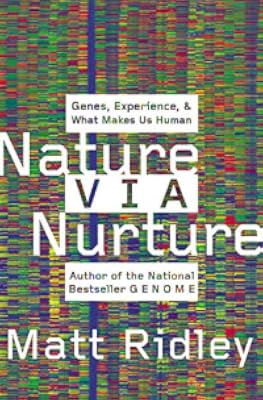
Nature via Nurture: Genes, Experience, and What Makes Us Human
by Matt Ridley
On This Page
Description
Publisher's description: Following his highly praised and bestselling book Genome: The Autobiography of a Species in 23 Chapters, Matt Ridley has written a brilliant and profound book about the roots of human behavior. Nature via Nurture explores the complex and endlessly intriguing question of what makes us who we are. In February 2001 it was announced that the human genome contains not 100,000 genes, as originally postulated, but only 30,000. This startling revision led some scientists to show more conclude that there are simply not enough human genes to account for all the different ways people behave: we must be made by nurture, not nature. Yet again biology was to be stretched on the Procrustean bed of the nature-nurture debate. Matt Ridley argues that the emerging truth is far more interesting than this myth. Nurture depends on genes, too, and genes need nurture. Genes not only predetermine the broad structure of the brain, they also absorb formative experiences, react to social cues, and even run memory. They are consequences as well as causes of the ill. Published fifty years after the discovery of the double helix of DNA, Nature via Nurture chronicles a revolution in our understanding of genes. Ridley recounts the hundred years' war between the partisans of nature and nurture to explain how this paradoxical creature, the human being, can be simultaneously free-willed and motivated by instinct and culture. Nature via Nurture is an enthralling, up-to-the-minute account of how genes build brains to absorb experience. show lessTags
Recommendations



Member Reviews
Matt Ridley doesn't disappoint. Similar to Genome: the Autobiography of a Species in 23 Chapters or The Red Queen: Sex and the Evolution of Human Nature, both highly engrossing reads where he managed to be both accessible yet detailed enough to please lay readers willing to delve deeper than your usual pop science book, here's another masterpiece set to become a classic. Please note the telling title -it's not about nature vs nurture, but a view which seems to flip our understanding of human nature completely upside-down. Well, of course, we all know that what shapes our behaviours and capabilities are both a matter of genes and environment... or do we? The traps of determinism (be it biological or environmental) seem to loom large show more indeed, and reading around in the mass medias or the pop culture it still seem to be either/ or. Is the debate between the geneticists against the empiricists really over?
'Nature via Nurture' is wide encompassing, and as such it can be intimidating. As much as I love Matt Ridley, it's undeniable that he here gives his readers a lot to chew upon! It will be enthralling, engrossing, and fascinating as usual, but it will also requires some more efforts too. In fact, he structured his book by building a whole argument starting around an imaginary picture featuring crucial scientist and their theories -Darwin, Galton, James, Kraepelin, Freud, Boas, Durkheim, Piaget, Lorenz, De Vries, Pavlov, and Watson. Needless to say, from biology to anthropology and psychology and psychiatry and even linguistics, here's a multi-tentacles monster! Nevertheless, this is probably the best window offered into the fascinating interaction between genes and environment, a great lecture about the never ending feedbacks shaping us all as unique individuals.
Absolutely brilliant. show less
'Nature via Nurture' is wide encompassing, and as such it can be intimidating. As much as I love Matt Ridley, it's undeniable that he here gives his readers a lot to chew upon! It will be enthralling, engrossing, and fascinating as usual, but it will also requires some more efforts too. In fact, he structured his book by building a whole argument starting around an imaginary picture featuring crucial scientist and their theories -Darwin, Galton, James, Kraepelin, Freud, Boas, Durkheim, Piaget, Lorenz, De Vries, Pavlov, and Watson. Needless to say, from biology to anthropology and psychology and psychiatry and even linguistics, here's a multi-tentacles monster! Nevertheless, this is probably the best window offered into the fascinating interaction between genes and environment, a great lecture about the never ending feedbacks shaping us all as unique individuals.
Absolutely brilliant. show less
Genlerle ilgili son keşiflere dayanan başarılı bilim yazarı Matt Ridley, insan davranışlarının kökenine eğildiği bu özenli kitabında dikkatini doğa-yetiştirme tartışmasına çeviriyor.
Doğa ve yetiştirme partizanları arasındaki yüzyıl savaşını naklediyor Ridley, böylelikle insanoğlu dediğimiz çelişkilerle yoğrulmuş bu varlığın aynı anda nasıl hem özgür irade sahibi hem de içgüdüler ile kültürün etkisi altında olduğunu açıklıyor. İnsan genomunun şifresinin çözülmesiyle artık biliyoruz ki genler beynin yapısını kabaca belirlemekle kalmıyor, ayrıca deneyimlere yanıt verebiliyor, sosyal tepkiler meydana getirebiliyor, hatta bellek oluşturabiliyorlar. Genler, iradenin hem sonucu show more hem de sebebidir.
"Ridley bilim yazarı olarak çok yetenekli. En zorlu tartışmaları zekice benzetmelerle aydınlatmasını biliyor."
-New York Times
"Ridley'in değindiği mesele için duyduğu heyecan okuyucuya bulaşıyor... Gösterişli, esprili, mizah anlayışına sahip bir tarzla yazıyor. Karışık meseleleri sıradan okuyucuya rahatlıkla anlatıyor."
-Los Angeles Times
"Kitap, kavrayış gücüyle, bilgelikle, şık bir tarzla yazılmış... Bizi biz yapan şeyin ne olduğuyla ilgili son keşifleri açık bir dille anlatıyor, konu ne olmak istediğimiz şeye gelince de bu keşifleri nasıl değerlendirmemiz gerektiğini söylüyor bize."
-Steven Pinker show less
Doğa ve yetiştirme partizanları arasındaki yüzyıl savaşını naklediyor Ridley, böylelikle insanoğlu dediğimiz çelişkilerle yoğrulmuş bu varlığın aynı anda nasıl hem özgür irade sahibi hem de içgüdüler ile kültürün etkisi altında olduğunu açıklıyor. İnsan genomunun şifresinin çözülmesiyle artık biliyoruz ki genler beynin yapısını kabaca belirlemekle kalmıyor, ayrıca deneyimlere yanıt verebiliyor, sosyal tepkiler meydana getirebiliyor, hatta bellek oluşturabiliyorlar. Genler, iradenin hem sonucu show more hem de sebebidir.
"Ridley bilim yazarı olarak çok yetenekli. En zorlu tartışmaları zekice benzetmelerle aydınlatmasını biliyor."
-New York Times
"Ridley'in değindiği mesele için duyduğu heyecan okuyucuya bulaşıyor... Gösterişli, esprili, mizah anlayışına sahip bir tarzla yazıyor. Karışık meseleleri sıradan okuyucuya rahatlıkla anlatıyor."
-Los Angeles Times
"Kitap, kavrayış gücüyle, bilgelikle, şık bir tarzla yazılmış... Bizi biz yapan şeyin ne olduğuyla ilgili son keşifleri açık bir dille anlatıyor, konu ne olmak istediğimiz şeye gelince de bu keşifleri nasıl değerlendirmemiz gerektiğini söylüyor bize."
-Steven Pinker show less
This book is superbly written and makes a very turgid subject interesting and understandable. Ridley shows that those who attribute all human behaviour either to nature (genetics) or nurture (environment) are both determinist and both wrong. Genes respond to the environment in fascinating and complex ways which he describes with well chosen experiments described in a very entertaining narrative.
Fabulous look into the relationship between genes and environment. Though it's left me more confused than ever. Though more informed than ever too. In summary, and as the title of the book sums up very neatly, there is no "versus" in the nature v. nurture debate. Great writer - the amount of information is enormous but the text is eminently readable all the same.
An incredible popular-science book; it's on the same level as The Selfish Gene. Ridley gives a fascinating account of how our environment exerts a tremendous influence on our development through what are known as "promoter genes." Promoter genes pick up on our environment, and, in response, turn "on" and "off" other genes. Promoter genes have the power to retard our development, or allow us to grow into our full potential.
The central premise of the book is that this interplay between environment and genetics gives lie to, and turns upside down, the tired debate of "nature vs nurture."
The central premise of the book is that this interplay between environment and genetics gives lie to, and turns upside down, the tired debate of "nature vs nurture."
To me this book felt like a padded out version of Genome, incidentally an excellent book. If you have read Genome recently, then you will notice many, many facts being repeated here almost verbatim. On it's own, this book is probably great, but it is a lousy read if Genome is still fresh in your memory.
It is NOT another book about nature vs. nurture debate. This the latest research into the interdependence of genes and environment and experience. Very, very interesting stuff, but it took me a lot of time to finish. There are too many digressions in each chapter, too many anecdotes, and too many illustrations to each point. It’s very clever and shows a lot of erudition (from Henry James to nematodes in one paragraph), but, in the end, the relevant information is all over the place and it is hard to follow what the actual thesis is. Some chapters are better than others, but I had to re-read pages at a time to make sure I knew what the main point was.
Members
- Recently Added By
Lists

Recommend the 20 best books you've read in the last five years
2,168 works; 606 members

Falling for Science
56 works; 3 members
Author Information

37+ Works 11,582 Members
Matt Ridley is the author of several award-winning books, including Genome, The Agile Gene, and The Red Queen, which have sold more than 800,000 copies in twenty-seven languages worldwide. He lives in England.
Awards and Honors
Common Knowledge
- Canonical title
- Nature via Nurture: Genes, Experience, and What Makes Us Human
- Alternate titles
- The Agile Gene: How Nature Turns on Nurture
- Original publication date
- 2003
- People/Characters
- Franz Boas; Charles Darwin [Charles Robert: 1809-1882]; Richard Dawkins; Sigmund Freud; Francis Galton; David Hume (1711-1776) (show all 12); William James; Konrad Lorenz; Ivan Pavlov; Jean Piaget; B. F. Skinner; John B. Watson
- Dedication
- For Jim
- First words
- PROLOGUE
Twelve hairy men
"Revealed: the secret of human behavior," read the banner headline in the British Sunday newspaper the Observer on 11 February 2001. - Last words
- (Click to show. Warning: May contain spoilers.)Long live Nature via Nurture.
- Blurbers
- Pinker, Steven; Sacks, Oliver
Classifications
Statistics
- Members
- 1,214
- Popularity
- 20,336
- Reviews
- 16
- Rating
- (3.94)
- Languages
- 6 — Dutch, English, Finnish, Italian, Portuguese, Spanish
- Media
- Paper, Audiobook, Ebook
- ISBNs
- 26
- ASINs
- 10