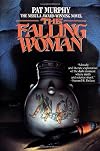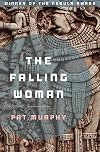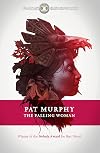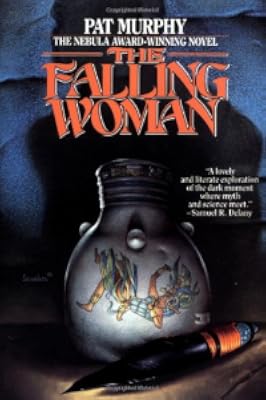
The Falling Woman
by Pat Murphy 
On This Page
Description
An archaeologist with a strange power risks death to unlock the secret of the Mayans. When night falls over the Yucatan, the archaeologists lay down their tools. But while her colleagues relax, Elizabeth Butler searches for shadows. A famous scientist with a reputation for eccentricity, she carries a strange secret. Where others see nothing but dirt and bones and fragments of pottery, Elizabeth sees shades of the men and women who walked this ground thousands of years before. She can speak show more to the past - and the past is beginning to speak back. As Elizabeth communes with ghosts, the daughter she abandoned flies to Mexico hoping for a reunion. She finds a mother embroiled in the supernatural, on a quest for the true reason for the Mayans' disappearance. To dig up the truth, the archaeologist who talks to the dead must learn a far more difficult skill: speaking to her daughter. show lessTags
Recommendations













Member Reviews
We start with Pat Murphy’s 1987 Nebula Award-winning novel, The Falling Woman. The protagonist, Elizabeth, an archaeologist, is an expert in the Mayan civilization—and one of the reasons she’s so good at what she does is that a youthful suicide attempt left her able to see the spirits of the ancient dead when she walks alone at dawn and dusk. Elizabeth is so enamored of her work that she abandoned her husband and daughter years ago to concentrate on her career.
Now, her former husband is dead, and her daughter, Diane, has flown to Mexico to see her estranged mother. It’s a difficult connection.
But as she awkwardly attempts to establish a relationship with her daughter, the visions she’s come to rely upon change; now, not only show more can she observe the ancients, but a Mayan priestess can see and speak with her. This priestess provides all sorts of useful information that leads Elizabeth to the archaeological find that will make her career—and keep her team in funding. But, as so often with ghosts, there are strings. This priestess wants a sacrifice—human, of course—to her god, and it needs to be someone Elizabeth values. Like, say, her daughter.
Elizabeth has already sacrificed her daughter to her career once; will she do it again, in a much more literal and bloody way? Oh, hell, no! But there are complications: Diane’s growing ability to see spirits, and the series of accidents and bad luck on the dig. The question of just how much power this Mayan goddess and her priestess have, as well as the fraught relationship between mother and daughter (who both fear madness) keeps the narrative moving at a good clip.
Reviewed on Lit/Rant: www.litrant.tumblr.com show less
Now, her former husband is dead, and her daughter, Diane, has flown to Mexico to see her estranged mother. It’s a difficult connection.
But as she awkwardly attempts to establish a relationship with her daughter, the visions she’s come to rely upon change; now, not only show more can she observe the ancients, but a Mayan priestess can see and speak with her. This priestess provides all sorts of useful information that leads Elizabeth to the archaeological find that will make her career—and keep her team in funding. But, as so often with ghosts, there are strings. This priestess wants a sacrifice—human, of course—to her god, and it needs to be someone Elizabeth values. Like, say, her daughter.
Elizabeth has already sacrificed her daughter to her career once; will she do it again, in a much more literal and bloody way? Oh, hell, no! But there are complications: Diane’s growing ability to see spirits, and the series of accidents and bad luck on the dig. The question of just how much power this Mayan goddess and her priestess have, as well as the fraught relationship between mother and daughter (who both fear madness) keeps the narrative moving at a good clip.
Reviewed on Lit/Rant: www.litrant.tumblr.com show less
Elizabeth Butler is an archaeologist working a dig at a Mayan site in the Yucatan. In her mid-fifties now, she has a painful personal history of a failed marriage, a failed suicide attempt, and lost custody of and limited contact with her daughter, Diane.
Diane Butler has lost her father, her boyfriend, and her job over the course of a couple of weeks, and for reasons she doesn't herself entirely understand, seeks out her famous and long-absent mother.
Diane has been having disturbing dreams, in which she is falling from a great height into a dark void.
Barbara has always seen shadows of the past, watched the long-dead inhabitants of the sites she studies going about their daily lives. It has given her a reputation for remarkably accurate show more and valuable hunches, but also a reputation for being very eccentric. Now one of the shadows, a priestess of the Mayan moon goddess from just before the disappearance of Maya civilization, has started speaking to her.
I knew when I began reading that I was taking up a very well-regarded but older novel, not just set but written in the mid-eighties, a time with in some respects a very different sensibility. Especially given its then-contemporary setting, I had some reservations, thinking that it might come off as a period piece. It didn't.
The writing drew me in and built a Yucatan that, whether real or not, felt real as I was reading it. The heat, the powerful sun, and the buried, ancient city all seemed palpable. The core of the novel, the relationship between Elizabeth and Diane, and the slowly revealed agenda of the Mayan priestess, is rich and intricate and beautifully developed.
I really could not put this one down. Highly recommended.
I received a free electronic galley of this book from the publisher via NetGalley. show less
Diane Butler has lost her father, her boyfriend, and her job over the course of a couple of weeks, and for reasons she doesn't herself entirely understand, seeks out her famous and long-absent mother.
Diane has been having disturbing dreams, in which she is falling from a great height into a dark void.
Barbara has always seen shadows of the past, watched the long-dead inhabitants of the sites she studies going about their daily lives. It has given her a reputation for remarkably accurate show more and valuable hunches, but also a reputation for being very eccentric. Now one of the shadows, a priestess of the Mayan moon goddess from just before the disappearance of Maya civilization, has started speaking to her.
I knew when I began reading that I was taking up a very well-regarded but older novel, not just set but written in the mid-eighties, a time with in some respects a very different sensibility. Especially given its then-contemporary setting, I had some reservations, thinking that it might come off as a period piece. It didn't.
The writing drew me in and built a Yucatan that, whether real or not, felt real as I was reading it. The heat, the powerful sun, and the buried, ancient city all seemed palpable. The core of the novel, the relationship between Elizabeth and Diane, and the slowly revealed agenda of the Mayan priestess, is rich and intricate and beautifully developed.
I really could not put this one down. Highly recommended.
I received a free electronic galley of this book from the publisher via NetGalley. show less
I'm not quite sure what to make of this book. On the one hand I loved reading about the archaeological dig that the characters were on. On the other hand I found that the characters fell flat and I had a hard time connecting with them.
What this book really had going for it was a really interesting look at an archaeological dig and at Mayan culture. I really enjoyed reading the parts about the Mayans and all their different gods and what those gods represented. I also liked when Elizabeth would explain the Mayan calendar. Her explanations became a bit confusing at times (it is a bit complex) but it was interesting nonetheless.
I really found it hard to connect with the characters in this book. At first I hated Elizabeth and felt that she show more was cold and heartless. Once I learned why she is so distant from her daughter Diane I began to feel a bit sorry for her. While I did feel sorry for her nothing about her really made me like her. Quite frankly she was crazy and I just couldn't believe that no one but Robert could have seen that and tried to get her some help. The character that I liked the most in this book was Barbara. She seemed to bring some normality to this book.
This book kept building to an event in which you know some characters in this book are going to break. It really picked up in the second half and I while I initially enjoyed the conflict at the end I feel like it dragged on a bit longer than it should have. I was satisfied with the ending of this book and how the relationship between Elizabeth and Diane is shown in the end.
Overall I enjoyed this book for the archaeological aspects, and the discussion on Mayan culture. I felt like the characters could have been developed more and that the conflict at the end could have been shortened a bit.
Thanks to NetGalley and the publisher for the galley. show less
What this book really had going for it was a really interesting look at an archaeological dig and at Mayan culture. I really enjoyed reading the parts about the Mayans and all their different gods and what those gods represented. I also liked when Elizabeth would explain the Mayan calendar. Her explanations became a bit confusing at times (it is a bit complex) but it was interesting nonetheless.
I really found it hard to connect with the characters in this book. At first I hated Elizabeth and felt that she show more was cold and heartless. Once I learned why she is so distant from her daughter Diane I began to feel a bit sorry for her. While I did feel sorry for her nothing about her really made me like her. Quite frankly she was crazy and I just couldn't believe that no one but Robert could have seen that and tried to get her some help. The character that I liked the most in this book was Barbara. She seemed to bring some normality to this book.
This book kept building to an event in which you know some characters in this book are going to break. It really picked up in the second half and I while I initially enjoyed the conflict at the end I feel like it dragged on a bit longer than it should have. I was satisfied with the ending of this book and how the relationship between Elizabeth and Diane is shown in the end.
Overall I enjoyed this book for the archaeological aspects, and the discussion on Mayan culture. I felt like the characters could have been developed more and that the conflict at the end could have been shortened a bit.
Thanks to NetGalley and the publisher for the galley. show less
I'd call this magical realism rather than straight fantasy, as it is based on actual historical fact. I can't understand why the tag cloud doesn't even have the word "Maya" in it, when it is all about Maya society.
Anyway, this is a marvelous book, full of fascinating research. It involves a woman who keeps seeing an image of a sacrifice victim of the Maya days. Is it her in a previous life? Is she hallucinating? It's all very dreamlike and gorgeously told. I read it many years ago, and it has stuck with me after all this time.
This was well worth a Nebula Award.
Anyway, this is a marvelous book, full of fascinating research. It involves a woman who keeps seeing an image of a sacrifice victim of the Maya days. Is it her in a previous life? Is she hallucinating? It's all very dreamlike and gorgeously told. I read it many years ago, and it has stuck with me after all this time.
This was well worth a Nebula Award.
http://nhw.livejournal.com/668913.html
This is a very good book, one of those rare but welcome moments when the Nebula process picked up on a real gem of a novel that had been overlooked elsewhere, even though it is only barely a genre novel, if anything more of a ghost story than sf or fantasy. The plot concerns an estranged mother and daughter, the former a famous archaeologist working on a Mayan site in the Yucatan, the latter escaping from a set of bad relationships to track down her mother, and the mother's ability to see the ghosts of the past (which has incidentally helped her get lucky with spectacular finds during her career). The writing alternates between first-person POV's of the two women. The third character is a Mayan show more priestess buried on the site who attempts to project her own life experiences onto the modern women. The writing is gripping and convincing, and although several of the layers of significance are pretty explicit, it worked for me. I'm glad it worked for the 1987 Nebula voters too. show less
This is a very good book, one of those rare but welcome moments when the Nebula process picked up on a real gem of a novel that had been overlooked elsewhere, even though it is only barely a genre novel, if anything more of a ghost story than sf or fantasy. The plot concerns an estranged mother and daughter, the former a famous archaeologist working on a Mayan site in the Yucatan, the latter escaping from a set of bad relationships to track down her mother, and the mother's ability to see the ghosts of the past (which has incidentally helped her get lucky with spectacular finds during her career). The writing alternates between first-person POV's of the two women. The third character is a Mayan show more priestess buried on the site who attempts to project her own life experiences onto the modern women. The writing is gripping and convincing, and although several of the layers of significance are pretty explicit, it worked for me. I'm glad it worked for the 1987 Nebula voters too. show less
I go to Nebula Award winners to find the best – to find stories that will excite and enrapture me. I go to find timeless moments. I go to find ground-breaking experiments. I go to find the peak of science-fiction craft. The Falling Woman is a nice story. At times it entertains, at times it feels formulaic. What it never seems to be is worthy of a Nebula Award. When I think Nebula Award I think novels like Dune and The Einstein Intersection and The Left Hand of Darkness and The Forever War and…well, unforgettable. This is, as I already said, a nice story. But it is not the kind that will knock your socks off, break your doors down, throw you for a loop. I read it, enjoyed parts (the archaeology – hey, it was my major), got bored show more with parts (the personal relationships didn’t ring that true and I quit caring pretty quickly), and finished it – essentially unchanged. A nebula award winner should do more. So, I did a little research thinking that it just might have been a bad year for nebulas. Nope – doesn’t hold water – two other nominees seemed infinitely better to me – The Forge of God by Greg Bear and The Uplift War by David Brin. So, I guess the voters got it wrong, or there was a split decision, or there were hanging chads, or the stars just weren’t in alignment. But, bottom line, while this is a written well enough and makes for a pleasant enough read, it is not a Nebula Award winner. I guess it is unfair to hold that against the book, but an expectation is built, and, when something doesn’t live up to an expectation, then it is a disappointment. show less
Story about a woman archaeologist uncovering a mystery at a South American site. Mostly about relationship between her and her estranged daughter. Some weird stuff, including local mythology. Writing good but wasn't as into the theme/message re connection.
Members
- Recently Added By
Lists

Fantasy Masterworks
66 works; 5 members

Broderick and Di Filippo's Science Fiction: The 101 Best Novels 1985-2010
103 works; 7 members

Nebula Award
111 works; 14 members
Author Information

85+ Works 4,135 Members
Pat Murphy is a LibraryThing Author, an author who lists their personal library on LibraryThing.
Some Editions
Awards and Honors
Awards
Series
Belongs to Publisher Series
Fantasy Masterworks (New design)
Common Knowledge
- Original publication date
- 1986
- People/Characters
- Elizabeth Waters; Diane Butler
- Important places
- Yucatán Peninsula, Mexico
- Epigraph
- This is the true account, when all was vague, all was silence, without motion and the sky was still empty. This is the first account, the first narrative. There was neither man nor beast, no bird, fish nor crab, no trees, roc... (show all)ks, caves nor canyons, no plants and no shrubs. Only the sky was there.
--Popol Vuh of the Quiche Maya - Dedication
- For my mother,
a remarkable woman who taught me many things,
and
For Richard,
who swam with me in the sacred cenote at Dzibilchaltun - First words
- There are no rivers on Mexico's Yucatan peninsula.
- Last words
- (Click to show. Warning: May contain spoilers.)"Tell me," she said, "about the shadows of the past."
- Blurbers
- Delany, Samuel R.; Shepard, Lucius; Wilhelm, Kate
- Original language
- English
Classifications
Statistics
- Members
- 729
- Popularity
- 38,887
- Reviews
- 17
- Rating
- (3.69)
- Languages
- English, French, German, Spanish
- Media
- Paper, Ebook
- ISBNs
- 15
- ASINs
- 5