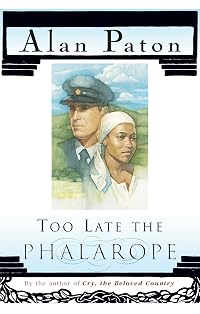
Too Late the Phalarope
by Alan Paton
On This Page
Description
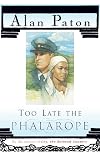
The story of a young white South African police lieutenant, idolized in his Afrikaner community, who violates one of the strictest laws of that country governing the relationship between white and black. It is a portrayal of the desperate struggle within himself of a conscience-stricken man, a story told with almost unbearable suspense and bringing to life, in its unfolding, a whole family of unforgettable characters: Pieter the young police lieutenant himself; his old stern-faced show more Bible-reading patriarch of a father; and Pieter's Aunt Sophie, the loving woman who tells the story and through whose eyes we see Pieter as only the eyes of love could see him. Here is reaffirmation of the worth and dignity of man, a book the reading of which is a terrific but exalting experience. John Barkham, the noted reviewer, says, "Too Late the Phalarope is that rare and splendid thing: a second novel which is the equal of its unforgettable predecessor."--Adapted from jacket. show lessTags
Recommendations



















Member Recommendations
Member Reviews
4.5 really (I don't give 1/2 stars).
A beautifully crafted book with an ominous sense of danger throughout. The themes of racial apartheid, temptation, and fall from grace permeate the novel. The prose feels masterful and gives the situation the gravity it deserves. Paton is also skilled at making the reader piece things together, yet never letting you feel lost. The title is clever too--the phalarope symbolizes both the father's dominance and yet also a shared moment of tenderness that comes too late to save Pieter.
I'd give the book 5 stars, but it felt a little sparse, I wanted more depth. However, that this deep, sad story can be communicated with such sparing prose is also a strength of the book.
A beautifully crafted book with an ominous sense of danger throughout. The themes of racial apartheid, temptation, and fall from grace permeate the novel. The prose feels masterful and gives the situation the gravity it deserves. Paton is also skilled at making the reader piece things together, yet never letting you feel lost. The title is clever too--the phalarope symbolizes both the father's dominance and yet also a shared moment of tenderness that comes too late to save Pieter.
I'd give the book 5 stars, but it felt a little sparse, I wanted more depth. However, that this deep, sad story can be communicated with such sparing prose is also a strength of the book.
I find it a shame that this book isn’t better known. I found it much more engaging than Cry, the Beloved Country– it even had me laughing at parts. And it’s not a happy or amusing story! It’s a tragic love story, but presented and unraveled in a way I did not at all expect. Set deep in South Africa’s time of apartheid, when interracial relationships were considered a crime- and that doesn’t just mean marriage or having children together. It meant no white person could ever be seen touching a black woman, or deep suspicion would be cast upon him. The story is centered on one family in particular: about a fine young man, admired in the community and working for the government no less. And how his family was always a bit show more troubled by his “softer” side- his father found his interest in stamp-collecting rather contemptible, for example. His mother worried over his sensitivity- though he could be just as stern as any when a situation required it. The problem arises when this young man becomes involved in the life of a black girl who struggles to get by. She can never seem to hold down a job so resorts to making and selling illegal liquor, and gets thrown into prison for it repeatedly, until the situation is so messed up that her child is taken away.. She did kind of hold her relationship with the main character as a threat over his head the whole time, to get help when she was in financial trouble. However the final key that made everything fall down, that ruined his entire family’s reputation, was something very subtle and unexpected, that she pulled out at the last minute proving that yes, indeed, they’d had an illicit tryst.
It is told so artfully, everything that’s of real importance to our character seems to happen hidden in the background, only slowly coming to light- probably because of course that’s how he had to keep things. It makes the reader wonder too for a while. I have to say, I found something a bit frustrating and annoying- it was difficult for me to keep straight who was who, and if they were friends or relatives, and what exactly that relationship. It’s told obliquely, from the viewpoint of the aunt. Who and how-related all the people are isn’t really pointed out to the reader- the narrative will just say something along the lines of so-and-so showed up and we did this and I’m puzzling over: is that her neighbor, her cousin or what? I admit it could just be my still-muddled head (I’ve been unwell lately) that I missed some introductions or cues . . .
While it is very different from both, this book reminded me a lot of Joyce Cary’s Mister Johnson, because of the writing style, the setting and the culture, the one native character that can’t seem to fathom what he is repeatedly doing to make ends meet is criminally wrong by the standards of the white people who have colonial rule. In a completely different way, it also made me think of One-Eyed Cat, because of how exquisitely it detailed the inner turmoil of someone who has a very troublesome or even dangerous secret, and is full of dread and suspicion about who might know, and misinterprets the comments and actions of those around him based on his guess of if they know or not- but he can never ask because if they don’t already know, it exposes everything!
Lastly I want to say (this is getting too long for sure) how much I enjoyed the scenes about stamp-collecting, because my husband has a huge stamp collection, so some of this was familiar to me, I read some of those parts out loud to him, he appreciated that too. And the phalarope? it’s a shorebird, that is sometimes but not often seen in a certain locale- the character and his father do a bit of bird-watching at one point, and often remark on it. There’s this whole thing about a huge gorgeously printed bird book this is however full of errors because it was made by an Englishman who apparently didn’t know the local birdlife too well at all. It’s the father’s thing, birdwatching, and it had a whole other symbolic layer in the narrative as well. Which I’m not quite sure I pick up on all of that, but this novel is definitely staying on my shelf for future re-reads. It's that good. show less
It is told so artfully, everything that’s of real importance to our character seems to happen hidden in the background, only slowly coming to light- probably because of course that’s how he had to keep things. It makes the reader wonder too for a while. I have to say, I found something a bit frustrating and annoying- it was difficult for me to keep straight who was who, and if they were friends or relatives, and what exactly that relationship. It’s told obliquely, from the viewpoint of the aunt. Who and how-related all the people are isn’t really pointed out to the reader- the narrative will just say something along the lines of so-and-so showed up and we did this and I’m puzzling over: is that her neighbor, her cousin or what? I admit it could just be my still-muddled head (I’ve been unwell lately) that I missed some introductions or cues . . .
While it is very different from both, this book reminded me a lot of Joyce Cary’s Mister Johnson, because of the writing style, the setting and the culture, the one native character that can’t seem to fathom what he is repeatedly doing to make ends meet is criminally wrong by the standards of the white people who have colonial rule. In a completely different way, it also made me think of One-Eyed Cat, because of how exquisitely it detailed the inner turmoil of someone who has a very troublesome or even dangerous secret, and is full of dread and suspicion about who might know, and misinterprets the comments and actions of those around him based on his guess of if they know or not- but he can never ask because if they don’t already know, it exposes everything!
Lastly I want to say (this is getting too long for sure) how much I enjoyed the scenes about stamp-collecting, because my husband has a huge stamp collection, so some of this was familiar to me, I read some of those parts out loud to him, he appreciated that too. And the phalarope? it’s a shorebird, that is sometimes but not often seen in a certain locale- the character and his father do a bit of bird-watching at one point, and often remark on it. There’s this whole thing about a huge gorgeously printed bird book this is however full of errors because it was made by an Englishman who apparently didn’t know the local birdlife too well at all. It’s the father’s thing, birdwatching, and it had a whole other symbolic layer in the narrative as well. Which I’m not quite sure I pick up on all of that, but this novel is definitely staying on my shelf for future re-reads. It's that good. show less
I had read that, as popular as Cry, the Beloved Country is, this work (published in 1953) is generally considered his best. Having only read these two novels and a collection of Paton’s short stories, I don’t know if I have enough familiarity with his work to pass judgment but I will say that this is a very impressive work. Paton succeeds brilliantly in getting into people’s minds and it is hard to imagine that his ability to do so or his understanding of how people think could be improved upon. It is not a surprise that Paton was brought up in the Christadelphian Church, a sect that believes in the absolute primacy of the Bible, among other things. His very deep knowledge of the Bible comes through on every page. More than show more intellectual familiarity with what the lines in the Bible say, Paton demonstrates a profound understanding of the complexity of human beings, of good and evil, and of the nature of shame, honesty, and acceptance. Indeed, much of the book is a meditation on belief and how it does (versus how it “should”) govern our behavior. The novel is the story of an upright young (white) police officer who transgresses the color line in apartheid South Africa in the 1950s. The act is not only a serious legal problem but far more so a family problem as he is from an old Boer (Dutch) family with strict cultural and religious standards. What happens is almost impossible to see happening any other way and Paton’s telling of the story, both in how and what people do as well as how and what they think, is masterful. He is especially impressive at depicting the conscience at work. Though I understand the compelling nature of Cry, the Beloved Country, I cannot understand why this novel isn’t far better known. show less
What are the consequences when an otherwise outstanding member of a community knowingly breaks the law, whether it be civil or moral (or both)? It was a question Nathaniel Hawthorne asked throughout many of his writings, and it is the issue that lies at the center of Alan Paton's powerful and deeply moving novel. -- Handsome Afrikaner Lieutenant Pieter van Vlaanderen seems to have it all: a sterling military service record, a respected police career, a loving family -- he is even an outstanding rugby player. But he gets involved in the life of a poor black woman Stephanie -- and this is the age of apartheid in South Africa. Crossing the color line is to have drastic repercussions for all aspects of his life. -- The story, narrated for show more the most part by Pieter's adoring aunt Sophie, who senses the oncoming tragedy but does not intervene until calamity strikes. The book as a whole packs quite an emotional wallop -- there are brilliant insights into the human condition, as well as into the strict racial divides of South Africa at the time. Somehow, though, it struck me that there was perhaps too much build-up to the revelation, and the denouement was rather sketchily impressionistic. (But, then again, this was not the story the author set out to tell.) Still, as one who loved Paton's 'Cry the Beloved County,' I was pleased to have read this, his second novel. show less
Paton’s Cry, the Beloved Country is one of my top three novels of all time, and so when I saw this, his other novel, sitting on a shelf, I knew that I’d have to read it one day. That shelf was in the UK at the time and I simply ran out of time to read it. Leaving the UK for Papua New Guinea, I was surprised to see it sitting on a shelf again here, of all places. There was no way I wasn’t going to read it now.
And I’m very glad I did because this is a tragically sad and moving novel not simply of the human condition but more specifically about the conflict that men face inside themselves. I would go so far as to say that there are very few married Christian men who do not face the temptation at some point to break their covenant show more of love with their wife. How do I dare to say such a statement. For two reasons, both of which I believe motivated Paton to write this.
The first is demonstrated by the opening line: secrecy is the bandage under which our sores come to fester. Many men, faced with temptation, smother it and fight against it within themselves not realising that should the fight be joined by others and particularly their wife, they would find it so much easier to overcome. By being open and honest, they disarm the temptation before it can manifest as action.
So why do they not simply admit to the temptations the face? Well, this is Paton’s other motivation and theme: men are often horrified to discover the temptations they face. They have no idea where these desires rise up from and think, as does Pieter van Vlaanderen, South African police lieutenant, that they themselves must be corrupt beyond their imaginations. Thus, to admit this to another would immediately raise questions about what lurks beneath the surface of the heart of a married man.
Paton deals with these two themes superbly in the book. The tension of conflict within the man is skilfully delayed so that you, the reader, share in his agony and have as long as possible in this all too brief novel to see the inevitable coming. My only complaint would be that the novel ends when it does with only the hope of restoration and redemption rather than it’s actual reality. But there is another tension dealt with very well too and that is the relationship between Pieter, the white authority figure without equal in his town and friend of all, and that of Stephanie, the black single-mother and petty criminal.
The South Africa of the time is depicted well, not as stunningly as in Cry, but nevertheless in horrific starkness at times. On the back of reading A Dry White Season, it’s given me a much greater perspective on the amazing progress that the nation has made in my lifetime.
One final note, the phalarope of the title is a type of bird that Pieter’s father and sees with him while sharing a very rare moment of togetherness bird watching. show less
And I’m very glad I did because this is a tragically sad and moving novel not simply of the human condition but more specifically about the conflict that men face inside themselves. I would go so far as to say that there are very few married Christian men who do not face the temptation at some point to break their covenant show more of love with their wife. How do I dare to say such a statement. For two reasons, both of which I believe motivated Paton to write this.
The first is demonstrated by the opening line: secrecy is the bandage under which our sores come to fester. Many men, faced with temptation, smother it and fight against it within themselves not realising that should the fight be joined by others and particularly their wife, they would find it so much easier to overcome. By being open and honest, they disarm the temptation before it can manifest as action.
So why do they not simply admit to the temptations the face? Well, this is Paton’s other motivation and theme: men are often horrified to discover the temptations they face. They have no idea where these desires rise up from and think, as does Pieter van Vlaanderen, South African police lieutenant, that they themselves must be corrupt beyond their imaginations. Thus, to admit this to another would immediately raise questions about what lurks beneath the surface of the heart of a married man.
Paton deals with these two themes superbly in the book. The tension of conflict within the man is skilfully delayed so that you, the reader, share in his agony and have as long as possible in this all too brief novel to see the inevitable coming. My only complaint would be that the novel ends when it does with only the hope of restoration and redemption rather than it’s actual reality. But there is another tension dealt with very well too and that is the relationship between Pieter, the white authority figure without equal in his town and friend of all, and that of Stephanie, the black single-mother and petty criminal.
The South Africa of the time is depicted well, not as stunningly as in Cry, but nevertheless in horrific starkness at times. On the back of reading A Dry White Season, it’s given me a much greater perspective on the amazing progress that the nation has made in my lifetime.
One final note, the phalarope of the title is a type of bird that Pieter’s father and sees with him while sharing a very rare moment of togetherness bird watching. show less
This second novel by Alan Paton, who acheived instant fame for Cry, The Beloved Country, is another work that highlights injustice in aparthied South Africa. Pieter van Vlaanderen, a police lieutenant, revered in his community as much for his moral rectitude as for his rugby skills, harbors a secret and shameful lust for the black girl Stephanie, against which he struggles but finally gives in to, in violation of the 1927 Immorality Act criminalizing sexual intercourse between natives and Europeans. The novel is narrated by his Aunt Sophie, who idolizes her nephew but is often confused and hurt by his dark moods. Admittedly heavy handed and somewhat contrived (how can she know what her nephew is thinking?), the narrative succeeds show more nonetheless by creating great suspense, even though we know in the end the great man falls. A powerful indictment of repressive laws that punish people for being human. show less
I remember the emotional shock of [b:Cry, the Beloved Country|6150|Cry, the Beloved Country|Alan Paton|https://i.gr-assets.com/images/S/compressed.photo.goodreads.com/books/1344182368l/6150._SY75_.jpg|59082] when I read it my senior year of high school, but not the body of it, so it was interesting to read another Paton work seven years later. His narration has a strong oral tendency, from the protagonist’s aunt’s perspective. The first few pages cast a pall over the rest of the book, and reading it feels like falling further towards an awful inevitable conclusion. Not a light beach read.
Members
- Recently Added By
Lists

Religious Fiction
58 works; 13 members

Allie's Favourite 150 Books
145 works; 3 members

Books Set In Africa
81 works; 4 members

Tammen Keltainen kirjasto
81 works; 1 member

5 Best 5 Years
71 works; 4 members

My favourite books
96 works; 3 members

Alphabetical Books
211 works; 3 members

Five star books
1,767 works; 110 members
Author Information

48+ Works 12,606 Members
Political activist Alan Steward Paton was born on January 11, 1903 in Natal, South Africa. He attended Maritzburg College and Natal University. He taught at Ixopo High School and Maritzburg College. In 1935, he was appointed principal of Diepkloof Reformatory for African Boys in Johannesburg and became interested in race relations. Although he show more intended to become a full-time writer after the publication of his first book, he instead became involved in politics. He was a member of the Liberal Party of South Africa, serving as vice-president, chairman, and president before the party was forced to disband in 1968 because of its anti-apartheid views. Paton is best known for his political activism and his first novel, Cry, the Beloved Country. He also wrote a second novel, Too Late the Phalarope, and two autobiographies, Toward the Mountains and Journey Continued. He died on April 12, 1988 in Lintrose, Botha's Hill, Natal. (Bowker Author Biography) show less
Some Editions
Awards and Honors
Distinctions
Series
Belongs to Publisher Series
Work Relationships
Is abridged in
Common Knowledge
- Canonical title
- Too Late the Phalarope
- Original title
- Too late the phalarope
- Alternate titles
- La jaula del prejuicio (Spanish title) (Spanish title)
- Original publication date
- 1953
- First words
- Perhaps I could have saved him, with only a word, two words, out of my mouth.
- Quotations
- To him the captain told the story of all, and when he had finished, the fierce old man struck the arm of his chair and said, I would shoot him like a dog.
Then because no one spoke, he said to the captain, wouldnâ€... (show all)™t you?
And the captain said, No.
- You wouldn’t?
- No.
- But he has offended against the race.
Then the captain said trembling, Meneer, as a policeman I know an offence against the law, and as a Christian I know an offence against God; but I do not know an offence against the race. - Last words
- (Click to show. Warning: May contain spoilers.)And I wish she could have written it, for maybe the power of her love that never sought itself, men would have turned to the holy task of pardon, that the body of our Lord might not be wounded twice, and virtue come of our offences.
- Original language*
- englanti
*Some information comes from Common Knowledge in other languages. Click "Edit" for more information.
Classifications
Statistics
- Members
- 752
- Popularity
- 37,463
- Reviews
- 16
- Rating
- (3.86)
- Languages
- 5 — English, Finnish, French, Norwegian, Swedish
- Media
- Paper, Ebook
- ISBNs
- 13
- ASINs
- 42