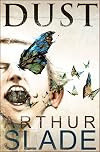
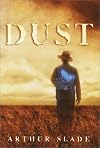
Dust
by Arthur Slade 
On This Page
Description
Eleven-year-old Robert is the only one who can help when a mysterious stranger arrives, performing tricks and promising to bring rain, at the same time children begin to disappear from a dust bowl farm town in Saskatchewan in the 1930s.Tags
Recommendations
















Member Recommendations
Member Reviews
During the Depression era, a small farming community in Saskatchewan is victim of the Dust Bowl and it's people are desperate for rain. Robert knows that had he accompanied his younger brother, seven-year-old Matthew on his walk to town to buy candy that day, he most likely would not have disappeared. But now he's gone and it seems everyone in town, including his usually stern parents, have forgotten all about Matthew; everyone but Robert, and the local RCMP representative, that is. Adults and children alike are under the spell of the mysterious Abram Harsich, an albino man newly arrived in the community, who brings them magic mirrors and enchanted butterflies, and promises to build a rain-making machine. Robert is suspicious of show more Harsich, a feeling that is intensified when his uncle, long dead in the Great War, sends him a message that the magician is a dangerous man. This young adult story reeled me in from the first page with great writing and a sense of mounting tension which didn't let up until the end. The malevolent Harsich is truly spooky, even though we know that Robert is bound to prevail, but when he does, we're still left with unanswered questions, which in this case, is all to the merit of this great little novel. show less
Set in a dry, dusty Canadian town during the Depression Era, young Robert Steelgate is missing his young brother Matthew. Yet the disturbing thing is that he seems to be the only person missing him. A stranger comes to town promising rain and that is the same time kids start disappearing. Coincidence, or not?
This book was like a really good episode of The Twilight Zone. Things start off so plain, so dried out, so matter-of-fact. Then young Matthew, who insisted he be allowed to walk to town that day (instead of riding in the cart with his mom), meets a pale stranger (Abram Harisch) on the road. Meanwhile, Robert is left at home to read his science fiction story (The Warlock of Mars) that his uncle lent him. Reluctantly, Robert sets his show more book aside to see to the chickens like he promised only to find some scared chickens and some nasty blood eggs. Yuck! That’s when Sargent Ramson and Officer Davies show up to take Robert to town to be with his family as they begin the search for Matthew.
With a blend of historical fiction, mystery, and science fiction, the author spins a tale of a town hoping too hard for good rains, of good people willing to let their memories of lost children slip from them, and of how one boy with a strong, questioning imagination may be the only one to save them. Quite frankly, it was those scared chickens and their blood eggs that sucked me into the story. It was spooky and yet the biologist in me wanted an egg to examine. But I couldn’t have one of those eggs, but I could examine this story. From there, I wasn’t disappointed.
Abram with the odd eyes (I think he’s an albino) sets up a movie screen and the town gathers to see the attraction. Once the stranger has gained some small amount of trust with the town, he starts setting in his motion his bigger plan: promise the rains & happiness, take their wealth & memories, keep his end of the bargain with an unknown entity (which means more children disappear). At one point, Abram confides a bit in Robert because Robert has this innate ability to see through Abram’s charms. That was an eerie scene!
The ending reveals the master plan of Abram while also keeping some things up to the reader to decide. I liked that there was a little mystery left over at the end. We have everything resolved that counts, but the exact how and why of it may never be fully understood. Also, there is some wonderful imagery involving butterflies and moths. It’s a recurring small touch that kept me hooked. I was quite pleased with the ending. Not everything ended in rainbows but enough did for me to say it was a happy ending for our main character, Robert.
I received a copy of this book at no cost from the author with no strings attached.
Narration: Arthur Slade was pretty good as a narrator for this story. He had distinct voices for each person and decent female voices. I especially liked his voice for Robert’s uncle who was always giving him SFF books that his mom might not approve of. show less
This book was like a really good episode of The Twilight Zone. Things start off so plain, so dried out, so matter-of-fact. Then young Matthew, who insisted he be allowed to walk to town that day (instead of riding in the cart with his mom), meets a pale stranger (Abram Harisch) on the road. Meanwhile, Robert is left at home to read his science fiction story (The Warlock of Mars) that his uncle lent him. Reluctantly, Robert sets his show more book aside to see to the chickens like he promised only to find some scared chickens and some nasty blood eggs. Yuck! That’s when Sargent Ramson and Officer Davies show up to take Robert to town to be with his family as they begin the search for Matthew.
With a blend of historical fiction, mystery, and science fiction, the author spins a tale of a town hoping too hard for good rains, of good people willing to let their memories of lost children slip from them, and of how one boy with a strong, questioning imagination may be the only one to save them. Quite frankly, it was those scared chickens and their blood eggs that sucked me into the story. It was spooky and yet the biologist in me wanted an egg to examine. But I couldn’t have one of those eggs, but I could examine this story. From there, I wasn’t disappointed.
Abram with the odd eyes (I think he’s an albino) sets up a movie screen and the town gathers to see the attraction. Once the stranger has gained some small amount of trust with the town, he starts setting in his motion his bigger plan: promise the rains & happiness, take their wealth & memories, keep his end of the bargain with an unknown entity (which means more children disappear). At one point, Abram confides a bit in Robert because Robert has this innate ability to see through Abram’s charms. That was an eerie scene!
The ending reveals the master plan of Abram while also keeping some things up to the reader to decide. I liked that there was a little mystery left over at the end. We have everything resolved that counts, but the exact how and why of it may never be fully understood. Also, there is some wonderful imagery involving butterflies and moths. It’s a recurring small touch that kept me hooked. I was quite pleased with the ending. Not everything ended in rainbows but enough did for me to say it was a happy ending for our main character, Robert.
I received a copy of this book at no cost from the author with no strings attached.
Narration: Arthur Slade was pretty good as a narrator for this story. He had distinct voices for each person and decent female voices. I especially liked his voice for Robert’s uncle who was always giving him SFF books that his mom might not approve of. show less
This is a short, but gripping story. Eleven-year-old Robert is the only person who notices the strange things happening in his town - children, including his little brother have gone missing, and their parents hardly seem to notice. A stranger has arrived, promising to bring rain, if the townspeople help build a machine.
The book is set during the Depression, in a small Saskatchewan town called Horshoe, and the backdrop of dusty prairie and looming poverty add to the creepiness of the tale.
One of the things I really enjoyed was the idea that your imagination is like a muscle, and you can exercise it and make it grow stronger. Although all of the town's adults fall under the spell of the evil newcomer, Robert's uncle, a reader and show more believer in stories, is able to resist the longest. It made it seem like by reading you could keep the wonder of childhood, even as you aged.
I'd recommend this to someone looking for a suspenseful story, someone who enjoys Diana Wynne Jones. show less
The book is set during the Depression, in a small Saskatchewan town called Horshoe, and the backdrop of dusty prairie and looming poverty add to the creepiness of the tale.
One of the things I really enjoyed was the idea that your imagination is like a muscle, and you can exercise it and make it grow stronger. Although all of the town's adults fall under the spell of the evil newcomer, Robert's uncle, a reader and show more believer in stories, is able to resist the longest. It made it seem like by reading you could keep the wonder of childhood, even as you aged.
I'd recommend this to someone looking for a suspenseful story, someone who enjoys Diana Wynne Jones. show less
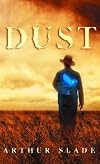
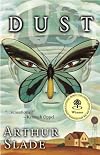
The cover enticed me, and I thought it would be set in the Dust Bowl. Not really. I was surprised to find it science fiction. A mysterious, perhaps soul-less man comes to town and mesmerizes people in order to distract them from the fact that he's taking the local children in order to gather their souls and essence (a kind of dust).
Deals with the theme of responsibility, (childhood wonder vs. reality/responsibility) very creatively--had me thinking, wondering. The protagonist is "on the cusp" of becoming an adult and therefore barely able to maintain his sense of wonder, belief in that which seems absurd, and so a man/being who exploits the "adultness" of the town can safely (maybe) reveal the awful truth of what he's doing to him, show more sure that as soon as the boy matures (like in a day or two?) he won't remember or even believe what he's being told. The few adults who have not succumbed to man's mind drug cannot solve the mystery/crime because they cannot believe in preposterous things, such as the truth. Interesting....
My son accused me of being a "non-believer" in all of these things he seems so naive to believe. I sigh. I thought about that often as I loathed these parents, but to whom I could also relate. Very thought-provoking in a simple way.
I believe its intended audience is middle school kids, but I can't see any of my students bearing with it. I found out, after reading this, that the girl who borrowed it and raved about it had actually given up after the 2nd chapter and didn't want to admit it. I liked it as an adult. show less
Deals with the theme of responsibility, (childhood wonder vs. reality/responsibility) very creatively--had me thinking, wondering. The protagonist is "on the cusp" of becoming an adult and therefore barely able to maintain his sense of wonder, belief in that which seems absurd, and so a man/being who exploits the "adultness" of the town can safely (maybe) reveal the awful truth of what he's doing to him, show more sure that as soon as the boy matures (like in a day or two?) he won't remember or even believe what he's being told. The few adults who have not succumbed to man's mind drug cannot solve the mystery/crime because they cannot believe in preposterous things, such as the truth. Interesting....
My son accused me of being a "non-believer" in all of these things he seems so naive to believe. I sigh. I thought about that often as I loathed these parents, but to whom I could also relate. Very thought-provoking in a simple way.
I believe its intended audience is middle school kids, but I can't see any of my students bearing with it. I found out, after reading this, that the girl who borrowed it and raved about it had actually given up after the 2nd chapter and didn't want to admit it. I liked it as an adult. show less
Arthur Slade's Dust is a relatively quick read, but an engaging one. Just as young Robert's little brother disappears, a stranger arrives in his Saskatchewan town with a promise to bring rain and end a damaging drought. Robert, who at eleven years old is on the cusp between childhood and adulthood, seems to be the only one not entirely enthralled by this mysterious character and his seductive promises. There isn't a great deal of action or mystery here, but those elements are secondary to the tone of the story, which deals with loss, not only of Robert's brother but of his youth; this tone is consistently good, and the characters are well-crafted with economy of style. I finished this book in an afternoon, and would definitely recommend it.
Like Ray Bradbury, with language a bit more straightforward, less flowery. Horror, inspired by old-school science fiction, hero is 11-12 but the book is really for 12 and up, too complex for most tweens. Don't read it too fast, like I did... I'm afraid that I didn't settle in and immerse myself and so I'll forget too much... and there are depths worth remembering....
Remember the Reverend Gibbs who died, supposedly of epilepsy and a bad ticker. Remember Edmund's warning through the mirror. Remember that Uncle Alden had more books than the school library. Remember how Saskatchewan reads like Oklahoma. Remember that some people are born without souls....
Recommended to fans of Bradbury, of horror, of creative paranormal fantasy, of show more literate fables. show less
Remember the Reverend Gibbs who died, supposedly of epilepsy and a bad ticker. Remember Edmund's warning through the mirror. Remember that Uncle Alden had more books than the school library. Remember how Saskatchewan reads like Oklahoma. Remember that some people are born without souls....
Recommended to fans of Bradbury, of horror, of creative paranormal fantasy, of show more literate fables. show less
A young boy accepts a ride to town with a stranger and never makes it into town. He is declared missing but the townspeople, although concerned for him, are more concerned about the lengthy drought. A new man arrives at the town and promises to bring rain to their county. The missing boy's older brother senses something dangerous about him, especially when more and more children go missing. The feeling intensifies when he realizes that no one, not even the parents, care about the missing children.
I mostly enjoyed this book up until the end. It has a dreamlike quality about it that is oddly interesting. However, I did not really enjoy the ending too much. I'm okay with supernatural and I'm okay with the inexplicable and I'm even okay show more with stuff that comes out of left field. But the ending here was just a little too odd for me.
I did really enjoy the older brother and how guilty he feels about his brother's disappearance. That felt very real to me. The way the town slowly starts changing and becoming indifferent to what has happened to their children was intriguing. It had a subtly creepy quality that builds throughout the story.
Overall, I'd give it a shot. show less
I mostly enjoyed this book up until the end. It has a dreamlike quality about it that is oddly interesting. However, I did not really enjoy the ending too much. I'm okay with supernatural and I'm okay with the inexplicable and I'm even okay show more with stuff that comes out of left field. But the ending here was just a little too odd for me.
I did really enjoy the older brother and how guilty he feels about his brother's disappearance. That felt very real to me. The way the town slowly starts changing and becoming indifferent to what has happened to their children was intriguing. It had a subtly creepy quality that builds throughout the story.
Overall, I'd give it a shot. show less
Members
- Recently Added By
Lists

Best Young Adult
399 works; 101 members

CBC's 100 Young Adult Books
100 works; 4 members
Author Information

49+ Works 2,196 Members
Arthur Slade is a LibraryThing Author, an author who lists their personal library on LibraryThing.
Awards and Honors
Awards
Distinctions
Notable Lists
Common Knowledge
- Canonical title
- Dust
- Original publication date
- 2001
- People/Characters
- Matthew Steelgate; Robert Steelgate; Abram Harsich
- Important places
- Saskatchewan, Canada; Horshoe, Saskatchewan, Canada
- Important events
- Great Depression
- First words
- Matthew Steelgate had five cents in his pocket and a yearning for chewing gum and licorice.
- Last words
- (Click to show. Warning: May contain spoilers.)He gazed out his window at the Cypress Hills and the mysterious blue-tinged sky.
Looking on and on forever. - Blurbers
- Oppel, Kenneth
Classifications
Statistics
- Members
- 406
- Popularity
- 76,569
- Reviews
- 17
- Rating
- (3.58)
- Languages
- English, Russian
- Media
- Paper, Audiobook, Ebook
- ISBNs
- 14
- ASINs
- 4