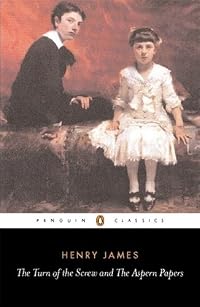
The Turn of the Screw / The Aspern Papers
by Henry James
On This Page
Description
To read a story by Henry James is to enter a world-- a rich, perfectly crafted domain of vivid language and splendid, complex characters. In this classic novella, a young governess who goes to an isolated English estate to take charge of two precocious children gradually realizes that her young charges are under the evil influence of the ghosts of the family's ex-steward and former governess.Tags
Recommendations












Member Recommendations
Member Reviews
As with every tale of horror “The Turn of the Screw” isolates the primary character, in this case the governess of two young children. It also isolates those around her as it takes place in a country home to which “The Master” never visits and from whence he wants no news or communications.
Within the residence the governess is the highest authority, followed by the housekeeper with the other servants being a social level further down in the pecking order.
The children in the care of the governess are, of course, the focus of the entire household.
There are several levels of isolation. As mentioned above, The Master minimised his contact with the household. The governess, while spending most of her time with the children is show more cautious of them and, as the substance of the story emerges she begins to distrust their manner and hence isolates herself from them.
The governess does, however, feel a level of affinity with the housekeeper but a difference in intellectual level is clearly identified and this, along with the expectations of their different positions in the household, limits the degree of association between the two women. For the climax of the story the housekeeper is removed from the scene entirely, along with one of the children. This serves to further isolate the governess.
Of course, the governess will have no social association with the other servants apart from being the recipient of the services provided by them within the remit of their function.
When Henry James organised his stories into categories he did not put “The Turn of the Screw” with his ghostly tales, but rather with his psychological stories. I can understand this. It was only the governess who observed the ghostly appearances. The story was a narration based on the writings of the governess. I questioned the alacrity of her story and believe we are dealing with an unreliable narrator.
I enjoyed this story as a ghost story, but also as a tale that can be interpreted as something else; a psychological tale of a person’s self delusion and her slow descent into paranoia. show less
Within the residence the governess is the highest authority, followed by the housekeeper with the other servants being a social level further down in the pecking order.
The children in the care of the governess are, of course, the focus of the entire household.
There are several levels of isolation. As mentioned above, The Master minimised his contact with the household. The governess, while spending most of her time with the children is show more cautious of them and, as the substance of the story emerges she begins to distrust their manner and hence isolates herself from them.
The governess does, however, feel a level of affinity with the housekeeper but a difference in intellectual level is clearly identified and this, along with the expectations of their different positions in the household, limits the degree of association between the two women. For the climax of the story the housekeeper is removed from the scene entirely, along with one of the children. This serves to further isolate the governess.
Of course, the governess will have no social association with the other servants apart from being the recipient of the services provided by them within the remit of their function.
When Henry James organised his stories into categories he did not put “The Turn of the Screw” with his ghostly tales, but rather with his psychological stories. I can understand this. It was only the governess who observed the ghostly appearances. The story was a narration based on the writings of the governess. I questioned the alacrity of her story and believe we are dealing with an unreliable narrator.
I enjoyed this story as a ghost story, but also as a tale that can be interpreted as something else; a psychological tale of a person’s self delusion and her slow descent into paranoia. show less
Henry James is one of those writers that I have heard a lot about. Maybe, I've even read some of his work along the way but really I'm pretty ignorant of his work. In fact, I found myself confounding him with that other famous American writer....Edgar Allan Poe. Anyway, I found this book, with two stories by Henry James, and decided to inform myself.
My verdict: interesting, nice use of words and phrasing, clever development of tension and characters.....not especially scary. Light entertainment yes. But not something that I found either believable or something that I wanted to pursue ....in terms of reading more of Henry James.
Both stories rely on; big, wealthy (unfriendly) houses, absent parents and remoteness. The governess in "Turn show more of the Screen" is a smart young women.....apparently with limited prospects because of her background. And Miss Tina in "The Aspern Papers" seems a complete victim of her aunt...unable to escape the confines of the house and utterly lost in the real world. And there is an underlying sexism about both stories......plus very much an "upstairs/downstairs world that I find both foreign and nasty.
In "The turn of the screw" papers there is the hint of paederphilia......unstated but very present. This was unsettling in itself. "Turn of the screw" calls upon the gullible and the supernatural in ways that I can imagine titillating but I found lacking.
There are flashes of the life of Peggy Guggenheim.....wealthy, passionate art collector,American, living in Venice ....in the Aspern papers. And I must admit to being somewhat confused about where Henry James was from because of his writing about England and America. So did bit of delving and found he was almost a mid Atlantic person who lived both in America and Europe and maybe never felt totally at home in either place. But he was able to write effortlessly about both. For me, I give the book (and the two stories) 3 stars. I won't be seeking out more works of Henry James. Not unenjoyable but life is too short (for me) to spend more time with this writer. show less
My verdict: interesting, nice use of words and phrasing, clever development of tension and characters.....not especially scary. Light entertainment yes. But not something that I found either believable or something that I wanted to pursue ....in terms of reading more of Henry James.
Both stories rely on; big, wealthy (unfriendly) houses, absent parents and remoteness. The governess in "Turn show more of the Screen" is a smart young women.....apparently with limited prospects because of her background. And Miss Tina in "The Aspern Papers" seems a complete victim of her aunt...unable to escape the confines of the house and utterly lost in the real world. And there is an underlying sexism about both stories......plus very much an "upstairs/downstairs world that I find both foreign and nasty.
In "The turn of the screw" papers there is the hint of paederphilia......unstated but very present. This was unsettling in itself. "Turn of the screw" calls upon the gullible and the supernatural in ways that I can imagine titillating but I found lacking.
There are flashes of the life of Peggy Guggenheim.....wealthy, passionate art collector,American, living in Venice ....in the Aspern papers. And I must admit to being somewhat confused about where Henry James was from because of his writing about England and America. So did bit of delving and found he was almost a mid Atlantic person who lived both in America and Europe and maybe never felt totally at home in either place. But he was able to write effortlessly about both. For me, I give the book (and the two stories) 3 stars. I won't be seeking out more works of Henry James. Not unenjoyable but life is too short (for me) to spend more time with this writer. show less
It's been decades since I read any Henry James, and I was inspired to read these two novellas by a review here on LT and by the approach of Halloween. While I found them both though-provoking, I found them a little cold as well.
The Turn of the Screw, as is well known, tells the tale of a young, naive, parson's daughter who becomes the governess to the orphaned nephew and niece of a young rich man who wants nothing to do with the children and ships them off to his country home. The children seem unbelievably angelic to the governess, who has developed a crush, based on two meetings, with the uncle, but soon she starts seeing ghosts who, upon descriptions given to the housekeeper, turn out to be the ghosts of the previous governess and a show more male servant, both now, obviously, dead. The governess, who tells the tale in the first person (it is her written report on the events, which has fallen into the hands of a now elderly man who reads it at a gathering), believes the ghosts are set on harming the children.
Ah, but are there really ghosts? Or are they the figments of the governess's imagination? Can the children possibly be that angelic and, if so, why did the boy get expelled from his school? Or was he? We only have the governess's word for that. And if what seems to happen at the end really happens, how did the governess go on to find future employment? I did find this story thoroughly creepy, probably especially because it left so many questions unanswered, but I also found the portrait of the governess a little over-the-top unpleasant.
The Aspern Papers are the obsession of the narrator of the second novella; he is a literary critic and devoted admirer of the long dead poet Jeffrey Aspern. Finding that his muse and possible lover, Juliana, is still alive, although aged and decrepit, and living with an elderly niece, Miss Tina, in an ancient Venice building, he schemes to become a lodger there under an assumed name, and even to try to gain the confidence of the niece (who is under the thumb of her aunt), so he can somehow acquire the papers. Everyone in this story comes off seeming exceedingly unpleasant, from the obsessed and unprincipled narrator to the vindictive and controlling Juliana to the terrified and naive Miss Tina. Of course, I wanted to find out what happened, but I can't say I enjoyed the story.
Based on the limited evidence of these two novellas, I have a distinct feeling that James did not particularly like women, but it's so long since I read anything else by him I could be completely wrong about this. show less
The Turn of the Screw, as is well known, tells the tale of a young, naive, parson's daughter who becomes the governess to the orphaned nephew and niece of a young rich man who wants nothing to do with the children and ships them off to his country home. The children seem unbelievably angelic to the governess, who has developed a crush, based on two meetings, with the uncle, but soon she starts seeing ghosts who, upon descriptions given to the housekeeper, turn out to be the ghosts of the previous governess and a show more male servant, both now, obviously, dead. The governess, who tells the tale in the first person (it is her written report on the events, which has fallen into the hands of a now elderly man who reads it at a gathering), believes the ghosts are set on harming the children.
Ah, but are there really ghosts? Or are they the figments of the governess's imagination? Can the children possibly be that angelic and, if so, why did the boy get expelled from his school? Or was he? We only have the governess's word for that. And if what seems to happen at the end really happens, how did the governess go on to find future employment? I did find this story thoroughly creepy, probably especially because it left so many questions unanswered, but I also found the portrait of the governess a little over-the-top unpleasant.
The Aspern Papers are the obsession of the narrator of the second novella; he is a literary critic and devoted admirer of the long dead poet Jeffrey Aspern. Finding that his muse and possible lover, Juliana, is still alive, although aged and decrepit, and living with an elderly niece, Miss Tina, in an ancient Venice building, he schemes to become a lodger there under an assumed name, and even to try to gain the confidence of the niece (who is under the thumb of her aunt), so he can somehow acquire the papers. Everyone in this story comes off seeming exceedingly unpleasant, from the obsessed and unprincipled narrator to the vindictive and controlling Juliana to the terrified and naive Miss Tina. Of course, I wanted to find out what happened, but I can't say I enjoyed the story.
Based on the limited evidence of these two novellas, I have a distinct feeling that James did not particularly like women, but it's so long since I read anything else by him I could be completely wrong about this. show less
The first novella in this thin volume containing two of Henry James's works is regarded as a so-called classic, the story of a young governess engaged to look after two orphaned children in a country house in England. When she first meets the children, Miles, aged 10, and Flora, aged 8, she is very much taken with them, and she is bewildered to learn that Miles has been expelled from his school. Events take a supernatural turn when she sees a man on the top of the tower who answers to the description of the former valet of the master of the house, Peter Quint, who has since died; not only that, but she also catches glimpses of a lady in a black dress, whom the housekeeper Mrs Grose, based on her description, identifies as the former show more governess Miss Jessel, who has also since passed on. The governess becomes convinced that the spirits are in secret communication with the children and have an unholy influence over them.
Years ago I saw the 1961 film The Innocents, based on The Turn of the Screw, and was always curious what the story was like in its original literary form. While the film as I recall it is very unambiguous in its interpretation that the children are indeed possessed by the spirits of the deceased valet and governess, the book is much more so, something I did not expect. Told in the style of a frame narrative, the first-person account penned by the governess is read out to an assembly of guests years later, and what emerges for me was the narrative of someone who was mentally unbalanced, and we only have the governess's word for it that the children were able to see and communicate with the spirits, as the writing itself is ambiguous on this point and the children never admit to seeing or hearing anything out of the ordinary, thus turning the story into an account by an unreliable narrator for me and elevating it from a boring and rather tame ghost story to something more interesting and deserving of reflection.
I did not get on with the character of the unnamed governess at all: I thought her conceited, needy, paranoid and hysterical, and the laboriousness and convolutedness of the prose in which the account is written as an outward sign of her disturbed mental state. At no stage did the narrative become more than mildly tense, and the interest is more in the psychological deportment of the governess and the children than in any horror attributed to it since the novella's publication. The ending, though anticipated by my having watched the film, is sudden and unexpected, and leaves the reader with unanswered questions as to what really happened.
The second novella is set in Venice, Italy, and tells of the frustrated attempts of an American editor to gain access to the private papers of Juliana Bordereau, former muse to the famous poet Jeffrey Aspern, in the hope of publishing previously unknown correspondence by the poet. Also written in the first person, the editor gains access under false pretences to the villa where Miss Bordereau lives in seclusion with only her middle-aged niece for company. On the very few occasions that the editor lays eyes on her, Juliana appeared to me like a shadow of Dickens's Miss Havisham, but that is really the only interesting thing that can be said of the story. I was repeatedly astonished how 80 pages could be spent without saying anything at all, as nothing of any significance takes place until the last 20 or so pages.
Reading the narrative felt like wading through treacle and I more than once toyed with the idea of giving up, and only the thought that there might be a twist at the end stopped me; there is a twist of sorts, not unexpected, and resembling the one in The Turn of the Screw – though written ten years earlier – in that the pursuit of the truth is abruptly cut short. Not once did I feel engaged with the unnamed narrator as he belittles the younger Miss Bordereau and compliments himself on his perceived cleverness, and I thought he deserved what he got at the end.
With a rating of three stars for The Turn of the Screw and one star for The Aspern Papers, this volume scores a measly two stars in my opinion. show less
Years ago I saw the 1961 film The Innocents, based on The Turn of the Screw, and was always curious what the story was like in its original literary form. While the film as I recall it is very unambiguous in its interpretation that the children are indeed possessed by the spirits of the deceased valet and governess, the book is much more so, something I did not expect. Told in the style of a frame narrative, the first-person account penned by the governess is read out to an assembly of guests years later, and what emerges for me was the narrative of someone who was mentally unbalanced, and we only have the governess's word for it that the children were able to see and communicate with the spirits, as the writing itself is ambiguous on this point and the children never admit to seeing or hearing anything out of the ordinary, thus turning the story into an account by an unreliable narrator for me and elevating it from a boring and rather tame ghost story to something more interesting and deserving of reflection.
I did not get on with the character of the unnamed governess at all: I thought her conceited, needy, paranoid and hysterical, and the laboriousness and convolutedness of the prose in which the account is written as an outward sign of her disturbed mental state. At no stage did the narrative become more than mildly tense, and the interest is more in the psychological deportment of the governess and the children than in any horror attributed to it since the novella's publication. The ending, though anticipated by my having watched the film, is sudden and unexpected, and leaves the reader with unanswered questions as to what really happened.
The second novella is set in Venice, Italy, and tells of the frustrated attempts of an American editor to gain access to the private papers of Juliana Bordereau, former muse to the famous poet Jeffrey Aspern, in the hope of publishing previously unknown correspondence by the poet. Also written in the first person, the editor gains access under false pretences to the villa where Miss Bordereau lives in seclusion with only her middle-aged niece for company. On the very few occasions that the editor lays eyes on her, Juliana appeared to me like a shadow of Dickens's Miss Havisham, but that is really the only interesting thing that can be said of the story. I was repeatedly astonished how 80 pages could be spent without saying anything at all, as nothing of any significance takes place until the last 20 or so pages.
Reading the narrative felt like wading through treacle and I more than once toyed with the idea of giving up, and only the thought that there might be a twist at the end stopped me; there is a twist of sorts, not unexpected, and resembling the one in The Turn of the Screw – though written ten years earlier – in that the pursuit of the truth is abruptly cut short. Not once did I feel engaged with the unnamed narrator as he belittles the younger Miss Bordereau and compliments himself on his perceived cleverness, and I thought he deserved what he got at the end.
With a rating of three stars for The Turn of the Screw and one star for The Aspern Papers, this volume scores a measly two stars in my opinion. show less
Oh, Henry James. The man of many commas. This was my second time reading, first time finishing (the first time I started reading was for a college lit class and other readings overwhelmed me before I could finish). It's hard to talk about the plot without giving anything away, as the details of the book are essentially the plot, which is in itself intentionally vague to the point where James actually relies on the reader having an inner sense of inherent wrongness to fill in the blanks of his own fiction.
This is, of course, a ghost story. A ghost story involving children, which is laid claim to be the most frightening kind. To the modern reader it is hardly terrifying, but with reflection over certain scenes I did find it to be show more chilling. I have a habit of imagining books as films as I read them, and I can't say this would transfer well while still remaining true to the book. It would have to be a very loose adaptation in order to come across as a horror film, as most of the terror of the book comes in quick gusts, allowing the reader to meditate on them obsessively as the governess does. That is where the real suspense of the book comes in, in the quoted "tightening of the screw" that continues to do up the narrator and add yet another pressure point on the vice of the novel.
Henry James has never been for everyone, but if you are predisposed to liking Victorian literature this one is certainly something fun to try out. Just, whatever you do, put on a goddamn hat. What kind of gentleman are you? Oh... oh, you're a ghost. I see. show less
This is, of course, a ghost story. A ghost story involving children, which is laid claim to be the most frightening kind. To the modern reader it is hardly terrifying, but with reflection over certain scenes I did find it to be show more chilling. I have a habit of imagining books as films as I read them, and I can't say this would transfer well while still remaining true to the book. It would have to be a very loose adaptation in order to come across as a horror film, as most of the terror of the book comes in quick gusts, allowing the reader to meditate on them obsessively as the governess does. That is where the real suspense of the book comes in, in the quoted "tightening of the screw" that continues to do up the narrator and add yet another pressure point on the vice of the novel.
Henry James has never been for everyone, but if you are predisposed to liking Victorian literature this one is certainly something fun to try out. Just, whatever you do, put on a goddamn hat. What kind of gentleman are you? Oh... oh, you're a ghost. I see. show less
Well, you certainly have to concentrate on the prose in this one; be prepared to pay attention.
A classic story with a classic question. Did all this really happen as the governess tells it? Were the children really possessed by the malevolent spirits of their dead servants? Was the governess really a half-crazy repressed old maid victim of Victorian society who in turn victimized her young charges? I prefer the former, but either one is horrifying in its own way.
Although a certain type of woman, from a certain strata of British Victorian society, may have been heavily oppressed by the morals and social expectations of the era, this is largely a myth. The very era itself is named for a woman. The same society also produced women like show more Christina Rossetti, May Morris, Evelyn de Morgan, Marie Correlli, Elizabeth Gaskell, Beatrix Potter, Ada Lovelace and many others; which clearly could not have happened if conditions were as 'anti-woman' as are popularly attributed.
I have seen three different film adaptations of this book. The first is titled "The Innocents" and the acting is old school melodrama, but the look of the black & white film is perfect; very gothic. Bly House and the entire estate have that lovely, eerie appearance. The last one was titled "The Turn of the Screw", and with an interesting twist, was set in the 1960's. The story remained true to the novel, in spite of the mod costuming. The cinematography was not as atmospheric as the black & white version, much more sunlit, but still visually appealing.
I know that some readers struggle with the prose of Henry James. The story is worth adapting your reading style; it is just a novella. This book will not appeal to fans of gore and bloodshed. show less
A classic story with a classic question. Did all this really happen as the governess tells it? Were the children really possessed by the malevolent spirits of their dead servants? Was the governess really a half-crazy repressed old maid victim of Victorian society who in turn victimized her young charges? I prefer the former, but either one is horrifying in its own way.
Although a certain type of woman, from a certain strata of British Victorian society, may have been heavily oppressed by the morals and social expectations of the era, this is largely a myth. The very era itself is named for a woman. The same society also produced women like show more Christina Rossetti, May Morris, Evelyn de Morgan, Marie Correlli, Elizabeth Gaskell, Beatrix Potter, Ada Lovelace and many others; which clearly could not have happened if conditions were as 'anti-woman' as are popularly attributed.
I have seen three different film adaptations of this book. The first is titled "The Innocents" and the acting is old school melodrama, but the look of the black & white film is perfect; very gothic. Bly House and the entire estate have that lovely, eerie appearance. The last one was titled "The Turn of the Screw", and with an interesting twist, was set in the 1960's. The story remained true to the novel, in spite of the mod costuming. The cinematography was not as atmospheric as the black & white version, much more sunlit, but still visually appealing.
I know that some readers struggle with the prose of Henry James. The story is worth adapting your reading style; it is just a novella. This book will not appeal to fans of gore and bloodshed. show less
No one seems to do gothic horror and be able to make the hair on the back of my neck stand up as well as Authors from this era; whether they are hinting at insanity or embracing it and giving it coffee, this novella has to rank up there with The Yellow Wallpaper. When the reader first embarks into this tale it would seem the perfect accompaniment to a cold winter night and a cosy fire place, after all it’s short in length and reads fairly quickly if you can come to grips with the style in which it is written, but don’t make any assumptions about this book.
The main character is also the narrator for the tale, and the reader sees the whole sequence of event unfold through her eyes. In the main lead, the reader is introduced to a show more character who definitely does not know herself and shows no signs of getting to know herself as the tale progresses. As we view the world through her eyes the reader is her companion as she descends into madness; or does she, and this is where one of the many twists enter the tale and have the reader wondering. At times I felt sorry for this character, at others she just grated on me to no end, this I put down to the time period in which the book is set and not the fact the fact that the character was badly written. In fact none of the characters in this novella are badly written, and each brings their own flaws and traits to play as the storyline unfolds.
This book is definitely ‘old school’ horror genre, rather than being in your face gory and ghastly, an atmosphere is created in this novella that is suggestive and lends itself perfectly to being able to scare the stripes off a zebra. Eerie and creepy descriptives are used to full effect in this tale and, although only a mere 120 pages long, I found myself getting up and turning a light on part way through. All the requirements of a truly good ghost story are included in the covers of this novella, and the fact that the readers imagination is able to hold full sway over the way in which they react to the occurrences. I have to say this is one of the better pieces of writing by this Author that I have read, and if it had been a few pages longer it would have received a full 5 thumbs review.
If you are looking for a truly good ghost story to fill your holiday season, but not overtake it completely then I would highly recommend you read this novella.
Originally reviewed on: http://catesbooknuthut.com/2014/12/08/review-the-turn-of-the-screw-henry-james/
This work is licensed under a Creative Commons Attribution-NonCommercial-NoDerivs 3.0 Unported License. show less
The main character is also the narrator for the tale, and the reader sees the whole sequence of event unfold through her eyes. In the main lead, the reader is introduced to a show more character who definitely does not know herself and shows no signs of getting to know herself as the tale progresses. As we view the world through her eyes the reader is her companion as she descends into madness; or does she, and this is where one of the many twists enter the tale and have the reader wondering. At times I felt sorry for this character, at others she just grated on me to no end, this I put down to the time period in which the book is set and not the fact the fact that the character was badly written. In fact none of the characters in this novella are badly written, and each brings their own flaws and traits to play as the storyline unfolds.
This book is definitely ‘old school’ horror genre, rather than being in your face gory and ghastly, an atmosphere is created in this novella that is suggestive and lends itself perfectly to being able to scare the stripes off a zebra. Eerie and creepy descriptives are used to full effect in this tale and, although only a mere 120 pages long, I found myself getting up and turning a light on part way through. All the requirements of a truly good ghost story are included in the covers of this novella, and the fact that the readers imagination is able to hold full sway over the way in which they react to the occurrences. I have to say this is one of the better pieces of writing by this Author that I have read, and if it had been a few pages longer it would have received a full 5 thumbs review.
If you are looking for a truly good ghost story to fill your holiday season, but not overtake it completely then I would highly recommend you read this novella.
Originally reviewed on: http://catesbooknuthut.com/2014/12/08/review-the-turn-of-the-screw-henry-james/
This work is licensed under a Creative Commons Attribution-NonCommercial-NoDerivs 3.0 Unported License. show less
Members
- Recently Added By
Lists

Favourite 19th century fiction
257 works; 62 members

Ghosts
278 works; 16 members

Short Stories, Tales and Novellas
31 works; 1 member

Novels featuring Orphans
76 works; 10 members

Ghost Stories That Thrill Us
256 works; 114 members
Author Information

Some Editions
Series
Belongs to Publisher Series
Work Relationships
Contains
Common Knowledge
- Canonical title
- The Turn of the Screw / The Aspern Papers
- Original publication date
- 1898: The Turn of the Screw; 1888: The Aspern Papers
- People/Characters
- The Governess; Mrs. Grose; Miles; Flora; Peter Quint; Miss Jessel
- First words
- The Turn of the Screw
THE STORY HAD HELD US, round the fire, sufficiently breathless, but except the obvious remark that it was gruesome, as on Christmas Eve in an old house a strange tale should essentially be, I ... (show all)remember no comment uttered till somebody happened to note it as the only case he had met in which such a visitation had fallen on a child.
The Aspern Papers
I had taken Mrs. Prest into my conficence; without her intruce I should have made but little advance, for the fruitful idea in the whole business dropped from her friendly lips. - Last words
- (Click to show. Warning: May contain spoilers.)When I look at it I can scarcely bear my loss – I mean of the precious papers. (The Aspern Papers)
- Disambiguation notice
- This work consists of both The Turn of the Screw and The Aspern Papers; do not combine it with either individual work.
Classifications
Statistics
- Members
- 1,785
- Popularity
- 12,190
- Reviews
- 25
- Rating
- (3.71)
- Languages
- 5 — English, German, Italian, Spanish, Swedish
- Media
- Paper, Ebook
- ISBNs
- 30
- ASINs
- 20