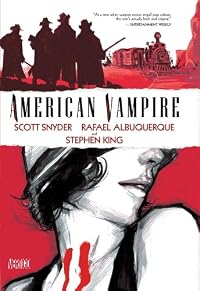
American Vampire Vol. 1
by Scott Snyder (Author), Rafael Albuquerque (Illustrator), Stephen King (Author)
American Vampire (Collections and Selections — 1-5)
On This Page
Description
"A new vampire for a new century. Cunning, ruthless, and rattlesnake mean, Skinner Sweet has a reputation for cussedness as long as he is ornery. As the first vampire conceived on American soil, however, he's not your usual creature of the night. Stronger, fiercer and powered by the sun, Sweet is the first of a new breed of bloodsucker: the American Vampire. Forty-five years after rising from his grave, Sweet finds himself in 1920s Los Angeles, where the young and beautiful are drawn like show more moths to the burning lights of Hollywood. Something beyond simple human greed is at work here, however, as struggling young actress Pearl Jones is about to discover. When her movie-star dreams are transformed into a bloody nightmare, Sweet provides her only chance for survival as well as the power to take revenge" -- dust jacket back. show lessTags
Recommendations



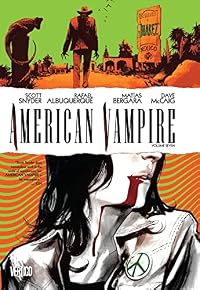
Member Recommendations

Member Reviews
I haven’t been living under a rock. I know that the names Scott Snyder and Stephen King are enough to make random people turn their heads when they overhear you in a supermarket. So I figured, why not tackle both names at once? Why not read a comic they wrote together? And about my favorite paranormal creature, the vampire, no less?
I expected greatness.
I should have lowered my expectations.
The Art
Oh wow. I didn’t know mainstream comics could look this awful and still get the greenlight for 9 volumes. Maybe Rafael Albuquerque is your cup of tea. Maybe you’re blind. I don’t know. ¯_(ツ)_/¯
The facial expressions in this were just…how???? Who sits down to draw, makes this monstrosity, and then calls it a day?
And who looks at it show more and says, “Yup, looks good! Let’s send this baby to print!”
Honestly, the only panels that didn’t look like garbage were the silhouette shots, and that’s only because I couldn’t see the people, only their black and white outlines.
The Story
Wow, Scott Snyder must be only good at one kind of bat-related property because he really sucks at vampires. He wanted to be original? He wanted to bring the fear back to vampires? Well, he seems to think that “original” means to do what everyone else is already doing.
Evil group of mustache twirling, chair sitting villains who do nothing for 90% of the story? Check ✔
Brooding love interest who saves the main character? Check ✔
Hints of a love triangle between the normal, good-for-you human and the bad boy vampire? Check ✔
And let us not forget that Snyder thinks phones run on magical vampire energy or perhaps just wishful thinking. He has a character who lives on a boat in 1925 and has a telephone? Um??? Did he do any research whatsoever? Radiophones are the only thing potentially likely but 1) there wasn’t even a transatlantic phone yet, and 2) regular (not radio) telephones still ran on a wire. There’s no way he has a regular phone on a boat. Forget vampires, the real strange stuff is that Henry the hobo is a time traveler.
Stephen King fared slightly better, but not by a lot. His side of the narrative at least tried to be coherent and well written, however pompous and pretentious it ended up being. It wasn’t really scary, except for one sequence that didn’t last for too long.
But what really nailed the stake into his coffin was this:
Why don’t you just kill me now, Stephen, so I don’t have to live in this world any longer?
TL;DR & Conclusion
I don’t understand why it was the way it was. The art was horrendous, the writing was just plain weird, and the tropes!!! It was so cliche!!! Which is hilarious because the forward and afterward are all about how it’s unique and transcends the current vampires, that they were gonna make vampires scary again, but I’m more afraid of Edward Cullen than I am of their stupid vampires.
Have you ever seen the movie Byzantium? With Saoirse Ronan? Well, it’s one of my favorite underrated vampire stories, and managed to do a past/present split perfectly while maintaining a linear narrative. If you want cool vampires, just watch that. It has some annoying parts, but you have to take what you can get. Or even just watch 2011's Priest, which is awful but better than this. show less
I expected greatness.
I should have lowered my expectations.
The Art
Oh wow. I didn’t know mainstream comics could look this awful and still get the greenlight for 9 volumes. Maybe Rafael Albuquerque is your cup of tea. Maybe you’re blind. I don’t know. ¯_(ツ)_/¯
The facial expressions in this were just…how???? Who sits down to draw, makes this monstrosity, and then calls it a day?
And who looks at it show more and says, “Yup, looks good! Let’s send this baby to print!”
Honestly, the only panels that didn’t look like garbage were the silhouette shots, and that’s only because I couldn’t see the people, only their black and white outlines.
The Story
Wow, Scott Snyder must be only good at one kind of bat-related property because he really sucks at vampires. He wanted to be original? He wanted to bring the fear back to vampires? Well, he seems to think that “original” means to do what everyone else is already doing.
Evil group of mustache twirling, chair sitting villains who do nothing for 90% of the story? Check ✔
Brooding love interest who saves the main character? Check ✔
Hints of a love triangle between the normal, good-for-you human and the bad boy vampire? Check ✔
And let us not forget that Snyder thinks phones run on magical vampire energy or perhaps just wishful thinking. He has a character who lives on a boat in 1925 and has a telephone? Um??? Did he do any research whatsoever? Radiophones are the only thing potentially likely but 1) there wasn’t even a transatlantic phone yet, and 2) regular (not radio) telephones still ran on a wire. There’s no way he has a regular phone on a boat. Forget vampires, the real strange stuff is that Henry the hobo is a time traveler.
Stephen King fared slightly better, but not by a lot. His side of the narrative at least tried to be coherent and well written, however pompous and pretentious it ended up being. It wasn’t really scary, except for one sequence that didn’t last for too long.
But what really nailed the stake into his coffin was this:
“Unfortunately she was his goddaughter”
Why don’t you just kill me now, Stephen, so I don’t have to live in this world any longer?
TL;DR & Conclusion
I don’t understand why it was the way it was. The art was horrendous, the writing was just plain weird, and the tropes!!! It was so cliche!!! Which is hilarious because the forward and afterward are all about how it’s unique and transcends the current vampires, that they were gonna make vampires scary again, but I’m more afraid of Edward Cullen than I am of their stupid vampires.
Have you ever seen the movie Byzantium? With Saoirse Ronan? Well, it’s one of my favorite underrated vampire stories, and managed to do a past/present split perfectly while maintaining a linear narrative. If you want cool vampires, just watch that. It has some annoying parts, but you have to take what you can get. Or even just watch 2011's Priest, which is awful but better than this. show less
Very few people are original these days when it comes to old mythos. Rarely do I see any evolution of fantastical creatures of old lore, so it's always refreshing to see a new take on something familiar. We're in the age of the undead - be it zombies returning to pay homage to our society, or vampires representing civil movements. However, if all you're adding to a mythos is talking zombies or vampires who sparkle in the sun, then you're clearly missing the point of evolution. Rather than evolving the creatures, you're simply dumbing them down to fit your homage to nothing. You should've written fanfiction instead. Though, even fanfiction adds to the mythos rather than raping it - yes, even the homoeroticism of every fanfiction adds show more more to the mythology than Mormon-esque philosophy and horny teenagers.
For most of their existence, vampires have been shrouded in darkness. Very few people have attempted to change that - day-walkers weren't scary enough, or thrilling enough (or sparkly enough, apparently). They are always placed in dank, dark locations because that's how it's always been. With the obvious exception of Anne Rice's existential vampires, who seem to find sunny areas like California and Miami quite alluring, even though they still only come out at night.
In American Vampire, writers Scott Synder and Stephen King offer us something new for us to sink our fangs in. Blending the old Euro Vampires - you know, the fancy dressed ones who hate the sun - with a "new vampire for a new century."
Blending the last years of the Wild West with 1920s America, the story follows the origin of the American Vampire and the war brewing between the old and the new. Stephen King focuses on the origin story, following outlaw Skinner Sweet as he descends into the well-lit realms of the American vampire as the Euro Vampires stand in shock of the abomination that is their bloodline. As Skinner Sweet tears through the new the century seeking revenge, he realizes the old west he once knew is coming to an end; meanwhile, lawman James Book is hot on his trail, seeking retribution of his own and hoping to put Sweet in his grave for good. Meanwhile, Scott Synder focuses on the twentieth century vampire and Skinner Sweet creation, Pearl Jones. The ambitious young actress is lured into her grave by her fading hopes of becoming a well-known actress. It's Skinner Sweet who brings her back from the dead in hopes that she will aid him in the destruction of those who made him what he is. Pearl seeks vengeance of her own on the Euro Vampires, killing them one at a time. The war is far from over in the conclusion of the first volume, as figures from Sweet's past return to finish what Book couldn't do.
The first volume is well thought out, and the characters are amazing. The fact that it blends two of my favorite time-periods is just the added bonus. The fact that something so well crafted by Stephen King has actually reached my eyes - let's remember my love/hate relationship with the writer - gives me goosebumps and keeps me wanting more. show less
For most of their existence, vampires have been shrouded in darkness. Very few people have attempted to change that - day-walkers weren't scary enough, or thrilling enough (or sparkly enough, apparently). They are always placed in dank, dark locations because that's how it's always been. With the obvious exception of Anne Rice's existential vampires, who seem to find sunny areas like California and Miami quite alluring, even though they still only come out at night.
In American Vampire, writers Scott Synder and Stephen King offer us something new for us to sink our fangs in. Blending the old Euro Vampires - you know, the fancy dressed ones who hate the sun - with a "new vampire for a new century."
Blending the last years of the Wild West with 1920s America, the story follows the origin of the American Vampire and the war brewing between the old and the new. Stephen King focuses on the origin story, following outlaw Skinner Sweet as he descends into the well-lit realms of the American vampire as the Euro Vampires stand in shock of the abomination that is their bloodline. As Skinner Sweet tears through the new the century seeking revenge, he realizes the old west he once knew is coming to an end; meanwhile, lawman James Book is hot on his trail, seeking retribution of his own and hoping to put Sweet in his grave for good. Meanwhile, Scott Synder focuses on the twentieth century vampire and Skinner Sweet creation, Pearl Jones. The ambitious young actress is lured into her grave by her fading hopes of becoming a well-known actress. It's Skinner Sweet who brings her back from the dead in hopes that she will aid him in the destruction of those who made him what he is. Pearl seeks vengeance of her own on the Euro Vampires, killing them one at a time. The war is far from over in the conclusion of the first volume, as figures from Sweet's past return to finish what Book couldn't do.
The first volume is well thought out, and the characters are amazing. The fact that it blends two of my favorite time-periods is just the added bonus. The fact that something so well crafted by Stephen King has actually reached my eyes - let's remember my love/hate relationship with the writer - gives me goosebumps and keeps me wanting more. show less
Snyder's story follows aspiring actress Pearl in 1920's Los Angeles and her way to becoming turned into a New World vampire, while King's story tells the story of Skinner Sweet, the original American Vampire. Now, this is how you reinvent vampires; Skinner Sweet is just the right mix of Old World haughtiness and New World audacity and Pearl is righteous and nice in all her viciousness. The story also has a genuine "American" feel to it (even if the artist is from Brazil) because both writers have taken advantage of some truly American images, like the history of Hollywood and of Wild West and cowboy life. It was really interesting to see how two different writing styles can be flawlessly bridged by a having a talented artist in common; show more the Snyder/King/Albuquerque-combo is very close to brilliant. The stories are solid, the art engaging and unexpected and I've already picked up the other volumes published thus far - can't wait to see what's in store for Skinner and Pearl. show less
I've always loved vampire narratives, but these days I feel as though I have to make that statement with a "but not those sparkly Meyers' bullshit vamps" disclaimer because the term "vampire" now requires two definitions: 1) glittering and eternal boy band wannabe who tries to protect naive (and horny!) young women from the monster he's become while slurping up woodland critters like they're Hi-C fruit boxes, and 2) vampires who seduce and cruelly toy with their prey before ripping open a jugular and letting someone else worry about the clean up. When it comes to vampires, I'm more of a "Team Kill" than "Team Brood." I tell you all of this to say that I really enjoyed American Vampire, which returns vampires to their more horrific show more origins: the single-minded drive of a predator coupled with human intelligence. Nothing is more terrifying.
The story is actually two intertwined narratives: the story of Skinner Sweet, a ruthless outlaw in the twilight of the Old West, and Polly, a Hollywood extra in the 1920's. Until Skinner is accidentally turned, vampires in America consist of Old World European vampires who have come to the United States to feed on the economic boom, as well as the unsuspecting populace. With Skinner's creation, a new kind of vampire is brought into being: one who can walk during the day and who is not susceptible to the weaknesses of the generation that came before him. It turns out that, with each new vampiric creation, a new and unpredictable strain of vampirism comes into being. Therefore, the European vampires jealously guard their "gift" lest they create a breed that can eventually overthrow them. This plot twist promises for rich and varied narratives as we follow these vampires into future storylines; Skinner creates Polly, a vampire whose powers mimic Skinner's but may ultimately eclipse his.
Of the two storylines, I preferred the Stephen King narrative about Skinner Sweet, but I'm a sucker for the Old West. However, it was a close call as Snyder's tale is equally intriguing and Polly is definitely one badass mamma-jamma.
While not quite as violent as I expected, Snyder and King have definitely given a tired genre a new life with plenty of subtext about American innovation versus European traditionalism. So keep the anemic Edwards of young adult narratives. From now on, I'll take my vampires like I take my tea--Sweet, please. show less
The story is actually two intertwined narratives: the story of Skinner Sweet, a ruthless outlaw in the twilight of the Old West, and Polly, a Hollywood extra in the 1920's. Until Skinner is accidentally turned, vampires in America consist of Old World European vampires who have come to the United States to feed on the economic boom, as well as the unsuspecting populace. With Skinner's creation, a new kind of vampire is brought into being: one who can walk during the day and who is not susceptible to the weaknesses of the generation that came before him. It turns out that, with each new vampiric creation, a new and unpredictable strain of vampirism comes into being. Therefore, the European vampires jealously guard their "gift" lest they create a breed that can eventually overthrow them. This plot twist promises for rich and varied narratives as we follow these vampires into future storylines; Skinner creates Polly, a vampire whose powers mimic Skinner's but may ultimately eclipse his.
Of the two storylines, I preferred the Stephen King narrative about Skinner Sweet, but I'm a sucker for the Old West. However, it was a close call as Snyder's tale is equally intriguing and Polly is definitely one badass mamma-jamma.
While not quite as violent as I expected, Snyder and King have definitely given a tired genre a new life with plenty of subtext about American innovation versus European traditionalism. So keep the anemic Edwards of young adult narratives. From now on, I'll take my vampires like I take my tea--Sweet, please. show less
If you'll allow me to go off topic from this graphic novel for a bit, I need to tell you about my love affair with vampires. From the time that I was 10 years old, and saw Dracula (the 1931 version with Bela Lugosi of course!), I was absolutely enamored with vampires. I read the original Dracula book, I pawed my way through all the Anne Rice vampire novels (which I probably shouldn't have read at 11, but *shrug*), and my bookish world became centered around finding more vampire reads.
Then in 2005 Twilight came out and I was so excited. I bought the book, read it, and promptly threw it across the room. What had happened to my vampires? Where were the cunning and vicious predators that I loved? Keep in mind that I hadn't read much YA at show more this point. I all but skipped it, with the exception of Lurlene McDaniels books, since my mom essentially let me read whatever I wanted. So I wasn't used to paranormal romance on a YA level, and I was angry. I pushed my vampires away, and moved on to other topics. It wasn't until 2011, when I picked up Enter, Night by Michael Rowe on a whim, that I finally started to fall back in love. Still, to this day, I'm very wary about anything vampire related. I'm always afraid to be burned.
Which is why my comic book loving friend had a very tough time convincing me to read American Vampire. He pushed, he prodded, he used my love of Stephen King against me. Finally, I gave in.
I have to say that, while I wasn't totally in love with this first volume in terms of the story, I am definitely in love with the vampires here! Putting these characters into the late 1800's and the early 1900's was a brilliant choice. There's nothing more perfect than the vicious deeds of a the notorious Skinner Sweet, set against the backdrop of the Old West. When Pearl Jones, a 1920's silent film actor, was introduced? I was hooked. These two characters couldn't be more different, but the vampirism flowing through their blood ties them together in the best way possible.
If you'd allow me, I'd go on for ages about the clever ways that these two stories are tied together. How brilliant Stephen King's writing for Skinner Sweet's origin story is, and how much my heart was happy at the art here. The illustrations are gorgeous, plain and simple. They're gritty and violent. I'm tentatively in love. I'm looking forward to Volume 2, and having a more fleshed out view of these two characters as they move forward. I'm glad I gave in and finally read this, because my bad-ass vampires are back! show less
Then in 2005 Twilight came out and I was so excited. I bought the book, read it, and promptly threw it across the room. What had happened to my vampires? Where were the cunning and vicious predators that I loved? Keep in mind that I hadn't read much YA at show more this point. I all but skipped it, with the exception of Lurlene McDaniels books, since my mom essentially let me read whatever I wanted. So I wasn't used to paranormal romance on a YA level, and I was angry. I pushed my vampires away, and moved on to other topics. It wasn't until 2011, when I picked up Enter, Night by Michael Rowe on a whim, that I finally started to fall back in love. Still, to this day, I'm very wary about anything vampire related. I'm always afraid to be burned.
Which is why my comic book loving friend had a very tough time convincing me to read American Vampire. He pushed, he prodded, he used my love of Stephen King against me. Finally, I gave in.
I have to say that, while I wasn't totally in love with this first volume in terms of the story, I am definitely in love with the vampires here! Putting these characters into the late 1800's and the early 1900's was a brilliant choice. There's nothing more perfect than the vicious deeds of a the notorious Skinner Sweet, set against the backdrop of the Old West. When Pearl Jones, a 1920's silent film actor, was introduced? I was hooked. These two characters couldn't be more different, but the vampirism flowing through their blood ties them together in the best way possible.
If you'd allow me, I'd go on for ages about the clever ways that these two stories are tied together. How brilliant Stephen King's writing for Skinner Sweet's origin story is, and how much my heart was happy at the art here. The illustrations are gorgeous, plain and simple. They're gritty and violent. I'm tentatively in love. I'm looking forward to Volume 2, and having a more fleshed out view of these two characters as they move forward. I'm glad I gave in and finally read this, because my bad-ass vampires are back! show less
I am going to start including graphic novels here because THAT'S WHY.
Well, this was good. I'm not exactly in the market for vampire fiction, certainly not vampire comics. Never heard of Scott Snyder, and Stephen King's name didn't do much to increase my interest. This hearks back to Vertigo's horror roots, of course, though they're a pretty diverse line nowadays, but you rarely get a Vertigo title without a dark and violent edge.
Two parallel stories of vampirism, one in the Wild West, the other in 1930s Hollywod. The older story is about the birth of a new breed of vampire, an outlaw desperado, and the later storyline is about another, newer version of the breed and her battle with the older class of European vamp that inadvertently show more created her. It's a cracking read, with great art, makes excellent use of its' setting and promises to deliver a lot more in future volumes. Excellent. show less
Well, this was good. I'm not exactly in the market for vampire fiction, certainly not vampire comics. Never heard of Scott Snyder, and Stephen King's name didn't do much to increase my interest. This hearks back to Vertigo's horror roots, of course, though they're a pretty diverse line nowadays, but you rarely get a Vertigo title without a dark and violent edge.
Two parallel stories of vampirism, one in the Wild West, the other in 1930s Hollywod. The older story is about the birth of a new breed of vampire, an outlaw desperado, and the later storyline is about another, newer version of the breed and her battle with the older class of European vamp that inadvertently show more created her. It's a cracking read, with great art, makes excellent use of its' setting and promises to deliver a lot more in future volumes. Excellent. show less
I'll start this off by saying that I fully expected to hate this.. or at least be bored by it. Despite the fact that Scott Snyder is highly regarded in the comic industry at the moment - what with kicking all kinds of ass with the recent Batman reboot/relaunch/whatever - and perennial favorite, Uncle Stevie lending his writing chops to the series, I still expected mediocrity.
Why?
Because I'm starting to hate vampires. No, this isn't an anti-twilight rant nor does it have anything to do with disliking something because it's popular. It mostly has to do with just a never ending stream of what feels like average content. Take Justin Cronin's The Passage series. While I felt the first book was OK at best, the second book was unbearable, so show more much so that I put it down - I just couldn't soldier on through something I feel so negatively about.
The good news is, with lowered expectations, it only really leaves room for someone to move up. That or dive down into the sub basement of boredom.
Snyder and King craft a story bringing together two distinct periods in time involving two pretty different characters. While at their core, they're a lot a like, it's there origins that bring about conflicting emotions in the reader. One, an outlaw of the old wild west and the other, a struggling young actress in 1920s Hollywood.
Both were excellent and certainly leave a lot in the open for future volumes. I already enjoy Snyder's writing but Rafael Albuquerque's art is exceptional to say the least. His visuals sync up perfectly with the style of the story that's being told and offer up some pretty gruesome shots.
This is the kind of vampire storytelling I can get behind. You've got compelling characters with an interesting plot for them to play around in. It doesn't feel manufactured and the inclusion of vampires never really feels like a gimmick used to cash in on the genre's massive popularity.
I've got volume one and two sitting on my coffee table all set to go - I think I'll be breezing through these in pretty rapid succession. show less
Why?
Because I'm starting to hate vampires. No, this isn't an anti-twilight rant nor does it have anything to do with disliking something because it's popular. It mostly has to do with just a never ending stream of what feels like average content. Take Justin Cronin's The Passage series. While I felt the first book was OK at best, the second book was unbearable, so show more much so that I put it down - I just couldn't soldier on through something I feel so negatively about.
The good news is, with lowered expectations, it only really leaves room for someone to move up. That or dive down into the sub basement of boredom.
Snyder and King craft a story bringing together two distinct periods in time involving two pretty different characters. While at their core, they're a lot a like, it's there origins that bring about conflicting emotions in the reader. One, an outlaw of the old wild west and the other, a struggling young actress in 1920s Hollywood.
Both were excellent and certainly leave a lot in the open for future volumes. I already enjoy Snyder's writing but Rafael Albuquerque's art is exceptional to say the least. His visuals sync up perfectly with the style of the story that's being told and offer up some pretty gruesome shots.
This is the kind of vampire storytelling I can get behind. You've got compelling characters with an interesting plot for them to play around in. It doesn't feel manufactured and the inclusion of vampires never really feels like a gimmick used to cash in on the genre's massive popularity.
I've got volume one and two sitting on my coffee table all set to go - I think I'll be breezing through these in pretty rapid succession. show less
Members
- Recently Added By
Lists

Recommended Comics / Graphic Novels
595 works; 122 members

70 of the Best Horror Comics
178 works; 5 members

Books Read in 2014
2,341 works; 86 members

Books Read in 2022
5,164 works; 111 members

Books Read in 2012
815 works; 34 members

Books Read in 2025
4,090 works; 97 members
Author Information

Scott Snyder is a multiple award-winning and bestselling American writer known for his 2006 short story collection Voodoo Heart, and his work in comic books, including American Vampire, Detective Comics, Batman, Batman: Gates of Gotham and Swamp Thing. Snyder graduated from Brown University in 1998 with a degree in creative writing, and then show more worked at Walt Disney World for about a year. Snyder's Disney World stint strongly influenced his writing; he later recalled, "it did a world of good for my writing. Snyder received his MFA from Columbia University in 2002. His first collection of stories, Voodoo Heart, was published by the Dial Press in June 2006 to highly positive reviews. The collection received starred reviews from Publishers Weekly and Booklist, and was a Kirkus Reviews "Hot Debut" of the year. Stephen King picked two of the included stories"Wreck" and "Dumpster Tuesday"for the 2007 The Best American Short Stories anthology shortlist. Voodoo Heart was shortlisted for The Story Prize in 2006. In 2009, Snyder began writing for Marvel Comics. His first foray into the genre was a one-shot focusing on the first Human Torch, part of Marvel's 70th anniversary celebrations. Since September 2011, Snyder has been writing both Batman and a new Swamp Thing ongoing series as part of The New 52, DC Comics' company-wide relaunch of all of its titles. Snyder will co-write Talon, a spin-off of the "Court of Owls" storyline in Batman, which will focus on a rogue Talon from the Court. In 2013 his title Batman Vol. 2: The City of Owls (the New 52) made The New york Times Best Seller List. Batman - Death of the Family Mask made the New York Times bestseller list in 2014. (Bowker Author Biography) show less


Stephen King was born in Portland, Maine, on September 21, 1947. After graduating with a Bachelor's degree in English from the University of Maine at Orono in 1970, he became a teacher. His spare time was spent writing short stories and novels. King's first novel would never have been published if not for his wife. She removed the first few show more chapters from the garbage after King had thrown them away in frustration. Three months later, he received a $2,500 advance from Doubleday Publishing for the book that went on to sell a modest 13,000 hardcover copies. That book, Carrie, was about a girl with telekinetic powers who is tormented by bullies at school. She uses her power, in turn, to torment and eventually destroy her mean-spirited classmates. When United Artists released the film version in 1976, it was a critical and commercial success. The paperback version of the book, released after the movie, went on to sell more than two-and-a-half million copies. Many of King's other horror novels have been adapted into movies, including The Shining, Firestarter, Pet Semetary, Cujo, Misery, The Stand, and The Tommyknockers. Under the pseudonym Richard Bachman, King has written the books The Running Man, The Regulators, Thinner, The Long Walk, Roadwork, Rage, and It. He is number 2 on the Hollywood Reporter's '25 Most Powerful Authors' 2016 list. King is one of the world's most successful writers, with more than 100 million copies of his works in print. Many of his books have been translated into foreign languages, and he writes new books at a rate of about one per year. In 2003, he received the National Book Foundation Medal for Distinguished Contribution to American Letters. In 2012 his title, The Wind Through the Keyhole made The New York Times Best Seller List. King's title's Mr. Mercedes and Revival made The New York Times Best Seller List in 2014. He won the Edgar Allan Poe Award in 2015 for Best Novel with Mr. Mercedes. King's title Finders Keepers made the New York Times bestseller list in 2015. Sleeping Beauties is his latest 2017 New York Times bestseller. (Bowker Author Biography) Stephen King is the author of more than thirty books, all of them worldwide bestsellers. Among his most recent are "Hearts in Atlantis", "The Girl Who Loved Tom Gordon", "Bag of Bones", & "The Green Mile". "On Writing" is his first book of nonfiction since "Danse Macabre", published in 1981. He served as a judge for Prize Stories: The Best of 1999, The O. Henry Awards. He lives in Bangor, Maine with his wife, novelist Tabitha King. King's book, The Bazaar of Bad Dreams: Stories, made the 2015 New York Times bestseller list. (Publisher Provided) show less
Some Editions
Awards and Honors
Awards
Series

Belongs to Publisher Series
Work Relationships
Common Knowledge
- Canonical title
- American Vampire Vol. 1
- Original publication date
- 2010-09-01
- People/Characters
- Skinner Sweet; Pearl Jones; Hattie Hargrove; Henry Preston; Chase Hamilton; B. D. Bloch (show all 19); Will Bunting; Ronnie Jeeks; The Blackmouth Twins; Mr. Percy; James Book; Agent Finch; Hector Camillo; Felix Camillo; Lucia; Edgar; Abilena Camillo; Benita Camillo; Felicia Book
- Important places
- Los Angeles, California, USA; Hollywood, Los Angeles, California, USA; Sidewinder, Colorado, USA; Las Cruces, New Mexico, USA; Lakeview, Colorado, USA
- First words
- Here's what vampires shouldn't be: pallid detectives who drink Bloody Marys and only work at night; lovelorn southern gentlemen; anorexic teenage girls; boy-toys with big dewy eyes.
- Last words
- (Click to show. Warning: May contain spoilers.)So, as Skinner says: Off we go...
- Original language
- English
- Disambiguation notice
- This is American Vampire, Vol. 1 containing issues 1-5. Do not combine with the DC Compact Comics Edition of American Vampire, Book One containing issues 1-11.
Classifications
- Genres
- Horror, Graphic Novels & Comics, Fiction and Literature
- DDC/MDS
- 741.5973 — Arts & recreation Drawing & decorative arts Drawing and drawings Comic books, graphic novels, fotonovelas, cartoons, caricatures, comic strips History, geographic treatment, biography North American United States (General)
- LCC
- PN6727 .S555 .A43 — Language and Literature Literature (General) Literature (General) Collections of general literature Comic books, strips, etc.
- BISAC
Statistics
- Members
- 1,051
- Popularity
- 24,345
- Reviews
- 55
- Rating
- (3.85)
- Languages
- 8 — Czech, English, Finnish, French, German, Italian, Spanish, Turkish
- Media
- Paper, Ebook
- ISBNs
- 17
- ASINs
- 3