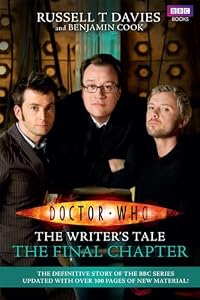
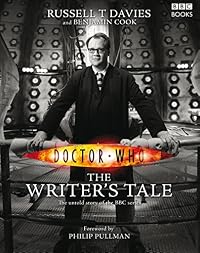
Doctor Who: The Writer's Tale: The Final Chapter
by Russell T. Davies, Benjamin Cook
Doctor Who {non-TV} (Writer's Tale)
On This Page
Description
For this revised and updated edition of The Writer's Tale, Head Writer and Executive Producer Russell T Davies and journalist Benjamin Cook continue their in-depth discussion of the creative life of Doctor Who to cover the last of Russell's specials, as well as the increasingly successfulTorchwood andThe Sarah Jane Adventures spin-offs. Candid and witty insights continue throughout a second year's worth of correspondence, covering David Tennant's final episodes as the Doctor, Russell's own show more departure from the show, and the legacy that both leave behind as a new era of Doctor Who begins.With over 300 pages of new material, and taking in events from the entire five years since the show's return in 2005, The Writer's Tale- The Final Chapter is the most comprehensive - and personal - account of Doctor Who ever published. show lessTags
Recommendations




Member Reviews
http://nwhyte.livejournal.com/1581275.html
Davies and Cook exchanged emails and texts for the last two years of Davies' tenure as show-runner of Doctor Who (ie 2007-2009), so the narrative is spontaneous, spur of the moment, and feels very genuine (though of course the reader cannot know what has been edited out in the process). I had already read the first half, and Cook and Davies spend some time in the second half discussing the reception of the original version. Davies is perpetually struggling with deadlines, with his other responsibilities as showrunner, with his role as a public figure and spokesman not only for his own show but for his industry.
The book offers insights into the process of writing, crafting and drafting, trying show more to get it right, over the period of weeks and months of producing Doctor Who. Occasionally one can trace particular elements to the outside world: Ben Cook, normally a passionate but detached observer, persuades Davies not to end Journey's End with a Cyberman teaser for The Next Doctor. But more often the writers are drawing on their own emotional resources and imagination, trying as it were to find the story that is trying to get out - there is a nice moment when Davies, emailing Cook, suddenly realises that Wilf Mott should be the instrument of the Tenth Doctor's demise.
Structured as a dialogue between two writers, with lots of pretty pictures and extra amaterial, it is also about a success: whether or not one is a fan of Who or of Davies' treatment of it, the fact is that he revived a faded franchise and made it a hit, and that in itself is a good story even if we are only getting the final years. I commented about the first edition that there were a lot of deaths in it; there is only one in the second half, but it is significant - the mother of the Executive Producer, Julie Gardner, of the same illness which Davies' own mother had succumbed to a few years earlier. While of course all authors draw on many life experiences, it's not too fanciful, I think, to see a direct link between this and the creation of the Claire Bloom character in The End of Time, who in Davies' mind is very explicitly the Doctor's own mother.
The Writer's Tale, however, is probably the best book about Doctor Who that will ever be written, and of immense interest to anyone who cares about television, sf, or indeed the creative process. show less
Davies and Cook exchanged emails and texts for the last two years of Davies' tenure as show-runner of Doctor Who (ie 2007-2009), so the narrative is spontaneous, spur of the moment, and feels very genuine (though of course the reader cannot know what has been edited out in the process). I had already read the first half, and Cook and Davies spend some time in the second half discussing the reception of the original version. Davies is perpetually struggling with deadlines, with his other responsibilities as showrunner, with his role as a public figure and spokesman not only for his own show but for his industry.
The book offers insights into the process of writing, crafting and drafting, trying show more to get it right, over the period of weeks and months of producing Doctor Who. Occasionally one can trace particular elements to the outside world: Ben Cook, normally a passionate but detached observer, persuades Davies not to end Journey's End with a Cyberman teaser for The Next Doctor. But more often the writers are drawing on their own emotional resources and imagination, trying as it were to find the story that is trying to get out - there is a nice moment when Davies, emailing Cook, suddenly realises that Wilf Mott should be the instrument of the Tenth Doctor's demise.
Structured as a dialogue between two writers, with lots of pretty pictures and extra amaterial, it is also about a success: whether or not one is a fan of Who or of Davies' treatment of it, the fact is that he revived a faded franchise and made it a hit, and that in itself is a good story even if we are only getting the final years. I commented about the first edition that there were a lot of deaths in it; there is only one in the second half, but it is significant - the mother of the Executive Producer, Julie Gardner, of the same illness which Davies' own mother had succumbed to a few years earlier. While of course all authors draw on many life experiences, it's not too fanciful, I think, to see a direct link between this and the creation of the Claire Bloom character in The End of Time, who in Davies' mind is very explicitly the Doctor's own mother.
The Writer's Tale, however, is probably the best book about Doctor Who that will ever be written, and of immense interest to anyone who cares about television, sf, or indeed the creative process. show less
This book is a series of e-mails between Russell T Davies, former executive producer and head writer for Doctor Who, and Benjamin Cook, journalist for Doctor Who Magazine, covering Davies's work on the series from February 2007 to July 2009, the time when the fourth series and the specials were produced. It's an expansion of an earlier work which I also enjoyed, and I think this is because it turns the production of the series itself into a story. I'm reading things I already know-- will they get Catherine Tate to play Donna? who will play Astrid? will the November special be canceled due to lack of funds?-- and yet I'm absolutely riveted, swept along by the story here. It's a neat trick, and a tribute to Davies's writing and Cook's show more e-mail selection. There a few things that stick out at me that are worth commenting on:
1. Madness. The most important thing one learns about Davies as a writer is that he grasps the fundamental madness of Doctor Who as a concept in a way few others have. Reading the early volumes of About Time, one is struck by the fact that everyone seems to think they're working on just another television series. Sure, its formula is a bit strange, but it's still just a TV show. The madness seems to almost emerge by accident rather than design. Davies understands how mad the show is, and builds it into every aspect of his design. I think the only other person to really grasp this was Robert Holmes. Time has yet to tell if Steven Moffat gets it, but I don't think you could write "The Girl in the Fireplace" if you didn't.
2. The Specials That Never Were. Davies's plans for the specials underwent endless permutations, and though I like some of what we got ("The Waters of Mars" was fantastic), you can't help wondering about that other world where an entirely different set of specials were made. I wish they'd done that Star Trek pastiche; it would've been fun. And that other finale for the tenth Doctor, featuring him by himself with a small alien family on a spaceship with a radiation leak, sounds fantastic. The man who gave us "Midnight" could have done that perfectly. As it is, "The End of Time" is a weird merger between that and the bombastic, and though Davies is generally quite good at that sort of thing, he didn't quite pull it off here. But why didn't he do it? That leads me to:
3. Visible Ben. In the first half of the book, Benjamin Cook vows to be "Invisible Ben," merely reading Davies's ideas, never judging or influencing them. Yet halfway through, he makes a (good) suggestion about the ending of "Journey's End," and he never returns to his invisibility. Except... I don't always like his ideas. He encourages Davies to bring back the Time Lords, amongst other things... Part of me wonders if he shouldn't have stayed invisible, and how that would have affected things.
4. Hooting. Davies seems to do this a lot when amused. I don't think I've ever seen the word used so much in a book that wasn't about owls. show less
1. Madness. The most important thing one learns about Davies as a writer is that he grasps the fundamental madness of Doctor Who as a concept in a way few others have. Reading the early volumes of About Time, one is struck by the fact that everyone seems to think they're working on just another television series. Sure, its formula is a bit strange, but it's still just a TV show. The madness seems to almost emerge by accident rather than design. Davies understands how mad the show is, and builds it into every aspect of his design. I think the only other person to really grasp this was Robert Holmes. Time has yet to tell if Steven Moffat gets it, but I don't think you could write "The Girl in the Fireplace" if you didn't.
2. The Specials That Never Were. Davies's plans for the specials underwent endless permutations, and though I like some of what we got ("The Waters of Mars" was fantastic), you can't help wondering about that other world where an entirely different set of specials were made. I wish they'd done that Star Trek pastiche; it would've been fun. And that other finale for the tenth Doctor, featuring him by himself with a small alien family on a spaceship with a radiation leak, sounds fantastic. The man who gave us "Midnight" could have done that perfectly. As it is, "The End of Time" is a weird merger between that and the bombastic, and though Davies is generally quite good at that sort of thing, he didn't quite pull it off here. But why didn't he do it? That leads me to:
3. Visible Ben. In the first half of the book, Benjamin Cook vows to be "Invisible Ben," merely reading Davies's ideas, never judging or influencing them. Yet halfway through, he makes a (good) suggestion about the ending of "Journey's End," and he never returns to his invisibility. Except... I don't always like his ideas. He encourages Davies to bring back the Time Lords, amongst other things... Part of me wonders if he shouldn't have stayed invisible, and how that would have affected things.
4. Hooting. Davies seems to do this a lot when amused. I don't think I've ever seen the word used so much in a book that wasn't about owls. show less
On his Who's Round podcast (in which he interviews various people who've been involved in Doctor Who over the years), Toby Hadoke got very annoyed with those listeners who only downloaded the episodes in which he interviewed Russell T Davies.
I do feel for Hadoke but I understand why listeners reacted in that way: it's not just that Davies was far more notable a contributor than Geoffrey J. Cravat and most of the others Hadoke has interviewed (as showrunner from 2005 to 2010, he oversaw the series' revival and arguably most popular period), it's that he is also one of the. best. interviewees. out there.
So The Writer's Tale, a record of the emails sent between Davies and journalist Benjamin Cook, over the latter years of Davies's time show more showrunning Doctor Who is a real treat.
If you're a fan of the show there's all the behind the scenes gossip and factoids you could hope for (Dennis Hopper's abortive role in the 2007 Christmas special; Davies's original low-budget plan for David Tennant's finale; Penny Carter, the companion who wasn't) but the real joy of the book is getting 700 pages of Davies's thoughts on narrative, representation, the TV industry, and everything in between.
Deliberately neither a behind the scenes guide nor an instruction manual on writing, it is a record of the process of writing as told from Davies's perspective. You don't have to agree with him, you don't have to emulate him, you don't even have to like him, but when you disagree, dissimulate or dislike it'll likely be in the understanding that it is Davies himself who has given you half the tools to argue against him. You may despair at his endless last-minute rushes to write his scripts, but it's because of him that you'll understand why that complicates matters and makes other people's lives more difficult. He's not short on self awareness.
He's also very, very funny, which helps.
Special shoutout also to interviewer and editor Benjamin Cook, who's the co-author of this book but too easily overlooked. He has an almost tabloid sensibility – but in this context that's actually a very, very good thing. So often in this correspondence he picks Davies up on points or off-hand comments that many would automatically shy away from out of politeness or fear of confrontation; Davies's reflection on his own grief at his mother's death is one of the most moving things I've read in a long time, and it's prompted by Cook asking him flat out why he's not come to terms with it.
Writing, Davies says, is about hammering away at your brain until you find some form of words that feels true to life as you have lived it. This book, as much as his TV scripts, is an exercise in that. God I wish he would write a novel; it'd probably kill me.
If you're a Doctor Who fan, this book is a no-brainer. If you've never even heard of a Dalek, but are interested in storytelling, put it at the top of your TBR pile. And always make time for a Russell T Davies interview.
Marvellous. show less
I do feel for Hadoke but I understand why listeners reacted in that way: it's not just that Davies was far more notable a contributor than Geoffrey J. Cravat and most of the others Hadoke has interviewed (as showrunner from 2005 to 2010, he oversaw the series' revival and arguably most popular period), it's that he is also one of the. best. interviewees. out there.
So The Writer's Tale, a record of the emails sent between Davies and journalist Benjamin Cook, over the latter years of Davies's time show more showrunning Doctor Who is a real treat.
If you're a fan of the show there's all the behind the scenes gossip and factoids you could hope for (Dennis Hopper's abortive role in the 2007 Christmas special; Davies's original low-budget plan for David Tennant's finale; Penny Carter, the companion who wasn't) but the real joy of the book is getting 700 pages of Davies's thoughts on narrative, representation, the TV industry, and everything in between.
Deliberately neither a behind the scenes guide nor an instruction manual on writing, it is a record of the process of writing as told from Davies's perspective. You don't have to agree with him, you don't have to emulate him, you don't even have to like him, but when you disagree, dissimulate or dislike it'll likely be in the understanding that it is Davies himself who has given you half the tools to argue against him. You may despair at his endless last-minute rushes to write his scripts, but it's because of him that you'll understand why that complicates matters and makes other people's lives more difficult. He's not short on self awareness.
He's also very, very funny, which helps.
Special shoutout also to interviewer and editor Benjamin Cook, who's the co-author of this book but too easily overlooked. He has an almost tabloid sensibility – but in this context that's actually a very, very good thing. So often in this correspondence he picks Davies up on points or off-hand comments that many would automatically shy away from out of politeness or fear of confrontation; Davies's reflection on his own grief at his mother's death is one of the most moving things I've read in a long time, and it's prompted by Cook asking him flat out why he's not come to terms with it.
Writing, Davies says, is about hammering away at your brain until you find some form of words that feels true to life as you have lived it. This book, as much as his TV scripts, is an exercise in that. God I wish he would write a novel; it'd probably kill me.
If you're a Doctor Who fan, this book is a no-brainer. If you've never even heard of a Dalek, but are interested in storytelling, put it at the top of your TBR pile. And always make time for a Russell T Davies interview.
Marvellous. show less
Oh, this is just brilliant! Welcome into the head of Russell T. Davies - a virtual trip to wonderland for any Whovian. Although this is mainly about writing the fourth series of the new Doctor Who and the following specials, the book covers everything from the financial issues of TV production, to public relations, to fandom, to rewriting other people's scripts, to Davies' own issues with crowds, and then a barrage of doctor-related gems in between. Obviously a must-read for Whovians, but this could still be read by anyone interested in TV writing or TV production. Also, since it's an email exchange between two close friends, we get access to some very personal information and the discussion sometimes gets excessively candid, but in a show more very, very good way. show less
I cannot begin to describe how excited I was upon acquiring The Writer's Tale - The Final Chapter. I have over the span of the last few years become a rabid little Doctor Who fan girl, and a bit of a British Television Junkie. Adding this to the fact that I think Russell T. Davies is brilliant, and I've loved him since I discovered Showtime's version of Queer as Folk which led me back to the original he created. I knew I was settling in for something that I would enjoy.
My surprise (though I don't know why I was really) comes from the fact that this book, not only gave me insight into a show I love and a man I admire, but it also spoke to me as a writer. The mad, manic process with continual highs and lows so freely spoken about in show more e-mails and text messages sent back and forth between Russell and Benjamin Cook, describes everything I've always felt writing to be. And probably for the first time ever, I came out of a book about writing, not feeling like I've been doing it all wrong, but rather feeling like I might have had it right this whole time. And while there are a lot of references to British television and Doctor Who, considering the origin, I think it can genuinely speak past that. With the footnotes to give a bit of background and explanation, I honestly believe this can speak to every writer, or any one who ever thought of being a writer, anyone who imagines mad, crazy, zany things, or simple moving moments.
Sure, it looks a bit like a daunting piece, well over 500 pages long, but I literally inhaled this tome in under 72 hours. It's funny, it's raw, and it doesn't lie. I simply cannot praise this enough. show less
My surprise (though I don't know why I was really) comes from the fact that this book, not only gave me insight into a show I love and a man I admire, but it also spoke to me as a writer. The mad, manic process with continual highs and lows so freely spoken about in show more e-mails and text messages sent back and forth between Russell and Benjamin Cook, describes everything I've always felt writing to be. And probably for the first time ever, I came out of a book about writing, not feeling like I've been doing it all wrong, but rather feeling like I might have had it right this whole time. And while there are a lot of references to British television and Doctor Who, considering the origin, I think it can genuinely speak past that. With the footnotes to give a bit of background and explanation, I honestly believe this can speak to every writer, or any one who ever thought of being a writer, anyone who imagines mad, crazy, zany things, or simple moving moments.
Sure, it looks a bit like a daunting piece, well over 500 pages long, but I literally inhaled this tome in under 72 hours. It's funny, it's raw, and it doesn't lie. I simply cannot praise this enough. show less
A MUST READ FOR FANS OF THE NEW DOCTOR WHO
This is a fantastic look backstage at the creation of Season Four of the new Who and the series of TV Specials that spanned the year between Doctor Ten (David Tennant) and Doctor Eleven (Matt Smith). It's told completely in a series of emails between the head writer of DW-Russell T. Davies and a writer for Doctor Who Magazine, Ben Cook. I found so many things I could relate to as Davies described the writing process: the procrastination, the late night work schedule, the characters talking in his head, the massive span of the Maybe. There's lots of eureka moments revealed: so many so THAT's why they told it that way epiphanies! It's amazing how many things now accepted as the only way to tell a show more story were made up at the last minute to fill a hole in the original plot!
Being the head writer, I suppose I shouldn't have been surprised by how much control Davies had over the other writers product, but my heart still went out to them when he ripped apart their scripts. One writer lost their story after over a year of development, although, now that I've seen previews for Season Five, it looks like it found a new home with the new Doctor. Russell Davies is above all things-a fanboy-and he insists he did it all for the good of the show. Argue all you like about his writing style and choices, but he did make DW a success and get it back on the air after a long absence. His trivia knowledge alone makes it obvious he was a great choice for head writer. The Doctor has been very important to him for a very long time.
It's a very frank memoir and reveals so much about the control of the DW empire and Davies himself, not to mention all those trips to Tesco each morning! Thank you for letting us inside your head. And good luck in LA!
One negative point: Having bought the extended version with two years of emails as opposed to one, the paper binding isn't really up to the task of 700+pages. I'd like to refer back to the book as I rewatch Season Four, but I'm afraid I'll break the spine! Perhaps a hardback edition for the American side of the pond would be in order. show less
This is a fantastic look backstage at the creation of Season Four of the new Who and the series of TV Specials that spanned the year between Doctor Ten (David Tennant) and Doctor Eleven (Matt Smith). It's told completely in a series of emails between the head writer of DW-Russell T. Davies and a writer for Doctor Who Magazine, Ben Cook. I found so many things I could relate to as Davies described the writing process: the procrastination, the late night work schedule, the characters talking in his head, the massive span of the Maybe. There's lots of eureka moments revealed: so many so THAT's why they told it that way epiphanies! It's amazing how many things now accepted as the only way to tell a show more story were made up at the last minute to fill a hole in the original plot!
Being the head writer, I suppose I shouldn't have been surprised by how much control Davies had over the other writers product, but my heart still went out to them when he ripped apart their scripts. One writer lost their story after over a year of development, although, now that I've seen previews for Season Five, it looks like it found a new home with the new Doctor. Russell Davies is above all things-a fanboy-and he insists he did it all for the good of the show. Argue all you like about his writing style and choices, but he did make DW a success and get it back on the air after a long absence. His trivia knowledge alone makes it obvious he was a great choice for head writer. The Doctor has been very important to him for a very long time.
It's a very frank memoir and reveals so much about the control of the DW empire and Davies himself, not to mention all those trips to Tesco each morning! Thank you for letting us inside your head. And good luck in LA!
One negative point: Having bought the extended version with two years of emails as opposed to one, the paper binding isn't really up to the task of 700+pages. I'd like to refer back to the book as I rewatch Season Four, but I'm afraid I'll break the spine! Perhaps a hardback edition for the American side of the pond would be in order. show less
I'd heard a lot of very positive things about this book, but I never really connected with it. It does give some fascinating insights into the process of running and writing an episodic TV show, and the included scripts are excellent examples of Davies’ work.
But... The connecting material of email exchanges between Davies and Cook often digressed from discussion on craft (which was insightful) in self-indulgent meanderings that had no real contribution to how or why certain storytelling decisions were made.
This wasn't a book I felt the urge to pick up and continue with each day. It sort of just sat there and was gradually worked through rather than read.
But... The connecting material of email exchanges between Davies and Cook often digressed from discussion on craft (which was insightful) in self-indulgent meanderings that had no real contribution to how or why certain storytelling decisions were made.
This wasn't a book I felt the urge to pick up and continue with each day. It sort of just sat there and was gradually worked through rather than read.
Members
- Recently Added By
Lists

Best Biographies, Autobiographies and Memoirs
464 works; 156 members

Favorite Memoirs and Biographies
4 works; 1 member

Five star books
1,755 works; 108 members
Author Information

121+ Works 3,708 Members
3+ Works 610 Members
Series

Work Relationships
Is an expanded version of
Common Knowledge
- Canonical title
- Doctor Who: The Writer's Tale: The Final Chapter
- Original publication date
- 2010-01-14
- People/Characters
- Russell T. Davies; Benjamin Cook; Paul Abbott; Freema Ageyman; Lindsey Alford; Howard Attfield (show all 90); Will Baker; John Barrowman; Pete Bennett; John Bleach; Myra Blyth; Nicholas Briggs; Charles III, King of the United Kingdom; Chris Chibnall; Noel Clarke; Will Cohen; Phil Collinson; Paul Cornell; Mark Cossey; Nicholas Courtney; Bernard Cribbins; Timothy Dalton; Gareth David-Lloyd; Peter Davison; Bryan Elsley; Lee Evans; Jennie Fava; John Fay; Janet Fielding; Peter Fincham; Judy Finnegan; Jane Fletcher; Phil Ford; Evelyn Gardner; Julie Gardner; Mark Gatiss; Michael Grade; Graeme Harper; Dennis Hopper; Rufus Hound; Julian Howarth; Jay Hunt; Lisa Jeynes; Matt Jones; Mike Jones; Anne Jowett; Peter Kay; Sam Kelly; Wynnie la Freak; Verity Lambert; Sarah Lancashire; Joseph Lidster; Euros Lyn; Tom MacRae; Richard Madeley; Paul Marquess; James Marsters; Peter McKinstry; Brian Minchin; Kylie Minogue; Caitlin Moran; James Moran; Colin Morgan; Chris Moyles; Eve Myles; Peter O'Toole; Francois Pandolfo; Billie Piper; Helen Raynor; Gareth Roberts; J. K. Rowling; Michelle Ryan; Lesley Sharp; John Simms; Tracie Simpson; Elisabeth Sladen; Andrew Smith; Matt Smith; Nikki Smith; James Strong; Catherine Tate; Colin Teague; Keith Temple; David Tennant; Ed Thomas; Russell Tovey; Jane Tranter; Piers Wenger; Penelope Wilton; Tony Wood
- Important places
- Cardiff, Wales, UK; Wales, UK; Dubai, United Arab Emirates; London, England, UK; Science Museum, London, England, UK; England, UK (show all 13); Los Angeles, California, USA; California, USA; Manchester, England, UK; Newport, Wales, UK; Rome, Italy; Italy; Swansea, Wales, UK
- First words
- Introduction (Russell T. Davies): I can't drive, so I get a lot of taxis.
Introduction (Benjamin Cook): ‘I love that image of this correspondence surviving a nuclear war,' Russell T Davies told me back in April 2007, two months into what would become a two-and-a-half-year-long exchange of e-mails... (show all) and text messages.
I've been thinking. - Last words
- (Click to show. Warning: May contain spoilers.)While always thinking of the ones I never wrote.
- Original language
- English
Classifications
- Genres
- Nonfiction, General Nonfiction, Biography & Memoir
- DDC/MDS
- 791.4572 — Arts & recreation Recreation, sports, and performing arts Movies, TV, Video Motion pictures, radio, television, podcasting Television Programs; television plays Single programs
- LCC
- PR6054 .A891513 .D63 — Language and Literature English English Literature 1961-2000
- BISAC
Statistics
- Members
- 291
- Popularity
- 110,114
- Reviews
- 10
- Rating
- (4.29)
- Languages
- English
- Media
- Paper, Ebook
- ISBNs
- 2
- ASINs
- 2