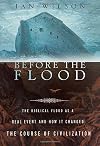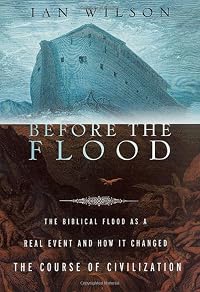
Before the Flood: The Biblical Flood as a Real Event and How It Changed the Course of Civilization
by Ian Wilson
On This Page
Description
The great Biblical flood described in Genesis has long been a subject of fascination and speculation. In the 19th century the English archbishop James Ussher established it as having happened in the year 2348 B.C., calculating what was then taken as the age of the earth and working backward through the entire series of Biblical "begats." Proof of the flood, which is an element of so many creation myths, began in earnest when archaeology started connecting physical evidence with Biblical show more story. As historian Ian Wilson reveals in this new book, evidence of a catastrophic event has been building steadily, culminating in the work of William Ryan and Walter Pitman. Several years ago Ryan and Pitman had posited that around 5600 BC there had been an inundation in the Black Sea of such proportions that it turned the freshwater lake into a saltwater lake by connecting it to the Mediterranean. Were that true, they estimated that there would be signs of civilization 300 feet below the surface of the Black Sea. In September 2000, using his famous underwater equipment, Robert Ballard explored parts of the Black Sea near the Turkish shore and found the remains of wood houses. There had been a flood that destroyed everything around it for hundreds of miles, killing tens of thousands of people. Exploring all the archeological evidence, Wilson explains how the Black Sea flood and the Biblical flood have to be connected. In particular, Wilson argues that the center of the civilized world was further to the West than previously thought-not in Egypt or Mesopotamia but in what is today Northern Turkey. The earliest, antediluvian civilizations may have migrated east into those places we have come to call the cradles of civilization, forced by the Black Sea flood to create new settlements. show lessTags
Recommendations












Member Reviews
well i thought this book began well, with a description of the various Flood myths the world contains. then it proceeds to locate a very possible actual event that the myths could celebrate. So far, so good. then after a chapter on the Robert Ballard expedition to the Black Sea, and his remarkable findings of rectangular dwellings at the site of a former sea-shore, now 90M beneath the waves, it gets rather more cosmic. And that's when I start re-channelling the me that read a number of works by Emmanuel Velikovsky. The book becomes a survey of possible sites for a superior civilization, with iron-working as a common technology, spread across the Mediterranean basin, up the Danube, and perhaps as far as the Punjab. then it goes into show more hiatus for 1500 years, reverts to copper-working as its primary technology, and is responsible for the usual Sumerian and Egyptian format for the advance of civilization until now.
perhaps the book was written to raise enough furor to get a good deal more submarine exploration of the Black sea, and I hope it does, but it goes into Atlantean studies, and that's very dodgy, as far as I'm concerned. I think i'll go read a stodgier book, "Deep History" in the near furure. show less
perhaps the book was written to raise enough furor to get a good deal more submarine exploration of the Black sea, and I hope it does, but it goes into Atlantean studies, and that's very dodgy, as far as I'm concerned. I think i'll go read a stodgier book, "Deep History" in the near furure. show less
This seemed like the exact sort of novel that I would love and maybe that's why I was harder on it than I needed to be. I didn't enjoy the episodic nature of the stories, nor did I find any of the characters in any way sympathetic. Samuel is so petulant and bitter; it makes it hard to care about what's happening to him and to his small New Brunswick town. I'm not, nor have I ever been, a teenage boy, so perhaps this is an accurate portrayal of what teenage boys are like. Even so, it's so unrelentingly peevish that the whole work was soured.
Approximately 5600 BC the Mediterranean Sea burst through the Bosporus and inundated the Black Sea, turning a fresh water lake into a salt water lake and drowning any existing coastal dwellings. Ian Wilson describes the underwater, submersible-aided, Black Sea archaeological discoveries of William Ryan, Walter Pitman and Robert Ballard. Wilson hypothesizes that the Black Sea food and the Biblical flood may be connected and that the center of the civilized world was located around the Black Sea in Turkey.
The author has a clear, elegant writing style that avoids overly-technical jargon and repetitive waffling. Ideas are presented logically and there is a clear differentiation between archaeological evidence, specialist interpretation and show more author interpretation. There is no religion bashing and no religion preaching in this book. All in all, a very nice archaeological detective story.
NOTE: This edition of the book has the photographs and illustrations printed very darkly, making it hard to determine some of the details. So if purchasing this book, see if you can find another edition or look up the pictures on the internet.
show less
The author has a clear, elegant writing style that avoids overly-technical jargon and repetitive waffling. Ideas are presented logically and there is a clear differentiation between archaeological evidence, specialist interpretation and show more author interpretation. There is no religion bashing and no religion preaching in this book. All in all, a very nice archaeological detective story.
NOTE: This edition of the book has the photographs and illustrations printed very darkly, making it hard to determine some of the details. So if purchasing this book, see if you can find another edition or look up the pictures on the internet.
show less
I loved this book. It is full of intrique and danger. This book is about a young man who comes to be on this earth as a messenger from God. Even if your not a Christian you can read this book and enjoy it. I would recommend this book to anyone.
Ratings
Members
- Recently Added By
Author Information

32+ Works 2,228 Members
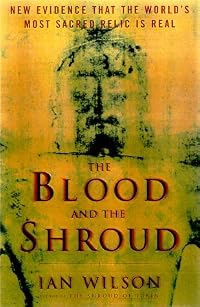
Born in London in 1941, Ian Wilson attended Emanuel School in London and Magdalen College in Oxford. After his schooling, Wilson pursued a career in business management. In 1973, he was invited to study the Shroud of Turin, a topic of interest very close to his heart. His work resulted in the best-seller The Turin Shroud, which was later show more translated into 10 languages. Wilson also co-scripted a critically-acclaimed television documentary on the subject, entitled The Silent Witness. This was followed by the best-selling book Jesus: The Evidence. Wilson is known for the investigative approach he takes in examining the evidence for life after death, stigmata, the biblical Exodus, the discovery of America, and the historical Shakespeare. Such was his approach in writing The Blood and the Shroud, which is the first detailed re-appraisal of the Shroud of Turin following the famous carbon dating. Wilson is married and has two sons. (Bowker Author Biography) show less
Awards and Honors
Classifications
- Genres
- Nonfiction, Anthropology, Religion & Spirituality, History
- DDC/MDS
- 220.93 — Religion The Bible The Bible Geography, history, chronology, persons of Bible lands in Bible times Archaeology (Material remains)
- LCC
- BS658 .W538 — Philosophy, Psychology and Religion The Bible The Bible Works about the Bible Bible and science
- BISAC
Statistics
- Members
- 168
- Popularity
- 192,891
- Reviews
- 4
- Rating
- (3.90)
- Languages
- English, Hungarian
- Media
- Paper, Audiobook, Ebook
- ISBNs
- 9
- ASINs
- 2