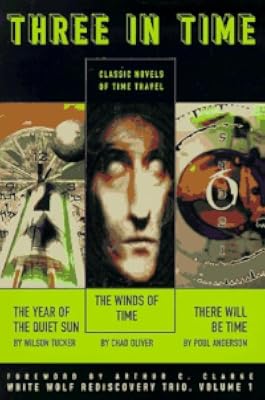
Three in Time: Classic Novels of Time Travel (White Wolf Rediscovery Trio, Vol. 1)
by Poul Anderson (Contributor), Jack Dann (Editor), Pamela Sargent (Editor), George Zebrowski (Editor)
White Wolf Rediscovery (Collections and Selections — 1)
On This Page
Description
The stories we tell are not limited to monsters and harsh otherworlds. Yet the fiction books in the Borealis imprint certainly belong to a world other than our own. This line encompasses our science fiction, fantasy and horror novels and anthologies.Tags
Recommendations


















Member Reviews
The Winds of Time: Chad Oliver
(First of the three novels included in the "Three in Time" collection)
Despite having been written in 1957, "The Winds of Time" remains an interesting twist on the usual time travel novel because these time travelers don’t use any sort of time machine to project themselves more than 15,000 years into the future. Rather, they use a potent drug to place themselves into suspended animation and let time itself travel at its normal pace. When they awaken, they are in the future. But all is not well.
Doctor Wes Chase, on a fishing vacation with his wife in Colorado, has his life forever changed when he is taken prisoner near a remote mountain lake by one of a group of aliens who crash landed on Earth some 15.000 show more years before his fateful encounter with them. When they crashed, these explorers, who closely resembled Earthlings, had been on a mission to find another race of men with whom they could partner up for the good of both groups. They quickly realized that Earth humans were in such a primitive stage of development that their only chance to ever see their home planet again required them to travel approximately 15,000 years into the future. Unfortunately for them, they awoke to find themselves still 200 years too early to expect any help from the people of Earth.
That’s where Wes Chase’s life changing adventure begins.
Chad Oliver, who died in 1993, was an anthropologist and his science fiction focused primarily on the kind of culture clash that results from the sudden contact of different cultural systems. Such a culture clash, and the way that both sides adapt and change each other in the process, is the most fascinating part of "The Winds of Time." Oliver’s style and his vision of what alien contact would be like influenced countless writers who followed him and he is regarded by many to be the equal of Robert A. Heinlein, Ray Bradbury and Arthur C. Clarke.
I have a fondness for time travel novels that goes back all the way to my teen years and that’s why I picked up "The Winds of Time." I was disappointed when I first realized that the novel did not employ the use of some kind of time travel hardware and relied instead on medicine to get the job done. But the longer that I read, and the more that I considered this twist, the more I realized that if time travel is ever to occur, Oliver’s idea is one of the more likely ways that it could actually happen. This isn’t a complicated novel, nor one filled with exotic battles and weaponry, but it is definitely one that fans of the genre will enjoy. It deserves to be remembered as one Science Fiction’s early classic volumes.
Rated at: 3.0
The Year of the Quiet Sun: Wilson Tucker
(Second of the three novels included in the "Three in Time" collection)
Written in 1970, this pessimistic time travel novel, a Hugo Award finalist, begins in 1978 when Brain Cheney is more or less drafted into a mysterious government project. Chaney is a Biblical scholar of sorts whose book debunking certain ancient scrolls has irritated many Christians around the country but he is also a professional demographer and has already produced one report for the government predicting how current trends will impact the near future. The government believes him to be perfect for this new project. Who better to send into the future in the new time machine invented by the Bureau of Weights and Measures than a man experienced in predicting that very future?
Interestingly, Brian Cheney and the two military officers drafted into the project with him travel only as far as twenty years into the future, to the turn of the new century, because government officials are so concerned with what they see as a dark future for the United States that they hope to learn enough from the time travel to change that future. Today’s readers, of course, have lived beyond the years visited by these time travelers so their adventurous trip into the future has become our past. As a result, The Year of the Quiet Sun reads as much like an alternate history novel at times as it does as a story of time travel.
Cheney, the only civilian time-traveler of the team, has little regard for politicians and resents the way that the President and his staff order that the first trip into the future be only to 1980 so that the President can determine whether or not he will be re-elected. The three travelers, who can go into the future only one-at-a-time due to the limitations of their vehicle, get that information for him but they also return to 1978 with news of the tremendous unrest and violence that is already impacting the future of America’s major cities, especially Chicago. It is when they are sent forward to 2000, and just beyond, to learn the effectiveness of the President’s attempt to save the country that the novel really takes off.
The second half of the book centers itself around realistic military skirmishes between government troops and the rebels who are intent on overthrowing the government with help from the Chinese, but it also details the evolving relationships of the three time- travelers and the head of their project, the beautiful Katherine with whom two of the men have become particularly smitten. Readers who may have found the pace of the book’s first half to be a bit slow in its set-up of the second half action will find themselves well-rewarded for staying with the book to the end. Tucker’s vision of the horrible future that could have resulted from the radicalism of the 1960s and early 1970s is a horrifying one.
Tucker even saves a nice little surprise for his readers until near the end, one that more astute readers than me may figure out earlier, but one that made me laugh out loud at its cleverness.
Rated at: 4.0 show less
(First of the three novels included in the "Three in Time" collection)
Despite having been written in 1957, "The Winds of Time" remains an interesting twist on the usual time travel novel because these time travelers don’t use any sort of time machine to project themselves more than 15,000 years into the future. Rather, they use a potent drug to place themselves into suspended animation and let time itself travel at its normal pace. When they awaken, they are in the future. But all is not well.
Doctor Wes Chase, on a fishing vacation with his wife in Colorado, has his life forever changed when he is taken prisoner near a remote mountain lake by one of a group of aliens who crash landed on Earth some 15.000 show more years before his fateful encounter with them. When they crashed, these explorers, who closely resembled Earthlings, had been on a mission to find another race of men with whom they could partner up for the good of both groups. They quickly realized that Earth humans were in such a primitive stage of development that their only chance to ever see their home planet again required them to travel approximately 15,000 years into the future. Unfortunately for them, they awoke to find themselves still 200 years too early to expect any help from the people of Earth.
That’s where Wes Chase’s life changing adventure begins.
Chad Oliver, who died in 1993, was an anthropologist and his science fiction focused primarily on the kind of culture clash that results from the sudden contact of different cultural systems. Such a culture clash, and the way that both sides adapt and change each other in the process, is the most fascinating part of "The Winds of Time." Oliver’s style and his vision of what alien contact would be like influenced countless writers who followed him and he is regarded by many to be the equal of Robert A. Heinlein, Ray Bradbury and Arthur C. Clarke.
I have a fondness for time travel novels that goes back all the way to my teen years and that’s why I picked up "The Winds of Time." I was disappointed when I first realized that the novel did not employ the use of some kind of time travel hardware and relied instead on medicine to get the job done. But the longer that I read, and the more that I considered this twist, the more I realized that if time travel is ever to occur, Oliver’s idea is one of the more likely ways that it could actually happen. This isn’t a complicated novel, nor one filled with exotic battles and weaponry, but it is definitely one that fans of the genre will enjoy. It deserves to be remembered as one Science Fiction’s early classic volumes.
Rated at: 3.0
The Year of the Quiet Sun: Wilson Tucker
(Second of the three novels included in the "Three in Time" collection)
Written in 1970, this pessimistic time travel novel, a Hugo Award finalist, begins in 1978 when Brain Cheney is more or less drafted into a mysterious government project. Chaney is a Biblical scholar of sorts whose book debunking certain ancient scrolls has irritated many Christians around the country but he is also a professional demographer and has already produced one report for the government predicting how current trends will impact the near future. The government believes him to be perfect for this new project. Who better to send into the future in the new time machine invented by the Bureau of Weights and Measures than a man experienced in predicting that very future?
Interestingly, Brian Cheney and the two military officers drafted into the project with him travel only as far as twenty years into the future, to the turn of the new century, because government officials are so concerned with what they see as a dark future for the United States that they hope to learn enough from the time travel to change that future. Today’s readers, of course, have lived beyond the years visited by these time travelers so their adventurous trip into the future has become our past. As a result, The Year of the Quiet Sun reads as much like an alternate history novel at times as it does as a story of time travel.
Cheney, the only civilian time-traveler of the team, has little regard for politicians and resents the way that the President and his staff order that the first trip into the future be only to 1980 so that the President can determine whether or not he will be re-elected. The three travelers, who can go into the future only one-at-a-time due to the limitations of their vehicle, get that information for him but they also return to 1978 with news of the tremendous unrest and violence that is already impacting the future of America’s major cities, especially Chicago. It is when they are sent forward to 2000, and just beyond, to learn the effectiveness of the President’s attempt to save the country that the novel really takes off.
The second half of the book centers itself around realistic military skirmishes between government troops and the rebels who are intent on overthrowing the government with help from the Chinese, but it also details the evolving relationships of the three time- travelers and the head of their project, the beautiful Katherine with whom two of the men have become particularly smitten. Readers who may have found the pace of the book’s first half to be a bit slow in its set-up of the second half action will find themselves well-rewarded for staying with the book to the end. Tucker’s vision of the horrible future that could have resulted from the radicalism of the 1960s and early 1970s is a horrifying one.
Tucker even saves a nice little surprise for his readers until near the end, one that more astute readers than me may figure out earlier, but one that made me laugh out loud at its cleverness.
Rated at: 4.0 show less
This here is three, three, three books in one:
The Winds of Time
I picked this up at the Friends of the Library sale. It was part of a three novel collection featuring my favorite sub-genre, time travel. Winds was nothing spectacular, merely (!) a good, solid science-fiction tale. It tells the story of a vacationing man who comes across a group of aliens who have been sequestered in the Colorado mountains for millenia, sleeping in suspended animation. It's almost two stories: one about the aliens and their purpose for coming to Earth, the other about a man who makes first contact and discovers his own alienation. If you're looking for a good science fiction tale to read, I'd advise you to check it out. (****)
The Year of the Quiet Sun
What show more a ride this one was. This is a novel that was highly regarded in it's day (1970). However it's a future dystopia--a tale in which features a future time that is very bleak. In this case, members of a time travel project in 1978 travel forward in time first to 1980 then to the turn of the century. Since I have lived through all of those time periods, I can tell you that Mr. Tucker didn't get anything predicted right. For some reason he figured that the attitudes of the late sixties counter culture towards nudity and marijuana would catch on while those on racial equality and the war in Vietnam wouldn't. But even as I was laughing at the details I was engrossed in the story and characters, trying to puzzle out what was happening and eagerly seeing what happened next. And the end, I totally missed a little detail which was hinted at and was surprised when it was revealed. This is definitely one of the great time travel novels that have been written, and hence is going on my shelf. (*****)
There Will Be Time
At last, a time travel story that comes up for a practical use for time travel besides setting up a beauracracy to protect "history as we know it." (Not that I don't enjoy tales like that...) Of course, you have to wait until the end of the book to find out what it is, but that's no problem. There Will Be Time is an excellent tale concerning a man who has the ability to project himself through time and how he manages to use this talent. Well, it's more than that. We see his moral development as he interacts with the people he meets in past, present and future. In one sense, history is immutable for him, so the author is free to explore how a time traveller would shape the future rather than getting fixated on the past. All in all, it's a great novel. Even if it wasn't in a collection along with another keeper, The Year of the Quiet Sun, I would put this one on my shelf. (*****)
--J. show less
The Winds of Time
I picked this up at the Friends of the Library sale. It was part of a three novel collection featuring my favorite sub-genre, time travel. Winds was nothing spectacular, merely (!) a good, solid science-fiction tale. It tells the story of a vacationing man who comes across a group of aliens who have been sequestered in the Colorado mountains for millenia, sleeping in suspended animation. It's almost two stories: one about the aliens and their purpose for coming to Earth, the other about a man who makes first contact and discovers his own alienation. If you're looking for a good science fiction tale to read, I'd advise you to check it out. (****)
The Year of the Quiet Sun
What show more a ride this one was. This is a novel that was highly regarded in it's day (1970). However it's a future dystopia--a tale in which features a future time that is very bleak. In this case, members of a time travel project in 1978 travel forward in time first to 1980 then to the turn of the century. Since I have lived through all of those time periods, I can tell you that Mr. Tucker didn't get anything predicted right. For some reason he figured that the attitudes of the late sixties counter culture towards nudity and marijuana would catch on while those on racial equality and the war in Vietnam wouldn't. But even as I was laughing at the details I was engrossed in the story and characters, trying to puzzle out what was happening and eagerly seeing what happened next. And the end, I totally missed a little detail which was hinted at and was surprised when it was revealed. This is definitely one of the great time travel novels that have been written, and hence is going on my shelf. (*****)
There Will Be Time
At last, a time travel story that comes up for a practical use for time travel besides setting up a beauracracy to protect "history as we know it." (Not that I don't enjoy tales like that...) Of course, you have to wait until the end of the book to find out what it is, but that's no problem. There Will Be Time is an excellent tale concerning a man who has the ability to project himself through time and how he manages to use this talent. Well, it's more than that. We see his moral development as he interacts with the people he meets in past, present and future. In one sense, history is immutable for him, so the author is free to explore how a time traveller would shape the future rather than getting fixated on the past. All in all, it's a great novel. Even if it wasn't in a collection along with another keeper, The Year of the Quiet Sun, I would put this one on my shelf. (*****)
--J. show less
Ratings
Members
- Recently Added By
Author Information

Poul Anderson, November 25, 1926 - July 31, 2001 Poul Anderson was born on November 25, 1926 in Bristol, Pennsylvania to parents Anton and Astrid. After his father's death, Poul's mother took them first to Denmark and then to Maryland and Minnesota. He earned his degree in Physics from the University of Minnesota, but chose instead to write show more stories for science fiction magazines, such as "Astounding." Anderson is considered a "hard science fiction" writer, meaning that his books have a basis in scientific fact. To attain this high level of scientific realism, Anderson spent many hours researching his topics with scientists and professors. He liked to write about individual liberty and free will, which was a well known theme in many of his books. He also liked to incorporate his love of Norse mythology into his stories, sometimes causing his modern day characters to find themselves in fantastical worlds, such as in "Three Hearts and Three Lions," published in 1961. Anderson has written over a hundred books, his last novel, "Genesis" won the John W. Campbell Award, one of the three major science fiction awards. He is a former president of the Science Fiction and Fantasy Writers of America and won three Nebula awards and nine Hugo Awards. In 1997, Anderson was named a Grandmaster by the Science Fiction and Fantasy Writers of America and was also inducted into the Science Fiction Fantasy Hall of Fame. Poul Anderson died on July 31, 2001 at the age of 74. (Bowker Author Biography) show less

Jack Dann is a science fiction writer and editor who was born in 1945 in Johnson City, New York, and now lives on a farm in Victoria, Australia. He is a multiple award winning author who has written or edited over 65 books, which have been translated into thirteen languages. His short stories have appeared in major magazines and anthologies show more including Omni, Asimov's F&SF, Penthouse, and Playboy. His historical fiction novel about Leonardo da Vinci, The Memory Cathedral, won the 1996 Australian Aurealis Award for Best Fantasy Novel and was number one on the Age bestseller list. His novella 'Da Vinci Rising', which integrates several sections of The Memory Cathedral with some new material, won the 1996 Nebula Award, making him the first Australian resident to win this award. He has received the Australian Aurealis Award twice, the Ditmar Award three times, and the World Fantasy Award. (Bowker Author Biography) show less


All Editions
Series

Work Relationships
Contains
Has as a reference guide/companion
Common Knowledge
- Original title
- Three in Time
Classifications
- Genres
- Fiction and Literature, Science Fiction, Horror
- DDC/MDS
- 813.54 — Literature & rhetoric American literature in English American fiction in English 1900-1999 1945-1999
- LCC
- PZ3 .C551205 — Language and Literature Fiction and juvenile belles lettres Fiction and juvenile belles lettres Fiction in English
Statistics
- Members
- 53
- Popularity
- 573,699
- Reviews
- 2
- Rating
- (4.00)
- Languages
- English
- Media
- Paper
- ISBNs
- 1
- ASINs
- 1