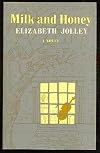
Milk and Honey
by Elizabeth Jolley
On This Page
Description
A self-absorbed young musician comes as a pupil-boarder to the house of an 'old European' family. Gradually his life is taken over and consumed, seemingly, by dark, mysterious forces within as much as outside himself. Milk and Honeyis a strangely haunting novel. While much of what we have come to expect and admire in Elizabeth Jolley's work is powerfully present - vivid and diverse characters, pathos, humour and acute perceptions of people and their situations - it is in many ways quite show more unlike anything she has previously written. A work of gothic proportions, Milk and Honeyis an astonishing tapestry of character and incident that surprises and yet never fails to convince. show lessTags
Recommendations









Member Reviews
The "blurb" on my edition of Milk and Honey describes a story of passion and duty, set in a family where music takes center stage. At a young age, Jacob is sent to live with a family who will develop his musical skills. He develops an infatuation for his tutor's daughter Louise, and later for an older woman named Madge who he meets through the local orchestra. Jacob's feelings of passion for Madge and duty towards Louise are the novel's primary conflict.
But this book is actually much darker and ambiguous. Louise's family (brother, father, and two spinster aunts) is described through Jacob's naive point of view. He fails to see the dysfunction and secrets, and the reader is also left to interpret events on their own. Jacob's show more relationship with Louise is unsatisfying for both of them, and it's not clear until much later why it develops as it does (avoiding spoilers here).
This short novel was difficult to read, but I felt compelled to finish just to see how some early foreshadowing came about. However, on the whole it wasn't especially satisfying. I admired some of Jolley's technique, but on the whole the characters were too shallow and the story far too bleak. show less
But this book is actually much darker and ambiguous. Louise's family (brother, father, and two spinster aunts) is described through Jacob's naive point of view. He fails to see the dysfunction and secrets, and the reader is also left to interpret events on their own. Jacob's show more relationship with Louise is unsatisfying for both of them, and it's not clear until much later why it develops as it does (avoiding spoilers here).
This short novel was difficult to read, but I felt compelled to finish just to see how some early foreshadowing came about. However, on the whole it wasn't especially satisfying. I admired some of Jolley's technique, but on the whole the characters were too shallow and the story far too bleak. show less
In anticipation of the centenary of Elizabeth Jolley's death on June 4th, I read my Fremantle Arts Centre Press edition of Jolley's fifth novel, Milk and Honey.
First published in 1984, Milk and Honey is in some ways classic Jolley: it features a lonely character alienated from and yet trapped in the society around him; but the Gothic elements in this novel were a departure from her previous fiction.
Somehow, I was able to get behind the paywall at the ABR to find Stephanie Trigg's 1986 review of The Well, which makes reference to the common themes in Jolley's fiction.
Comparing Jolley with Helen Garner whose work is said by critics and reviews to be similarly confined to a domestic canvas, Triggs writes that Jolley’s pictures of show more domestic life are much wilder, more dramatic, and more violent. Murder, madness, sexual and psychological violence abound, and many Jolley narratives in their bare bones are quite alarming and bizarre. That is most certainly true of Milk and Honey, despite the Biblical allusion of its title to a 'promised land' of abundance and fertility. There are unexplained deaths, illnesses and disappearances, and a death which is not a death though the 'murderer' thinks it is. The central character's wife has a child but it's not his because he is impotent with her, though not with his lover who is herself infertile. The sterile marriage is offset by the birth of a child through incest.
The 'mad woman in the attic' is not a woman and is not mad either, but rather a grotesque caricature whose tragedy is that he has been denied a life because of his parents' fear of doctors. Reminiscent of the entrapment imposed by the destitute elderly Russian émigré, Nastasya, in The Newspaper of Claremont Street (1981, see my review) Waldemar both traps his family and is trapped by them because they refuse to hand him over to institutional care. Childlike Waldemar, dripping with the honey that he loves to eat, is the only character who represents fertility and abundance.
And the musical prodigy turns out to be really rather ordinary, fit only for a provincial orchestra and then not even that when his own violence disfigures his hands. This is not a story of resilience or triumph over adversity and there is little kindness in it.
In Brian Dibble's 2008 biography Doing Life (which I can't find on my shelves, did I lend it to someone?), Jolley's story begins with the enigmas of her own family life. As I wrote in my review, Jolley’s father bore his wife’s love for the enigmatic (and underfoot) Mr Berrington with fortitude, and this influenced Jolley’s interest in depicting sexual triangles.
To read the rest of my review please visit https://anzlitlovers.com/2023/05/28/milk-and-honey-1984-by-elizabeth-jolley/ show less
First published in 1984, Milk and Honey is in some ways classic Jolley: it features a lonely character alienated from and yet trapped in the society around him; but the Gothic elements in this novel were a departure from her previous fiction.
Somehow, I was able to get behind the paywall at the ABR to find Stephanie Trigg's 1986 review of The Well, which makes reference to the common themes in Jolley's fiction.
Comparing Jolley with Helen Garner whose work is said by critics and reviews to be similarly confined to a domestic canvas, Triggs writes that Jolley’s pictures of show more domestic life are much wilder, more dramatic, and more violent. Murder, madness, sexual and psychological violence abound, and many Jolley narratives in their bare bones are quite alarming and bizarre. That is most certainly true of Milk and Honey, despite the Biblical allusion of its title to a 'promised land' of abundance and fertility. There are unexplained deaths, illnesses and disappearances, and a death which is not a death though the 'murderer' thinks it is. The central character's wife has a child but it's not his because he is impotent with her, though not with his lover who is herself infertile. The sterile marriage is offset by the birth of a child through incest.
The 'mad woman in the attic' is not a woman and is not mad either, but rather a grotesque caricature whose tragedy is that he has been denied a life because of his parents' fear of doctors. Reminiscent of the entrapment imposed by the destitute elderly Russian émigré, Nastasya, in The Newspaper of Claremont Street (1981, see my review) Waldemar both traps his family and is trapped by them because they refuse to hand him over to institutional care. Childlike Waldemar, dripping with the honey that he loves to eat, is the only character who represents fertility and abundance.
And the musical prodigy turns out to be really rather ordinary, fit only for a provincial orchestra and then not even that when his own violence disfigures his hands. This is not a story of resilience or triumph over adversity and there is little kindness in it.
In Brian Dibble's 2008 biography Doing Life (which I can't find on my shelves, did I lend it to someone?), Jolley's story begins with the enigmas of her own family life. As I wrote in my review, Jolley’s father bore his wife’s love for the enigmatic (and underfoot) Mr Berrington with fortitude, and this influenced Jolley’s interest in depicting sexual triangles.
To read the rest of my review please visit https://anzlitlovers.com/2023/05/28/milk-and-honey-1984-by-elizabeth-jolley/ show less
Ratings
Members
- Recently Added By
Lists

Australian Classics: Fifty Great Writers and Their Celebrated Works
43 works; 1 member
Author Information

30+ Works 2,135 Members
Elizabeth Jolley was born Monica Elizabeth Knight in Birmingham, England on June 4, 1923. She was educated privately until age 11, when she was sent to Sibford School, a Quaker boarding school. At 17 she began training as nurse in London and was exposed firsthand to the horrors of World War II. She emigrated to Australia in 1959 with her husband show more and their three children. Before becoming a full-time author, she had numerous jobs including nursing, housecleaning, and farming. She published her first book of short stories, Five Acre Virgin and Other Stories, in 1976, and her first novel, Palomino, in 1980. Her other works included The Newspaper of Claremont Street, Mr. Scobie's Riddle, The Well, My Father's Moon, Miss Peabody's Inheritance, Foxybaby, and The Sugar Mother. She died on February 13, 2007 at the age of 83. (Bowker Author Biography) show less
Awards and Honors
Common Knowledge
- Original publication date
- 1984
- First words
- This was the street where Madge, suddenly worried that she had forgotten her tampax, drove slowly, unconcernedly, taking up the whole road while she fumbled mysteriously to find out.
Classifications
Statistics
- Members
- 116
- Popularity
- 281,272
- Reviews
- 2
- Rating
- (3.69)
- Languages
- English, French
- Media
- Paper, Audiobook
- ISBNs
- 9
- ASINs
- 3