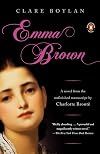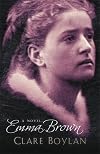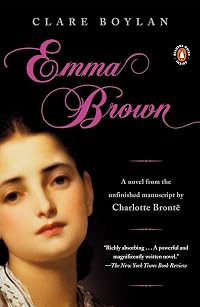
Emma Brown
by Clare Boylan
On This Page
Description
The author creates a complete narrative around the twenty pages of unfinished manuscript by Charlotte Bronte? about a mysterious young student, the child of an apparently wealthy father, who turns a provincial Victorian school upside down.Tags
Recommendations





Member Reviews
I started this book with trepidation. Often, works based off of unfinished manuscripts are horrible. The worst of the genre being those that just recycle characters and plot points from other works by the same author.
Thus, I was pleasantly surprised by how Boylan took 20 pages of a manuscript from Charlotte Bronte and wrote a story that was all her own and highly entertaining in its own right. The first chapter from Boylan was a bit of an abrupt transition. As the story gained in momentum though, Boylan found her own rhythm and voice that was reminiscent of Bronte without being derivative or fake.
All in all, I really enjoyed this and would have been quite happy to read it even without the Bronte connection.
Thus, I was pleasantly surprised by how Boylan took 20 pages of a manuscript from Charlotte Bronte and wrote a story that was all her own and highly entertaining in its own right. The first chapter from Boylan was a bit of an abrupt transition. As the story gained in momentum though, Boylan found her own rhythm and voice that was reminiscent of Bronte without being derivative or fake.
All in all, I really enjoyed this and would have been quite happy to read it even without the Bronte connection.
I wouldn't actually call this a beach read. It's far too thick to lug to the beach and, honestly, the way I sobbed a little reading it on the train would also be inappropriate for the beach. You'll just have to let this one slide. My blogging schedule is very tight these next few weeks so you get what you get.
And what you're getting today is a beautiful book inspired by some twenty-odd pages Charlotte Brontë abandoned in the two years before her death. These same pages (it is assumed) inspired Frances Hodgson Burnett's A Little Princess, wherein a well-mannered and well-off little girl is established at a boarding school but, when she loses her father, the school keeps her on as a maid, of sorts, until she meets with a happy ending at show more the hand of an exotic gentleman who was previously a friend of her father's.
Most people know the Shirley Temple version or the 1995 version (Liam Cunningham FTW!!.... sorry... sometimes I'm a 15 year-old-girl...), both of which took liberties with that story and resolved the plot with the girl's father being recovered from an injury in the war (oh, he's not dead... we just thought he was dead!) and they're reunited la-dee-da. Well. It's interesting to see the way twenty pages of introduction can influence two decidedly different stories.
Boylan begins her version by including Brontë's twenty-page text, and then continues in Brontë fashion, that is from the perspective of a youngish (30s) widow. It is from her that we learn Emma's tale. You can almost see Mr. Carrisford and others in Mrs. Chalfont and in Mr. Ellin, whose backstory is taken from another unfinished Bronte work, and who, with Mrs. Chalfont, goes about Emma's salvation. True to Charlotte's style, there's more here than meets the eye--everyone involved seems to always have more history to share. Boylan fleshes them out in the form of self-narrative, something Charlotte Brontë was very accustomed to doing.
Boylan not only carried on in Brontë style and character, she considered Charlotte's life - her experiences in her later life which would have surely influenced this novel, had she completed it. She was very attuned to the plight of London's poor, and since Charlotte wrote best about what she knew, it's almost certain that similar episodes would have made it into her text. But while little Emma holds the title's name, it is the narrator's life story that is the most sympathetic and the most genuine.
Part of this surely comes from the fact that Charlotte was yet again writing as a governess whose life was not ideal - I'll grant Charlotte the credit for that. But the way in which Boylan brings her to life - quite literally by mashing together tiny bits and pieces of Jane Eyre, Shirley and Vilette. As Mrs. Chalfont's youth unfolds as young Isa on the page, she is vibrant and alive and, most importantly, full of passion. Passion is perhaps one of the most important qualities in a Charlotte Bronte novel. After all, it was she who criticized Jane Austen, saying "...she ruffles her reader by nothing vehement, disturbs him by nothing profound: the Passions are perfectly unknown to her; she rejects even a speaking acquaintance with that stormy Sisterhood..."
True, passion is of the utmost importance and Boylan has written it beautifully. But while these similarietes stand, and the key features are honored, there is a certain unease in the pastiche. Boylan did, I'm sure, her best to capture Brontë's voice and tone, but by clipping together her past works and then laying her later life's experiences over them, the voice of the novel seems off. There is almost as much of Brontë in the stroytelling as there is of Thackeray and, perhaps even more so, Dickens.
I can see how that would irk a Brontë scholar, and it must be observed that, as much as we would like it to be Charlotte's novel, it is only Clare Boylan's. But for being her novel, it is touching and passionate and excellent. I borrowed this one from the library, and I truly regret it - I wish I'd sucked it up and bought it for myself. But hey, Christmas is coming!
Lauren Cartelli
www.theliterarygothamite.com show less
And what you're getting today is a beautiful book inspired by some twenty-odd pages Charlotte Brontë abandoned in the two years before her death. These same pages (it is assumed) inspired Frances Hodgson Burnett's A Little Princess, wherein a well-mannered and well-off little girl is established at a boarding school but, when she loses her father, the school keeps her on as a maid, of sorts, until she meets with a happy ending at show more the hand of an exotic gentleman who was previously a friend of her father's.
Most people know the Shirley Temple version or the 1995 version (Liam Cunningham FTW!!.... sorry... sometimes I'm a 15 year-old-girl...), both of which took liberties with that story and resolved the plot with the girl's father being recovered from an injury in the war (oh, he's not dead... we just thought he was dead!) and they're reunited la-dee-da. Well. It's interesting to see the way twenty pages of introduction can influence two decidedly different stories.
Boylan begins her version by including Brontë's twenty-page text, and then continues in Brontë fashion, that is from the perspective of a youngish (30s) widow. It is from her that we learn Emma's tale. You can almost see Mr. Carrisford and others in Mrs. Chalfont and in Mr. Ellin, whose backstory is taken from another unfinished Bronte work, and who, with Mrs. Chalfont, goes about Emma's salvation. True to Charlotte's style, there's more here than meets the eye--everyone involved seems to always have more history to share. Boylan fleshes them out in the form of self-narrative, something Charlotte Brontë was very accustomed to doing.
Boylan not only carried on in Brontë style and character, she considered Charlotte's life - her experiences in her later life which would have surely influenced this novel, had she completed it. She was very attuned to the plight of London's poor, and since Charlotte wrote best about what she knew, it's almost certain that similar episodes would have made it into her text. But while little Emma holds the title's name, it is the narrator's life story that is the most sympathetic and the most genuine.
Part of this surely comes from the fact that Charlotte was yet again writing as a governess whose life was not ideal - I'll grant Charlotte the credit for that. But the way in which Boylan brings her to life - quite literally by mashing together tiny bits and pieces of Jane Eyre, Shirley and Vilette. As Mrs. Chalfont's youth unfolds as young Isa on the page, she is vibrant and alive and, most importantly, full of passion. Passion is perhaps one of the most important qualities in a Charlotte Bronte novel. After all, it was she who criticized Jane Austen, saying "...she ruffles her reader by nothing vehement, disturbs him by nothing profound: the Passions are perfectly unknown to her; she rejects even a speaking acquaintance with that stormy Sisterhood..."
True, passion is of the utmost importance and Boylan has written it beautifully. But while these similarietes stand, and the key features are honored, there is a certain unease in the pastiche. Boylan did, I'm sure, her best to capture Brontë's voice and tone, but by clipping together her past works and then laying her later life's experiences over them, the voice of the novel seems off. There is almost as much of Brontë in the stroytelling as there is of Thackeray and, perhaps even more so, Dickens.
I can see how that would irk a Brontë scholar, and it must be observed that, as much as we would like it to be Charlotte's novel, it is only Clare Boylan's. But for being her novel, it is touching and passionate and excellent. I borrowed this one from the library, and I truly regret it - I wish I'd sucked it up and bought it for myself. But hey, Christmas is coming!
Lauren Cartelli
www.theliterarygothamite.com show less
A really fine book. Boylan did not try to be Charlotte Bronte, and there are darker events in the book than you find in Victorian novels, dealing as it does with the lives of street children and adolescent prostitutes. I think the key is that the fragment was so short. It was enough to establish a few characters and an intriguing situation, but not so long that it over-committed the new author. Still, Boylan had the task of keeping her characterization consistent with the Bronte’s beginning, and she succeeded. And despite the darker elements, there is much about this novel that is genuinely Victorian: the conventionally happy ending (complete with rescued street urchin); an episode involving imprisonment, forgery, and mistaken show more identity from Mrs. Chalfont’s youth; the notion that a marriage between a very young woman and a middle-aged man can be a happy one. There are some lighter elements that are rarely found in nineteenth-century novels, however, including Mrs. Chalfont’s brief moment of rekindled passion in mid-life (the nineteenth century favored very young heroines) when she is reunited with the man she once loved. It is a nineteenth century novel for a twenty-first century sensibility, possessed of both Bronte’s generosity of spirit and the modern willingness to have a little reality mixed in with our fantasy. show less
While it may be "Brontean," it has much more a feel of Anne to it than Charlotte. The abused governess recalls Agnes Grey, and there are times when the novel's tone much more resembles the greater religiosity of Anne than Charlotte.
A more serious problem, though, is the author's problem with narrative point of view. Although Isa Chalfont is the ostensible narrator, the author has a tendency to slip into a more omniscient narrator in those chapters in which Mrs Chalfont isn't immediately present. This just isn't the skillful handling of a first person narration that Charlotte demonstrated in Jane Eyre or Villette or that Emily demonstrated in Wuthering Heights. It's the much less skillful narration of The Tenant of Wildfell Hall.
This show more book just doesn't have the feel of Charlotte to it. show less
A more serious problem, though, is the author's problem with narrative point of view. Although Isa Chalfont is the ostensible narrator, the author has a tendency to slip into a more omniscient narrator in those chapters in which Mrs Chalfont isn't immediately present. This just isn't the skillful handling of a first person narration that Charlotte demonstrated in Jane Eyre or Villette or that Emily demonstrated in Wuthering Heights. It's the much less skillful narration of The Tenant of Wildfell Hall.
This show more book just doesn't have the feel of Charlotte to it. show less
Emma Brown is a modern-day continuation of a novel left unfinished by Charlotte Bronte at the time of her death. It's a quick read, and one which definitely encompasses all the kinds of twists and turns of astonishing coincidence that marks a truly Gothic, Brontean novel. However, the tone is much too modern, with turns of thought and phrase that struck me as anachronistic; for Boylan to have updated the novel in that respect made me wish that she had equally made the plot more suited to modern sensibilities--the disconnect made the book seem much sillier than I think it was. Certainly, it ensured that the ending squicked the hell out of me.
Interesting if you want to see the chapters that Charlotte Bronte left behind, but for me this show more was pretty forgettable stuff. show less
Interesting if you want to see the chapters that Charlotte Bronte left behind, but for me this show more was pretty forgettable stuff. show less
When Charlotte Brontë died, she left 20 pages of a novel behind. Clare Boylan decided to finish it. A little girl is enrolled in a private girls' academy. She is shy and reclusive, but the headmistresses make much of her because it's obvious that her benefactor has money. Trouble arises when her benefactor can't be found and the girl can't--or won't--tell anyone anything about herself.
I have to say that this novel stayed true to the whole Gothic, melodramatic feel that I associate with the Brontës. There were all kinds of improbable twists, turns, loops, and coincidences. Boylan was much more explicit than Charlotte Brontë could have been. Not that she was explicit, it just seems that some things weren't referred to, even obliquely, show more in those times. I did pick out where Charlotte left off and Boylan took over, but I was pleasantly surprised by how well it did all fit together.
There were a lot of chapters covering the back stories of the supporting characters. They were absolutely necessary, but since I didn't know that until the end, I was mostly frustrated and wishing I could get on with the "real" story.
I would have rated this a little higher if I could have liked Emma a little better. But I really, really didn't like her. She was all "Woe is me!" and "All is ashes." She kept going though, through all her troubles, so I had to admire her for that, but would a smile really have killed her? And her world view was stark black and white. She did not see or acknowledge any shade of gray. She was very unforgiving and intolerant. If this character had been written in Jane Eyre's place, she would never have forgiven Mr. Rochester for lying about his marriage and that would have been the end of that.
But I did like Isabel Chalfont. Her life was never easy either, but she made the best of it, learned what she could, found happiness where she could, and tried not to dwell too much on things she couldn't change.
I think fans of the Brontës, who have read all their work and wish they could read more, will actually like this. Just don't expect anything other than doom and gloom from Emma. show less
I have to say that this novel stayed true to the whole Gothic, melodramatic feel that I associate with the Brontës. There were all kinds of improbable twists, turns, loops, and coincidences. Boylan was much more explicit than Charlotte Brontë could have been. Not that she was explicit, it just seems that some things weren't referred to, even obliquely, show more in those times. I did pick out where Charlotte left off and Boylan took over, but I was pleasantly surprised by how well it did all fit together.
There were a lot of chapters covering the back stories of the supporting characters. They were absolutely necessary, but since I didn't know that until the end, I was mostly frustrated and wishing I could get on with the "real" story.
I would have rated this a little higher if I could have liked Emma a little better. But I really, really didn't like her. She was all "Woe is me!" and "All is ashes." She kept going though, through all her troubles, so I had to admire her for that, but would a smile really have killed her? And her world view was stark black and white. She did not see or acknowledge any shade of gray. She was very unforgiving and intolerant. If this character had been written in Jane Eyre's place, she would never have forgiven Mr. Rochester for lying about his marriage and that would have been the end of that.
But I did like Isabel Chalfont. Her life was never easy either, but she made the best of it, learned what she could, found happiness where she could, and tried not to dwell too much on things she couldn't change.
I think fans of the Brontës, who have read all their work and wish they could read more, will actually like this. Just don't expect anything other than doom and gloom from Emma. show less
Clare Boylan, who sadly died in 2006, wrote her story using the first two chapters of a novel started by Charlotte Bronte entitled "Emma," as well as parts of a work entitled "The Story of Willie Ellin", then went off on her own. I will definitely agree with other reviewers who say that this book probably wouldn't have been the outcome of Charlotte Bronte's work, but all the same, it was quite good -- a page turner from start to finish. I read the entire story in one sitting, all 400+ pages.
The book begins with a young girl, Matilda Fitzgibbon, being left at a school for young ladies run by the misses Wilcox at Fuchsia Lodge. She has been left with beautiful clothes as well as instructions that she is to be favored by the headmistress. show more But toward Christmas time, Miss Mabel Wilcox writes the parents of her pupils about their plans for their children at Christmas vacation, and discovers that the address left by Matilda's father is nonexistent. Upon further checking, they find that Mr. Fitzgibbon himself is nonexistent, and thus that Matilda's fees are going to be left unpaid. This the Misses Wilcox cannot abide, and these revelations set into motion a story that at times will have you flipping pages wondering what else can possibly happen. It is part detective story, part a coming of age novel, part a novel about the refusal of the human spirit to be crushed, and on top of it all, very well written, even if it was not perhaps carried through the way Charlotte Bronte would have. It is a rather dark story the whole way through -- the kind of things Charlotte Bronte fans might actually enjoy.
I would most definitely recommend it to people who like a bit of the gothic in their reading, people who enjoy period pieces, and people who are looking for a good story. From start to finish you will not be let down, unless, of course, you are a Bronte purist and can't fathom someone else taking this all on. Understandable, so, if that's you, this probably isn't your cup of tea.
The characters are very well done, the action is nonstop, and this is a fine book all around. I highly recommend this one. show less
The book begins with a young girl, Matilda Fitzgibbon, being left at a school for young ladies run by the misses Wilcox at Fuchsia Lodge. She has been left with beautiful clothes as well as instructions that she is to be favored by the headmistress. show more But toward Christmas time, Miss Mabel Wilcox writes the parents of her pupils about their plans for their children at Christmas vacation, and discovers that the address left by Matilda's father is nonexistent. Upon further checking, they find that Mr. Fitzgibbon himself is nonexistent, and thus that Matilda's fees are going to be left unpaid. This the Misses Wilcox cannot abide, and these revelations set into motion a story that at times will have you flipping pages wondering what else can possibly happen. It is part detective story, part a coming of age novel, part a novel about the refusal of the human spirit to be crushed, and on top of it all, very well written, even if it was not perhaps carried through the way Charlotte Bronte would have. It is a rather dark story the whole way through -- the kind of things Charlotte Bronte fans might actually enjoy.
I would most definitely recommend it to people who like a bit of the gothic in their reading, people who enjoy period pieces, and people who are looking for a good story. From start to finish you will not be let down, unless, of course, you are a Bronte purist and can't fathom someone else taking this all on. Understandable, so, if that's you, this probably isn't your cup of tea.
The characters are very well done, the action is nonstop, and this is a fine book all around. I highly recommend this one. show less
Members
- Recently Added By
Author Information

16+ Works 1,013 Members
All Editions
Work Relationships
Is an expanded version of
Common Knowledge
- Canonical title
- Emma Brown
- Original publication date
- 2003
- Dedication
- To the memory of Carol Shields
- First words
- We all seek an ideal in life.
- Quotations
- I suspect the influence of unsupervised reading.
- Last words
- (Click to show. Warning: May contain spoilers.)Reader you must decide.
- Original language
- English
- Disambiguation notice
- - Emma Brown by Clare Boylan is a completion of a novel that Charlotte Bronte started, but left unfinished at her death.
- Emma: a Fragment is the unfinished work by Bronte.
- Emma by Charlotte Bronte a... (show all)nd Another Lady (ie Constance Savery) is another completion of Bronte's incomplete work.
Please do not combine these works (or any completed works with different completed works, or with the original unfinished work).
Classifications
Statistics
- Members
- 598
- Popularity
- 48,800
- Reviews
- 16
- Rating
- (3.39)
- Languages
- Dutch, English, German, Hungarian
- Media
- Paper, Audiobook
- ISBNs
- 16
- ASINs
- 3