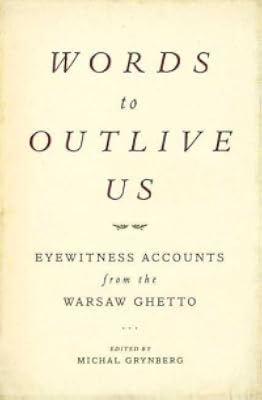
Words to Outlive Us: Eyewitness Accounts from the Warsaw Ghetto
by Michal Grynberg
On This Page
Description
This collective memoir--a mosaic of individual diaries, journals, and accounts--follows the fate of the Warsaw Jews from the first bombardments of the Polish capital to the razing of the Jewish district: the frantic exchange of apartments as the walls first go up; the daily battle against starvation and disease; the moral ambiguities confronting Jewish bureaucracies under Nazi rule; the ingenuity of smugglers; and the acts of resistance. Stunning in their immediacy, these urgent accounts show more challenge us to imagine the unimaginable. show lessTags
Recommendations


















Member Recommendations
Member Reviews
This is a fine collection of accounts, most of which have never been previously published, that really gave me the sense of what it was like to live and fight and die in the Warsaw ghetto. The writers were a wide variety of people -- mostly Jews of course, but there were some gentiles, and even one young child -- and there were biographical sketches revealing details of each person's life and fate, if known. Recommended for scholarly Holocaust collections.
A book that brings home to us the nightmare of daily life under the Nazi persecutions.The nitty-gritty of finding food,finding work,holding on to some semblance of humanity in the worst of all scenarios.
A book to remind us of small heroisms,and to remind us of the human beings capability for evil,and capacity for suffering.
This ought to be standard reading in high school.
A book to remind us of small heroisms,and to remind us of the human beings capability for evil,and capacity for suffering.
This ought to be standard reading in high school.
This review says it better than I can:
From Publishers Weekly
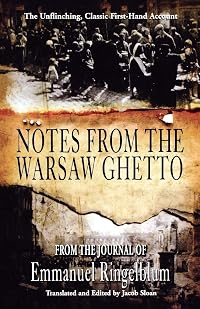
The 29 never-before-published diaries, letters and personal accounts in the late historian Grynberg's vital collection offer a devastating portrait of life in the Warsaw Ghetto between 1940 and 1943. Less than 1% of the almost 500,000 Jews confined there survived the disease, malnutrition and deportation to concentration camps; a handful of the contributors escaped the ghetto by navigating the sewer system to the "Aryan" side of Warsaw. Historian Emanuel Ringelblum's noted journals provided an exhaustive, firsthand record of the Warsaw Ghetto, but these skillfully translated records by shopkeepers and doctors, dentists and schoolgirls are more powerful. Ghetto residents write show more of needing to get permission to bake matzoh, longing for the patter of autumn rain or hiding in a room with 200 stifling, hot, dirty, stinking people; two cases of full-blown tuberculosis; one of measles. Several of the diarists are members of the Jewish police, who express the agony of trying to provide for their families while collaborating with the enemy. The diversity of the contributors' cultural and economic backgrounds adds to the mural of a variegated Jewish Warsaw during Nazi occupation; mostly translated from Polish, the different voices include assimilationists, traditionalists, communists, socialists and Zionists. Some are despairing; others, like the brilliant Helena Midler, whose parodic Bunker Weekly stuck out its tongue at hardship, find ways to laugh. Many of the accounts note the meticulous planning behind the Nazis' dizzying regulations, and the editor adds relevant data, including maps and detailed rosters of laborers. If one can read only one book on the Warsaw Ghetto, this is it. show less
From Publishers Weekly
The 29 never-before-published diaries, letters and personal accounts in the late historian Grynberg's vital collection offer a devastating portrait of life in the Warsaw Ghetto between 1940 and 1943. Less than 1% of the almost 500,000 Jews confined there survived the disease, malnutrition and deportation to concentration camps; a handful of the contributors escaped the ghetto by navigating the sewer system to the "Aryan" side of Warsaw. Historian Emanuel Ringelblum's noted journals provided an exhaustive, firsthand record of the Warsaw Ghetto, but these skillfully translated records by shopkeepers and doctors, dentists and schoolgirls are more powerful. Ghetto residents write show more of needing to get permission to bake matzoh, longing for the patter of autumn rain or hiding in a room with 200 stifling, hot, dirty, stinking people; two cases of full-blown tuberculosis; one of measles. Several of the diarists are members of the Jewish police, who express the agony of trying to provide for their families while collaborating with the enemy. The diversity of the contributors' cultural and economic backgrounds adds to the mural of a variegated Jewish Warsaw during Nazi occupation; mostly translated from Polish, the different voices include assimilationists, traditionalists, communists, socialists and Zionists. Some are despairing; others, like the brilliant Helena Midler, whose parodic Bunker Weekly stuck out its tongue at hardship, find ways to laugh. Many of the accounts note the meticulous planning behind the Nazis' dizzying regulations, and the editor adds relevant data, including maps and detailed rosters of laborers. If one can read only one book on the Warsaw Ghetto, this is it. show less
Ratings
Members
- Recently Added By
Lists

Holocaust Narratives
159 works; 3 members
Author Information
6 Works 165 Members
Michal Grynberg, an associate of the Jewish Historical Institute in Warsaw, devoted decades of his life to compiling and publishing firsthand accounts from ghettos throughout Poland.
Some Editions
Common Knowledge
- Important places
- Warsaw Ghetto
- Important events
- Holocaust
Classifications
Statistics
- Members
- 159
- Popularity
- 205,273
- Reviews
- 3
- Rating
- (4.21)
- Languages
- English, Spanish
- Media
- Paper, Ebook
- ISBNs
- 6
- ASINs
- 2