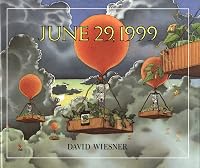
June 29, 1999
by David Wiesner
On This Page
Description
While her third-grade classmates are sprouting seeds in paper cups, Becky has a more ambitious, innovative science project in mind.Tags
Recommendations










Member Recommendations
Member Reviews
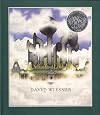
This is one of David Wiesner (3-time Caldecott Award winner)'s older stories, which contains many of his signature touches: surreal floating items in otherwise realistic settings, clever and beautiful visuals, exquisitely rendered detail, and a delightfully whimsical story. In June 29, 1999, a girl sends vegetable seedlings into the upper atmosphere as a science project. Soon giant vegetables fall to earth ("Cucumbers circle Kalamazoo. Lima beans loom over Levittown."), each page crazier and funnier than the last. The twist at the end is that these are not her vegetables, somehow transformed in space, but instead are the accidental kitchen scrapings of a clumsy alien cephalopod.
The real reason I love it, though, is my 6 and a half year show more old's reaction to it. She read it to herself as I was driving and giggled her way through the story. Her review: "I loved it! The vegetables had such great adventures!" show less
The real reason I love it, though, is my 6 and a half year show more old's reaction to it. She read it to herself as I was driving and giggled her way through the story. Her review: "I loved it! The vegetables had such great adventures!" show less
Holly Evans has the bright idea to send off plant seedlings into the sky by attaching them to Acme balloons for her science project. About a month later, on June 29, 1999, gigantic vegetables start floating down to earth, landing all over America: "Cucumbers circle Kalamazoo. Lima beans loom over Levittown. Artichokes advance on Anchorage. Parsnips pass by Providence." These strange events are widely reported in the media, but Holly is astounded when watching the TV coverage, she sees that "Cauliflower carpets California, spinach blankets Greenwich, and Arugula covers Ashtabula" because the strange thing is, Holly didn't include Arugula in her experiment. Another fantastic Wiesner project which to my mind is as great as Flotsam. Why it show more didn't get a Caldecott is the real mystery here. show less
Holly Evans sends vegetables into the sky for a science project. When the sky is filled with huge vegetables, Holly thinks that it is a success. However, she finds out that some of the vegetables are not the same vegetables that she sent up. She becomes disappointed in her project and wonders where the vegetables could be coming from. Meanwhile, in the sky, an assistant fry cook of the Alula Borealis, accidentally sends their entire food supply down to Earth. That's where all of the vegetables came from, and they also received ours from Earth. This is a strange little story, but it is expected since it comes from David Wiesner. I don't think that I would read this book to my students when learning about science, but it is a good story show more to feed the imagination. show less
Vegetables are (beautifully) floating in the sky! This is another whimsically illustrated book from Wiesner. The illustrations also portray different parts of the United States, so this could be a fun book to include when discussing the variety in American geography. l also love the character design of the aliens at the end of the story.
Red peppers. I always knew they were the flightiest of vegetables. And this book proves it. When giant vegetables mysteriously float down to Earth's surface, one little girl wonders if her science project has gone astonishingly awry.
Hilarious artwork, and an entirely convincing broccoli tree house. Like the author's other books.the wonderfully realistic style of he art contrasts so well with the hilarious oddness of the subject.
Hilarious artwork, and an entirely convincing broccoli tree house. Like the author's other books.the wonderfully realistic style of he art contrasts so well with the hilarious oddness of the subject.
I really thought this book was fun to read and creative. The illustrations were wonderful and did a great job of telling the story visually. The ending was funny and very unexpected. I also loved the alliteration in the story, which I think would be very entertaining for children. It's a great read for children and encourages their imagination!
In 1999, a young girl sends some vegetable seedlings up in the air for a school science experiment. Soon giant vegetables start falling from the sky all across the world.
This whimsical book was set in the near-future from its publication date, giving it a science fiction feel. My initial reaction to seeing the title was that it would feel dated, but it really isn't. The illustrations are well done, complementing the text. This is a good read for when you want to share something that is simply light and fun.
This whimsical book was set in the near-future from its publication date, giving it a science fiction feel. My initial reaction to seeing the title was that it would feel dated, but it really isn't. The illustrations are well done, complementing the text. This is a good read for when you want to share something that is simply light and fun.
Members
- Recently Added By
Lists

Honey For a Child's Heart
1,152 works; 25 members

Brightly Beaming Curriculum Books
281 works; 8 members

Reading Rainbow
193 works; 10 members

Books Read in 2022
5,226 works; 115 members
Author Information

20+ Works 19,692 Members
American children's book author and illustrator David Wiesner was born in Bridgewater, New Jersey on February 5, 1956. He graduated with a BFA in Illustration from Rhode Island School of Design. Known for his imaginative work, Wiesner is particularly celebrated for using wordless storytelling in his picture books. His latest picture book is about show more two artists; it is entitled, Art & Max. "Sector 7" and "Free Fall" are Caldecott Honor Books, while Wiesner won the prestigious Caldecott Medal for "Tuesday" (1992), "The Three Pigs" (2002), and "Flotsam" (2007). Wiesner is only the second person to have won this award three times. (Bowker Author Biography) show less
All Editions
Awards and Honors
Awards
Distinctions
Work Relationships
Is contained in
Common Knowledge
- People/Characters
- Holly Evans
- Important places
- New Jersey, USA; Ho-Ho-Kus, New Jersey, USA
- Dedication
- For Kevin and Dawon,
hello and goodbye - First words
- The place is Ho-Ho-Kus, New Jersey.
- Last words
- (Click to show. Warning: May contain spoilers.)As their vegetables drifted toward the small blue planet below, everyone on board has the same thought: Where would their supper come from?
Classifications
Statistics
- Members
- 1,443
- Popularity
- 16,386
- Reviews
- 68
- Rating
- (4.20)
- Languages
- Chinese, English
- Media
- Paper
- ISBNs
- 12
- UPCs
- 2
- ASINs
- 7