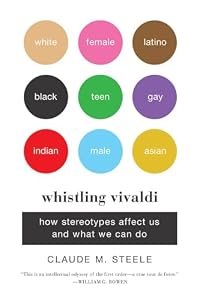
Whistling Vivaldi: How Stereotypes Affect Us and What We Can Do (Issues of Our Time)
by Claude M. Steele
On This Page
Description
In this work, the author, a social psychologist, addresses one of the most perplexing social issues of our time: the trend of minority underperformance in higher education. With strong evidence showing that the problem involves more than weaker skills, he explores other explanations. Here he presents an insider's look at his research and details his groundbreaking findings on stereotypes and identity, findings that will deeply alter the way we think about ourselves, our abilities, and our show more relationships with each other. Through dramatic personal stories, he shares the researcher's experience of peering beneath the surface of our ordinary social lives to reveal what it is like to be stereotyped based on our gender, age, race, class, or any of the ways by which we culturally classify one another. What he discovers is that this experience of "stereotype threat" can profoundly affect our functioning: undermining our performance, causing emotional and physiological reactions, and affecting our career and relationship choices. But because these threats, though little recognized, are near-daily and life-shaping for all of us, the shared experience of them can help bring Americans closer together. Always aware of the ways that identity plays out in the lives of real people, his conclusions shed new light on a host of American social phenomena, from the racial gender gaps in test scores to the belief in the superior athletic prowess of black men. In a time of renewed discourse about race and class, this work offers insight into how we form our sense of self, and lays out a plan that will both reduce the negative effects of "stereotype threat" and begin reshaping American identities. -- From book jacket. show lessTags
Recommendations



















Member Reviews
Women worry about the stereotype that men are better at math. African-Americans worry about the stereotype of lesser academic achievement. Whites worry about the stereotype of lesser athletic ability, or that Asians supposedly are better at math. Men going into an empathetic profession worry about stereotypes of lesser empathy. And so on. Social psycologist Claude Steele calls these stereotype threats, and just the anxiety they create can severely impede performance, as confirmed in a truckload of social experiments.
"There is truly inspirational news here: evidence that often small, feasible things done to reduce these threats in schools and classrooms can dramatically reduce the racial and gender achievement gaps that so discouragingly show more characterize our society."
I found this book absolutely fascinating. It discloses truths that get lost under unreasoning and misleading emotion, provides insights and information I never would have thought of, and demonstrates the healthy effects of the kinds of "small, feasible things" he mentions on people's performances in their preferred fields, and on their relating to each other. I'm grateful to Ellen for her great review of this book. It deserves widespread attention.
Something as simple as reminding "test takers of identities that counter the relevant stereotype" before a test has been shown to have a significant positive, measurable impact on test results. The one requisite: the person must care about his/her performance. We also learn that anxiety over stereotype threats actually activates non-performing parts of the brain - it literally causes the brain to use its capabilities in a non-productive way. And we'll virtually all claim, and believe, that we're not experiencing that anxiety when, in fact, we are.
Counseling in certain ways can cause dramatic change; expressing company policy in certain ways can make even a non-diverse company attractive to diverse candidates. Whites who are unconsciously chary of discussing racial issues with blacks become more open (and physically move their chairs closer!) when the exchange is framed as a learning experience. (Other positive framing cues didn't work, but that did).
This is an important book, and it's heartening that the studies described are being conducted all over the world, with results continuing to confirm the insights and productive strategies described by Claude Steele. show less
"There is truly inspirational news here: evidence that often small, feasible things done to reduce these threats in schools and classrooms can dramatically reduce the racial and gender achievement gaps that so discouragingly show more characterize our society."
I found this book absolutely fascinating. It discloses truths that get lost under unreasoning and misleading emotion, provides insights and information I never would have thought of, and demonstrates the healthy effects of the kinds of "small, feasible things" he mentions on people's performances in their preferred fields, and on their relating to each other. I'm grateful to Ellen for her great review of this book. It deserves widespread attention.
Something as simple as reminding "test takers of identities that counter the relevant stereotype" before a test has been shown to have a significant positive, measurable impact on test results. The one requisite: the person must care about his/her performance. We also learn that anxiety over stereotype threats actually activates non-performing parts of the brain - it literally causes the brain to use its capabilities in a non-productive way. And we'll virtually all claim, and believe, that we're not experiencing that anxiety when, in fact, we are.
Counseling in certain ways can cause dramatic change; expressing company policy in certain ways can make even a non-diverse company attractive to diverse candidates. Whites who are unconsciously chary of discussing racial issues with blacks become more open (and physically move their chairs closer!) when the exchange is framed as a learning experience. (Other positive framing cues didn't work, but that did).
This is an important book, and it's heartening that the studies described are being conducted all over the world, with results continuing to confirm the insights and productive strategies described by Claude Steele. show less
This should be required reading for every educator in the U.S. and perhaps beyond. Steele, an eminent social psychologist at Stanford University (now at UC-Berkeley), described his research into stereotype thread and its impact on students' performance in a variety of situations. While much of the research focuses on the impact of stereotype threat on women in math-related fields and African-Americans in academic settings more broadly, I appreciated that some of his team's research has focused on the affect of stereotype threat on white students faced with interacting with black students regarding a racially-charged topic. The white students are also subject to stereotype threat in their desire not to be judged as racially insensitive; show more this confirms the broad applicability of the research without undermining the observation that, on average, it is not white students who face adverse identity contingencies in academic settings on a day-to-day basis.
He offers ways to address stereotype threat such as encouraging students engaging in intercultural dialogue to adopt a learning attitude, and teachers can create this by using learning objectives and clearly stating that learning IS the objective (reassuring students that they won't be judged based on stereotypes about their group has no positive impact at all), and that mistakes are to be expected. He also outlines some implications for mentors as well as for educational institutions for minimizing the cues that activate stereotype threat for students in negatively stereotyped groups.
And remember, this varies on context -- as a white woman I am vulnerable to stereotype threat based on my gender in some but not all situations and this depends, in part, on which of my identities is made salient in a particular situation.
I listened to this as an audiobook and found it engaging, thought-provoking, and enjoyable. I also recommend it for anyone interested in the process of social psychological research as the descriptions of the experiments and the thinking that surrounded them was fascinating and took me back to my early graduate school days. show less
He offers ways to address stereotype threat such as encouraging students engaging in intercultural dialogue to adopt a learning attitude, and teachers can create this by using learning objectives and clearly stating that learning IS the objective (reassuring students that they won't be judged based on stereotypes about their group has no positive impact at all), and that mistakes are to be expected. He also outlines some implications for mentors as well as for educational institutions for minimizing the cues that activate stereotype threat for students in negatively stereotyped groups.
And remember, this varies on context -- as a white woman I am vulnerable to stereotype threat based on my gender in some but not all situations and this depends, in part, on which of my identities is made salient in a particular situation.
I listened to this as an audiobook and found it engaging, thought-provoking, and enjoyable. I also recommend it for anyone interested in the process of social psychological research as the descriptions of the experiments and the thinking that surrounded them was fascinating and took me back to my early graduate school days. show less
Steele's book should be considered essential reading for anyone who seriously reflects on social identity in today's world. It is a strenuous and comprehensive evaluation of the scientific exploration that has been accomplished in this area. It also serves as a professional memoir for the author. Steele is careful to note that no one is free of bias, not even himself. Yet we can strive to make up for such human deficits through scientific probing into the unknown. While keeping in mind that at the root of identity an unknown factor may eventually foist all of our efforts at comprehension, Steele stoically pushes forward towards his ideal of progress and reform. Running on the hypothesis that stereotypes negatively effect the performance show more of high-achieving students in academic settings, Steele takes his reader on an exploration of the effects of stereotype threat. Stereotype threat is a subset of what Steele calls, "identity contingencies". These contingencies are based on an individual's sense of belonging to a group. When an individual believes that their liberties are hampered by one of these contingencies found in the social setting, this concern begins to impede the mental functioning of the individual (defined by working memory, ability to perform tasks, and a sense of self-esteem). A negative reaction to identity contingencies may be sparked by the slightest suggestion from the environment, usually spiraling into a vicious cycle of torment and stress. Although Steele only measures the effects caused by temporary stereotype threat, he acknowledges that the effects of stereotype threat on a long-term basis could be physically damaging to health. To add weight to this idea, he enlists the "John Henryism" hypothesis of Sherman James.
Steele's experimental conclusions suggest a solution to the problem of minority student underachievement: through changing a small part of the academic learning environment (the cues) minorities can be led to feel a sense of "identity safety". Although other cues also effect the performance of a ability-stereotyped students, like critical mass, Steele is optimistic that cues can be manipulated for desired positive outcomes. While he acknowledges that there are some things that we simply cannot change overnight, historical repercussions that continue to threaten our society, we must "err in the direction of urging greater trust, rather than greater vigilance" (p. 164).
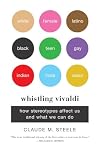
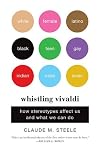
My only criticism of this book is that the cover and title do not adequately convey the scope of information contained in the book. They under/over-estimate the topics covered in the book. When I first saw the cover I expected this book to engage the entire palette of color-coded stereotypes in the cover-image. To my disappointment, the book had nothing in depth to say about the stereotypes of Latinos, Indians, Gays, Males, or Teens. There was a brief discussion on stereotypes of old age, which could be used to contrast with stereotypes of youth, yet no real discussion on this topic. The groups that were of primary concern were white and black Males (cognitive ability, athletics), females (math ability), and Asians (math ability). The title was also misleading. The author's message is that "whistling Vivaldi" is not enough to effect widespread change, when arising in the mind of a stereotyped student. It is not the responsibility of victims of stereotype threat, but that of their mentors and leaders to alter the cues and make performance environments identity safe for stereotyped students. In this sense, "whistling Vivaldi", can also be the solution, when suggested by a mentor. If every suggestion is a deception, then every compulsion is an adaptation to a contingency. At this level, the logic of this whole experimental journey into identity gets a bit murky, yet this is where discussion needs to start. We would also have to journey outside the realm of social psychology to approach these mysteries. show less
Steele's experimental conclusions suggest a solution to the problem of minority student underachievement: through changing a small part of the academic learning environment (the cues) minorities can be led to feel a sense of "identity safety". Although other cues also effect the performance of a ability-stereotyped students, like critical mass, Steele is optimistic that cues can be manipulated for desired positive outcomes. While he acknowledges that there are some things that we simply cannot change overnight, historical repercussions that continue to threaten our society, we must "err in the direction of urging greater trust, rather than greater vigilance" (p. 164).
My only criticism of this book is that the cover and title do not adequately convey the scope of information contained in the book. They under/over-estimate the topics covered in the book. When I first saw the cover I expected this book to engage the entire palette of color-coded stereotypes in the cover-image. To my disappointment, the book had nothing in depth to say about the stereotypes of Latinos, Indians, Gays, Males, or Teens. There was a brief discussion on stereotypes of old age, which could be used to contrast with stereotypes of youth, yet no real discussion on this topic. The groups that were of primary concern were white and black Males (cognitive ability, athletics), females (math ability), and Asians (math ability). The title was also misleading. The author's message is that "whistling Vivaldi" is not enough to effect widespread change, when arising in the mind of a stereotyped student. It is not the responsibility of victims of stereotype threat, but that of their mentors and leaders to alter the cues and make performance environments identity safe for stereotyped students. In this sense, "whistling Vivaldi", can also be the solution, when suggested by a mentor. If every suggestion is a deception, then every compulsion is an adaptation to a contingency. At this level, the logic of this whole experimental journey into identity gets a bit murky, yet this is where discussion needs to start. We would also have to journey outside the realm of social psychology to approach these mysteries. show less
Review: Whistling Vivaldi and other Clues to How Stereotypes Affect Us, by Claude M. Steele.
(Interview with author: http://www.npr.org/templates/story/story.php?storyId=125859207)
A group of students who are good at math are about to be given a hard test. Strangely, it often happens that women who appear to be as equally qualified in math as men don’t actually test as well, and that is true in the control group. But one group of women, just before the test, is told that this is a “gender normed test” which does not have a disparity in scores between men and women (in reality, everyone gets the same test). The women do better. Another group of women is given a short survey about how they feel about coed dorms. They do worst of all. show more What gives? Stereotype threat. The first group of women is already under stereotype threat (the idea that women don’t do as well as men at math is a known stereotype), the second group has had it removed (to some degree) and the third group has had it increased (by being reminded that they are women). Just this small outward change in the situation around the test is enough to change their scores, because what stereotype threat does is trigger activity in your mind that detracts from working on the problem at hand. Despite and because of the desire to do well and not confirm bad stereotypes (that women can’t do math), these women are not able to perform at their full ability.
In this book, Steele discusses similar results found with African American students, white athletes, and other groups. But the researchers – using fascinating studies – go further to figure out what is going on, and, perhaps even more importantly, what can be done about this. This is a book about underperformance, about what makes people feel safe – or not - in certain locations, about why white people who aren’t racist might still choose to sit somewhere else on a plane (they so want to avoid having a conversation where they might make a mistake and sound racist!). It’s about how we evaluate a room or group of people or an organization - are there people like me? Are there indicators that [the identity I am most concerned about in this situation] is safe or not?
I highly recommend this book for people who work with groups that are particularly subject to stereotypes, or who want to know about how stereotype threat works in all of us, how it even affects us as a country as we deal with increased societal segmentation. The book is very readable, well documented, and it moves on to the research about the next logical step in the issue: What do we do about this? show less
(Interview with author: http://www.npr.org/templates/story/story.php?storyId=125859207)
A group of students who are good at math are about to be given a hard test. Strangely, it often happens that women who appear to be as equally qualified in math as men don’t actually test as well, and that is true in the control group. But one group of women, just before the test, is told that this is a “gender normed test” which does not have a disparity in scores between men and women (in reality, everyone gets the same test). The women do better. Another group of women is given a short survey about how they feel about coed dorms. They do worst of all. show more What gives? Stereotype threat. The first group of women is already under stereotype threat (the idea that women don’t do as well as men at math is a known stereotype), the second group has had it removed (to some degree) and the third group has had it increased (by being reminded that they are women). Just this small outward change in the situation around the test is enough to change their scores, because what stereotype threat does is trigger activity in your mind that detracts from working on the problem at hand. Despite and because of the desire to do well and not confirm bad stereotypes (that women can’t do math), these women are not able to perform at their full ability.
In this book, Steele discusses similar results found with African American students, white athletes, and other groups. But the researchers – using fascinating studies – go further to figure out what is going on, and, perhaps even more importantly, what can be done about this. This is a book about underperformance, about what makes people feel safe – or not - in certain locations, about why white people who aren’t racist might still choose to sit somewhere else on a plane (they so want to avoid having a conversation where they might make a mistake and sound racist!). It’s about how we evaluate a room or group of people or an organization - are there people like me? Are there indicators that [the identity I am most concerned about in this situation] is safe or not?
I highly recommend this book for people who work with groups that are particularly subject to stereotypes, or who want to know about how stereotype threat works in all of us, how it even affects us as a country as we deal with increased societal segmentation. The book is very readable, well documented, and it moves on to the research about the next logical step in the issue: What do we do about this? show less
Steele's book made me think. I thought about what he said, the implications for teachers, and where I stand personally. Steele manages to discuss emotionally charged topics that most people shy away from because of his even-handed, open-minded approach. He is well-spoken, well-read, and tries to be as objective as possible. In an academic setting, persuasion is positively correlated with unemotional presentation. Steele wants to leave his readers with a heightened sensitivity to discriminatory tendencies, or our “social reality”. As a reader, I was left with exactly that.
He refers to stereotyping as a “human predicament”. Having a bias is human nature, and it's okay to observe those emotions. Steele says “Although the book show more deals with issues that can have a political charge, neither it nor the work it reports is propelled by an ideological orientation – to the best of my and my colleagues' ability” (page 13). Steele sprinkles his book with occasional concessions that he is also human. I think that was important because by continuously owning his humanity, he increases his credibility and improves the book's readability. I found this commendable and I kept reading.
I enjoyed reading the part about “over-efforting”. Steele discusses the SAT scores (page 101) differing among black, white, and asian students. He discusses how black students studied longer and independently, while white and asian students utilized peers and other resources to check understanding. The white and asian students scored higher than the black students, whom were left frustrated; “this was a frustrating experience, which made them wonder whether they belonged there”. To me, this felt like an overgeneralization. It puts everything into the context of generalities and obscures the talent and value of individuals. For example, I strongly suspect there were whites and asians who did poorly and black students who did well... raising the question: what is the value of conclusions derived from standardized testing? That's a topic beyond the scope of Steele's book.
I think Steele's book raises important questions and content gracefully. Reading his book makes me hopeful for conversations in the future where important issues can be discussed with a minimum of personal angst, no matter how legitimate. This content tends to provoke equally emotionally valid counterpoints, but that emotional back-and-forth creates a situation wherein the academic focus is the first victim. In contrast, Steele manages to take that heavy content and wrote a readable, digestible, informative and helpful book. show less
He refers to stereotyping as a “human predicament”. Having a bias is human nature, and it's okay to observe those emotions. Steele says “Although the book show more deals with issues that can have a political charge, neither it nor the work it reports is propelled by an ideological orientation – to the best of my and my colleagues' ability” (page 13). Steele sprinkles his book with occasional concessions that he is also human. I think that was important because by continuously owning his humanity, he increases his credibility and improves the book's readability. I found this commendable and I kept reading.
I enjoyed reading the part about “over-efforting”. Steele discusses the SAT scores (page 101) differing among black, white, and asian students. He discusses how black students studied longer and independently, while white and asian students utilized peers and other resources to check understanding. The white and asian students scored higher than the black students, whom were left frustrated; “this was a frustrating experience, which made them wonder whether they belonged there”. To me, this felt like an overgeneralization. It puts everything into the context of generalities and obscures the talent and value of individuals. For example, I strongly suspect there were whites and asians who did poorly and black students who did well... raising the question: what is the value of conclusions derived from standardized testing? That's a topic beyond the scope of Steele's book.
I think Steele's book raises important questions and content gracefully. Reading his book makes me hopeful for conversations in the future where important issues can be discussed with a minimum of personal angst, no matter how legitimate. This content tends to provoke equally emotionally valid counterpoints, but that emotional back-and-forth creates a situation wherein the academic focus is the first victim. In contrast, Steele manages to take that heavy content and wrote a readable, digestible, informative and helpful book. show less
This book was written in 2010 and covers how individual psychology affects society concerning race, gender, mental illness, age, and other differences. Its intended audience seems to consist primarily of Americans. However, it seems like the United States has travelled a long journey since 2010, since the beginning of the Obama era. That journey seems to have spanned places both on and off the beaten path towards social equality. After finishing this book, I’m left to wonder what Steele’s thoughts are concerning this journey.
None of this invalidates any of the research Steele presents from the field of social psychology. He writes about studies showing how the mere mention of a racial or gender category can elicit better-or-worse show more test scores in college students. He also writes about his personal journey in trying to raise academic achievement in minorities in the college setting. The historical chain of research – brilliant in its design, meticulous in its handling, and clear in its presentation – is still abundantly relevant.
The last chapter – a surmise on whether we’ve reached a “post-racial” society (Steele says no) – seems very dated. Racial discord seems high at the moment I write this in 2020. Most citizens would now laugh at the notion that America has reached post-racial status. Such an observation seems in line with the findings of Steele’s research. “Stereotype threat” is the anxiety that a stereotype of bad outcomes for a group will apply in one’s own specific case. It can be observed in all races, genders, etc. It says simply that one’s identity matters and will continue to matter. Feeling stereotype threat is an innate part of being human. Steele sees that the only way to better the situation is embracing that identity and seeing its positive benefits.
This work has obvious impact for students as well as educators. It also contains insight for social leaders. Americans, living in an acknowledged “melting pot” society, will recognize behaviors that their friends, neighbors, and even themselves have in response to stereotype threat. Steele’s treatment is helpful in slowing down the continual flow of thoughts about this issue in order to see it more cleanly. I, for one, will be more deliberate in how I deal with those of different identity than me in certain social settings. show less
None of this invalidates any of the research Steele presents from the field of social psychology. He writes about studies showing how the mere mention of a racial or gender category can elicit better-or-worse show more test scores in college students. He also writes about his personal journey in trying to raise academic achievement in minorities in the college setting. The historical chain of research – brilliant in its design, meticulous in its handling, and clear in its presentation – is still abundantly relevant.
The last chapter – a surmise on whether we’ve reached a “post-racial” society (Steele says no) – seems very dated. Racial discord seems high at the moment I write this in 2020. Most citizens would now laugh at the notion that America has reached post-racial status. Such an observation seems in line with the findings of Steele’s research. “Stereotype threat” is the anxiety that a stereotype of bad outcomes for a group will apply in one’s own specific case. It can be observed in all races, genders, etc. It says simply that one’s identity matters and will continue to matter. Feeling stereotype threat is an innate part of being human. Steele sees that the only way to better the situation is embracing that identity and seeing its positive benefits.
This work has obvious impact for students as well as educators. It also contains insight for social leaders. Americans, living in an acknowledged “melting pot” society, will recognize behaviors that their friends, neighbors, and even themselves have in response to stereotype threat. Steele’s treatment is helpful in slowing down the continual flow of thoughts about this issue in order to see it more cleanly. I, for one, will be more deliberate in how I deal with those of different identity than me in certain social settings. show less
The first sentence of the acknowledgements set me up for what I anticipated to be a rather brutal read. When Steele prefaced the entire work with the idea that scientists are made to create articles rather than books, I predicted that the work would present significant challenges to this quite non-science minded reader. Well, my predictions proved true, as I struggled through the bulk of the text, having to re-read certain passages numbers of times just to get the vaguest of understandings as to what was going on. The narrative structure moved things along at a pace that read somewhat smoother than a textbook, but not by much. Regardless, every bit of struggle was absolutely worth it in the end. Not only was I able to walk away with show more insight towards the effects of stereotypes and their detrimental effects, but I was forced to take a look at myself and the way that identity contingencies affect me. I’ve spent most of my life trying (and in my mind succeeding) to break certain stereotypes placed on me, the middle class, middle aged white guy. Now that I think that I’ve shaken this image, another falls in my lap-the old person who’s going back to school. At any rate, the text forced me to consider that perhaps I can be my own worst enemy in my attempts to break free of these threats.
Because the book deals with these threats and contingencies being so engrained into the individual, I really think Steele’s work could be a beneficial read not only to educators but to anyone with an interest towards bettering the human condition. As Steele says early on, these “identity threats…play an important role in some of society’s most important social problems” (15). As I made predictions about the work based on its subtitle and the number of groups represented on the cover, I assumed that it would focus strictly on external components f stereotyping, not the way that these threats are internalized. This is coupled with the fact that the internalizing of these if a new concept for me. I guess I expected more “hard factors” (26) as Steele puts it, factors based on social structures, etc. All considered, it proves that stereotype threats, though “often subtle enough to be beneath our awareness, can nonetheless significantly affect things as important as our functioning” (61).
Personally I found chapter six to be the most interesting as well as the most relatable. Like most guys my age (almost 40), I grew up with a generation of parents, particularly fathers, who lived by the philosophy of “just buckle down and overcome” (98). I guess I’ve never been necessarily opposed to this philosophy as I’m one to put my head down and fight my way out of anything, but as the text and research suggest, it often just isn’t that simple. The result for me was a fierce independence coupled with determination to prove to others and to myself that “I got this,” often resulting in an “over efforting” (105) that consistently proved counterproductive. Though it establishes a determined work ethic in mind and body, the effects can be of detrimental consequence, “fiercely interfering with performance” as well as making it “difficult to stay in the setting” (111).
From the perspective of a future educator, chapter nine seemed to resonate the most. What particularly stood out was the way in which the presentation of feedback was framed. Regardless of the student, the standard is set high, and every student is told that they can achieve said standard. Under the philosophy of “self-affirmation theory,” if a student’s self-image is threatened, there is still a chance to “step back, take a breath and affirm a larger valued sense of self” (173). The text is filled with loads of other ideas to put into practice as educators, but these stood out to me the most. Although the book was by far the most challenging piece that I read this semester, it was also the most fulfilling. It’s one of those books that I have difficulty in explaining to others, but it doesn’t matter because I get it. show less
Because the book deals with these threats and contingencies being so engrained into the individual, I really think Steele’s work could be a beneficial read not only to educators but to anyone with an interest towards bettering the human condition. As Steele says early on, these “identity threats…play an important role in some of society’s most important social problems” (15). As I made predictions about the work based on its subtitle and the number of groups represented on the cover, I assumed that it would focus strictly on external components f stereotyping, not the way that these threats are internalized. This is coupled with the fact that the internalizing of these if a new concept for me. I guess I expected more “hard factors” (26) as Steele puts it, factors based on social structures, etc. All considered, it proves that stereotype threats, though “often subtle enough to be beneath our awareness, can nonetheless significantly affect things as important as our functioning” (61).
Personally I found chapter six to be the most interesting as well as the most relatable. Like most guys my age (almost 40), I grew up with a generation of parents, particularly fathers, who lived by the philosophy of “just buckle down and overcome” (98). I guess I’ve never been necessarily opposed to this philosophy as I’m one to put my head down and fight my way out of anything, but as the text and research suggest, it often just isn’t that simple. The result for me was a fierce independence coupled with determination to prove to others and to myself that “I got this,” often resulting in an “over efforting” (105) that consistently proved counterproductive. Though it establishes a determined work ethic in mind and body, the effects can be of detrimental consequence, “fiercely interfering with performance” as well as making it “difficult to stay in the setting” (111).
From the perspective of a future educator, chapter nine seemed to resonate the most. What particularly stood out was the way in which the presentation of feedback was framed. Regardless of the student, the standard is set high, and every student is told that they can achieve said standard. Under the philosophy of “self-affirmation theory,” if a student’s self-image is threatened, there is still a chance to “step back, take a breath and affirm a larger valued sense of self” (173). The text is filled with loads of other ideas to put into practice as educators, but these stood out to me the most. Although the book was by far the most challenging piece that I read this semester, it was also the most fulfilling. It’s one of those books that I have difficulty in explaining to others, but it doesn’t matter because I get it. show less
Members
- Recently Added By
Lists

Non-Fiction Worth Reading
1,015 works; 260 members

Books for Educators
164 works; 6 members

Black Authors
381 works; 32 members

Books Read in 2017
4,249 works; 130 members
Author Information

5+ Works 965 Members
Series
Belongs to Publisher Series
Common Knowledge
- Dedication
- To Dorothy and, in order of their arrival in the clan, Jory, Ben, Dayna, Sidney, Coleman, and Matthew
And to my parents, Ruth and Shelby Steele - First words
- I have a memory of the first time I realized I was black.
- Quotations
- Stereotype threat, then, is a general phenomenon. It happens to all of us, all the time. Negative stereotypes about our identities hover in the air around us. When we are in situations to which these stereotypes are relevant,... (show all) we understand that we could be judged or treated in term so of them. If we are invested in what we’re doing, we get worried; we try to disprove the stereotype or avoid confirming it. We present ourselves in counter-stereotypical ways. We avoid situations where we have to contend with this pressure. It’s not all-determining, but it persistently, often beneath our awareness, organizes our actions and choices, our lives – like how far we walk down the aisle of an airplane to find a seat, or how well we do on a round of golf, or on an IQ test. We think of ourselves as autonomous individuals. After all, we make choices. But we often forget that we make choices within contexts, always. And the pressures tied to our social identities is a component of these contexts. This is difficult to appreciate by reflecting on our experience. And yet, as I’ve urged throughout this book, it is precisely these pressures that make a social identity real for us.
Stereotype threat is a broad fact of life. (pp 209-210)
Still, a hope arises from this research. If we want to overcome underperformance, if we want to open the door for many stereotyped students to learn and prosper in society, we should, in addition to focusing on skill and know... (show all)ledge, also focus on reducing these threats in schools, classrooms, workplaces, even basketball gyms. You should focus on making the identity less ‘inconvenient’ (pp 189-190)
Being threatened because we have a given characteristic is what makes us most aware of being a particular kind of person.To see this in your own life, think of the important settings in your life, your school, your workplace,... (show all) your family. The argument, put most strongly, is that if there is nothing in these settings that you have to deal with because you are a woman, or older, or black, or have a Spanish accent, then these characteristics – being a woman, being older, being black, or having a Spanish accent – will not become important social identities for you in that setting. They’ll be characteristics you have. You may cherish them for a variety of reasons. But in that setting they won’t much affect how you see things, whom you identify with, how you react emotionally to events I the setting, whom you relate to easily, and so on. They won’t become central to who you are there. P 73
James Comer… gives a simple piece of advice. If something happens that might reflect prejudice or unfairness against people from their neighborhood, he tells them, they should ignore it. If it happens again, he tells them t... (show all)hey should ignore it. If it happens a third time, he tells them, they should raise all hell.…His advice, if they could make it a habit of mind, raises the threshold for how much ambiguity is worth worrying about. Until things become clearer, they can move concerns about identity to the back burner. Pp 75-76 - Last words
- (Click to show. Warning: May contain spoilers.)My hope for Whistling Vivaldi is that, in some small way at least, it will help to sustain that hope.
- Blurbers
- West, Cornel; Guinier, Lani; Gardner, Howard; Bowen, William G.; Bhabha, Homi; Katznelson, Ira (show all 7); Edelman, Marian Wright
- Canonical DDC/MDS
- 303.385
- Canonical LCC
- HM1096.S736
- Disambiguation notice
- The hardback and paperback editions have different subtitles for some reason. However, both are 242 pages and the W.W. Norton website refers to each of them as "other formats" of one another.
Classifications
- Genres
- Sociology, General Nonfiction, Nonfiction, Science & Nature
- DDC/MDS
- 303.385 — Social sciences Social sciences, sociology & anthropology Social processes Coordination and control Public opinion
- LCC
- HM1096 .S736 — Social sciences Sociology (General) Sociology Social psychology Social perception. Social cognition
- BISAC
Statistics
- Members
- 834
- Popularity
- 32,643
- Reviews
- 29
- Rating
- (3.86)
- Languages
- English
- Media
- Paper, Audiobook, Ebook
- ISBNs
- 3
- ASINs
- 8