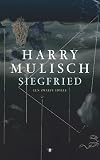
Siegfried
by Harry Mulisch
On This Page
Description
Can a work of imagination help to understand the nature of evil? This question, posed to Rudolf Herter as he reads from his book The Invention of Love, sparks off a series of strange events. The story two old servants of Hitler tell is more terrible than anything Herter can imagine.Tags
Recommendations











Member Reviews
The novel Siegfried is a short, dark meditation on Hitler, written towards the end of Mulisch's life. The distinguished, seventy-year-old Dutch writer Rudolf Herter is on a trip to Vienna as guest of the Dutch embassy to promote his thousand-page millennium-novel The invention of love (...is this starting to sound like anyone we know?) when he bumps into an elderly couple who turn out to have been employed as personal servants at the Berghof in Obersalzberg during and immediately before the war, and are in possession of a terrible secret they unaccountably want to share with a random passing novelist before they die... Mulisch uses this as the hook for a partly historical, partly metaphysical, and partly fantastic exploration of who show more Hitler was and why we have so much difficulty pinning him down psychologically and philosophically. Probably mostly nonsense, but very elegant and erudite nonsense, and eminently readable. show less
This book poses the question of what if Hitler had a son? It takes that jumping off point to explore an issue that has puzzled many--why was Hitler so evil? I liked the part of the book imagining the war-time life of Hitler, as Eva Braun bears him a hidden son. I found the philosophical musings by a fictional present-day narrator sandwiching the story less interesting. I like Harry Mulisch as an author very much, and recommend his book The Assault over this one, although this one raises some fascinating points.
In a counterfactual historical fiction book, Hitler had a son named Siegfried. This is yet another masterpiece from Harry Mulisch's pen, and it is both readable and profound.
Wel goed geschreven, als je de stilistische eigenaardigheden negeert: wie gebruikt er nu leestekencombinaties als ;- midden in een zin, of allleen - en dan weer alleen ; Geen touw aan vast te knopen. Ook afleidingen van landennamen schrijft Mulisch steeds zonder hoofdletter. Het verhaal is spannend maar tegelijk zo onzinnig dat je je niet echt kunt laten meesslepen. Bovendien: de figuur van Hitler gebruiken voor een onzinnig flosofisch spelletje, is dat niet obsceen?
Rudolf Herter is een beroemd, gevierd schrijver. Hij is in Wenen -waar hij uiteraard in hotel Sacher logeert- ter gelegenheid van de verschijning van zijn boek in Oostenrijk. Tijdens een televisie-interview ontspruit in hem een idee voor een nieuwe roman: een gedachtenexperiment waarin Hitler de hoofdrol speelt. Voordat hij tijd heeft dit idee uit te werken wordt hij na een lezing aangesproken door een ouder echtpaar. Zij zeggen hem iets belangwekkends te willen vertellen en hij spreekt af hen de volgende dag te bezoeken. Tijdens dit bezoek blijkt dat de twee mensen in de huishouding van Hitler hebben gediend. De vrouw was het kamermeisje van Eva Braun, de man de trouwe bediende van de Führer. Nu zij in hun nadagen zijn willen zij het show more geheim niet langer met zich meedragen dat zij al die jaren bewaard hebben. Rudolf Herter is verbijsterd. Hij belooft geheimhouding tot na de dood van de twee. Maar zijn roman hoeft hij niet meer te bedenken: die is hem die ochtend geschonken. Later op de dag spreekt hij zijn gedachten in op een dictafoon. Met dit apparaatje nog in de hand treft zijn geliefde hem uren later aan. Dood. Het geheim van de twee bejaarden heeft hij niet prijsgegeven op het ingesproken bandje. Wel ongewild het geheim waardoor Hitler geteisterd werd. show less
Uitgeleend Silvia Iordan juni 2022
Members
- Recently Added By
Author Information

124+ Works 11,783 Members
Mulisch's name will go down in history as the writer par excellence of modern myths, and possibly not only in Dutch literary history. Every one of his great novels such as Het Stenen Bruidsbed (The Stone Bridal Bed) (1959), Hoogste Tijd (High Time) (1985), and De Aanslag (The Assault) (1982) is technically based on, or evokes reminiscences of, show more existing classical myths; at the same time, each work is thematically related to the author's own time and experiences, usually World War II. Every one of the more important characters, excluding the main characters who normally serve as narrators or reporters, is an embodiment or personification of an archetype. In The Assault the various characters not only play completely different roles in the killing of a German officer by members of the Dutch Resistance movement, but they also represent distinct types. The action is also much more than an incident. The protagonist, Anton Steenwijk, spends a lifetime trying to solve the puzzle consisting of the various causes and effects relative to the fatal act. He does this not as a detective but as a normal, thinking human being who is interested in knowing where he came from and where he is headed. The puzzle that presents itself to him is as complex, yet as logical, as the waves created by a passing ship, reverberating indefinitely, even when the ship has disappeared from sight. Mulisch is, with Wolkers, Hermans, and Vestdijk, one of the most talented novelists of his generation, but he may be expected to outlive all three others because of the classical nature of his work, classical here meaning "of primary significance for all people of all times." (Bowker Author Biography) Harry Mulisch is the author of such internationally bestselling novels as "The Assault", which was made into the film that won the 1987 Oscar for Best Foreign Film, & "The Discovery of Heaven". He has also published short stories, essays, poetry, plays, & philosophical works. He lives in Amsterdam. (Bowker Author Biography) show less
Awards and Honors
Awards
Notable Lists
Series
Belongs to Publisher Series
Gallimard, Folio (4292)
Work Relationships
Has as a student's study guide
Common Knowledge
- Canonical title
- Siegfried
- Original title
- Siegfried: een zwarte idylle
- Original publication date
- 2001-01-??
- People/Characters
- Adolf Hitler; Eva Braun; Rudolf Herter; Ulrich Falk; Siegfried Hitler
- Important places
- Vienna, Austria; Berchtesgaden, Bavaria, Germany
- Epigraph
- Warum holt mich der Teufel nicht?
Bei ihm ist es bestimmt schöner als hier.
EVA BRAUN, Dagboek, 2.III.35 - First words
- Toen het landingsgestel met een dreun het beton raakte, schrok Rudolf Herter wakker uit een diepe, droomloze slaap.
- Last words
- (Click to show. Warning: May contain spoilers.)Daarna niets meer.
- Blurbers
- Cohen, Job (Mayor of Amsterdam, The Netherlands) (Mayor of Amsterdam, The Netherlands)
- Original language*
- Nederlands
*Some information comes from Common Knowledge in other languages. Click "Edit" for more information.
Classifications
- Genres
- General Fiction, Fiction and Literature
- DDC/MDS
- 839.31364 — Literature & rhetoric German & related literatures Other Germanic literatures Netherlandish literatures Dutch Dutch fiction 20th Century 1945-1999
- LCC
- PT5860 .M85 .S5413 — Language and Literature German, Dutch and Scandinavian literatures Dutch literature Individual authors or works 1800-1960
- BISAC
Statistics
- Members
- 795
- Popularity
- 34,842
- Reviews
- 15
- Rating
- (3.57)
- Languages
- 13 — Czech, Dutch, English, Estonian, French, German, Greek, Italian, Norwegian (Bokmål), Norwegian, Russian, Spanish, Swedish
- Media
- Paper, Audiobook
- ISBNs
- 26
- ASINs
- 2