On This Page
Description
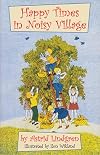
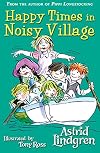
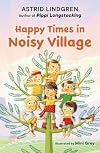
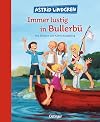
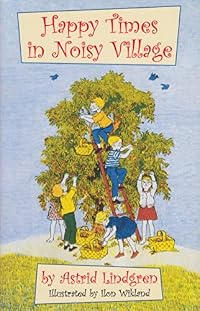
Ten-tear-old Lisa tells about her brothers and playmates and the happy times they spend making tunnels in the hay, playing the perfect April Fool's Day prank, and creating the Cherry Company in their Swedish village.Tags
Recommendations









Member Reviews
The concluding part about Bullerbyn contains many of the episodes that were my favorites when I was little – when the climb mountains and meet the angry ram on the islet, the crayfishing, the funny chapter about babysitting Kerstin, the black snot after selling cherries by the road. I read this book especially again and again. It’s interesting to ponder why I found it so exciting. Really, everything happening here is on such a small scale. I’m sure Lindgren’s dry sarcastic humor worked on me even then, but there is also a rare balance of adventure, freedom and true security here. Hard to pinpoint, but very palpable.
What luck! Happy Times in Noisy Village arrived just in time to get me through another illness. Nothing will distract you from feeling sick like one of Astrid Lindstrom’s Noisy Village books. Happy Times in Noisy Village is the sequel to fabulous The Children of Noisy Village, which I was luckily able to read on Audible. While the sequel isn’t on Audible, the paperback version gave me the chance to enjoy Ilon Wikland’s lovely illustrations.
The six children of Noisy Village — 9-year-old Lisa; her mischievous older brothers, Karl and Bill; and neighbors Anna, Britta, and Olaf — don’t live in an actual village at all, but in a grouping of three farmhouses, as was the way in Sweden long ago. The three farmhouses got the show more affectionate nickname because of all of the ruckus an active pack of children can create.
The tales, set at the turn of the 20th century, are deceptively simple — helping out an ailing teacher, baby-sitting, selling cherries to passersby, outwitting the smug boys, pulling a baby tooth, and a Midsummer festival — and Lindgren, best known for Pippi Longstocking and its sequels, always turns them into gems, never cloying, as they easily could have been.
It might be tempting to read this book immediately; however, trust me: You’ll be glad if you save it for your direst hour of need — and need of distraction. Highly recommended to readers of all ages. show less
The six children of Noisy Village — 9-year-old Lisa; her mischievous older brothers, Karl and Bill; and neighbors Anna, Britta, and Olaf — don’t live in an actual village at all, but in a grouping of three farmhouses, as was the way in Sweden long ago. The three farmhouses got the show more affectionate nickname because of all of the ruckus an active pack of children can create.
The tales, set at the turn of the 20th century, are deceptively simple — helping out an ailing teacher, baby-sitting, selling cherries to passersby, outwitting the smug boys, pulling a baby tooth, and a Midsummer festival — and Lindgren, best known for Pippi Longstocking and its sequels, always turns them into gems, never cloying, as they easily could have been.
It might be tempting to read this book immediately; however, trust me: You’ll be glad if you save it for your direst hour of need — and need of distraction. Highly recommended to readers of all ages. show less
Oh, oh how darling. Yes they're good and sweet children, but not saccharine or implausible. They get into little mischiefs - and even have little sulks, like healthy, beloved, well-raised children naturally would. I'm such a fan-girl of Lindgren. My only 'complaint' here is that the children are ages 9-11 but they are drawn more like 6-8 and in some ways have characteristics of children younger than they are, too.
Noisy Village is the name given to a group of three farm houses due to the ruckus created by the six children who live there. Lisa, who is nine years old, narrates the fun and adventures she and her brothers and friends have all throughout the year. Woven within the story are a number of Swedish traditions such as dancing around the Mid-summer Eve pole. I first read this as a child but still loved the humor of situations and the personalities of the children upon reading it as an adult.
Another one of my all time favorites. I like it so much because it has funny parts and usually isn't scary but is still interesting. A girl named Lisa is the main character and narrates the book. She lives in the middle of 3 houses people call Noisy Village because with all these kids are running around and like all kids do... making noise. She and her best friend Anna have adventures along with the other kids of Noisy Village. People who will like this book probably like books about kids and the olden days.
Ten-tear-old Lisa tells about her brothers and playmates and the happy times they spend making tunnels in the hay, playing the perfect April Fool's Day prank, and creating the Cherry Company in their Swedish village.
It breathes happiness. Good stuff to read together with a child.
Members
- Recently Added By
Lists

Favorite Childhood Books
1,646 works; 517 members

1950s
340 works; 22 members
Author Information

823+ Works 45,805 Members
Astrid Lindgren: November 7, 1907 - January 28, 2002 There are few children's authors more famous than Astrid Lindgren, creator of the feisty, legendary heroine, Pippi Longstocking. Lindgren was born on November 14, 1907, in Sweden. Her work has been acclaimed with many prestigious awards, among them the Hans Christian Andersen Medal (1958), the show more Lewis Carroll Shelf Award (1978), and the International Book Award (1993). This truly internationally known author was the recipient of the Albert Schweitzer Medal and has been honored repeatedly in her native Sweden. There is a bronze statue of her in a Stockholm park. Her picture is on a postage stamp. The "World of Astrid Lindgren" is a theme park featuring the wholesome characters of her books. The annual children's literature award is known as the Astrid Lindgren Prize. The inspiration for this long and illustrious career, spanning five decades, is the author's own childhood. Her memories - of free and often wild play with her brothers and sister, of loving parents, of a close-knit farm community, of reading about heroines like Pollyanna and Anne of Green Gables - became the foundations of her books. Lindgren has said, "I write to amuse the child within me, and I can only hope that in this way other children as well can have a little fun." Lindgren amused her own children by telling them stories. Her daughter, Karin, named Pippi Longstocking, and the first written story was given to Karin as a birthday gift. The next year, 1945, Pippi Longstocking won a best children's book competition and Lindgren began writing the perennially child-pleasing stories that make up her enormous body of work, some of which are the series based on "Children of Noisy Village", the fable "The Tomten", the rambunctious "Karlson-On-the-Roof", the irrepressible"Lotta on Troublemaker Street" , the controversial "The Brothers Lionheart", and the unforgettable, wildly funny superheroine, Pippi, was featured in other books and became a star of stage, screen and television. Lindgren has been called the world's most read author of children's books. She is hailed as the third most translated children's book author after H.C. Andersen and the Grimm brothers. Her impact on the world of children's literature is immeasurable. Astrid Lindgren died in her sleep, in her home in Sweden on January 28, 2002 at the age of 94. (Bowker Author Biography) show less

Astrid Lindgren has a Legacy Library. Legacy libraries are the personal libraries of famous readers, entered by LibraryThing members from the Legacy Libraries group.
Some Editions
Series

Work Relationships
Is contained in
Common Knowledge
- Canonical title*
- Ingen steder som Bakkebygrenda
- Original title
- Bara Roligt i Bullerbyn; Bullerby Boken; Bullerbyboken
- Alternate titles
- Hapy Times In Noisy Village; Bara roligt I Bullerbyn
- Original publication date
- 1952
- Important places*
- Bullerbyn
- Original language
- Swedish
*Some information comes from Common Knowledge in other languages. Click "Edit" for more information.
Classifications
- Genres
- Children's Books, Fiction and Literature
- DDC/MDS
- 839.7374 — Literature & rhetoric German & related literatures Other Germanic literatures Swedish literature Swedish fiction 1900-1999 1945-1999
- LCC
- PZ7 .L6585 .H — Language and Literature Fiction and juvenile belles lettres Fiction and juvenile belles lettres Juvenile belles lettres
- BISAC
Statistics
- Members
- 594
- Popularity
- 49,129
- Reviews
- 9
- Rating
- (4.24)
- Languages
- 12 — Danish, Dutch, English, Finnish, French, German, Greek, Indonesian, Japanese, Norwegian (Bokmål), Norwegian, Swedish
- Media
- Paper, Audiobook, Ebook
- ISBNs
- 41
- ASINs
- 4