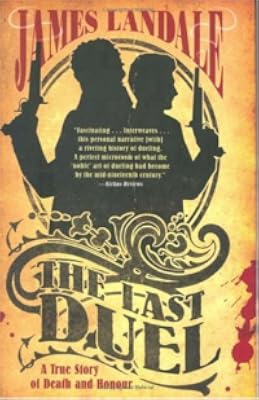
Duel: A True Story of Death and Honour
by James Landale
On This Page
Description
In 1826 a merchant named David Landale shot his banker dead in a duel. It was one of the final fatal duels recorded in Europe. This is the remarkable story. Two centuries later, one of his descendents, James Landale, a BBC correspondent, explains why two rational, educated men chose to resolve a business dispute by shooting at each other. Using newly discovered archives and personal family history, The Last Duel reconstructs the escalating words and deeds that led to the fatal encounter as show more well as the cultural, social, and economic circumstances surrounding it. In a fascinating, personal, and involving narrative, Landale paints a complete picture of life as a businessman, educated citizen, and man of honor at a time when civil courts all but did not exist and commerce was exploding. Landale interweaves the bloodied history of dueling itself, from its barbaric beginnings to its acceptance by the nobility, and goes on to explain why, in the middle of the 19th century, it suddenly lost its social legitimacy. The Last Duel is an utterly engrossing investigative history that, for the modern reader, brings to life the personal, social, and historical landscape of the time and why this curious thing called honor drove so many young men to an early grave. - Jacket flap. show lessTags
Recommendations







Member Reviews
(Reprinted from the Chicago Center for Literature and Photography [cclapcenter.com]. I am the original author of this essay, as well as the owner of CCLaP; it is not being reprinted illegally.)
It's no secret that I'm a huge fan of what I call "NPR-worthy" nonfiction books, or in other words a book which contains all the precise research and fact-checking of an academic paper, but written in a narrative style engaging enough to score them an interview on NPR; but there's also a big problem with the growing popularity of NPR-worthy books, which is that in their haste to assemble a 300-page manuscript that can be sold as a typical $25 hardback, a lot of these books will end up containing only about a magazine article's worth of actual show more interesting content, the other 250 pages padded with ancillary information about those times in general that don't really have anything to do with the subject at hand. Take for example James Landale's The Last Duel, which features a legitimately fascinating event at its core -- the very last publicly recorded formal pistol duel in Scotland, that is, taking place in 1826 just as the emerging Romantic Age was to profoundly redefine the meaning of the word "gentleman," giving Landale the perfect excuse to examine not only this particular event but also the history of dueling in general, from its start in jousting matches among knights in the Middle Ages to its death during the Victorian Age of the 19th century, and of how related issues like greater rule of law, a better-working justice system, more sophisticated weapons, and an overall rise in sanctity for human life eventually did away with the millennium-old tradition for good.
But unfortunately, even all this is only enough to fill about a third of a book, so Landale has to search long and hard for even tangentially related information to fill the rest -- there is an entire chapter, for example, just on the history of the city of Kirkcaldy where the duel took place, and an entire other chapter just on the history of the mercantile industry, a financial dispute within which is what brought about the duel, and an entire other chapter just on the history of the Napoleonic Wars, which is what bankrupted Britain in the 1820s and led to the financial dispute to begin with. That's an awful long distance to travel from one's main subject, and is not the issue I wanted to read about when I picked up the book in the first place, which is why The Last Duel gets an only tepid recommendation from me today, a book worth reading for those interested in the history of dueling but that one will have to do a lot of hunting and pecking with to find the good bits.
Out of 10: 7.0 show less
It's no secret that I'm a huge fan of what I call "NPR-worthy" nonfiction books, or in other words a book which contains all the precise research and fact-checking of an academic paper, but written in a narrative style engaging enough to score them an interview on NPR; but there's also a big problem with the growing popularity of NPR-worthy books, which is that in their haste to assemble a 300-page manuscript that can be sold as a typical $25 hardback, a lot of these books will end up containing only about a magazine article's worth of actual show more interesting content, the other 250 pages padded with ancillary information about those times in general that don't really have anything to do with the subject at hand. Take for example James Landale's The Last Duel, which features a legitimately fascinating event at its core -- the very last publicly recorded formal pistol duel in Scotland, that is, taking place in 1826 just as the emerging Romantic Age was to profoundly redefine the meaning of the word "gentleman," giving Landale the perfect excuse to examine not only this particular event but also the history of dueling in general, from its start in jousting matches among knights in the Middle Ages to its death during the Victorian Age of the 19th century, and of how related issues like greater rule of law, a better-working justice system, more sophisticated weapons, and an overall rise in sanctity for human life eventually did away with the millennium-old tradition for good.
But unfortunately, even all this is only enough to fill about a third of a book, so Landale has to search long and hard for even tangentially related information to fill the rest -- there is an entire chapter, for example, just on the history of the city of Kirkcaldy where the duel took place, and an entire other chapter just on the history of the mercantile industry, a financial dispute within which is what brought about the duel, and an entire other chapter just on the history of the Napoleonic Wars, which is what bankrupted Britain in the 1820s and led to the financial dispute to begin with. That's an awful long distance to travel from one's main subject, and is not the issue I wanted to read about when I picked up the book in the first place, which is why The Last Duel gets an only tepid recommendation from me today, a book worth reading for those interested in the history of dueling but that one will have to do a lot of hunting and pecking with to find the good bits.
Out of 10: 7.0 show less
There are two narratives present in Duel, and as perhaps is expected in such situations, one is better than the other.
The first is the story of David Landale, an ancestor of the author, who in 1826 took part in the last fatal duel in Scotland. It covers the events leading up to the duel itself, and through to the end of the subsequent trial. It's the better of the two sections, as it's more focused though it suffers from a few flaws. The first is that Landale's sources are perhaps of questionable bias -- his primary is a record of the trial compiled by one of the counsel for the defence. When combined with his own obvious biases, the rather one-sided nature of the narrative becomes apparent. Which isn't to say that it might not be true show more as told, and it's unlikely that any other version will emerge given the paucity of other first-hand documentation. The second is that occasionally his prose is perhaps a little overwrought. Case in point:
(He also states near the beginning that he's tried to avoid giving thoughts or words to people without documentation to back it up. How well he succeeds is perhaps debatable — though there is a bibliography no citations are given for quotations themselves, and there are occasions where we're told how someone felt without any backing being given. It's an admirable attempt, at least.)
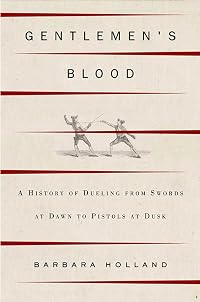
The second narrative is a general history of dueling itself. It's not as interesting as the main narrative, perhaps partly because there is less personal investment but also largely because there's nothing to differentiate it from any of the other popular histories of dueling. Due to the fact that it's not the primary nature of the book, it's shallower than many, but it still manages to touch on the same themes and examples as you'd see anywhere else: medieval trial by combat, jousts (though he does make certain to note that there is no direct connection between those and dueling), the rise in popularity in early modern Europe, the formalization of the code duello, Pushkin, Hamilton/Burr, Wellington, the Irish, the French, &c., the rise in popularity among the middle classes and the corresponding decline among the upper, the popularity and differences in America, and the final fall from grace. If there's one thing I'll say for it is that, compared to some of the other popular histories I've read (most recently, Barbara Holland's Gentlemen's Blood — the less said, the better) it's written in a fairly calm and neutral tone. It's superficial perhaps, but there's certainly worse out there.
Overall, I enjoyed it well enough to say that it wasn't a waste of time, but not enough to say that I'd want to read it again. show less
The first is the story of David Landale, an ancestor of the author, who in 1826 took part in the last fatal duel in Scotland. It covers the events leading up to the duel itself, and through to the end of the subsequent trial. It's the better of the two sections, as it's more focused though it suffers from a few flaws. The first is that Landale's sources are perhaps of questionable bias -- his primary is a record of the trial compiled by one of the counsel for the defence. When combined with his own obvious biases, the rather one-sided nature of the narrative becomes apparent. Which isn't to say that it might not be true show more as told, and it's unlikely that any other version will emerge given the paucity of other first-hand documentation. The second is that occasionally his prose is perhaps a little overwrought. Case in point:
"With the fatal shot still ringing in their ears, David Landale and William Millie sat back in the chaise and ordered John Mason to drive them as fast as possible from the sodden field in Fife where George Morgan's body was slowly growing as cold and damp as the earth beneath him. They were now on the run."
(He also states near the beginning that he's tried to avoid giving thoughts or words to people without documentation to back it up. How well he succeeds is perhaps debatable — though there is a bibliography no citations are given for quotations themselves, and there are occasions where we're told how someone felt without any backing being given. It's an admirable attempt, at least.)
The second narrative is a general history of dueling itself. It's not as interesting as the main narrative, perhaps partly because there is less personal investment but also largely because there's nothing to differentiate it from any of the other popular histories of dueling. Due to the fact that it's not the primary nature of the book, it's shallower than many, but it still manages to touch on the same themes and examples as you'd see anywhere else: medieval trial by combat, jousts (though he does make certain to note that there is no direct connection between those and dueling), the rise in popularity in early modern Europe, the formalization of the code duello, Pushkin, Hamilton/Burr, Wellington, the Irish, the French, &c., the rise in popularity among the middle classes and the corresponding decline among the upper, the popularity and differences in America, and the final fall from grace. If there's one thing I'll say for it is that, compared to some of the other popular histories I've read (most recently, Barbara Holland's Gentlemen's Blood — the less said, the better) it's written in a fairly calm and neutral tone. It's superficial perhaps, but there's certainly worse out there.
Overall, I enjoyed it well enough to say that it wasn't a waste of time, but not enough to say that I'd want to read it again. show less
Ratings
Members
- Recently Added By
Author Information
2 Works 76 Members
Common Knowledge
- Canonical title
- Duel: A True Story of Death and Honour
- Alternate titles
- The Last Duel
- Original publication date
- 2005
- People/Characters
- Landale, David
- Epigraph
- 'Guy, what would you do if you were challenged to a duel?'
'Laugh.'
'Yes, of course.'
'What made you think of that now?'
'I was thinking about honour. It is a thing that changes, doesn't it? I me... (show all)an, a hundred and fifty years ago we would have had to fight if challenged. Now we'd laugh. There must have been a time a hundred years or so ago when it was rather an awkward question.'
Evelyn Waugh, Officers mid Gentlemen, 1955 - Dedication
- For my mother and father
- First words
- Prologue The loom of dawn was still rising from the eastern horizon as the four men walked up the steep track through the plantation.
Chapter 1 In the early evening of July 18 in the year 1825... (show all), fifteen men gathered upstairs at the George Inn in Kirkcaldy, a small town on the south-eastern coast of Scotland. - Last words
- (Click to show. Warning: May contain spoilers.)They are buried in the same grave in the shadow of the ruins of St Andrews cathedral looking out over the North Sea, just a few miles up the coast from where, a generation before, their father and uncle had duelled at dawn.
- Original language
- English UK
- Disambiguation notice
- American title: "The Last Duel: A True Story of Death and Honor"
Classifications
- Genres
- Nonfiction, History, General Nonfiction, Sports and Leisure, Biography & Memoir
- DDC/MDS
- 394.809411 — Society, government, & culture Customs, etiquette & folklore General customs Dueling and suicide Biography And History Europe
- LCC
- CR4595 .S38 .L36 — Auxiliary Sciences of History Heraldry Heraldry Chivalry and knighthood (Orders, decorations, etc.) Duels and dueling
- BISAC
Statistics
- Members
- 71
- Popularity
- 432,816
- Reviews
- 2
- Rating
- (3.17)
- Languages
- English, Swedish
- Media
- Paper
- ISBNs
- 4