
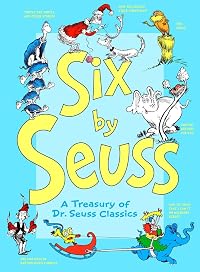
Six by Seuss: A Treasury of Dr. Seuss Classics
by Dr. Seuss
On This Page
Description
An anthology of six stories by Dr. Seuss, including "And To Think That I Saw It On Mulberry Street," "The 500 Hats of Bartholomew Cubbins," "Horton Hatches the Egg," "How the Grinch Stole Christmas," "The Lorax," and "Yertle the Turtle."Tags
Recommendations





Member Reviews
I can’t believe that the first book that Theodor Geisel ever tried to get published was rejected so many times before someone saw the genius in his work. I guess it takes a Seussical mind to really appreciate the whimsy and avant-garde of his books as an adult. That being said, it seems to be a no-brainer that children would love Suess’ books, since they are from the get-go charming, hilarious, and ridiculous - which really captures the imagination and true essence of children everywhere. And to Think That I Saw It On Mulberry Street is a Suess book that I often over-look, since it doesn’t have the same amusing made-up characters that I find so endearing in stories like How the Grinch Stole Christmas and The Lorax, but I show more definitely appreciated this first volume of the Seuss-library. All children tell stories, and exaggerated stories at that, so I found it hilarious to read along to see just how ridiculous this little boy would make his story by the time he returned home. Unfortunately his father (the instigator of the careful observations by the little boy) doesn’t get the enlarged version of the story, so the reader is left with the secret of the boy’s imagination. We know what the little boy thinks he saw on Mulberry street, so we in a sense become his confidants and closest friends - even if we don’t get a chance to tell our extrapolated version of the story in turn.
I was not veyr impressed by The 500 Hats of Bartholomew Cubbins. Suess seems to have lost his eloquence and humour that comes from his careful use of lyricism and brevity that were so apparent in And To Think That I Saw It On Mulberry Street. He's trying to be too much like storytellers of old - who overuse words and don't utilize illustration enough - and this clearly doesn't work. It's pretty obvious why I had never read this book (or even noticed it in a store), since there's no way that lovers of Seuss's distinctive style could like this story.
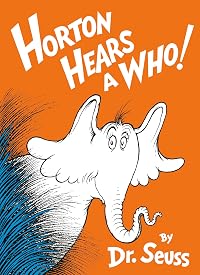
Horton Hatches the Egg is a pretty cute story, even if it is a bit overtly moralistic. The message that it's a good thing to be responsible is very clear, but thankfully Seuss wraps the theme up in the hilarious scenario of an elephant awkwardly perched in a tree in an attempt to hatch an egg. I was pretty surprised (and overjoyed) to see the lazy Maysie bird get her come-uppance when the egg finally hatched and it turned out to be a little winged elephant! Too cute, if completely unrealistic!
Not a big fan of Yertle the Turtle and other Stories. The animals are great characters and the rhymes are typically well-done, but their moralist-themes make them not much more exciting than Aesop's Fables. It's not surprising that Seuss published this set of stories, though, since his publishers likely looked at his talent for drawing animals and figured that a set of values-tales would be an easy sell for the children's market. Kids get entertainment through the rhymes and illustrations, and parents get to feel good about teaching their children positive values.
How the Grinch Stole Christmas is in much the same vein (in essence it is a story about the true value of Christmas and a condemnation of consumer society), but Seuss takes it one step further by giving this story such a memorable protagonist. The story of the Grinch and his hatred towards Christmas has become as synonymous with the holiday as Charles Dickens' Scrooge, who learns a similar lesson - albeit without the whimsical setting and amusing thymes that Seuss is known for. I often forget the simpler aspects of this story in lieu of the Jim Carey film version which expands a lot on Seuss's original story, but the original never loses it's charm.
The Lorax is a moral tale as well, and even though it's environmental message is a bit heavyhanded, I absolutely love this story. Suess' rhymes are absolutely perfect and his bevy of fantastical creatures (from singing fish to the fiesty Lorax) are absolutely wonderful. I can't imagine that anyone reading this story would be unaffected by the devastation that corporate greed and lack of environmental care that occurs in the story, since it's so blatantly obvious that this is exactly what is happenning in the world right now. I sincerely hope that kids who read the Lorax in this generation and the next take it to heart, since Suess is absolutely right when he says that "unless someone like [us] cares a whole awful lot, nothing is going to get better. It's not." show less
I was not veyr impressed by The 500 Hats of Bartholomew Cubbins. Suess seems to have lost his eloquence and humour that comes from his careful use of lyricism and brevity that were so apparent in And To Think That I Saw It On Mulberry Street. He's trying to be too much like storytellers of old - who overuse words and don't utilize illustration enough - and this clearly doesn't work. It's pretty obvious why I had never read this book (or even noticed it in a store), since there's no way that lovers of Seuss's distinctive style could like this story.
Horton Hatches the Egg is a pretty cute story, even if it is a bit overtly moralistic. The message that it's a good thing to be responsible is very clear, but thankfully Seuss wraps the theme up in the hilarious scenario of an elephant awkwardly perched in a tree in an attempt to hatch an egg. I was pretty surprised (and overjoyed) to see the lazy Maysie bird get her come-uppance when the egg finally hatched and it turned out to be a little winged elephant! Too cute, if completely unrealistic!
Not a big fan of Yertle the Turtle and other Stories. The animals are great characters and the rhymes are typically well-done, but their moralist-themes make them not much more exciting than Aesop's Fables. It's not surprising that Seuss published this set of stories, though, since his publishers likely looked at his talent for drawing animals and figured that a set of values-tales would be an easy sell for the children's market. Kids get entertainment through the rhymes and illustrations, and parents get to feel good about teaching their children positive values.
How the Grinch Stole Christmas is in much the same vein (in essence it is a story about the true value of Christmas and a condemnation of consumer society), but Seuss takes it one step further by giving this story such a memorable protagonist. The story of the Grinch and his hatred towards Christmas has become as synonymous with the holiday as Charles Dickens' Scrooge, who learns a similar lesson - albeit without the whimsical setting and amusing thymes that Seuss is known for. I often forget the simpler aspects of this story in lieu of the Jim Carey film version which expands a lot on Seuss's original story, but the original never loses it's charm.
The Lorax is a moral tale as well, and even though it's environmental message is a bit heavyhanded, I absolutely love this story. Suess' rhymes are absolutely perfect and his bevy of fantastical creatures (from singing fish to the fiesty Lorax) are absolutely wonderful. I can't imagine that anyone reading this story would be unaffected by the devastation that corporate greed and lack of environmental care that occurs in the story, since it's so blatantly obvious that this is exactly what is happenning in the world right now. I sincerely hope that kids who read the Lorax in this generation and the next take it to heart, since Suess is absolutely right when he says that "unless someone like [us] cares a whole awful lot, nothing is going to get better. It's not." show less
We pulled this off the shelf originally just to read the Grinch, but we ended up reading all of it. From the prose Bartholomew Cubbins to the almost non-sensical Lorax, this collection is a lot of fun, but each story contains a wonderful message: take care of what you have, be honest, pride is dangerous. Dr. Seuss entertains and teaches, and Rebekah and I had fun being a part of both.
I was reminded recently that I should hang on to my child-part because it is too important to lose track of. Thinking of that I picked up this book which has been on my shelf for years. I had to take the wrap off before I read it. I bought it because one of the stories The 500 Hats of Bartholomew Cubbins was a favorite of mine before I turned ten. It is still a very good story. Bartholomew goes into town with some cranberries to sell and when the king comes by he takes off his hat but there is still one on his head. The king gets very upset but no matter how often Bartholomew takes off his hat he still has one on his head. He gets sent to the executioner, but he refuses to cut off Bartholomew's head because he can't get his hat off. As show more he takes off more hats each new one becomes more ornate with jewels and feathers. The 500th hat is so magnificent the king buys it for 500 pieces of gold. When Bartholomew hands the king that hat his head is finally bare.
The book also contains Horton Hatches the Egg, "I meant what I said and I said what I meant an elephant's faithful one hundred percent." Then the egg hatches and an elephant with wings comes out. How the Grinch Stole Christmas is probably the best known story because of the television show. The last story The Lorax was written in 1971 and is about the spoiling of the environment.
The book has all of the original drawings in full color and Dr. Seuss's verse is very entertaining. Reading these stories put a smile on my face and I will always have a place where I can enjoy the child in me. show less
The book also contains Horton Hatches the Egg, "I meant what I said and I said what I meant an elephant's faithful one hundred percent." Then the egg hatches and an elephant with wings comes out. How the Grinch Stole Christmas is probably the best known story because of the television show. The last story The Lorax was written in 1971 and is about the spoiling of the environment.
The book has all of the original drawings in full color and Dr. Seuss's verse is very entertaining. Reading these stories put a smile on my face and I will always have a place where I can enjoy the child in me. show less
Mulberry St., 500 Hats, Horton, Yertle, the Grinch and the Lorax all make an appearance in this omnibus of Seuss. This was given to one of my sons, but was beloved by both, so I bought another. There are just some things which are hard to share. We had many lovely readings full of laughter with these stories.
I would have this book in my collection if I didn't have a child. But this copy belongs to my daughter Rhiannon who received it in 2008 when she was 4. These stories been one of her most frequent requests. Infact, we usually bring this book with us when we go out of town. These stories are great because they are funny to read but they have an underlying bigger meaning. Her favorites are The Lorax, Horton Hatches the Egg, How the Grinch Stole Christmas and Gertrude McFuzz.
HATED The 500 Hats of Bartholemew Cubbins
Horton Hatches an Egg made Scott and I die laughing
How the Grinch Stole Christmas....of course that is a favorite.
The Lorax....excellent reminder to treat our planet with respect.
Horton Hatches an Egg made Scott and I die laughing
How the Grinch Stole Christmas....of course that is a favorite.
The Lorax....excellent reminder to treat our planet with respect.
If you are looking for a collection of stories that will keep your child interested this is it! My 4 yr old son will sit quietly and keep prompting me to read the whole book to him... if only my voice would last that long!!
Members
- Recently Added By
Lists

Nice Anthologies for Kids
66 works; 3 members

Written and Illustrated By
805 works; 1 member
Author Information

795+ Works 357,965 Members
Theodor Seuss Geisel was born in Springfield, Massachusetts on March 2, 1904. He wrote and illustrated more than 45 picture books under the pseudonym Dr. Seuss. His first picture book, And to Think That I Saw It on Mulberry Street, was published in 1937. His other books included The Cat in the Hat, The Butter-Battle Book, The Lorax, The Bippolo show more Seed and Other Lost Stories, Fox in Socks: Dr. Seuss's Book of Tongue Tanglers, What Pet Should I Get?, and Oh, the Places You'll Go. In 1984, he received a Pulitzer Prize for his contributions to children's literature. He died of oral cancer on September 24, 1991 at the age of 87. (Bowker Author Biography) show less
Some Editions
Work Relationships
Contains
Common Knowledge
- Canonical title
- Six by Seuss: A Treasury of Dr. Seuss Classics
- People/Characters
- Bartholomew Cubbins; The Lorax; Horton the Elephant; The Grinch; Yertle the Turtle; Gertrude McFuzz
- Related movies
- The Lorax (1972 | IMDb); 500 Hats of Bartholemew Cubbins (1943 | IMDb); Horton Hatches the Egg (1942 | IMDb); Horton Hatches the Egg (1992 | IMDb); How the Grinch Stole Christmas! (1966 | IMDb); How the Grinch Stole Christmas! (1992 | IMDb) (show all 9); How the Grinch Stole Christmas! Special Edition (1994 | IMDb); How the Grinch Stole Christmas (2000 | IMDb); The Lorax (2012 | IMDb)
- First words
- When I leave home to walk to school, Dad always says to me, "Marco, keep your eyelids up and see what you can see."
Classifications
- Genres
- Children's Books, Picture Books
- DDC/MDS
- 809 — Literature & rhetoric Literature, rhetoric & criticism History, description, critical appraisal of more than two literatures
- LCC
- PZ8.3 .G276 .S — Language and Literature Fiction and juvenile belles lettres Fiction and juvenile belles lettres Juvenile belles lettres
- BISAC
Statistics
- Members
- 2,058
- Popularity
- 10,056
- Reviews
- 13
- Rating
- (4.54)
- Languages
- English
- Media
- Paper
- ISBNs
- 7
- ASINs
- 8