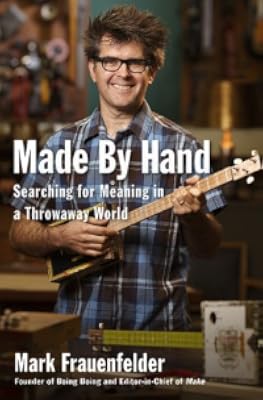
Made by Hand: Searching for Meaning in a Throwaway World
by Mark Frauenfelder
On This Page
Description
From his unique vantage point as editor in chief of Make magazine, the hub of the newly invigorated do-it-yourself (DIY) movement, Mark Frauenfelder takes listeners on an inspiring and surprising tour of the vibrant world of DIY. The Internet has brought together large communities of people who share ideas, tips, and blueprints for making everything from unmanned aerial vehicles to pedal-powered iPhone chargers to an automatic cat feeder jury-rigged from a VCR.DIY is a direct reflection of show more our basic human desire to invent and improve, long suppressed by the availability of cheap, mass-produced products that have drowned us in bland convenience and cultivated our most wasteful habits. Frauenfelder spent a year trying a variety of offbeat projects, such as keeping chickens and bees, tricking out his espresso machine, whittling wooden spoons, making guitars out of cigar boxes, and doing citizen science with his daughters in the garage. His whole family found that DIY helped them take control of their lives, offering a path that was simple, direct, and clear. Working with their hands and minds helped them feel more engaged with the world around them.Frauenfelder reveals how DIY is changing our culture for the better. He profiles fascinating "alpha makers" leading various DIY movements and grills them for their best tips and insights.Beginning his journey with hands as smooth as those of a typical geek, Frauenfelder offers a unique perspective on how earning a few calluses can be far more rewarding and satisfying than another trip to the mall. show lessTags
Recommendations






















Member Reviews
Most of the reviewers who marked this book less than 3 stars did so because it was not what they expected. This is NOT a DIY/HOWTO book. It doesn't have detailed plans or discussions on projects. If you are already in the habit of building and fixing things for yourself, then this book is likely not for you.
The audience of this book are people like me. People who have gone through their lives thinking the "fix" is to call a professional or buy a replacement in the store. We lie to ourselves by saying "I'd do a terrible job. I should just let a professional handle it". Or "I don't have the time; it's easier to just go buy a replacement". Some of this is true. Most of the time, professionals will do a better job. And buying a replacement show more is way easier and faster so we can get back to our hectic lives. But by doing this, we are missing out on a great deal.
As Mark discussed his life story, I felt like we went down very similar paths. Granted, I didn't end up wealthy because of a few websites and blogs, but other than that we shared some common themes. His dad was an electrical engineer. Mine was a carpenter (both working in a physical world). Mark because a writer/blogger who sepnt most of his time plugged in and in front of a screen. I'm in IT, so I do much of the same. He had a few failed DIY projects early on that discouraged him from fixing things around the house. So did I. And I know I'm not alone here. Many people are in the same state of mind. We've lost touch with the things we interact with on a daily basis because someone else is there to take care of it faster for us.
About a year ago, I had enough. I decided it was time for me to start fixing things around the house as a way to give back to my family - and I haven't stopped since. I love it. As Mark preaches in his book - fixing and making things is hugely satisfying. He tells us that one of the things that keeps us fron trying is our fear of failing - of not doing it perfect. And he's right. I installed a dish washer a month ago by myself. It took me 6 hours, but I learned so much in that time that I now know more about the power in our house, the plumbing in the house and how to take care of issues with the dishwasher if anything ever happens. Plus I saved us a $125 install fee. So, now, rather than having to wait for a repairman to come and deal with it, I can fix it myself. This is what the book is about.
Mark talks about raising chickens, planting a garden, raising bees, and a few other projects he has tackled. We can't all do things like this, but we can all find something to do that supports or sustains us a little more. We all have room for a planter for herbs. We all have furniture that needs assembled - even the Ikea stuff.
I hope people that read this book are encouraged to try and interact with the worls around them more and make new things. Or fix the things they already have rather than chucking them in the trash and perpetuating the cycle show less
The audience of this book are people like me. People who have gone through their lives thinking the "fix" is to call a professional or buy a replacement in the store. We lie to ourselves by saying "I'd do a terrible job. I should just let a professional handle it". Or "I don't have the time; it's easier to just go buy a replacement". Some of this is true. Most of the time, professionals will do a better job. And buying a replacement show more is way easier and faster so we can get back to our hectic lives. But by doing this, we are missing out on a great deal.
As Mark discussed his life story, I felt like we went down very similar paths. Granted, I didn't end up wealthy because of a few websites and blogs, but other than that we shared some common themes. His dad was an electrical engineer. Mine was a carpenter (both working in a physical world). Mark because a writer/blogger who sepnt most of his time plugged in and in front of a screen. I'm in IT, so I do much of the same. He had a few failed DIY projects early on that discouraged him from fixing things around the house. So did I. And I know I'm not alone here. Many people are in the same state of mind. We've lost touch with the things we interact with on a daily basis because someone else is there to take care of it faster for us.
About a year ago, I had enough. I decided it was time for me to start fixing things around the house as a way to give back to my family - and I haven't stopped since. I love it. As Mark preaches in his book - fixing and making things is hugely satisfying. He tells us that one of the things that keeps us fron trying is our fear of failing - of not doing it perfect. And he's right. I installed a dish washer a month ago by myself. It took me 6 hours, but I learned so much in that time that I now know more about the power in our house, the plumbing in the house and how to take care of issues with the dishwasher if anything ever happens. Plus I saved us a $125 install fee. So, now, rather than having to wait for a repairman to come and deal with it, I can fix it myself. This is what the book is about.
Mark talks about raising chickens, planting a garden, raising bees, and a few other projects he has tackled. We can't all do things like this, but we can all find something to do that supports or sustains us a little more. We all have room for a planter for herbs. We all have furniture that needs assembled - even the Ikea stuff.
I hope people that read this book are encouraged to try and interact with the worls around them more and make new things. Or fix the things they already have rather than chucking them in the trash and perpetuating the cycle show less
Made By Hand is one man's exploration into the world of DIY. I found it somewhat inspiring in that I've had the idea of doing a lot of similar projects and haven't gotten around to them yet, and Frauenfelder made them seem more easy and accessible than I thought.
Frauenfelder details several projects that he took on, including growing a garden, raising chickens and bees, making instruments and re-programming his espresso maker. I feel that a lot of people would benefit by exploring their ability to make and do with things that we already have instead of buying new things, and that is really what this book encourages.
That said, I found this book to be slightly masturbatory in nature. I'm never a big fan of reading about how cool people show more think they are because they did something new, and that's really how this book came across to me. I've read a lot of DIY books (Toolbox for Sustainable City Living and The Urban Homestead) where you can get a sense of the author's pride without getting caught up in it.
Also, does Frauenfelder honestly not know a single female DIYer? The only people he interviews or talks about in his book are male. Women show up in two contexts: wives and daughters. He wonders why his daughter gets frustrated with science while perpetuating the myth that only men do cool things in his book. What gives?
I also found that the DIYers he talks about in his book mostly come from positions of privilege: went to a great school, got lucky in the dot com boom, work from home and have plenty of time to stay at home with their kids, etc. I don't think this book would resonate with the average American. show less
Frauenfelder details several projects that he took on, including growing a garden, raising chickens and bees, making instruments and re-programming his espresso maker. I feel that a lot of people would benefit by exploring their ability to make and do with things that we already have instead of buying new things, and that is really what this book encourages.
That said, I found this book to be slightly masturbatory in nature. I'm never a big fan of reading about how cool people show more think they are because they did something new, and that's really how this book came across to me. I've read a lot of DIY books (Toolbox for Sustainable City Living and The Urban Homestead) where you can get a sense of the author's pride without getting caught up in it.
Also, does Frauenfelder honestly not know a single female DIYer? The only people he interviews or talks about in his book are male. Women show up in two contexts: wives and daughters. He wonders why his daughter gets frustrated with science while perpetuating the myth that only men do cool things in his book. What gives?
I also found that the DIYers he talks about in his book mostly come from positions of privilege: went to a great school, got lucky in the dot com boom, work from home and have plenty of time to stay at home with their kids, etc. I don't think this book would resonate with the average American. show less
This was a fun book to read about people who are trying the DIY way of life. He really honors the mistakes that are bound to happen and realizes that that is part of the joy of DIY. Reminds me of a story as a young DIYer the first time I changed up a sewing pattern because I liked the style of one shirt and then the sleeve style of another. I just lined the little notches up and it looked like it would work, so I told my mom I was going to do it that way. She about had a cow. The shirt turned out great! I think Mark should talk to a few OT's and I bet he'd be amazed at our ingenuity. Fun book.
Pretty entertaining book. It's a collection of essays, basically, about Frauenfelder's efforts to get more connected to the things in his life. He gardens, raises chickens, builds, and tinkers. The chapters are linked by the overarching DIY philosophy.
That said, some of the writing feels a little precious, and the book actually discouraged me a bit. I'm relatively handy, but the problems the author encounters served as cautions against taking on anything too grandiose (like raising chickens in an urban or suburban setting).
But if you're interested in the 'maker revolution,' this is a good book to read as an introduction to 'making stuff.' It's relatively simple to get started. You don't have to kill your lawn to make space for a garden, show more as the author does. You can start by cooking more meals at home or baking your own bread. The goal is simply to be productive, to consume less, and to feel a connection with the world around you. show less
That said, some of the writing feels a little precious, and the book actually discouraged me a bit. I'm relatively handy, but the problems the author encounters served as cautions against taking on anything too grandiose (like raising chickens in an urban or suburban setting).
But if you're interested in the 'maker revolution,' this is a good book to read as an introduction to 'making stuff.' It's relatively simple to get started. You don't have to kill your lawn to make space for a garden, show more as the author does. You can start by cooking more meals at home or baking your own bread. The goal is simply to be productive, to consume less, and to feel a connection with the world around you. show less
The best thing about this book is the encouragement to persevere, pointing out that making mistakes is the best way to learn. I have often talked myself out of trying something, convinced I will make mistakes. Mark Frauenfelder assures me I will likely do just that, but that its OK and I'll get something more out of the trying than if I had simply HAP (hired a professional) as opposed to DIY. I loved this book for the freedom it gave me to not let failure crush me. Not everything in the book turns out perfectly but that's the whole point. What does turn out perfectly is the satisfaction of connecting to the world we live in and awakening our sense of possibilities.
This was an interesting one. As Arthur Miller had Willy Loman say, "A man who can't make things with his hands is not a man." This isn't really that, but it does cover the author's experiences in the DIY movement. He tries to keep bees, he has chickens, he makes his own musical instrument, he tries to grow his own food, he modifies his espresso machine and so on. Along the way in his adventure, he learns of other people like himself, people with the right variety of crazy and the know-how to do certain things. Not that he throws himself into it completely, one person was preparing for the eventual end of oil, and had set it up where he grew all of his own food and never went to the market, or something to that effect.
The book tells us show more that society wasn't always one where people threw things like cars away for the next model; you were expected to be able to do your own repairs, since most people in the early 20th century grew up on farms. The decline of this attitude towards our things was pretty clear. This fellow who was a relation of some famous psychologist got into marketing and changed people's perceptions.
So, this book isn't really a how-to of any kind, but it is really interesting nonetheless. For one thing, people feel a sense of pride out of things that they made themselves. It is a human thing to take a device or object and be able to fix it or put it to a new use, and the author encapsulated that feeling pretty well. He was looking for more satisfaction in his life, and found out that it wasn't at the bottom of a box or package. show less
The book tells us show more that society wasn't always one where people threw things like cars away for the next model; you were expected to be able to do your own repairs, since most people in the early 20th century grew up on farms. The decline of this attitude towards our things was pretty clear. This fellow who was a relation of some famous psychologist got into marketing and changed people's perceptions.
So, this book isn't really a how-to of any kind, but it is really interesting nonetheless. For one thing, people feel a sense of pride out of things that they made themselves. It is a human thing to take a device or object and be able to fix it or put it to a new use, and the author encapsulated that feeling pretty well. He was looking for more satisfaction in his life, and found out that it wasn't at the bottom of a box or package. show less
Frauenfelder's is an inspiring DIY memoir that ends in a powerful chapter about how kids learn. I won't be raising chickens anytime soon (I'd like to but my current residential situation prohibits it), but I'm going to expand my efforts with growing food and making stuff with my kids. [full review]
Members
- Recently Added By
Lists

Penguin Random House
458 works; 4 members
Author Information

69+ Works 2,435 Members
Common Knowledge
- Original publication date
- 2010
- Dedication
- For Carla, Sarina, and Jane
- First words
- On New Year's Day 2003, my wife, Carla, and I were sitting in the garden of a little coffeehouse in Studio City, California, with out notebooks and pens in hand.
- Quotations
- Recreational shopping, it turns out, is no match for recreational making.
- Last words
- (Click to show. Warning: May contain spoilers.)They understand that when you do something yourself, the thing that changes most profoundly is you.
- Blurbers
- Savage, Adam; Anderson, Chris; Jacobs, A.J.; Hodgman, John; Crawford, Matthew B.; Morris, Errol
Classifications
Statistics
- Members
- 199
- Popularity
- 165,211
- Reviews
- 13
- Rating
- (3.33)
- Languages
- English
- Media
- Paper, Audiobook, Ebook
- ISBNs
- 7
- ASINs
- 2