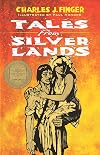
Tales From Silver Lands
by Charles J. Finger
On This Page
Description
"Atmospheric woodcuts illustrate this Newbery Award-winning collection of 19 South American folktales. Charles J. Finger heard the tales firsthand from native storytellers, whose fables of talking animals, witches, giants, and ordinary people in supernatural settings provide remarkable insights into regional values and culture. The first of the stories, "A Tale of Three Tails," tells of an age when the rat had a tail like a horse, the rabbit had a tail like a cat, and the deer's tail was show more plumed like the tail of a dog. "The Magic Dog" recounts an act of kindness to a stray animal that helps overcome a witch's curse. In "The Calabash Man," the creatures of the jungle assist a suitor in winning his bride, and in "El Enano," a greedy troll's insatiable appetite leads to his downfall. Packed with adventure and full of surprises, these and other stories emphasize the importance of hard work, courage, and loyalty"-- "Atmospheric woodcuts illustrate this Newbery Award-winning collection of 19 South American folktales. Fables of talking animals, witches, giants, and ordinary people in supernatural settings provide insights into regional values and culture"-- show lessTags
Recommendations













Member Reviews
I will admit to some trepidation about this book when first I picked it up. The author traveled to South America to collect the fairy-tale equivalents of the people of the “Silver Lands.” The fact that he did this in the 1920s made me nervous (see my post about Dr. Dolittle.) Instead, I found a wonderful collection, told with respect and honor towards the people whose stories they were. I would highly recommend having a copy of this on your shelf next to H.C. Anderson and the Grimms. However, don’t read it straight through. These are to be savored individually. (pannarrens)
I love these stories. They are so different from the fairy tales and legends that were local to my youth, they felt almost completely alien, which is a rather delicious feeling, and one that is hard to recapture as you get older and more experienced in the world.
A collection of stories told to children and among adults in South America. The author collected them from the locals as he traveled among them. I had great fun reading the book and delighted in how different the stories were from the ones I learned as a child. My favorite was the story of Nasca and the fox-faced man. But I won't tell you which one that is. To find out, you will have to read the stories.
As far as a collection of fairy-esque tales go, it was pretty charming. The stories get a little redundant (evil witch! enchanted animal!) if you read them in bulk, but the writing is easy to go with. Some tales stuck with me stronger than others, but most are fun to retell -just because of their level of absurdity. Even with a few boring bits, I think the cute pieces can pull the weight without too much trouble.
I enjoyed the tales that Finger collected, but I would have been more comfortable with more formal source notes as a supplement to Finger's occasional brief explanations that would open a tale explaining how he came across it. I know this was published before source notes were a standard practice, but it really does muddy the waters as to what parts really happened to the author and what he created for the purpose of the tale. I also thought the tales could have been better organized within the book - the trio of tales about the three giants was split up and I didn't understand why at all. This could be used as a source for storytellers looking for multicultural tales, but I think most kids won't be interested in reading it anymore. The show more only audiences I see are kids who are obsessed with fairy tales and folktales (read all of Andrew Lang's stuff and want more like it, for example) or those obsessed with the Newbery. show less
Gleaned from his travels in South America, these folktales vary in their styles. Some seem very familiar to those of the Brother Grimm, while others are very clearly morality tales where virtue gives great strength. There is a flavor of South America, but also a timeless and placeless quality to the tales. Some of the funnest stories are the ones that explain things like where monkeys came from and how the flamingo got its red and pink feathers.
Not a book you'd read all at once, but not bad for read alouds a chapter at a time. Some stories are better than others. Harmless.
Members
- Recently Added By
Lists

Best Newbery Medal Winners
94 works; 54 members

Newbery Medal Winners - By Year
105 works; 7 members

Books Read in 2019
4,052 works; 110 members

EGBERTINA's List of Newbery books that I hated or found unnecessary
58 works; 3 members
Author Information

48+ Works 726 Members
Some Editions
Awards and Honors
Awards
Common Knowledge
- Canonical title
- Tales From Silver Lands
- Original publication date
- 1924
- Dedication
- To the golden hearted Carl Sandburg and his friends, my children Helen and Herbert.
- First words
- Down in Honduras there is a town called Pueblo de Chamelecón which is not much of a town after all.
- Last words
- (Click to show. Warning: May contain spoilers.)But only those who are not wise and learned know the truth of the matter, as you may test for yourself by asking any very wise men who come to visit you.
Classifications
- Genres
- Children's Books, Kids, Fiction and Literature
- DDC/MDS
- 398.2098 — Society, government, & culture Customs, etiquette & folklore Folklore & Folktales Folk literature History, geographic treatment, biography South American folktales
- LCC
- PZ8 .F494 .T — Language and Literature Fiction and juvenile belles lettres Fiction and juvenile belles lettres Juvenile belles lettres
- BISAC
Statistics
- Members
- 596
- Popularity
- 49,028
- Reviews
- 10
- Rating
- (3.54)
- Languages
- Chinese, English
- Media
- Paper, Ebook
- ISBNs
- 10
- UPCs
- 1
- ASINs
- 17