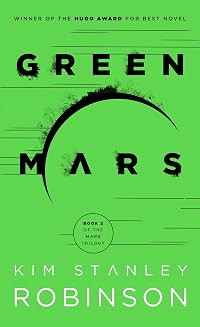
On This Page
Description
Winner of the Hugo Award for Best Novel • Kim Stanley Robinson’s classic trilogy depicting the colonization of Mars continues in a thrilling and timeless novel that pits the settlers against their greatest foes: themselves.“One of the major sagas of the [latest] generation in science fiction.”—Chicago Sun-Times
Nearly a generation has passed since the first pioneers landed on Mars, and its transformation to an Earthlike planet is under way. But not everyone wants to see the show more process through. The methods are opposed by those determined to preserve their home planet’s hostile, barren beauty. Led by the first generation of children born on Mars, these rebels are soon joined by a handful of the original settlers. Against this cosmic backdrop, passions, partnerships, and rivalries explode in a story as spectacular as the planet itself. show less
Tags
Recommendations




Member Recommendations
Member Reviews
Green Mars is the second volume in Kim Stanley Robinson’s Mars Trilogy. We are now approaching fifty years since the first settlers landed on Mars. The First Hundred were cut down to size in the aftermath of the failed revolution of 2061, and the survivors live either in hidden settlements or under false identities. The changes wrought by CO2 fixing organisms are beginning to show results, and mining the hidden aquifers and other sources of water ice offers the possibility of seas and rivers on the Martian surface. And new generations of native-born Martians are coming of age and have their own ideas about their world and what to do with it.
In this novel, we meet new characters, and we see something of the situation on Earth, caught show more in the throes of megacorporation rivalry that is expressed in open warfare. But then catastrophic climate change intervenes, and Mars suddenly takes on a new significance as a possible bolt-hole for those with the resources to make the journey and the benefit of the longevity treatments to enjoy their new-found security. Various factions on Mars see that as a threat. Events move on from there.
Despite that summary of the broad action of the novel, do not think that this is a novel of thrills and intrigue. It remains a story about sciency people doing sciency things. There is a lot of political theory in this book, as well as a continuing and loving description of the evolving Martian biosphere. The characters are drawn quite broadly, though there is no need for detailed pen portraits in a novel extending over more than 500 pages; rather, Robinson lets the characters speak for themselves through their words and actions. One of the main proponents of terraforming Mars, Sax Russell, has his own section of the book, entitled “The Scientist as Hero". Suffice it to say that there is more science in this than heroism. Yet this section ends with one of the novel's action sequences, where Russell is outed as one of the First Hundred, demonised by the megacorporations as instigators of the 2061 rebellion; is captured, tortured and then rescued by other Martian pioneers.
Another section of the novel is named “What is to be Done?”, which some will recognise as the title of one of Lenin's key tracts on the evolution of revolutionary politics. It recounts the events of a conference of the various underground groups to decide on a political agenda for an independent Mars, and will test the tolerance of many readers for rules fetishism. But those readers who have had any contact with political or campaigning movements will recognise the processes, the debates and the factionalisms on show here, and find themselves in familiar territory.
Although this is the middle book of a trilogy, it doesn’t have “middle book syndrome”, because it talks about key events in the evolution of the new Mars. By the end of the book, people are able to survive on the surface of Mars with only facemasks and warm outer clothing, though this is an extreme measure forced on them by a man-made disaster; but it is a pointer to the future.
I've made this book sound very dry. But it held me gripped. Then again, I've lived a big part of my life in a political environment and can relate to people planning, and influencing, and debating to make things happen. Yet the author also shows us people relating to the beauty of Mars; the whole argument in this book as in the previous one, is the conflict between those who wish to leave Mars as untouched as possible and those who want Mars to become habitable for people – the Reds versus the Greens. And Robinson is quite happy to stop and show us how people react to their new environment. One of the inventions in Red Mars was the areophany – a ritual involving dance and the recitation of the names of Mars in all the different languages of Earth. At the end of the conference I referred to earlier, one of the First Hundred, widely regarded by her colleagues as the high priestess of the emergent Martian biosphere, makes a ceremonial appearance involving this areophany, to remind all the delegates of just what it is that they should be working towards, and I found myself getting a little emotional.
I am coming to the conclusion that Kim Stanley Robinson's Mars Trilogy is probably the work that modern science fiction should be judged by. It doesn’t do a lot of things that readers demand of novels nowadays – no easily relatable characters, no journey of self-discovery, no obvious life lessons or personal revelations. But it speaks very directly about how we should think about our lives, the economy, the environment, and how each of those things interacts with the others. By placing the action in a setting where the environment is what we make it, and extremely fragile to boot, it makes us think about how we would behave if our very ability to walk around in the open air was something to aspire to rather than something we take for granted. So many things follow from that premise.
There are billionaires who want to settle Mars in their lifetimes. It is widely assumed that the Mars trilogy has been part of their essential background reading. Yet Robinson's research has been so thorough that the scale of capital outlay needed to support a Mars colony is clearly shown to be immense, well beyond the capacity of even a billionaire to facilitate. There is a “tech bro” in Green Mars; he is painted as a fairly benevolent character, but he is an outlier within his own billionaire community. And those who see this book and the other volumes in the trilogy as a blueprint ignore at their risk that this book, in particular, describes the formation and the rise of the “Mars Underground”; and that when people make plans, other people have the capacity to derail those plans just through their natural reactions. If we are to have a future as a multi-planet civilisation, there will be points in our future that will seem very much like the events of Green Mars; but they will take their own direction and events will never fall the way people think they will. No plan survives first contact with reality. Green Mars shows us that, and anyone who sees this book as some sort of guide to the future would do well to bear that in mind. show less
In this novel, we meet new characters, and we see something of the situation on Earth, caught show more in the throes of megacorporation rivalry that is expressed in open warfare. But then catastrophic climate change intervenes, and Mars suddenly takes on a new significance as a possible bolt-hole for those with the resources to make the journey and the benefit of the longevity treatments to enjoy their new-found security. Various factions on Mars see that as a threat. Events move on from there.
Despite that summary of the broad action of the novel, do not think that this is a novel of thrills and intrigue. It remains a story about sciency people doing sciency things. There is a lot of political theory in this book, as well as a continuing and loving description of the evolving Martian biosphere. The characters are drawn quite broadly, though there is no need for detailed pen portraits in a novel extending over more than 500 pages; rather, Robinson lets the characters speak for themselves through their words and actions. One of the main proponents of terraforming Mars, Sax Russell, has his own section of the book, entitled “The Scientist as Hero". Suffice it to say that there is more science in this than heroism. Yet this section ends with one of the novel's action sequences, where Russell is outed as one of the First Hundred, demonised by the megacorporations as instigators of the 2061 rebellion; is captured, tortured and then rescued by other Martian pioneers.
Another section of the novel is named “What is to be Done?”, which some will recognise as the title of one of Lenin's key tracts on the evolution of revolutionary politics. It recounts the events of a conference of the various underground groups to decide on a political agenda for an independent Mars, and will test the tolerance of many readers for rules fetishism. But those readers who have had any contact with political or campaigning movements will recognise the processes, the debates and the factionalisms on show here, and find themselves in familiar territory.
Although this is the middle book of a trilogy, it doesn’t have “middle book syndrome”, because it talks about key events in the evolution of the new Mars. By the end of the book, people are able to survive on the surface of Mars with only facemasks and warm outer clothing, though this is an extreme measure forced on them by a man-made disaster; but it is a pointer to the future.
I've made this book sound very dry. But it held me gripped. Then again, I've lived a big part of my life in a political environment and can relate to people planning, and influencing, and debating to make things happen. Yet the author also shows us people relating to the beauty of Mars; the whole argument in this book as in the previous one, is the conflict between those who wish to leave Mars as untouched as possible and those who want Mars to become habitable for people – the Reds versus the Greens. And Robinson is quite happy to stop and show us how people react to their new environment. One of the inventions in Red Mars was the areophany – a ritual involving dance and the recitation of the names of Mars in all the different languages of Earth. At the end of the conference I referred to earlier, one of the First Hundred, widely regarded by her colleagues as the high priestess of the emergent Martian biosphere, makes a ceremonial appearance involving this areophany, to remind all the delegates of just what it is that they should be working towards, and I found myself getting a little emotional.
I am coming to the conclusion that Kim Stanley Robinson's Mars Trilogy is probably the work that modern science fiction should be judged by. It doesn’t do a lot of things that readers demand of novels nowadays – no easily relatable characters, no journey of self-discovery, no obvious life lessons or personal revelations. But it speaks very directly about how we should think about our lives, the economy, the environment, and how each of those things interacts with the others. By placing the action in a setting where the environment is what we make it, and extremely fragile to boot, it makes us think about how we would behave if our very ability to walk around in the open air was something to aspire to rather than something we take for granted. So many things follow from that premise.
There are billionaires who want to settle Mars in their lifetimes. It is widely assumed that the Mars trilogy has been part of their essential background reading. Yet Robinson's research has been so thorough that the scale of capital outlay needed to support a Mars colony is clearly shown to be immense, well beyond the capacity of even a billionaire to facilitate. There is a “tech bro” in Green Mars; he is painted as a fairly benevolent character, but he is an outlier within his own billionaire community. And those who see this book and the other volumes in the trilogy as a blueprint ignore at their risk that this book, in particular, describes the formation and the rise of the “Mars Underground”; and that when people make plans, other people have the capacity to derail those plans just through their natural reactions. If we are to have a future as a multi-planet civilisation, there will be points in our future that will seem very much like the events of Green Mars; but they will take their own direction and events will never fall the way people think they will. No plan survives first contact with reality. Green Mars shows us that, and anyone who sees this book as some sort of guide to the future would do well to bear that in mind. show less
Lately it seems as if I’m returning to my teenage reading years with epic sci-fi future histories, which are involving for both the emotions and intellect. To carry the reader along for 600 pages or more, the writer has to craft a vivid and distinctive world then fill it with careful plotting and interesting characters. The examples I’ve read this year are Cixin Liu’s [b:Remembrance of Earth's Past|36520192|Remembrance of Earth's Past (The Three-Body Problem)|Liu Cixin|https://images.gr-assets.com/books/1509603033s/36520192.jpg|58251384] trilogy, Ada Palmer’s 'Terra Ignota' series ([b:Too Like the Lightning|26114545|Too Like the Lightning (Terra Ignota, #1)|Ada show more Palmer|https://images.gr-assets.com/books/1443106959s/26114545.jpg|46061374] et al), potentially James S.A. Corey’s 'Expanse' series ([b:Leviathan Wakes|8855321|Leviathan Wakes (The Expanse, #1)|James S.A. Corey|https://images.gr-assets.com/books/1411013134s/8855321.jpg|13730452] et al), and now Kim Stanley Robinson’s [b:Mars Trilogy|1655299|Mars Trilogy|Kim Stanley Robinson|https://images.gr-assets.com/books/1456997462s/1655299.jpg|1649931]. What I find fascinating is the variation in underlying philosophy that these series exhibit when laying out their future world. [b:Too Like the Lightning|26114545|Too Like the Lightning (Terra Ignota, #1)|Ada Palmer|https://images.gr-assets.com/books/1443106959s/26114545.jpg|46061374] et al are dense with abstract philosophy, so cannot be readily reduced to a single ethos - at least not one that I’ve yet discerned. I’ve only read one book of Corey's 'Expanse' and that was plot-heavy, so will need to go further into the series before speculating. [b:Remembrance of Earth's Past|36520192|Remembrance of Earth's Past (The Three-Body Problem)|Liu Cixin|https://images.gr-assets.com/books/1509603033s/36520192.jpg|58251384] and the [b:Mars Trilogy|1655299|Mars Trilogy|Kim Stanley Robinson|https://images.gr-assets.com/books/1456997462s/1655299.jpg|1649931] make for a fascinating contrast, though.
[a:Cixin Liu|18455699|Cixin Liu|https://s.gr-assets.com/assets/nophoto/user/u_50x66-632230dc9882b4352d753eedf9396530.png]’s universe is one of conflict and zero-sum decisions. Not in a reductive or simplistic way, but he takes a fundamentally pessimistic approach to the potential for cooperation, resource-sharing, and communication between groups and species. His trilogy reads as an absorbing yet dispiriting thought experiment. [a:Kim Stanley Robinson|1858|Kim Stanley Robinson|https://images.gr-assets.com/authors/1376955089p2/1858.jpg], however, is one of the most hopeful writers I’ve ever come across. His work dwells on minutiae of incremental change for the better, the work of collaboration, and the potential for technology to offer liberation rather than just threats. Both series take the well-established approach of using several key figures as narrators of a period in which tumultuous interplanetary change takes place. In Cixin Liu’s books, these figures are generally, though not always, selected to make major decisions by a faceless state power. In Kim Stanley Robinson’s, their decisions are generally made in opposition to faceless state power, attempting to assert independence within a complex environment. In both cases, the narrators dwell on the validity of their decisions throughout their long lives. In the [b:Mars Trilogy|1655299|Mars Trilogy|Kim Stanley Robinson|https://images.gr-assets.com/books/1456997462s/1655299.jpg|1649931], though, the characters have much greater agency in their narratives. There is very little of Cixin Liu’s carefully articulated fatalism. Both writers offer thought-provoking visions of the future with considerable conviction.
I also enjoyed ‘Green Mars’ as a novel in its own right, of course. It has been almost exactly two years since I read [b:Red Mars|77507|Red Mars (Mars Trilogy, #1)|Kim Stanley Robinson|https://images.gr-assets.com/books/1440699787s/77507.jpg|40712], so I couldn’t remember prior events with total clarity. This did not prove to be a problem, though, as such events were often referred to and rehashed, such that I could keep up. Indeed, ‘Green Mars’ has a much slower-paced plot than its predecessor, as the dramatic happenings of previous years have left the remaining members of the First Hundred on Mars fragmented and wary of further conflict. During ‘Green Mars’, they process what happened in 2061, withdraw from politics to pursue personal projects, and slowly encourage a new revolutionary movement to gather momentum. As a consequence, there are long stretches of the novel in which relatively little actually occurs. Stanley Robinson is such a great writer that they do not pall; his descriptions of lichen on the surface of Mars are absolutely beguiling. Nonetheless, I’m deducting one star because the dramatic events of the final hundred pages are hard-won for both the characters and the reader. During the lull, there are some outstanding descriptive passages and set pieces, in particular the constitutional convention of Mars. While not downplaying the intense difficulty of achieving political consensus, this sequence shows how common ground can be found and the immense importance that this has.
The first two books of the [b:Mars Trilogy|1655299|Mars Trilogy|Kim Stanley Robinson|https://images.gr-assets.com/books/1456997462s/1655299.jpg|1649931] have aged well - they’re more than twenty years old. Everyone has a tablet/laptop called a lectern (a much better name than ‘laptop’, surely); communication is usually by smartwatch or teleconference. The takeover of Earth by vast corporations that privatise whole countries, and want to privatise Mars, certainly hasn’t lost plausibility. Actually, the one thing I’ve noticed improving in Stanley Robinson’s more recent work, like [b:New York 2140|29570143|New York 2140|Kim Stanley Robinson|https://images.gr-assets.com/books/1471618737s/29570143.jpg|49898123], is that his female characters aren’t all jealous of one another anymore. Maya and Nadia provide the point of view for much of ‘Green Mars’, which I thoroughly appreciated with the exception of when, for example, Maya got into a slap-fight with another woman and called her a slut. I found Maya and Nadia only jarred as characters when they slipped into this weird jealousy of other women. Otherwise the characterisation is varied, nuanced, and interesting. Sax’s mad scientist perspective is very compelling and Maya’s body dysmorphia and deja vu as a result of old age are depicted with subtlety. The novel also has much to say about Mars’ multicultural society and how new cultures can be built from old traditions, new ideas, and cross-fertilisation between groups. Again, this is wonderfully hopeful and carefully argued. I am of course now eager to read [b:Blue Mars|77504|Blue Mars (Mars Trilogy, #3)|Kim Stanley Robinson|https://images.gr-assets.com/books/1429497319s/77504.jpg|40711]. show less
[a:Cixin Liu|18455699|Cixin Liu|https://s.gr-assets.com/assets/nophoto/user/u_50x66-632230dc9882b4352d753eedf9396530.png]’s universe is one of conflict and zero-sum decisions. Not in a reductive or simplistic way, but he takes a fundamentally pessimistic approach to the potential for cooperation, resource-sharing, and communication between groups and species. His trilogy reads as an absorbing yet dispiriting thought experiment. [a:Kim Stanley Robinson|1858|Kim Stanley Robinson|https://images.gr-assets.com/authors/1376955089p2/1858.jpg], however, is one of the most hopeful writers I’ve ever come across. His work dwells on minutiae of incremental change for the better, the work of collaboration, and the potential for technology to offer liberation rather than just threats. Both series take the well-established approach of using several key figures as narrators of a period in which tumultuous interplanetary change takes place. In Cixin Liu’s books, these figures are generally, though not always, selected to make major decisions by a faceless state power. In Kim Stanley Robinson’s, their decisions are generally made in opposition to faceless state power, attempting to assert independence within a complex environment. In both cases, the narrators dwell on the validity of their decisions throughout their long lives. In the [b:Mars Trilogy|1655299|Mars Trilogy|Kim Stanley Robinson|https://images.gr-assets.com/books/1456997462s/1655299.jpg|1649931], though, the characters have much greater agency in their narratives. There is very little of Cixin Liu’s carefully articulated fatalism. Both writers offer thought-provoking visions of the future with considerable conviction.
I also enjoyed ‘Green Mars’ as a novel in its own right, of course. It has been almost exactly two years since I read [b:Red Mars|77507|Red Mars (Mars Trilogy, #1)|Kim Stanley Robinson|https://images.gr-assets.com/books/1440699787s/77507.jpg|40712], so I couldn’t remember prior events with total clarity. This did not prove to be a problem, though, as such events were often referred to and rehashed, such that I could keep up. Indeed, ‘Green Mars’ has a much slower-paced plot than its predecessor, as the dramatic happenings of previous years have left the remaining members of the First Hundred on Mars fragmented and wary of further conflict. During ‘Green Mars’, they process what happened in 2061, withdraw from politics to pursue personal projects, and slowly encourage a new revolutionary movement to gather momentum. As a consequence, there are long stretches of the novel in which relatively little actually occurs. Stanley Robinson is such a great writer that they do not pall; his descriptions of lichen on the surface of Mars are absolutely beguiling. Nonetheless, I’m deducting one star because the dramatic events of the final hundred pages are hard-won for both the characters and the reader. During the lull, there are some outstanding descriptive passages and set pieces, in particular the constitutional convention of Mars. While not downplaying the intense difficulty of achieving political consensus, this sequence shows how common ground can be found and the immense importance that this has.
The first two books of the [b:Mars Trilogy|1655299|Mars Trilogy|Kim Stanley Robinson|https://images.gr-assets.com/books/1456997462s/1655299.jpg|1649931] have aged well - they’re more than twenty years old. Everyone has a tablet/laptop called a lectern (a much better name than ‘laptop’, surely); communication is usually by smartwatch or teleconference. The takeover of Earth by vast corporations that privatise whole countries, and want to privatise Mars, certainly hasn’t lost plausibility. Actually, the one thing I’ve noticed improving in Stanley Robinson’s more recent work, like [b:New York 2140|29570143|New York 2140|Kim Stanley Robinson|https://images.gr-assets.com/books/1471618737s/29570143.jpg|49898123], is that his female characters aren’t all jealous of one another anymore. Maya and Nadia provide the point of view for much of ‘Green Mars’, which I thoroughly appreciated with the exception of when, for example, Maya got into a slap-fight with another woman and called her a slut. I found Maya and Nadia only jarred as characters when they slipped into this weird jealousy of other women. Otherwise the characterisation is varied, nuanced, and interesting. Sax’s mad scientist perspective is very compelling and Maya’s body dysmorphia and deja vu as a result of old age are depicted with subtlety. The novel also has much to say about Mars’ multicultural society and how new cultures can be built from old traditions, new ideas, and cross-fertilisation between groups. Again, this is wonderfully hopeful and carefully argued. I am of course now eager to read [b:Blue Mars|77504|Blue Mars (Mars Trilogy, #3)|Kim Stanley Robinson|https://images.gr-assets.com/books/1429497319s/77504.jpg|40711]. show less
Green Mars is still a good book, but it suffers a little but from a sophmore slump, as the conflicts and challenges are nowhere near as interesting as those in Red Mars. It doesn't help that many of the most interesting characters die during the last book. A bigger problem is that KSR seems too be losing touch with the scope and scale of what he's attempting. The best way that I can describe it is that in the book, people are fleeing an overcrowded Earth to move to Mars to live in tiny apartments and rovers where they teleoperate giant ice mining robots to create a world circling sea. The setting can't decide if it's pre-apocalyptic, post-scarcity, totally pulpy, or any other description. Maybe this is a strength, but in a very hard show more scifi book, I find this floppiness annoying.
(first read December 11, 2012, updated for Hugo reread below)
***********************
Kim Stanley Robinson's Mars Trilogy is a masterpiece in science fiction, a dreamy, imaginative, yet rigorously technical account of building a new ecology and new society on Mars. The First Hundred are a compelling cast of geniuses and contradictions, world-class experts stable enough to pass a barrage of tests to go to Mars, yet monomaniacal enough to cast aside all their ties to Earth. Red Mars, the story of landing, division in the new colony, the growth of Mars into a world, and then the spasm of violence that is the abortive revolt of 2061, is one of the best books ever written: lyrical in its depictions of the Martian landscape, smart in its politics and science, and using its multiple narrators to best effect in showing the fragmentation of the unique men and women who first landed on Mars.
Green Mars continues the story, focusing on the native Martians and their nascent political community, but with a heavier touch and less interesting characters than the first book. The story opens with Nirgal, a third generation Martian and member of the underground society, growing up in a small town named Zygote under the South Polar Ice Cap, with the surviving First Hundred under the direct car of the enigmatic Hiroki, the farm ecologist who disappeared in the earliest days of the settlement. It's a profoundly strange upbringing, the smallest of small towns with a dozen or so other kids and the legends of the first days. It's like a town with a one-room school house where the teachers are all Nobel prize winning scientists, the Founding Fathers of your nascent nation, and a literal priestess-goddess. Nirgal grows up, wanders around Mars with the legendary traveler Coyote (who stowed away on the initial journey), and then goes off to coordinate all the diverse groups of the underground and demimonde community in political awareness of the their status as Martians.
The story then follows Sax Russell, another of the First Hundred, as he emerges from hiding to take back up the cause of terraforming. Sax wanders through alpine meadows and glaciers on Mars, forming a liaison with the only one of the First Hundred to stay loyal to Earth, and then getting captured and rescued by his friends, suffering a stroke in the process. The thread then switches between Nadia, Maya, and Art, respectively two of the First Hundred, Russian construction engineer and diplomat, and a spy sent from the profoundly strange super-corporation Praxis, which is trying to form an alliance with Mars as a test for new ecologically sustainable economics needed on Earth. Together, all the characters create a kind of constitutional convention at a settlement, where the diverse groups (space communists, Sufi mystics, Polynesian matriarchies, anarchist geologists) agree to recognize human rights and the diversity of communities in a generalized document. The biggest split is between Reds, who prefer to keep Mars as it is, and Greens, who want to follow a terraforming program leading to humans walking under an open sky. Years pass, tensions mount, and then the collapse of the Antarctic ice shelf on Earth, Mars declares independence, use non-violent means to kick the last few cops off planet, and then evacuate a city threatened by flooding in an orderly and triumph walk with nothing but simple carbon dioxide filter masks.
This is not a fast book, or an action packed book, or one with strong characters, but then that's not what KSR is about as an author. The thing is that even on a reread, this feels like a 50 page political pamphlet wrapped in 500 pages about alpine meadows, scientific conferences, and left wing rallies. I really like Robinson, he's a gentleman and a scholar, and I even agree with his politics/economics. The world would be a lot better if more people saw it like he did. But this book is about as didactic as The Moon is a Harsh Mistress and way more mellow. The little communities on Mars, scholar-farmers living in cliffside apartments and tented valleys as their gigantic robots go through the centuries long work of making seas and skies and fields, are just so... dull.
The first book really shined in the animosities and visions of three characters: Arkady Bogdanov and his utopian quest to break off entirely from an Earth-bound past, John Boone and his innate charisma and love of newness of Mars, and Frank Chambers and his aggressive pragmatism and anger at anyone who stood before him. All these characters are dead at the start of Green Mars, and and viewpoints that replace them are cloudier, smaller, more hectoring in their insistence that we the reader, as early 21st century humans, are at fault for not living in the world KSR imagines. show less
(first read December 11, 2012, updated for Hugo reread below)
***********************
Kim Stanley Robinson's Mars Trilogy is a masterpiece in science fiction, a dreamy, imaginative, yet rigorously technical account of building a new ecology and new society on Mars. The First Hundred are a compelling cast of geniuses and contradictions, world-class experts stable enough to pass a barrage of tests to go to Mars, yet monomaniacal enough to cast aside all their ties to Earth. Red Mars, the story of landing, division in the new colony, the growth of Mars into a world, and then the spasm of violence that is the abortive revolt of 2061, is one of the best books ever written: lyrical in its depictions of the Martian landscape, smart in its politics and science, and using its multiple narrators to best effect in showing the fragmentation of the unique men and women who first landed on Mars.
Green Mars continues the story, focusing on the native Martians and their nascent political community, but with a heavier touch and less interesting characters than the first book. The story opens with Nirgal, a third generation Martian and member of the underground society, growing up in a small town named Zygote under the South Polar Ice Cap, with the surviving First Hundred under the direct car of the enigmatic Hiroki, the farm ecologist who disappeared in the earliest days of the settlement. It's a profoundly strange upbringing, the smallest of small towns with a dozen or so other kids and the legends of the first days. It's like a town with a one-room school house where the teachers are all Nobel prize winning scientists, the Founding Fathers of your nascent nation, and a literal priestess-goddess. Nirgal grows up, wanders around Mars with the legendary traveler Coyote (who stowed away on the initial journey), and then goes off to coordinate all the diverse groups of the underground and demimonde community in political awareness of the their status as Martians.
The story then follows Sax Russell, another of the First Hundred, as he emerges from hiding to take back up the cause of terraforming. Sax wanders through alpine meadows and glaciers on Mars, forming a liaison with the only one of the First Hundred to stay loyal to Earth, and then getting captured and rescued by his friends, suffering a stroke in the process. The thread then switches between Nadia, Maya, and Art, respectively two of the First Hundred, Russian construction engineer and diplomat, and a spy sent from the profoundly strange super-corporation Praxis, which is trying to form an alliance with Mars as a test for new ecologically sustainable economics needed on Earth. Together, all the characters create a kind of constitutional convention at a settlement, where the diverse groups (space communists, Sufi mystics, Polynesian matriarchies, anarchist geologists) agree to recognize human rights and the diversity of communities in a generalized document. The biggest split is between Reds, who prefer to keep Mars as it is, and Greens, who want to follow a terraforming program leading to humans walking under an open sky. Years pass, tensions mount, and then the collapse of the Antarctic ice shelf on Earth, Mars declares independence, use non-violent means to kick the last few cops off planet, and then evacuate a city threatened by flooding in an orderly and triumph walk with nothing but simple carbon dioxide filter masks.
This is not a fast book, or an action packed book, or one with strong characters, but then that's not what KSR is about as an author. The thing is that even on a reread, this feels like a 50 page political pamphlet wrapped in 500 pages about alpine meadows, scientific conferences, and left wing rallies. I really like Robinson, he's a gentleman and a scholar, and I even agree with his politics/economics. The world would be a lot better if more people saw it like he did. But this book is about as didactic as The Moon is a Harsh Mistress and way more mellow. The little communities on Mars, scholar-farmers living in cliffside apartments and tented valleys as their gigantic robots go through the centuries long work of making seas and skies and fields, are just so... dull.
The first book really shined in the animosities and visions of three characters: Arkady Bogdanov and his utopian quest to break off entirely from an Earth-bound past, John Boone and his innate charisma and love of newness of Mars, and Frank Chambers and his aggressive pragmatism and anger at anyone who stood before him. All these characters are dead at the start of Green Mars, and and viewpoints that replace them are cloudier, smaller, more hectoring in their insistence that we the reader, as early 21st century humans, are at fault for not living in the world KSR imagines. show less
I prefer this book to the first, possibly because my expectations this time around were better aligned with the actual content. This is not a series about terraforming Mars, but it is the story of its colonization with terraforming as part of the background, together with a lot of political, economic and sociological turmoil. The big questions posed concern whether Mars' primary value lies merely its mineral wealth, or does it offer something more to human civilization and what form should that take? There are even strong proponents in the novel for surrendering the question and respecting the planet's natural state. You might take the sequence of titles in this series as a spoiler for how well that view fares.
The sequel follows the show more model established in the first novel, devoting each section to following another character while feeding into the overarching story of what's being done to the planet, how its future is being determined and by whom. The author might easily have adopted one particular approach to Mars as his protagonist view, but instead he's presented a story that covers the entire spectrum of possible approaches and throws them into conflict with one another. As a reader I was perpetually re-evaluating which faction is right, and discovering it is easier to shift sympathies from one view of the story to another with each new section than it is to arrive at an easy answer. I expect by the end of the trilogy there will be a dominant faction or two, but at this rate it will come with knowing the full price that was paid and having seen other promising visions of Mars' future pass into nothing. It's harsh, but I like it. show less
The sequel follows the show more model established in the first novel, devoting each section to following another character while feeding into the overarching story of what's being done to the planet, how its future is being determined and by whom. The author might easily have adopted one particular approach to Mars as his protagonist view, but instead he's presented a story that covers the entire spectrum of possible approaches and throws them into conflict with one another. As a reader I was perpetually re-evaluating which faction is right, and discovering it is easier to shift sympathies from one view of the story to another with each new section than it is to arrive at an easy answer. I expect by the end of the trilogy there will be a dominant faction or two, but at this rate it will come with knowing the full price that was paid and having seen other promising visions of Mars' future pass into nothing. It's harsh, but I like it. show less
I'm still digging this portrayal of humanity's fledgling expansion beyond Earth: the various terraforming efforts driven and sabotaged by the competing, world-conquering corporations and the many nuanced groups/individuals who have embraced Mars as their home -- especially the generations of those born on the red planet, evolving into a new species! Curious to see what a "free" Mars coalesces into -- can capitalism really be escaped; are pharonic projects still feasible; should humans (of whatever flavor) dream and mold on a cosmic scale?
I just...can't. I know this won a Hugo. Hell, the next one, which I'm loathe to even pick up, also won a Hugo. But I was white knuckling my way through this. Almost unreadably bad. At least with the first one, I got to some degree why certain groups of folks liked it. This...the characterization is bad, the science is incredibly boring, the stakes seem low, there's stakeholders and threads all over the place that aren't fleshed out and/or seem to matter so little I'm not sure why they were introduced. We spend massive amounts of time and space on things that seem completely unimportant. The politics don't even seem as involved as the first one. It just kind of drags with nothing to hold onto unless you really like reading about lichen show more (and I mean, would otherwise maybe read a textbook on lichen?). I'm kind of afraid how bad Blue Mars might be. But I'm still going to hold onto hope that unrelated KSR books are vast improvements on this beast that was hundreds of pages longer than it had any need or rite to be. show less
O segundo livro da trilogia da terraformação de Marte continua incrível, com sua mistura de personagens realistas, ficção científica cientificamente muito bem informada, perspicácia política e generosidade intelectual ampla. Ademais, salta aos olhos aqui o papel central de Sax Russell, um dos 100 colonizadores iniciais que eu menos desenvolvi empatia no primeiro livro, e um arco de redenção pra Maya Toitovna. Acho brilhante o ritmo em que a narrativa alterna descrições da paisagem e dos projetos científicos envolvidos, com as tensões políticas envolvidas em fazer de Marte um lugar para se viver bem, a despeito das giga-transnacionais e a mesquinharia humana em geral. Recomendadíssimo. E ao que parece vou acabar show more considerando a trilogia como um todo uma obra prima.
Livro ganhador do prêmio Hugo para novelas, 1994. show less
Livro ganhador do prêmio Hugo para novelas, 1994. show less
Members
- Recently Added By
Lists

Best Science Fiction Novels
816 works; 430 members

Hugo Award Winning Novels
63 works; 23 members

NPRs your picks: top 100 Sci-Fi/Fantasy books
297 works; 80 members

Hugo Awards - Best Novel
69 works; 10 members
Locus Award for Best Novel/SF Novel
53 works; 6 members

Space Colonization
100 works; 26 members

Speculative Fiction to Read
706 works; 32 members

A Rainbow of Books: Colors in the Title
570 works; 24 members

Books Set on Mars
22 works; 7 members

Books Read in 2009
464 works; 11 members

Five star books
1,767 works; 110 members

Unread books
1,063 works; 87 members

Books Read in 2022
5,218 works; 114 members

Books Read in 2013
1,630 works; 51 members
Book Worlds We'd Like To Visit
322 works; 158 members

Books Read in 2026
1,969 works; 66 members
Survey of Classic Science Fiction
171 works; 48 members
Author Information

139+ Works 49,459 Members
Kim Stanley Robinson was born in Orange County, California on March 23, 1952. He received a B. A. and Ph. D. from the University of California at San Diego and an M. A. from Boston University. His first trilogy of books, Orange County, collectively won a Nebula Award and two Hugo Awards. His other works include the Mars trilogy, 2312, and Aurora. show more He has won an Asimov Award, a World Fantasy Award, a Locus Reader's Poll Award, and a John W. Campbell Award. (Bowker Author Biography) show less
Some Editions
Awards and Honors
Awards
Notable Lists
Series

Belongs to Publisher Series
Work Relationships
Is contained in
Is replied to in
Has as a supplement
Common Knowledge
- Canonical title
- Green Mars
- Original title
- Green Mars
- Original publication date
- 1993-10
- People/Characters
- Maya Toitovna; Hiroko Ai; Desmond "Coyote" Hawkins; Nirgal; Jackie Boone; Ann Clayborne (show all 14); Saxifrage "Sax" Russell; Peter Clayborne; Nadia Chernyshevski; Art Randolph; William Fort; Michel Duval; Vlad Taneev; Phyllis Booth
- Important places
- Mars
- Dedication
- for Lisa and David
- First words
- The point is not to make another Earth.
- Quotations
- "Even if you want no state, or a minimal state, then you still have to argue it point by point. Especially since most minimalists want to keep exactly the economic and police system that keeps them privileged. That's libert... (show all)arians for you -- anarchists who want police protection from their slaves!"
- Last words
- (Click to show. Warning: May contain spoilers.)And they went forward up the train.
- Original language
- English
Classifications
Statistics
- Members
- 5,745
- Popularity
- 2,278
- Reviews
- 70
- Rating
- (3.88)
- Languages
- 10 — Czech, Dutch, English, French, German, Hebrew, Italian, Polish, Romanian, Spanish
- Media
- Paper, Audiobook, Ebook
- ISBNs
- 42
- ASINs
- 18