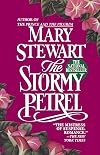
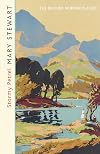
The Stormy Petrel
by Mary Stewart
On This Page
Description
For writer Rose Fenemore, an isolated cottage on a remote Scottish island seemed like an ideal away-from-it-all retreat. Here is a place where she can work in peace, and where her brother Crispin could walk, fish, and photograph the birds and wildlife. But it is not easy to escape the world and its troubles. Crispin's arrival is delayed, and Rose, on her own in the lonely cottage, has to cope with two very different men who come in from the sea on the night of a summer storm. This gripping, show more nail-biting tale set on a beautiful isolated Hebridean island features love, intrigue, and adventure. show lessTags
Recommendations


















Member Reviews
3.5 Stars, rounded up.
If I did not love Mary Stewart’s style and descriptive abilities so much, perhaps The Stormy Petrel would have been a major disappointment for me. Ah, but I do love those things, so I find that I enjoyed this book despite its weak ending and under-developed characters.
Silence? The wash of waves on the pebbled beach, the crying and calling of the wheeling gulls, the silver chain of sound from a lark above the cliff-top, and a final coda, the distant breathy note of the ferry’s siren as she drew away towards the west. The last link gone. Solitude. Complete and unassailable solitude.
I feel as if I have just been put down for vacation, escaped the noise and clatter and found a haven of birds and sunshine.
Another show more plus in this novel, for me, is Mary Stewart’s reflections on what it is to create a book or poem.
From experience, I knew what to do. Write. Write anything. Bad sentences, meaningless sentences, anything to get the mind fixed again to that sheet of paper and oblivious of the “real” world. Write until the words begin to make sense, the cogs mesh, the wheels start to turn, the creaking movement quickens and becomes a smooth, oiled run, and then, with luck, exhaustion will be forgotten, and the real writing will begin.
All her hallmark assets are present here, they just don’t come together in the same way they did in her earlier books. I think one must consider that she is seventy-five writing this one, while her most successful novels were written when she was much younger and probably felt a stronger relationship to the young women she was portraying.
I wonder if I read this book back in 1991 when it was released. I was an avid fan. I find it hard to believe that I just passed it by. I can imagine that I would have been disappointed, if I did read it then, and subsequently forgotten it entirely. I’m a kinder reader now. I am older myself. I revel in her ability to transport me to the Hebrides and show me a broch and a petrel. I don’t think we have anyone writing today who can soothe and comfort as she did. Her writing is stylish and intelligent--I guess I miss her.
In the words of John Donne's Song:
Go and catch a falling star,
Get with child a mandrake root,
Tell me where all past years are,
Or who cleft the devil's foot,
Teach me to hear mermaids singing,
Or to keep off envy's stinging,
And find
What wind
Serves to advance an honest mind.
I believe Mary Stewart helps us to hear the song. show less
If I did not love Mary Stewart’s style and descriptive abilities so much, perhaps The Stormy Petrel would have been a major disappointment for me. Ah, but I do love those things, so I find that I enjoyed this book despite its weak ending and under-developed characters.
Silence? The wash of waves on the pebbled beach, the crying and calling of the wheeling gulls, the silver chain of sound from a lark above the cliff-top, and a final coda, the distant breathy note of the ferry’s siren as she drew away towards the west. The last link gone. Solitude. Complete and unassailable solitude.
I feel as if I have just been put down for vacation, escaped the noise and clatter and found a haven of birds and sunshine.
Another show more plus in this novel, for me, is Mary Stewart’s reflections on what it is to create a book or poem.
From experience, I knew what to do. Write. Write anything. Bad sentences, meaningless sentences, anything to get the mind fixed again to that sheet of paper and oblivious of the “real” world. Write until the words begin to make sense, the cogs mesh, the wheels start to turn, the creaking movement quickens and becomes a smooth, oiled run, and then, with luck, exhaustion will be forgotten, and the real writing will begin.
All her hallmark assets are present here, they just don’t come together in the same way they did in her earlier books. I think one must consider that she is seventy-five writing this one, while her most successful novels were written when she was much younger and probably felt a stronger relationship to the young women she was portraying.
I wonder if I read this book back in 1991 when it was released. I was an avid fan. I find it hard to believe that I just passed it by. I can imagine that I would have been disappointed, if I did read it then, and subsequently forgotten it entirely. I’m a kinder reader now. I am older myself. I revel in her ability to transport me to the Hebrides and show me a broch and a petrel. I don’t think we have anyone writing today who can soothe and comfort as she did. Her writing is stylish and intelligent--I guess I miss her.
In the words of John Donne's Song:
Go and catch a falling star,
Get with child a mandrake root,
Tell me where all past years are,
Or who cleft the devil's foot,
Teach me to hear mermaids singing,
Or to keep off envy's stinging,
And find
What wind
Serves to advance an honest mind.
I believe Mary Stewart helps us to hear the song. show less
When Rose Fenemore travels to the island of Moila off the west coast of Scotland, she is looking forward to spending a quiet holiday with her brother Crispin in a paradise filled with seabirds and wild flowers. Remote and lonely, the secluded island seems to Rose to be the perfect place to relax and get away from it all. In fact, the isolated cottage she has rented - advertised as an "ivory tower" - promises to be the ideal retreat where Rose can finish writing her novel, and Crispin can commune with nature - walking, fishing and indulging in his passion for photography.
However, things don't turn out quite so idyllically. Her brother's arrival is delayed, and the island's peace is shattered by the arrival of two men, seeking shelter show more during a violent summer storm. Each man tells a remarkably different story - conflicting narratives that draw Rose into a web of menace and suspicion.
Rose's discovery of the stormy petrels - the fragile, elusive seabirds that nest ashore but spend the majority of their lives flying just above the waves - comes to symbolize for Rose her confusion about Ewen Mackay, the man known as the island's prodigal son, as well as the man who calls himself John Parsons - someone whose account of himself Rose has every reason to distrust.
I enjoyed reading this book - it was certainly interesting and a remarkably quick read for me. However, I must say that I didn't really find the plot all that suspenseful - at least not as suspenseful as some of Ms. Stewart's other work that I've read. Although I wouldn't say that this book is Ms. Stewart's absolute best - compared to some of her other books that I've read in the past - it still was quite good. I would give The Stormy Petrel by Mary Stewart an A! show less
However, things don't turn out quite so idyllically. Her brother's arrival is delayed, and the island's peace is shattered by the arrival of two men, seeking shelter show more during a violent summer storm. Each man tells a remarkably different story - conflicting narratives that draw Rose into a web of menace and suspicion.
Rose's discovery of the stormy petrels - the fragile, elusive seabirds that nest ashore but spend the majority of their lives flying just above the waves - comes to symbolize for Rose her confusion about Ewen Mackay, the man known as the island's prodigal son, as well as the man who calls himself John Parsons - someone whose account of himself Rose has every reason to distrust.
I enjoyed reading this book - it was certainly interesting and a remarkably quick read for me. However, I must say that I didn't really find the plot all that suspenseful - at least not as suspenseful as some of Ms. Stewart's other work that I've read. Although I wouldn't say that this book is Ms. Stewart's absolute best - compared to some of her other books that I've read in the past - it still was quite good. I would give The Stormy Petrel by Mary Stewart an A! show less
I fell in love with a Scottish island when I was eight years old.
Looking back it was a mad thing for my parents to do, travelling so far across country with two young children, but that wanted to see Scotland, and they had been guided to a particular place by a very good friend. So if it was madness it was the very best kind of madness, and if I had to live outside Cornwall I should still choose to live on a Scottish Island.
That’s what drew me to ‘Stormy Petrel, even though I knew it was one of Mary Stewart’s later novels and not considered to be her best work; it was set on a fictional Scottish island, and island very close to and very like mine.
The story opened in a Cambridge where Rose, who write poetry for love and science show more fiction for money, was a tutor of English. A newspaper advertisement caught her eye: an advertisement for cottage on the Hebridean island of Moila. It sounded perfect. Rose could have the time and space to write and her doctor brother, a keen wildlife photographer, would love to take pictures of the rare birds that nested on the island.
Rose travelled north before her brother, and she found the island and the cottage to be everything she hoped them to be.
When Rose wakes in the night to the sounds of someone moving about downstairs she assumes that her brother has arrived. But he hasn’t, and another man is making tea in the kitchen. Both are startled, but the intruder is quick to reassure Rose, explaining that he had lived there with foster parents, he had fallen out of touch, he had no idea that they had moved away. And then another man arrived. His explanation was that he was a visiting geologist, he had been camping, and when the storm carried his tent away he had come to look for shelter where he saw lights.
The two men claimed not to have met, but there was something in their manners towards each other that told rose that they had, that something was amiss. Rose made a sensible decision: she withdrew to her room, leaving the pair to make the best of things downstairs.
When Rose woke again the storm and her house-guests had gone. She thought that was the end of things, but of course it was only the beginning ….
I found a lot to like in ‘Stormy Petrel’.
Moila is so beautifully and lovingly described that I was transported, and I didn’t doubt for one second that it was inspired by a place that Mary Stewart knew and loved.
” It is not a large island, perhaps nine miles by five, with formidable cliffs to the north-west that face the weather like the prow of a ship. From the steep sheep-bitten turf at the head of these cliffs the land slopes gently down towards a glen where the island’s only sizeable river runs seawards out of a loch cupped in a shallow basin among low hills. Presumably the loch – lochan, rather, for it is not large – is fed by springs eternally replenished by the rain, for nothing flows into it except small burns seeping through rush and bog myrtle, which spread after storms into sodden quagmires of moss. But the outflow is perennially full, white water pouring down to where the moor cleaves open and lets it fall to the sea.”
I loved that Rose came to love her island as I loved mine, that she appreciated that things that made it so special. And I was pleased that she proved herself to be sensible, capable and practical.
I was pleased that the romance was low-key, and that the resolution of the story was gentle, with future possibilities simply suggested.
I was less pleased that the suspense was low-key, that it became clear quickly who was the hero and who was the villain, that the villain was not so very wicked, and that there was very little mystery to be resolved or danger to be faced.
And so I loved my trip to Moila, I loved the company, but the story – it needed something more. show less
Looking back it was a mad thing for my parents to do, travelling so far across country with two young children, but that wanted to see Scotland, and they had been guided to a particular place by a very good friend. So if it was madness it was the very best kind of madness, and if I had to live outside Cornwall I should still choose to live on a Scottish Island.
That’s what drew me to ‘Stormy Petrel, even though I knew it was one of Mary Stewart’s later novels and not considered to be her best work; it was set on a fictional Scottish island, and island very close to and very like mine.
The story opened in a Cambridge where Rose, who write poetry for love and science show more fiction for money, was a tutor of English. A newspaper advertisement caught her eye: an advertisement for cottage on the Hebridean island of Moila. It sounded perfect. Rose could have the time and space to write and her doctor brother, a keen wildlife photographer, would love to take pictures of the rare birds that nested on the island.
Rose travelled north before her brother, and she found the island and the cottage to be everything she hoped them to be.
When Rose wakes in the night to the sounds of someone moving about downstairs she assumes that her brother has arrived. But he hasn’t, and another man is making tea in the kitchen. Both are startled, but the intruder is quick to reassure Rose, explaining that he had lived there with foster parents, he had fallen out of touch, he had no idea that they had moved away. And then another man arrived. His explanation was that he was a visiting geologist, he had been camping, and when the storm carried his tent away he had come to look for shelter where he saw lights.
The two men claimed not to have met, but there was something in their manners towards each other that told rose that they had, that something was amiss. Rose made a sensible decision: she withdrew to her room, leaving the pair to make the best of things downstairs.
When Rose woke again the storm and her house-guests had gone. She thought that was the end of things, but of course it was only the beginning ….
I found a lot to like in ‘Stormy Petrel’.
Moila is so beautifully and lovingly described that I was transported, and I didn’t doubt for one second that it was inspired by a place that Mary Stewart knew and loved.
” It is not a large island, perhaps nine miles by five, with formidable cliffs to the north-west that face the weather like the prow of a ship. From the steep sheep-bitten turf at the head of these cliffs the land slopes gently down towards a glen where the island’s only sizeable river runs seawards out of a loch cupped in a shallow basin among low hills. Presumably the loch – lochan, rather, for it is not large – is fed by springs eternally replenished by the rain, for nothing flows into it except small burns seeping through rush and bog myrtle, which spread after storms into sodden quagmires of moss. But the outflow is perennially full, white water pouring down to where the moor cleaves open and lets it fall to the sea.”
I loved that Rose came to love her island as I loved mine, that she appreciated that things that made it so special. And I was pleased that she proved herself to be sensible, capable and practical.
I was pleased that the romance was low-key, and that the resolution of the story was gentle, with future possibilities simply suggested.
I was less pleased that the suspense was low-key, that it became clear quickly who was the hero and who was the villain, that the villain was not so very wicked, and that there was very little mystery to be resolved or danger to be faced.
And so I loved my trip to Moila, I loved the company, but the story – it needed something more. show less
I think of this book as one of those old fashioned cozy mysteries. No big murder and mayhem and horrible deaths. This mystery is in fact rather light on the suspense element, although it tries to set up a mystery. It isn't scary. There's barely a touch of romance. In my youthful days I enjoyed Mary Stewart's early work such as the Moonspinners. This was different, but I enjoyed the book as a pleasant light read, and what I most enjoyed was the descriptive nature of the environment of the Scottish Hebrides, and a feel for being isolated on an island like that. I also liked that the protagonist, a poet and professor, was secretly a science fiction writer under an alias.
I saw this book on sale at Amazon and the description appealed to me. There is an old house, a cozy cottage and its on an isolated island off the Scottish coast. There is also a mystery and lots bird watching activity so this all appealed to me. Yeah, I am a nerd about stories featuring old houses or mentions of birds/wildlife.
Our main character is Rose Fenemore, a college professor of English and also a poet. She finds an advertisement for a rental on an isolated island off Scotland. It’s a perfect retreat for her to relax and work on her poetry without interruptions by students or campus life. Rose invites her brother, an avid bird watcher, to come along for the vacation. Sounds like a relaxing place with peace and quiet.
One evening show more after Rose is in bed she hears a door open downstairs and goes to investigate, thinking her brother finally arrived. There is a stranger in her kitchen who proceeds to tell her this used to be his childhood home. Right there I had to suspend disbelief as Rose’s reaction was more of annoyance rather than fear. Rose is 27 years old, not a big woman and she is suddenly alone in complete isolation with a stranger. She makes him a cup of coffee and they chat a bit. But then, even odder, another man turns up on this stormy night. He also coms in. Hmmmm...
What I liked about the book was the setting and descriptions of the island. The quieter and slow pace of life appeals to me very much. The birds, seals, old house on the hill and residents of the island were described well. The mystery regarding the two men is solved and there is a hint of romance on the horizon here.
Seems I read a book by Mary Stewart a long time ago but I can’t remember which one, just remembered I liked the style so this sounded like a good plot. Apparently from other reviews I am seeing this wasn’t her finest book. I would certainly try more by this author and start with recommendations from her avid fans. show less
Our main character is Rose Fenemore, a college professor of English and also a poet. She finds an advertisement for a rental on an isolated island off Scotland. It’s a perfect retreat for her to relax and work on her poetry without interruptions by students or campus life. Rose invites her brother, an avid bird watcher, to come along for the vacation. Sounds like a relaxing place with peace and quiet.
One evening show more after Rose is in bed she hears a door open downstairs and goes to investigate, thinking her brother finally arrived. There is a stranger in her kitchen who proceeds to tell her this used to be his childhood home. Right there I had to suspend disbelief as Rose’s reaction was more of annoyance rather than fear. Rose is 27 years old, not a big woman and she is suddenly alone in complete isolation with a stranger. She makes him a cup of coffee and they chat a bit. But then, even odder, another man turns up on this stormy night. He also coms in. Hmmmm...
What I liked about the book was the setting and descriptions of the island. The quieter and slow pace of life appeals to me very much. The birds, seals, old house on the hill and residents of the island were described well. The mystery regarding the two men is solved and there is a hint of romance on the horizon here.
Seems I read a book by Mary Stewart a long time ago but I can’t remember which one, just remembered I liked the style so this sounded like a good plot. Apparently from other reviews I am seeing this wasn’t her finest book. I would certainly try more by this author and start with recommendations from her avid fans. show less
Romantic suspense, thy author is Mary Stewart. One of the best parts of any Mary Stewart book is the description of the area; I feel you get a hint of why you should visit the location someday.
This book is lowkey on the suspense and romance departments, but it was the level I needed at the time. There are hints of it being one of her later books: there are subplots involving drugs and an overly aggressive land developer who didn't understand the draw of the Hebridean island of the Scottish Highlands.
What I liked most was the heroine was a writer. As Hugh Templer, she wrote lucrative science fiction while she was a struggling poet under her real name. I enjoyed her observations on writing.
In short, I would strongly recommend this book show more to those who enjoy a gentle romantic suspense novel. show less
This book is lowkey on the suspense and romance departments, but it was the level I needed at the time. There are hints of it being one of her later books: there are subplots involving drugs and an overly aggressive land developer who didn't understand the draw of the Hebridean island of the Scottish Highlands.
What I liked most was the heroine was a writer. As Hugh Templer, she wrote lucrative science fiction while she was a struggling poet under her real name. I enjoyed her observations on writing.
In short, I would strongly recommend this book show more to those who enjoy a gentle romantic suspense novel. show less
Fun story. The romance is barely hinted at, the mystery keeps popping up and disappearing again, and the real story is just people and everyday events and the island life. There's more interest in the styles and types of writing, and the mechanics of getting food when there's only a thrice-weekly ferry, than in a thief and con-man. And the machair and the midges and the stormy petrels are what really stand out. There's also a good bit of philosophy, of the uncommon-sense variety - those who can write should, and not let the world drown them out; it's not a betrayal to tell the truth on a liar... like that. Lovely story.
Members
- Recently Added By
Lists

Books Read in 2018
4,360 works; 110 members

Books Read in 2024
4,727 works; 128 members
Author Information

51+ Works 40,210 Members
Mary Stewart was born on September 17, 1916 in Sunderland, County Durham, England. She received a First Class Honours B.A. in English from Durham University in 1938 and a teaching certificate in 1939. She taught in elementary school until 1941 when she was offered a post at Durham University. She taught there until 1945 and received a M.A. in show more English during that time. Her first book, Madam, Will You Talk?, was published in 1955. Her other works included My Brother Michael, Touch Not the Cat, This Rough Magic, Nine Coaches Waiting, Thornyhold, Rose Cottage, and the Merlin Trilogy. She also wrote children's books including Ludo and the Star Horse and A Walk in Wolf Wood. She died on May 9, 2014 at the age of 97. (Bowker Author Biography) show less
Work Relationships
Is contained in
Is abridged in
Reader's Digest Auswahlbücher 189 : McCreadys Doppelspiel. Geheimnisvolle Gäste. Die Lerche fliegt im Morgengrauen. Einsames Blockhaus by Reader's Digest
Una fortuna pericolosa (Follett Ken) - Ingraham la scuola della paura (Andrews Colin) - L'isola delle foche (Stewart Mary) - nel cuore dell'uragano (Higgins Jack) by Reader's Digest
Reader's Digest Condensed Books: Rivers of Gold • Scoundrel • Stormy Petrel • Death Penalty by Reader's Digest
Common Knowledge
- Original title
- Stormy Petrel
- Original publication date
- 1991
- People/Characters
- Rose Fenemore; Ewen Mackay; John Parsons; Crispin Fenemore; Neil Hamilton; Megan Lloyd (show all 10); Ann Tracy; Hartley Bagshaw; Mrs. MacDougall; Archie McLaren
- Important places
- Inner Hebrides, Scotland, UK; Argyll and Bute, Scotland, UK; Highland, Scotland, UK
- Dedication
- Dedicated to Culcioides Pulicaris Argyllensis with respect
- First words
- I must begin with a coincidence which I would not dare to recount if this were a work of fiction.
- Last words
- (Click to show. Warning: May contain spoilers.)I believe I was still smiling when I fell asleep.
- Disambiguation notice
- Stormy Petrel in the UK; The Stormy Petrel in the US.
Classifications
Statistics
- Members
- 842
- Popularity
- 32,649
- Reviews
- 18
- Rating
- (3.37)
- Languages
- English, German, Portuguese
- Media
- Paper, Audiobook, Ebook
- ISBNs
- 20
- ASINs
- 13