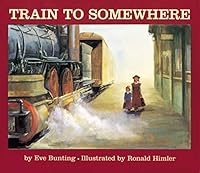
Train to Somewhere
by Eve Bunting
On This Page
Description
In the late 1800s, Marianne travels westward on the Orphan Train in hopes of being placed with a caring family.Tags
Recommendations

























Member Reviews
Marianne, heading west with fourteen other children on an Orphan Train, is sure her mother will show up at one of the stations along the way. When her mother left Marianne at the orphanage, hadn't she promised she'd come for her after making a new life in the West? Stop after stop goes by, and there's no sign of her mother in the crowds that come to look over the children. No one shows any interest in adopting shy, plain Marianne, either. But that's all right: She has to be free for her mother to claim her. Then the train pulls into its final stop, a town called Somewhere . . .
There was a plethora of children who were orphans or homeless in Amerrica during the years of 1850's through the 1920's. There simply were not enough orphanages to accommodate all those in need. The solution was to place children on trains heading for the mid west where at specific stops, adults would look the children over, and then decide which one to take.
Some children landed in good homes and were loved. Yet, others were used as unpaid help on farms or as house keepers. Naturally, those who wanted a child to love, picked the youngest ones first, leaving older ones to be chosen as workers.
Based on this historical event, the author tells the story of Marianne, who with fourteen other children took the train to locations throughout show more the midwest in the hope they would first and foremost be wanted and loved. Sadly, Marianne was not a beautiful little child. She was heading toward teen age years, hoping against any probability that at one of the stops her biological mother would be there to claim and love her.
Left at the orphanage, she was promised by her mother that she would come and get her when it was financially possible to raise her. With soft illustrations, Ronald Himler's art and Eve Bunting's ability to tell a poignant story, capture the readers emotions as they route for Marianne to be loved.
Her one little friend Nora is easily taken on one of the first stops. Lying and telling the couple that Marianne is her sister, does not entice the couple to take two children.
Alas, as the train approaches the very last stop, in a small town named "Somewhere," Marianne is the only child left. As tears softly fall on her face, she notices that there is one elder couple on the platform. They long for a child and as they tell her they wanted a boy, they readily accept that she is she is the one for them. show less
Some children landed in good homes and were loved. Yet, others were used as unpaid help on farms or as house keepers. Naturally, those who wanted a child to love, picked the youngest ones first, leaving older ones to be chosen as workers.
Based on this historical event, the author tells the story of Marianne, who with fourteen other children took the train to locations throughout show more the midwest in the hope they would first and foremost be wanted and loved. Sadly, Marianne was not a beautiful little child. She was heading toward teen age years, hoping against any probability that at one of the stops her biological mother would be there to claim and love her.
Left at the orphanage, she was promised by her mother that she would come and get her when it was financially possible to raise her. With soft illustrations, Ronald Himler's art and Eve Bunting's ability to tell a poignant story, capture the readers emotions as they route for Marianne to be loved.
Her one little friend Nora is easily taken on one of the first stops. Lying and telling the couple that Marianne is her sister, does not entice the couple to take two children.
Alas, as the train approaches the very last stop, in a small town named "Somewhere," Marianne is the only child left. As tears softly fall on her face, she notices that there is one elder couple on the platform. They long for a child and as they tell her they wanted a boy, they readily accept that she is she is the one for them. show less
A good historical view of the orphan trains that made their way west in the early days of the country. Children were chosen or not chosen and left with very little. It is text heavy, but each page also offers intriguing illustrations of the early American West sometime between the 1850s and the 1920s. This is a period of history that many readers might not be familiar with so it could prove interesting to have in a library. The story is narrated by Marriane, a child on the orphan train yearning to find her own mother who had promised to return to her in New York. As the book says, "Sometimes what you get turns out to be better than what you wanted in the first place." Marianne is the last child to be adopted, but she does find a good show more home with an elderly couple. The narration has thoughtful inclusions and memorable moments to match the well-drawn pictures. Five stars for a beautifully illustrated and written book about a challenging and under-written era. show less
Summary
Marianne, an orphan, is on a train going across the country, looking to be adopted. Well, the other kids on the train are looking to be adopted. She just wants to find her Mom, who went west (the same as the train!) to work and left her at the orphanage years ago. Will she find her mom before she’s adopted by strangers?
Personal Opine
Heart wrenching. Simply heart wrenching. Rarely does a picture book get my ice cold heart to attempt beating, but this one did it. With gorgeous artwork complimenting it, this book weaves a wonderful story about orphans in that time period. With a surprise ending to round it off, I highly recommend this book.
Class extension ideas
1. Have a discussion with the kids about the context of the show more story—about the post WWI-pre Great Depression time period.
2. There’s a train in this story, so have the kids draw trains. Only, have each kid draw a single car of the train with a different word about the time period (or adoption), then put them all together on the wall like one big super train. show less
Marianne, an orphan, is on a train going across the country, looking to be adopted. Well, the other kids on the train are looking to be adopted. She just wants to find her Mom, who went west (the same as the train!) to work and left her at the orphanage years ago. Will she find her mom before she’s adopted by strangers?
Personal Opine
Heart wrenching. Simply heart wrenching. Rarely does a picture book get my ice cold heart to attempt beating, but this one did it. With gorgeous artwork complimenting it, this book weaves a wonderful story about orphans in that time period. With a surprise ending to round it off, I highly recommend this book.
Class extension ideas
1. Have a discussion with the kids about the context of the show more story—about the post WWI-pre Great Depression time period.
2. There’s a train in this story, so have the kids draw trains. Only, have each kid draw a single car of the train with a different word about the time period (or adoption), then put them all together on the wall like one big super train. show less
This was a great children book and I loved how they let kids see the lives of 14 orphans. Some children can truly relate to this book if they have been in and out of foster homes. Although it was very sad and upsetting to see how these children were treated. I also believe the author did a great job at using setting to enhance the illustrations in the story. I also love that it can create an amazing critical thinking topic for children to discuss in 3rd-5th grade. It was a great story on how something so sad in history has the ability to have a happy ending.
First off, I love the watercolor paintings in this book. It gives a vivid understanding and outlook on what it was like during this time. The book was about a fourteen year old girl, hoping to reunite with her mother, after her mother left to start them a new and better life. However, Marianne never see her mother while she is on the orphan train and ends up being adopted by an elderly couple, who was in hopes of adopting a baby. Marianne soon finds out that sometimes what you don't want, ends up being a better option for you. I also like the descriptions throughout the book. For example, when the train stops and the girl describes everything around her like all the people, the dogs, and the buildings. Then she further tells how the show more people select which children they want based off of muscles and gender and what they would be good for. show less
The fact that Marianne is an orphan immediately made me sad. All children really want is a family who loves them and there are so many children out there without one. Before the last stop, I wanted to cry because I wasn't sure if she would have someone adopt her. Not every story has a happy ending and I'm really glad this one does. Life isn't always what you expect but will work out, sometimes in a better way.
Members
- Recently Added By
Author Information

274+ Works 51,637 Members
Eve Bunting was born in 1928 in Maghera, Ireland, as Anne Evelyn Bunting. She graduated from Northern Ireland's Methodist College in Belfast in 1945 and then studied at Belfast's Queen's College. She emigrated with her family in 1958 to California, and became a naturalized citizen in 1969. That same year, she began her writing career, and in 1972, show more her first book, "The Two Giants" was published. In 1976, "One More Flight" won the Golden Kite Medal, and in 1978, "Ghost of Summer" won the Southern California's Council on Literature for Children and Young People's Award for fiction. "Smokey Night" won the American Library Association's Randolph Caldecott Medal in 1995 and "Winter's Coming" was voted one of the 10 Best Books of 1977 by the New York Times. Bunting is involved in many writer's organizations such as P.E.N., The Authors Guild, the California Writer's Guild and the Society of Children's Book Writers. She has published stories in both Cricket, and Jack and Jill Magazines, and has written over 150 books in various genres such as children's books, contemporary, historic and realistic fiction, poetry, nonfiction and humor. (Bowker Author Biography) show less
All Editions
Awards and Honors
Awards
Distinctions
Notable Lists
Common Knowledge
- Original publication date
- 1996
- First words
- "This is our train, Marianne," Miss Randolph says, and Nora clutches at my hand.
- Last words
- (Click to show. Warning: May contain spoilers.)"I'm ready."
- Original language
- English
Classifications
Statistics
- Members
- 1,032
- Popularity
- 24,962
- Reviews
- 50
- Rating
- (4.28)
- Languages
- Chinese, English
- Media
- Paper, Ebook
- ISBNs
- 13
- UPCs
- 2
- ASINs
- 4