
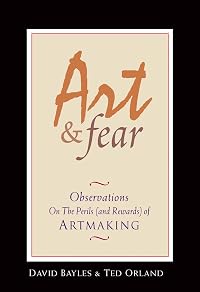
Art & Fear: Observations On the Perils (and Rewards) of Artmaking
by David Bayles, Ted Orland
On This Page
Description
Art & Fear explores the way art gets made, the reasons it often doesn't get made, and the nature of the difficulties that cause so many artists to give up along the way. The book's co-authors, David Bayles and Ted Orland, are themselves both working artists, grappling daily with the problems of making art in the real world. Their insights and observations, drawn from personal experience, provide an incisive view into the world of art as it is experienced by art makers themselves. This is not show more your typical self-help book. This is a book written by artists, for artists - it's about what it feels like when artists sit down at their easel or keyboard, in their studio or performance space, trying to do the work they need to do. First published in 1994, Art & Fear quickly became an underground classic. Word-of-mouth response alone-now enhanced by internet posting-has placed it among the best-selling books on art-making and creativity nationally. Art & Fear has attracted a remarkably diverse audience, ranging from beginning to accomplished artists in every medium, and including an exceptional concentration among students and teachers. The original Capra Press edition of Art & Fear sold 80,000 copies. show lessTags
Recommendations

Member Reviews
A must read for every artist and art appreciator/viewer, because "we all get hung up" soon or later on the philosophical and psychological What is art? What was (is) the artist trying to say? How do artists persevere in a world that is obsessed with art fashion? aspects.
Two of my favourite quotes will serve as displays of the intriguing writing style that so captivated me:
With respect to Academia: wherein most prominent graduate students describe themselves as survivors of their formal education: "The thought of working in the art education system ~ either as student or faculty ~ is about as attractive as standing beneath a steady drizzle of dead cats." (p. 80). (Note: any grad student surviving long enough to achieve their degree show more would probably agree with this).
And:
In reference to artists' worries about funding and achieving solo exhibitions (when straying too far from the innocuous norm), "the American Revolution was not financed by grants from the Crown" (p.68). Perhaps that observation was meant you weren't supposed to be intimidated by societal acceptance, and the authors do go on to suggest strategies for survival.
Aside from some amusing writing, I found the philosophy encouraging and reassuring. Whether you write music, dance, paint or sculpt, there was a feeling of camaraderie and understanding here that I've never encountered elsewhere. show less
Two of my favourite quotes will serve as displays of the intriguing writing style that so captivated me:
With respect to Academia: wherein most prominent graduate students describe themselves as survivors of their formal education: "The thought of working in the art education system ~ either as student or faculty ~ is about as attractive as standing beneath a steady drizzle of dead cats." (p. 80). (Note: any grad student surviving long enough to achieve their degree show more would probably agree with this).
And:
In reference to artists' worries about funding and achieving solo exhibitions (when straying too far from the innocuous norm), "the American Revolution was not financed by grants from the Crown" (p.68). Perhaps that observation was meant you weren't supposed to be intimidated by societal acceptance, and the authors do go on to suggest strategies for survival.
Aside from some amusing writing, I found the philosophy encouraging and reassuring. Whether you write music, dance, paint or sculpt, there was a feeling of camaraderie and understanding here that I've never encountered elsewhere. show less
It started out pretty good. But then you hit chapter VIII (Conceptual Worlds) and the authors start into sophistric contortions trying to definite art in such a way as to exclude and denigrate what they consider lesser: crafts, and creative works notable for skillful execution without any sufficiently intellectual concept behind them.
They also really don't seem to have any understanding of the creative drive to make something. Which is baffling. And they seem to think there is a limit to what an artist can learn about their medium. They use this as a way to dismiss craft, as if craftspeople are just trained monkeys repeating a stale technique. Like technique is finite and only ever learned from more experienced artists. My Brother In show more Christ, if you love your medium you will discover things no one could have taught you. But maybe you can teach to others. :)
The first part was decent, but later chapters were so toxic they spoiled it. show less
They also really don't seem to have any understanding of the creative drive to make something. Which is baffling. And they seem to think there is a limit to what an artist can learn about their medium. They use this as a way to dismiss craft, as if craftspeople are just trained monkeys repeating a stale technique. Like technique is finite and only ever learned from more experienced artists. My Brother In show more Christ, if you love your medium you will discover things no one could have taught you. But maybe you can teach to others. :)
The first part was decent, but later chapters were so toxic they spoiled it. show less
It's not often I find a book that truly reflects what I myself have witnessed and thought for so many years. Art & Fear puts into words all of the struggles we as artists go through every single day we create. I cannot stress enough how happy I am that it also puts such emphasis on the one true threat to our creativity: Quitting. I've been an artist for 15 years, and yet this book still provides insights and new viewpoints on the creative process. No matter where you stand in your creative journey I highly encourage giving it a read.
Years before Malcolm Gladwell built a wonderfully compelling case for the critical importance of practice and opportunity in "Outliers: The Story of Success," David Bayles and Ted Orland spent seven years producing their thin, lean, and absolutely inspiring work on how we can develop our own creative artistry through faith and perseverance. "You make good work by (among other things) making lots of work that isn't very good, and gradually weeding out the parts that aren’t good, the parts that aren't yours" (p. 26) they write, and in the process do us all a favor by reminding us that creativity flourishes through what we learn from failure as much as from what we learn through success. We're working with the basics here, as we can see show more from chapter headings including "Fears About Yourself," "Fears About Others," and "Finding Your Work." The writers address the perils of trying to create work that pleases others rather than work that begins by pleasing ourselves--a theme of interest to anyone involved in creative endeavors, including any trainer-teacher-learner. They remind us that if we teach, we also need to set aside time for pursuing our craft--a warning that applies equally to trainers who may not make the time to continue pursuing the learning opportunities that they need to be effective. They conclude by suggesting that making art "is to sing with the human voice" and that if we are to persevere, we would do well to begin by developing our own unique voices and using those voices to explore our darkest chasms to produce the "revealing light" of our own minds" (p. 117). show less
The intention of this book is to help the artist view the work they do, themselves, and the way they go about it, for example “...fears about yourself prevent you from doing your best work, while fears about your reception by others prevent you from doing your own work.”
How letting fears be in control prevents us from being creative. And for some, it stifles the creative process for good. The message on the whole seemed to be, your not alone in fear. It's as if they are holding up a mirror so you can see what the fear does to the creative process, then they help you navigate the obstacles it places in your way.
Subtitled, “Observations on the Perils (and Rewards) of Art Making” the first observation that stood out to me, show more “Working in the service of self.” Oh, how I relate to that one. I want to write and create, but the uncertainty and unpredictability weigh so heavy on my mind that I find it almost impossible to pursue this avenue. "Almost" being the operative word since here I am writing.
I think as you read this book you find the insights that pertain to you will stand out and help you recognize the personal stumbling blocks and that you’ll find value in acknowledging and learning from these.
“...doing something no one much cares whether you do, for which there may be neither audience nor reward.” Gee, since you put it that way. I laughed a lot reading some of the observations because it’s a wonder any of us creates anything, and yet we do. Even knowing how impossible it seems to put value on what is a selfish pursuit we do it. I can’t seems to get away from the need to make something, anything, and share it.
I guess I understood everything this book had to offer and in that understanding realized I can’t deny wanting to create and figure out what that means for me. show less
How letting fears be in control prevents us from being creative. And for some, it stifles the creative process for good. The message on the whole seemed to be, your not alone in fear. It's as if they are holding up a mirror so you can see what the fear does to the creative process, then they help you navigate the obstacles it places in your way.
Subtitled, “Observations on the Perils (and Rewards) of Art Making” the first observation that stood out to me, show more “Working in the service of self.” Oh, how I relate to that one. I want to write and create, but the uncertainty and unpredictability weigh so heavy on my mind that I find it almost impossible to pursue this avenue. "Almost" being the operative word since here I am writing.
I think as you read this book you find the insights that pertain to you will stand out and help you recognize the personal stumbling blocks and that you’ll find value in acknowledging and learning from these.
“...doing something no one much cares whether you do, for which there may be neither audience nor reward.” Gee, since you put it that way. I laughed a lot reading some of the observations because it’s a wonder any of us creates anything, and yet we do. Even knowing how impossible it seems to put value on what is a selfish pursuit we do it. I can’t seems to get away from the need to make something, anything, and share it.
I guess I understood everything this book had to offer and in that understanding realized I can’t deny wanting to create and figure out what that means for me. show less
The paradox of artmaking is that most artists believe on some level that they are (or should be) exceptional individuals with a unique vision, but also that that vision should be one that most people should be able to identify with. This book does nothing to resolve that paradox, but it does present us with reasons to live with the contradiction (of our own ordinariness and our art's timelessness; ars longa, vita brevis) and go on producing in spite of it.
A great book about the process of making art and the many challenges that prevent or stop artists from creating as well as instructions on how to push through resistance and get the work done. Very valuable reading for a jaded veteran creator who often wonders, "Should I quit?" After reading this book, the answer is a resounding, "No!"
Members
- Recently Added By
Lists

Books I've Read
40 works; 2 members

Books Read in 2026
1,880 works; 66 members
Author Information

4 Works 1,981 Members
8 Works 2,114 Members
Common Knowledge
- Original publication date
- 1985
- Epigraph
- Writing is easy:
all you do it sit staring at a blank sheet of paper until the drops of blood form on your forehead.
— Gene Fowler
Life is short, art long, opportunity fleeting, experience treacherous, judgement difficult.
— Hippocrates (460-400 B.C.) - Dedication
- for Jon, Shannon & Ezra
- First words
- Making art is difficult.
- Quotations
- Often the work we have not done seems more real in our minds than the pieces we have completed. (pg. 1)
Oᴘᴇʀᴀᴛɪɴɢ Mᴀɴᴜᴀʟ ғᴏʀ Nᴏᴛ Qᴜɪᴛᴛɪɴɢ:
A. Make friends with others who make art, and share your in-progress work with each other frequently.
B. Learn to think of [A], rather tha... (show all)n the Museum of Modern art, as the destination of your work. (pg. 12)
By definition, whatever you have is exactly what you need to produce your best work. (pg. 26)
Art is exquisitely responsive. (pg. 49)
Unfortunately, healthy artistic environments are about as healthy as unicorns. (pg. 71)
Ironically, the artist who would teach is often doomed before ever setting foot in the classroom. (pg. 80) - Last words
- (Click to show. Warning: May contain spoilers.)And curiously, uncertainty is the comforting choice.
Classifications
Statistics
- Members
- 1,955
- Popularity
- 10,825
- Reviews
- 42
- Rating
- (4.03)
- Languages
- English, German
- Media
- Paper, Audiobook, Ebook
- ISBNs
- 12
- UPCs
- 2
- ASINs
- 9
