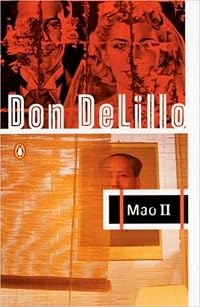
Mao II
by Don DeLillo
On This Page
Description
Don DeLillo presents an extraordinary new novel about words and images, novelists and terrorists, the mass mind and the arch-individualist. At the heart of the book is Bill Gray, a famous reclusive writer who escapes the failed novel he has been working on for many years and enters the world of political violence, a nightscape of Semtex explosives and hostages locked in basement rooms. Bill's dangerous passage leaves two people stranded: his brilliant, fixated assistant, Scott, and the show more strange young woman who is Scott's lover-and Bill's. show lessTags
Recommendations












Member Reviews
The set piece that opens Mao II perfectly establishes the tone of the novel: a huge crowd of people has gathered in the stands at Yankee Stadium to witness the mass wedding ceremony of 13,000 followers of the Korean cult leader, the Reverend Sun Myung Moon. The estranged parents of one young woman search despondently to find their daughter on the field, but she is anonymous in the midst of thousands of identically dressed brides who are standing next to the identically dressed grooms they barely know. The crowd, it seems, has swallowed the individual as the betrothed couples symbolically pledge their allegiance to both the movement and their Moonie master.
More intense scenes of crowds follow in this book that is as much about ideas and show more images as it is about plot and story. Several people are crushed to death at a soccer game as a horde of gate-crashers push the capacity of the stadium past its limits. A million people gather in a great square in China beneath a portrait of Mao Zedong. A woman wanders through a New York City park that is overrun by a nameless, faceless throng of homeless people, trying to help in what little ways she can. Two individuals sit in the seclusion of an apartment and watch on television as hundreds of thousands mourn at the funeral of Ayatollah Khomeini. As the author himself puts it: “The future belongs to crowds.”
The plot of Mao II embeds another of its provocative themes: how terrorists have supplanted the role of novelists to shock and capture the public’s collective imagination. Bill Gray is in self-imposed exile after his early success as a novelist made him a celebrated figure. Protected by a young assistant and his girlfriend—a deprogrammed Moonie—Gray has spent the last 23 years working on a new book that he may never finish. Two events bring him out of isolation: the arrival of photographer obsessed with capturing the images of famous writers and a request from his former editor to aid in freeing a poet who is being held hostage by radical Maoist revolutionaries in the Middle East. The protagonist’s increasing involvement in the rescue attempt, along with the juxtaposition between the hostage and Gray himself, is the story line that drives the narrative.
This novel was written right after White Noise and Libra and immediately before Underworld, which places it squarely in the middle of the most productive part of Don DeLillo’s lengthy and remarkable career. Although Mao II lacks some of the depth and complexity (and even some of the dark humor) of those other works, it is still a compelling piece of fiction that challenges the reader throughout. DeLillo is masterful when it comes to embedding captivating thoughts into taut, well-crafted sentences. He is also frequently prophetic. The terror motif that defines this work anticipated both the Oklahoma City bombing and September 11th by several years; in fact, his occasional descriptions of the twin towers are simply haunting. More than a quarter-century after its publication, this remains relevant story-telling. show less
More intense scenes of crowds follow in this book that is as much about ideas and show more images as it is about plot and story. Several people are crushed to death at a soccer game as a horde of gate-crashers push the capacity of the stadium past its limits. A million people gather in a great square in China beneath a portrait of Mao Zedong. A woman wanders through a New York City park that is overrun by a nameless, faceless throng of homeless people, trying to help in what little ways she can. Two individuals sit in the seclusion of an apartment and watch on television as hundreds of thousands mourn at the funeral of Ayatollah Khomeini. As the author himself puts it: “The future belongs to crowds.”
The plot of Mao II embeds another of its provocative themes: how terrorists have supplanted the role of novelists to shock and capture the public’s collective imagination. Bill Gray is in self-imposed exile after his early success as a novelist made him a celebrated figure. Protected by a young assistant and his girlfriend—a deprogrammed Moonie—Gray has spent the last 23 years working on a new book that he may never finish. Two events bring him out of isolation: the arrival of photographer obsessed with capturing the images of famous writers and a request from his former editor to aid in freeing a poet who is being held hostage by radical Maoist revolutionaries in the Middle East. The protagonist’s increasing involvement in the rescue attempt, along with the juxtaposition between the hostage and Gray himself, is the story line that drives the narrative.
This novel was written right after White Noise and Libra and immediately before Underworld, which places it squarely in the middle of the most productive part of Don DeLillo’s lengthy and remarkable career. Although Mao II lacks some of the depth and complexity (and even some of the dark humor) of those other works, it is still a compelling piece of fiction that challenges the reader throughout. DeLillo is masterful when it comes to embedding captivating thoughts into taut, well-crafted sentences. He is also frequently prophetic. The terror motif that defines this work anticipated both the Oklahoma City bombing and September 11th by several years; in fact, his occasional descriptions of the twin towers are simply haunting. More than a quarter-century after its publication, this remains relevant story-telling. show less
A thoughtful, engaging, relevant book.
"Mao II" (1991), by Don DeLillo (b. 1936), is the story of Bill Gray, a reclusive novelist. He lives off royalties, supporting Scott, a live-in secretary, and Karen, a young woman with whom both men have a comfortable relationship.
Bill is a recluse, supposedly working on a new book, but never appears in public or contacts anyone. Scott is his household helper, but also cajoles him when he gets lazy. Karen is a credulous and sensitive person who was a Moonie in the past, and finds individual life difficult.
Bill's agent tells him he has been asked to meet a terrorist group in Beirut, which has taken a hostage. He is to read a statement of support, at a London press conference, and the hostage will be show more released. He goes to London, but after some difficulties, steals away to Cyprus, unbeknownst to his agent, or to Scott and Karen. He accompanies a sympathizer of the Maoist group, hoping to meet the leader himself, perhaps in Beirut.
Will he make it to Beirut? Will he return to America? Will he meet the terrorists? Will he free the hostage, or will he be taken hostage himself? The book will answer these questions eventually, but more interesting are the deeper challenges DeLillo poses.
The book makes much of Chairman Mao throughout. In London and Cyprus, Bill converses at length with the terror group's sympathizer, arguing over the nature of terrorism, socialism, totalitarianism, and other such matters. The book discusses such organizations as the Shining Path, such world leaders as Khomeini (who died in 1989), and such events as the Tiananmen Square massacres (which occured in 1989).
DeLillo seems to ask, what makes a leader? What makes a follower? Why is Karen so credulous? Will she get caught by another cult? Is Scott a leader, perhaps a frustrated one? Why is Bill interested in these matters? Why is a terrorist leader interested in him? Does Bill remain an outsider just so he won't get inadvertently influenced by society's inevitable groupings?
Like a contemporary artist, DeLillo doesn't provide a didactic guide, but a curious exploration. He studies crowd behavior and credulity, as well as those (always men?) who manipulate others, or perhaps only superficially attempt it. Most remarkable that he addressed an issue in 1989 which is so relevant today, post-9/11, and did so before Saddam Hussein, another manipulator, became such a household name. It reminds us that history progresses from one manipulative despot to another.
DeLillo remains artistically neutral, but seems to have more sympathy for freedom and individuality than for group behavior of any sort, even though he understands the reasons for it. Readers may decide for themselves.
The prose is lively. The dialog is interesting and idiomatic, if awkward at times, but most often clever. The tone is hustling and bustling, scrambled and chaotic, and contrasted with the literary seclusion of the countryside. I recommend it to anyone who enjoys contemporary American fiction, or wants to reflect on the nature of crowd behavior, manipulative leaders, or terrorism. It will engage curious readers, and provoke you to thought. show less
"Mao II" (1991), by Don DeLillo (b. 1936), is the story of Bill Gray, a reclusive novelist. He lives off royalties, supporting Scott, a live-in secretary, and Karen, a young woman with whom both men have a comfortable relationship.
Bill is a recluse, supposedly working on a new book, but never appears in public or contacts anyone. Scott is his household helper, but also cajoles him when he gets lazy. Karen is a credulous and sensitive person who was a Moonie in the past, and finds individual life difficult.
Bill's agent tells him he has been asked to meet a terrorist group in Beirut, which has taken a hostage. He is to read a statement of support, at a London press conference, and the hostage will be show more released. He goes to London, but after some difficulties, steals away to Cyprus, unbeknownst to his agent, or to Scott and Karen. He accompanies a sympathizer of the Maoist group, hoping to meet the leader himself, perhaps in Beirut.
Will he make it to Beirut? Will he return to America? Will he meet the terrorists? Will he free the hostage, or will he be taken hostage himself? The book will answer these questions eventually, but more interesting are the deeper challenges DeLillo poses.
The book makes much of Chairman Mao throughout. In London and Cyprus, Bill converses at length with the terror group's sympathizer, arguing over the nature of terrorism, socialism, totalitarianism, and other such matters. The book discusses such organizations as the Shining Path, such world leaders as Khomeini (who died in 1989), and such events as the Tiananmen Square massacres (which occured in 1989).
DeLillo seems to ask, what makes a leader? What makes a follower? Why is Karen so credulous? Will she get caught by another cult? Is Scott a leader, perhaps a frustrated one? Why is Bill interested in these matters? Why is a terrorist leader interested in him? Does Bill remain an outsider just so he won't get inadvertently influenced by society's inevitable groupings?
Like a contemporary artist, DeLillo doesn't provide a didactic guide, but a curious exploration. He studies crowd behavior and credulity, as well as those (always men?) who manipulate others, or perhaps only superficially attempt it. Most remarkable that he addressed an issue in 1989 which is so relevant today, post-9/11, and did so before Saddam Hussein, another manipulator, became such a household name. It reminds us that history progresses from one manipulative despot to another.
DeLillo remains artistically neutral, but seems to have more sympathy for freedom and individuality than for group behavior of any sort, even though he understands the reasons for it. Readers may decide for themselves.
The prose is lively. The dialog is interesting and idiomatic, if awkward at times, but most often clever. The tone is hustling and bustling, scrambled and chaotic, and contrasted with the literary seclusion of the countryside. I recommend it to anyone who enjoys contemporary American fiction, or wants to reflect on the nature of crowd behavior, manipulative leaders, or terrorism. It will engage curious readers, and provoke you to thought. show less
This novel is a highly atmospheric, almost surreal world that's eerily reminiscent of the one we live in. Sometimes the prose hits you like a stream of consciousness with no apparent end, immersing you in all the mundane, the nitty-gritty, the bustle of human life - and it's hard to separate one thing from another, or maybe you were never supposed to in the first place, simply absorb what you see as it happens.
One of DeLillo's main motifs seems to be images and how we are constantly bombarded by them, to the point where everything but violence and death ceases to have impact... and even these sometimes lose their meaning for us as well, if they are repeated enough for us to see. It's illustrated sharply in some of the characters' show more experiences. Brita, a self-made photographer, used to take pictures of city underworlds until she realized even the graphic nature of those images faded into the background compared to their tragic beauty. Bill, the reclusive writer who is being stifled by his latest book, abandons his quiet, structured life for a nightscape of terror and violence, perhaps because that's the only place he feels alive, an active contributor to events he used to merely write about. Scott, the reclusive writer's fiercely loyal assistant, leads a mundane life dealing with copies upon copies of Bill's past work, work-in-progress, letters, etc. until he becomes somewhat of an automaton. At one point, he views an exhibit on Chairman Mao comprised of so many versions of the same portrait that it's rendered almost harmless, a mere fancy for the eyes, though at the same time it is an image that cannot be forgotten.
Karen, our final main character, is a particularly unique person and I can't decide how I feel about her, or even if I understand her completely. She experiences firsthand the mindless mass multiplication of a specific image - that of marriage, where thousands of couples are paired together under the religious cult leader Master Moon. She later escapes both the cult and her own family, wandering through life on her own terms. Karen acts like a sponge for all things human, to the point where she loses nearly all individual expression and identity - almost dead to the world, as it were, but her actions speak differently. She seems to consciously seek out human images, with a special focus on anything grim and bleak - from peddling flowers and peanuts on the road to wandering among homeless people, many of them shadowy and dangerous, listening to their stories and foraging items for them that can be exchanged for money. To me she represents the deeply buried longing in all of us to just get out there, to do something to combat our apathy and insulation, to see the world for what it really is and feel like part of something bigger, to feel alive even if it's in the most unlikely situations. And maybe it's those unlikely situations, those in-between places, those dark and bleak surroundings that truly awaken us, that tell us what we've been blind to all along.
At first, when I reached the ending I was disappointed that Bill never seemed to work up the courage to make a stand against the terrorists, or finish writing something about the hostage that would give him meaning and identity, or turn himself over to save the hostage writer's life. His lateness to act struck me as extremely selfish. Instead of doing any of those things, Bill gets himself hit by a car (seemingly on purpose), refuses to get treatment, and ends up dying alone and anonymous on a ferry, after finally making the vague impulse to meet the terrorist leader Abu Rashid. It's a sad and meaningless end, one which he may have wanted all along - to disappear forever from the public eye and human consciousness, all on his own terms. I didn't understand at first why he had to die that way, why DeLillo chose that route and not some meaningful struggle against the terrorists. But it brings back another of DeLillo's recurring themes - "the future belongs to crowds."
Here, the terrorists are one of many crowds in question, but they represent the main threat to Bill's purpose as an author because of their ability to "make raids on human consciousness" - shaping the world and controlling its people's minds through violence. So in reality, Bill has been fighting them all this time using the power of his words alone. And now that he has lost even that - his ability to influence through his novels - there is no other reason for him to fight on, or even live on; the battle has already been lost. Thus, when it comes to individual vs. the crowd, the individual inevitably takes the loss. And that's the major tragedy of our time - when individualism and freedom of expression, things that make us human, are erased in favor of mass-mandated conformity for the sake of the vague feeling of "belonging." And even meaning itself fades into obscurity, as our lives are inundated by images and news to which we become increasingly desensitized. DeLillo illustrates this with depressing accuracy and heart-wrenching eloquence - and for a book written decades ago, it was startlingly prophetic in its telling.
One of DeLillo's main motifs seems to be images and how we are constantly bombarded by them, to the point where everything but violence and death ceases to have impact... and even these sometimes lose their meaning for us as well, if they are repeated enough for us to see. It's illustrated sharply in some of the characters' show more experiences. Brita, a self-made photographer, used to take pictures of city underworlds until she realized even the graphic nature of those images faded into the background compared to their tragic beauty. Bill, the reclusive writer who is being stifled by his latest book, abandons his quiet, structured life for a nightscape of terror and violence, perhaps because that's the only place he feels alive, an active contributor to events he used to merely write about. Scott, the reclusive writer's fiercely loyal assistant, leads a mundane life dealing with copies upon copies of Bill's past work, work-in-progress, letters, etc. until he becomes somewhat of an automaton. At one point, he views an exhibit on Chairman Mao comprised of so many versions of the same portrait that it's rendered almost harmless, a mere fancy for the eyes, though at the same time it is an image that cannot be forgotten.
Karen, our final main character, is a particularly unique person and I can't decide how I feel about her, or even if I understand her completely. She experiences firsthand the mindless mass multiplication of a specific image - that of marriage, where thousands of couples are paired together under the religious cult leader Master Moon. She later escapes both the cult and her own family, wandering through life on her own terms. Karen acts like a sponge for all things human, to the point where she loses nearly all individual expression and identity - almost dead to the world, as it were, but her actions speak differently. She seems to consciously seek out human images, with a special focus on anything grim and bleak - from peddling flowers and peanuts on the road to wandering among homeless people, many of them shadowy and dangerous, listening to their stories and foraging items for them that can be exchanged for money. To me she represents the deeply buried longing in all of us to just get out there, to do something to combat our apathy and insulation, to see the world for what it really is and feel like part of something bigger, to feel alive even if it's in the most unlikely situations. And maybe it's those unlikely situations, those in-between places, those dark and bleak surroundings that truly awaken us, that tell us what we've been blind to all along.
At first, when I reached the ending I was disappointed that Bill never seemed to work up the courage to make a stand against the terrorists, or finish writing something about the hostage that would give him meaning and identity, or turn himself over to save the hostage writer's life. His lateness to act struck me as extremely selfish. Instead of doing any of those things, Bill gets himself hit by a car (seemingly on purpose), refuses to get treatment, and ends up dying alone and anonymous on a ferry, after finally making the vague impulse to meet the terrorist leader Abu Rashid. It's a sad and meaningless end, one which he may have wanted all along - to disappear forever from the public eye and human consciousness, all on his own terms. I didn't understand at first why he had to die that way, why DeLillo chose that route and not some meaningful struggle against the terrorists. But it brings back another of DeLillo's recurring themes - "the future belongs to crowds."
Here, the terrorists are one of many crowds in question, but they represent the main threat to Bill's purpose as an author because of their ability to "make raids on human consciousness" - shaping the world and controlling its people's minds through violence. So in reality, Bill has been fighting them all this time using the power of his words alone. And now that he has lost even that - his ability to influence through his novels - there is no other reason for him to fight on, or even live on; the battle has already been lost. Thus, when it comes to individual vs. the crowd, the individual inevitably takes the loss. And that's the major tragedy of our time - when individualism and freedom of expression, things that make us human, are erased in favor of mass-mandated conformity for the sake of the vague feeling of "belonging." And even meaning itself fades into obscurity, as our lives are inundated by images and news to which we become increasingly desensitized. DeLillo illustrates this with depressing accuracy and heart-wrenching eloquence - and for a book written decades ago, it was startlingly prophetic in its telling.
Reason read: TBR takedown, August 2024. As with all DeLillo's novels, there is so much here. The book is about a reclusive author who is doing his best to avoid finishing this novel. But... it is about crowds, politcal terrorism, art vs terrorism.
DeLillo stated; "...the future belongs to crowds''. This gives me pause. The book features the Blessing Ceremony of the Unificaetion church wedding in Yankee Stadium, The crowds of homeless in the Tompkin Square Park area in New York City, and the mourners at Ayatollah's funeral. None of these seem appealing but DeLillo examines the nature of crowds and their relation to personal and collective identity. The book also looked at art as influencing culture (Andy Warhol's pictures of Mao Zedong, show more author's novels and writings) and terrorism as means of effecting change in culture. In this story, there is a writer from Switzerland who is being held prisoner by a terrorist group and the writer who doesn't want to finish his book and prefers the life of a recluse. The arch individualist and the mass mind; Khomeini's fatwa calling for death of Salmon Rushdie, J.D. Salinger ambushed by photographers in his reclusive home in New Hampshire, and the mass wedding Blessing Ceremony at Yankee Stadium. This book published in 1991 was a head of its time in contemplation of the effects of political terrorism that was soon to arrive in the United States. show less
DeLillo stated; "...the future belongs to crowds''. This gives me pause. The book features the Blessing Ceremony of the Unificaetion church wedding in Yankee Stadium, The crowds of homeless in the Tompkin Square Park area in New York City, and the mourners at Ayatollah's funeral. None of these seem appealing but DeLillo examines the nature of crowds and their relation to personal and collective identity. The book also looked at art as influencing culture (Andy Warhol's pictures of Mao Zedong, show more author's novels and writings) and terrorism as means of effecting change in culture. In this story, there is a writer from Switzerland who is being held prisoner by a terrorist group and the writer who doesn't want to finish his book and prefers the life of a recluse. The arch individualist and the mass mind; Khomeini's fatwa calling for death of Salmon Rushdie, J.D. Salinger ambushed by photographers in his reclusive home in New Hampshire, and the mass wedding Blessing Ceremony at Yankee Stadium. This book published in 1991 was a head of its time in contemplation of the effects of political terrorism that was soon to arrive in the United States. show less
Mao II is a short novel revolving around four main characters: a famous recluse writer, Bill Gray, who's biggest fear is publishing a new book that does not live up to his fan's expectations, his obsessive compulsive assistant, a stray teenager who got brainwashed by the Reverend Moon of the Unification Church, and a professional photographer, Brita Nilsson.
DeLillo emphatically states "the future belongs to crowds" but I'd say he missed his mark. He should have said, "the future belongs to the media". The overall theme appears to be that the media plays a tremendous role in validating who we are and the importance of our lives. The opening scene is a mass marriage of 6500 couples performed by Reverend Moon at the Yankee Stadium. Massive show more media coverage! Then the story jumps ahead (5 to 7 years) to the story of Bill Gray, who is obsessed with his public image and the media. And of course, the professional photographer, Brita Nilsson "is" the media.
Although the book held my interest, there are several things I didn't like about it. First, DeLillo doesn't concern himself too much with form. There are run-on sentences that sometimes last a half of a page. This writing style worked for some classic writer's (like Proust) who were not in any hurry for the plot to go anywhere, but seems unsuited for Mao II. And all characters, (including the 3rd person telling the story) and a homeless fourteen year old boy, speak in the same abrupt, sporadic, dialect that is both eloquent and intellectually philosophical. Even the small talk is filled with unnatural, excessive, sparring witticism. This makes it hard to connect with any of the characters. There is no individuality.
Second, the different segments, Moonies/terrorists/recluse writier, seem awkwardly forced to fit together. And even though the story takes place between 1982 and 1989 it is told as though it were happening in some futuristic era where some inferred danger lurks, that is never really explained. As a result, I was perplexed by the fearful, wary, climate pervading the book. It just didn't seem real. Ironically, the book was awarded the Pen/Faulkner Award, so the media (even in real life) tries to dictate what (and who) is important. show less
DeLillo emphatically states "the future belongs to crowds" but I'd say he missed his mark. He should have said, "the future belongs to the media". The overall theme appears to be that the media plays a tremendous role in validating who we are and the importance of our lives. The opening scene is a mass marriage of 6500 couples performed by Reverend Moon at the Yankee Stadium. Massive show more media coverage! Then the story jumps ahead (5 to 7 years) to the story of Bill Gray, who is obsessed with his public image and the media. And of course, the professional photographer, Brita Nilsson "is" the media.
Although the book held my interest, there are several things I didn't like about it. First, DeLillo doesn't concern himself too much with form. There are run-on sentences that sometimes last a half of a page. This writing style worked for some classic writer's (like Proust) who were not in any hurry for the plot to go anywhere, but seems unsuited for Mao II. And all characters, (including the 3rd person telling the story) and a homeless fourteen year old boy, speak in the same abrupt, sporadic, dialect that is both eloquent and intellectually philosophical. Even the small talk is filled with unnatural, excessive, sparring witticism. This makes it hard to connect with any of the characters. There is no individuality.
Second, the different segments, Moonies/terrorists/recluse writier, seem awkwardly forced to fit together. And even though the story takes place between 1982 and 1989 it is told as though it were happening in some futuristic era where some inferred danger lurks, that is never really explained. As a result, I was perplexed by the fearful, wary, climate pervading the book. It just didn't seem real. Ironically, the book was awarded the Pen/Faulkner Award, so the media (even in real life) tries to dictate what (and who) is important. show less
When I was a kid, and perhaps even to this day, I believed that Bob Dylan had all the answers. A whole generation of good-intentioned folkie-activists and beatniks thought the same I suppose. The point being is that too often we put all our hope in writers, as if they will reveal everything to us. Mao II explores the cult of personality around the writer; how worship of something/someone can be analogous to terrorism or cult worship. It takes many twists and turns around this idea, revealing how broken and suffering the life of a writer can be. It only becomes more confusing when you add a really odd sexual relationship to it. Highly recommended to anyone who is fascinated by artists...a little too much.
When I was a kid, and perhaps even to this day, I believed that Bob Dylan had all the answers. A whole generation of good-intentioned folkie-activists and beatniks thought the same I suppose. The point being is that too often we put all our hope in writers, as if they will reveal everything to us. Mao II explores the cult of personality around the writer; how worship of something/someone can be analogous to terrorism or cult worship. It takes many twists and turns around this idea, revealing how broken and suffering the life of a writer can be. It only becomes more confusing when you add a really odd sexual relationship to it. Highly recommended to anyone who is fascinated by artists...a little too much.
Members
- Recently Added By
Lists

Novels from The Guardian's Great American Novelist Tournament
148 works; 24 members

Top Five Books of 2017
757 works; 231 members
1,001 BYMRBYD Concensus
723 works; 27 members

Pen/Faulkner Winners and Finalists
178 works; 9 members
Harold Bloom - The Western Canon: D. The Chaotic Age
833 works; 24 members

My TBR
371 works; 3 members

Pulitzer Prize for Fiction - Finalists
88 works; 9 members

living room bookshelf
150 works; 1 member

Don DeLillo books
19 works; 1 member

Great American Novels
158 works; 42 members
Author Information

53+ Works 48,995 Members
Don DeLillo was born in the Bronx, New York on November 20, 1936. He received a bachelor's degree in communication arts from Fordham University in 1958. After graduation, he was a copywriter for an advertising company and wrote short stories on the side. His first story, The River Jordan, was published two years later in Epoch, the literary show more magazine of Cornell University. His first novel, Americana, was published in 1971. His other works include Ratner's Star, The Names, Libra, Underworld, The Body Artist, Cosmopolis, Falling Man, Point Omega, and The Angel Esmeralda, a collection of short stories. He won several awards including the National Book Award for fiction in 1985 for White Noise, the PEN/Faulkner Award in 1992 for Mao II, the PEN/Saul Bellow Award for Achievement in American Fiction in 2010, and the inaugural Library of Congress Prize for American Fiction in 2013. (Bowker Author Biography) show less
Awards and Honors
Series
Belongs to Publisher Series
Keltainen kirjasto (268)
Work Relationships
Common Knowledge
- Canonical title
- Mao II
- Original title
- Mao II
- Original publication date
- 1991
- People/Characters
- Bill Gray
- Important places
- New York, New York, USA; Beirut, Lebanon; Cyprus; Lebanon; New York, USA
- Dedication*
- Voor Gordon Lish
- First words
- Aí vêm eles, marchando à luz do sol americano
- Quotations
- The future belongs to crowds
- Last words*
- (Click to show. Warning: May contain spoilers.)De dode stad nog eenmaal gefotografeerd.
- Blurbers
- Pynchon, Thomas
- Original language
- English
*Some information comes from Common Knowledge in other languages. Click "Edit" for more information.
Classifications
Statistics
- Members
- 2,625
- Popularity
- 7,180
- Reviews
- 30
- Rating
- (3.58)
- Languages
- 12 — Danish, Dutch, English, Finnish, French, German, Italian, Polish, Portuguese, Russian, Spanish, Swedish
- Media
- Paper, Audiobook, Ebook
- ISBNs
- 45
- ASINs
- 7