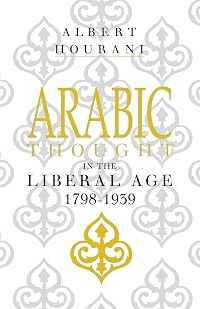
Arabic Thought in the Liberal Age, 1798-1939
by Albert Hourani
On This Page
Description
Arabic Thought in the Liberal Age is the most comprehensive study of the modernizing trend of political and social thought in the Arab Middle East. Albert Hourani studies the way in which ideas about politics and society changed during the nineteenth and the first half of the twentieth centuries, in response to the expanding influence of Europe. His main attention is given to the movement of ideas in Egypt and Lebanon. He shows how two streams of thought, the one aiming to restate the social show more principles of Islam, and the other to justify the separation of religion from politics, flowed into each other to create the Egyptian and Arab nationalisms of the present century. The last chapter of the book surveys the main tendencies of thought in the post-war years. Since its publication in 1962, this book has been regarded as a modern classic of interpretation. It was reissued by the Cambridge University Press in 1983 and has subsequently sold over 8000 copies. show lessTags
Recommendations







Member Reviews
This is a reasonably interesting book on the thoughts of various 19th and early 20th century Arab thinkers on governance and secular modernization. These thoughts were for the most part inspired by events in Europe, but Europe remains firmly in the background in this book. The author usually just notes that a particular thinker spent so an so many years in France before returning home, and instead explains in some detail how the person in question wanted to reform his own country. The legitimacy of the Ottoman empire, the preconditions of national solidarity, and nationalism (in the latter part of the period, during the birth of independent nation states in Arab lands) take center stage. It seems like most of the plans and ideas show more presented in this book did not incite much enthusiasm among a broader public and political developments didn't proceed in the way that any of these authors expected, but it's nevertheless interesting to learn about their worldview.
Political ideas are one central theme of this book and religion is another. Most of the writers presented consider these two themes inseparable. Again and again they return to the same dilemma: modernization can be good only insofar as it accommodates Islam, but Islam cannot be reformed or modernized. There's a passage somewhere in the book about one of these "modern" Arab thinkers (I forgot which one) who considers long and hard if those who convert away from Islam should be allowed to live or not. Others are much more tolerant, but I think this illustrates well how the strength of islamic tradition shackled the development of new ideas on tolerance and freedom in the Arab world. Even enterprising intellectuals with full freedom of expression struggled to reconcile their religious beliefs with political, economic and technical development. In the face of such a fundamental obstacle to modernization, it seems to be no wonder that Arab societies have developed so fitfully and achieved so little political freedom in the 100 years that have passed after these ideas were published. show less
Political ideas are one central theme of this book and religion is another. Most of the writers presented consider these two themes inseparable. Again and again they return to the same dilemma: modernization can be good only insofar as it accommodates Islam, but Islam cannot be reformed or modernized. There's a passage somewhere in the book about one of these "modern" Arab thinkers (I forgot which one) who considers long and hard if those who convert away from Islam should be allowed to live or not. Others are much more tolerant, but I think this illustrates well how the strength of islamic tradition shackled the development of new ideas on tolerance and freedom in the Arab world. Even enterprising intellectuals with full freedom of expression struggled to reconcile their religious beliefs with political, economic and technical development. In the face of such a fundamental obstacle to modernization, it seems to be no wonder that Arab societies have developed so fitfully and achieved so little political freedom in the 100 years that have passed after these ideas were published. show less
Ratings
Members
- Recently Added By
Lists

The Emergence of the Modern Middle East
289 works; 13 members

Universtiy of Toronto - NMC473/2173H - Intellectuals of the Arab World
91 works; 2 members
Author Information

28 Works 4,089 Members
Albert Hourani was Emeritus Fellow, St. Antony's College, Oxford. He died in 1993
Classifications
- Genres
- Nonfiction, History, General Nonfiction, Politics and Government, Philosophy, Religion & Spirituality
- DDC/MDS
- 320.5 — Society, government, & culture Political science Types of Government Political ideologies
- LCC
- JA84 .A6 .H6 — Political Science Political science (General) Political science (General) History
- BISAC
Statistics
- Members
- 186
- Popularity
- 175,178
- Reviews
- 1
- Rating
- (3.89)
- Languages
- English, Portuguese
- Media
- Paper, Ebook
- ISBNs
- 5
- ASINs
- 1