Summer Birds: The Butterflies of Maria Merian
by Margarita Engle
On This Page
Description
The story of a young girl living in the Middle Ages who took the time to observe the life cycle of butteflies--and in so doing disproved a theory that went all the way back to ancient Greece.Tags
Recommendations














Member Reviews
Contrary to the popular belief of those around her, thirteen-year-old Maria Merian - a seventeenth-century German girl with a talent for painting and an inquisitive mind - did not believe that butterflies and other insects were creatures "of the devil," spawned from mud in a process known as spontaneous generation. Having carefully observed these smaller creatures, from their larval through adult stages, and painstakingly documented them in her notes and drawings, Maria knew that they underwent an astonishing process known as metamorphosis, and that they were as harmless as they were beautiful.
Maria Sibylla Merian, a late seventeenth and early eighteenth-century artist and scientist, one who documented the life-cycle of one hundred and show more eighty-six insect species, and whose botanical illustrations are still beloved today, is a fascinating figure. Her travels to Suriname, and her documentation of the flora and fauna there, are astonishing enough for their time, but when one considers the restrictions placed on so many women during this period, they are all the more amazing! I am so glad that this picture-book "biography" (it's really more story than biography) is available, as both narrative and artwork are immensely engaging. I simply loved Julie Paschkis' gorgeous illustrations!
That said, a pretty glaring factual error prevents me from giving this the four stars it would otherwise deserve. No, contrary to the dust jacket blurb (and the book description found all over the internet), Merian did not live in the "Middle Ages!" I don't know where the editor was on that one, since the informational afterword gives her dates (1647-1717), and the medieval period is generally agreed to have ended in the fifteenth century! Such a misleading statement, in a book meant to inform young readers, is most unfortunate, and I therefore recommend Summer Birds only to children reading with an informed adult, who can point out this odd inaccuracy. show less
Maria Sibylla Merian, a late seventeenth and early eighteenth-century artist and scientist, one who documented the life-cycle of one hundred and show more eighty-six insect species, and whose botanical illustrations are still beloved today, is a fascinating figure. Her travels to Suriname, and her documentation of the flora and fauna there, are astonishing enough for their time, but when one considers the restrictions placed on so many women during this period, they are all the more amazing! I am so glad that this picture-book "biography" (it's really more story than biography) is available, as both narrative and artwork are immensely engaging. I simply loved Julie Paschkis' gorgeous illustrations!
That said, a pretty glaring factual error prevents me from giving this the four stars it would otherwise deserve. No, contrary to the dust jacket blurb (and the book description found all over the internet), Merian did not live in the "Middle Ages!" I don't know where the editor was on that one, since the informational afterword gives her dates (1647-1717), and the medieval period is generally agreed to have ended in the fifteenth century! Such a misleading statement, in a book meant to inform young readers, is most unfortunate, and I therefore recommend Summer Birds only to children reading with an informed adult, who can point out this odd inaccuracy. show less
I know, I said I wasn't going to look at any more picture book biographies. But...but...but....it's sooooo pretty!
Told in the first person and in simple, lucid, and brilliant text, Maria Merian explains how she knows that "summer birds," butterflies, moths, and other small creatures, are not the evil things people in the 1600s thought. She describes their metamorphosis and thinks about the future, when she will write books and travel in search of even more small creatures. A historical note explains Merian's important role in medieval science, her discovery of the process of metamorphosis, and her eventual travels.
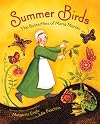
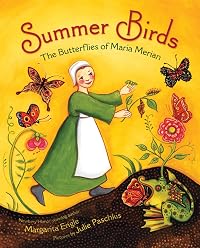
Paschkis' art is amazing. Maria's determined figure dominates the illustrations, which contrast elaborate and strange show more medieval beliefs and mythical creatures with gorgeous butterflies and scientific observations. Each step in the process of metamorphosis is delicately illustrated in wild variety against a white background, contrasting with the black and brown backgrounds of the old medieval beliefs. The process culminates in Maria's dream of travel and scientific study, and is full of imaginative stylings of butterflies and other small creatures.
Verdict: This would make an excellent nonfiction read-aloud for kindergarten. With a little help, a beginning reader could also navigate the simple text.
ISBN: 978-0805089370; Published April 2010 by Henry Holt; Borrowed from the library show less
Told in the first person and in simple, lucid, and brilliant text, Maria Merian explains how she knows that "summer birds," butterflies, moths, and other small creatures, are not the evil things people in the 1600s thought. She describes their metamorphosis and thinks about the future, when she will write books and travel in search of even more small creatures. A historical note explains Merian's important role in medieval science, her discovery of the process of metamorphosis, and her eventual travels.
Paschkis' art is amazing. Maria's determined figure dominates the illustrations, which contrast elaborate and strange show more medieval beliefs and mythical creatures with gorgeous butterflies and scientific observations. Each step in the process of metamorphosis is delicately illustrated in wild variety against a white background, contrasting with the black and brown backgrounds of the old medieval beliefs. The process culminates in Maria's dream of travel and scientific study, and is full of imaginative stylings of butterflies and other small creatures.
Verdict: This would make an excellent nonfiction read-aloud for kindergarten. With a little help, a beginning reader could also navigate the simple text.
ISBN: 978-0805089370; Published April 2010 by Henry Holt; Borrowed from the library show less
This simple, elegant book is about13-year-old Maria Merian who is fascinated by the transformative nature of caterpillars, moths, butterflies, and common amphibians. Young Maria questions the notion of her time: that “summer birds,” the medieval name for butterflies, are born of mud. She uses her keen observation skills to prove otherwise. Colorful, whim sical illustrations add to this amazing biographical sketch of Young Maria. Author’s Note.
This is by far one of the most beautifully illustrated books I've read. This book is based on the true story of young thirteen year old Maria Sibylla Merian, who, in the middle ages dispelled the belief that butterflies were of the devil.
The theory that butterflies grew deep in the mud and were scornful, evil objects was a very popular myth. Called the summer birds, the thought was that these beast of the devil grew up from the depths of the dark.
Watching them intensely, Maria captured the caterpillar, beetles and dragonflies and observed their cycles. Keeping them in jars, and feeding them leaves, she documented the stages of growth.
Taking a gigantic risk, Maria could have been deemed a witch for dabbling in something of Satan. As she show more studied the moths from cocoon to the chrysalis process, she watched as the incredibly beautiful butterflies grew and then drank nectar from flowers.
Carefully painting the images she observed, she documented and disproved the long-held theory.
I enjoy this book so much that I will purchase a copy for my library of illustrated books. show less
The theory that butterflies grew deep in the mud and were scornful, evil objects was a very popular myth. Called the summer birds, the thought was that these beast of the devil grew up from the depths of the dark.
Watching them intensely, Maria captured the caterpillar, beetles and dragonflies and observed their cycles. Keeping them in jars, and feeding them leaves, she documented the stages of growth.
Taking a gigantic risk, Maria could have been deemed a witch for dabbling in something of Satan. As she show more studied the moths from cocoon to the chrysalis process, she watched as the incredibly beautiful butterflies grew and then drank nectar from flowers.
Carefully painting the images she observed, she documented and disproved the long-held theory.
I enjoy this book so much that I will purchase a copy for my library of illustrated books. show less
I have just finished Penelope Farmer's The Summer Birds" so I was excited to read this. Sure enough, the introductory note that explains that the term refers to the mysterious butterflies does illuminate the novel, as I assume Farmer is referencing the medieval superstition to help evoke her themes. But that's just an aside to those of you who have, or will, read the novel.
More relevantly, Engle's picture-book is marvelous. I love the art by Paschkis, and the story of a young girl who risked being branded a witch for the sake of scientific curiosity is both valuable and enchanting.
I'd like to know where your library shelved it. I know we're reading it for our 'Artist's' theme and I agree it fits - but I also agree with my library that show more shelved it under science & nature. One could argue that it is also a biography. In addition, there's the decision whether to put it with the books for pre-schoolers, or for school-age children. My library had it shelved for the (approximately) 6-12 year-olds, but I imagine children as young as three would enjoy it on their own level." show less
More relevantly, Engle's picture-book is marvelous. I love the art by Paschkis, and the story of a young girl who risked being branded a witch for the sake of scientific curiosity is both valuable and enchanting.
I'd like to know where your library shelved it. I know we're reading it for our 'Artist's' theme and I agree it fits - but I also agree with my library that show more shelved it under science & nature. One could argue that it is also a biography. In addition, there's the decision whether to put it with the books for pre-schoolers, or for school-age children. My library had it shelved for the (approximately) 6-12 year-olds, but I imagine children as young as three would enjoy it on their own level." show less
This picture-book biography introduces young readers to thirteen-year-old Maria Sibylla Merian, a naturalist and painter from the seventeenth century most famous for her studies of butterflies. Glimpses into seventeenth-century superstitions are mixed with careful explanations of creature lifecycles, which unfortunately results in an unfocused read that does not quite work as a history book nor quite as a science book. The illustrations are its highlight. Clearly echoing Merian’s own naturalist style, these illustrations use plentiful whitespace to spotlight detailed watercolors of plants and insects. Rich earth tones of green, brown and gold create a warm, natural palette that fits perfectly with its subject. Libraries with strong show more art or biography picture-book collections may wish to add this title to their collection, while those looking for scientific titles may wish to look instead at Merian’s own publications. For readers ages five to eight. show less
The colorful and detailed illustrations in this book are absolutely gorgeous. This book recounts the life of Maria Merian, who as a child in the 1600's observed and painted the life cycle of butterflies. She was instrumental in educating the public that insects and small creatures did not come from mud. This book would be a great tool for teaching the life cycle of butterflies and frogs.
Members
- Recently Added By
Lists

al.vick-wishlist-Children's
462 works; 3 members

Youth: Zoology
128 works; 1 member

One Picture Book Per Country
206 works; 1 member

Book Review Roundup
254 works; 2 members
Author Information

57+ Works 7,218 Members
Margarita Engle is a Cuban-American poet and novelist. Her books include The Wild Book, Tropical Secrets, The Firefly Letters, The Lightning Dreamer, When You Wander, Mountain Dog, and Silver People. She has received several awards including the Jane Addams Children's Book Award, the Pura Belpré Award, the Américas Award, and the Claudia Lewis show more Poetry Award for The Surrender Tree and the Pura Belpré Award and the Américas Award for The Poet Slave of Cuba. (Bowker Author Biography) show less
All Editions
Awards and Honors
Awards
Common Knowledge
- Original publication date
- 2010-04-27
- People/Characters
- Maria Sybilla Merian
- Important places
- Germany; Netherlands; Suriname (also Surinam); Suriname (also Surinam)
Classifications
Statistics
- Members
- 399
- Popularity
- 78,006
- Reviews
- 12
- Rating
- (3.76)
- Languages
- English
- Media
- Paper
- ISBNs
- 3
- ASINs
- 1