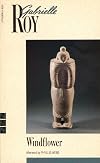
Windflower
by Gabrielle Roy
On This Page
Description
Set against the austere landscape of northern Labrador, Windflower is the poignant story of Elsa Kumachuk, a young Inuit woman torn between two worlds by the birth of her blond-haired, blue-eyed son. Unacknowledged by his father, an American GI, the child is welcomed into the Inuit community with astonishment and delight. Elsa, however, must come to terms with the conflicting values implied by her son’s dual heritage. Gabrielle Roy’s last novel, Windflower is both a moving account of one show more woman’s tragic dilemma and a sensitive portrait of a society in transition. show lessTags
Recommendations


























Member Reviews
I was introduced to Gabrielle Roy in high school when I read Rue Deschambault in French class; later in a Canadian literature class in university I read The Tin Flute and Where Rests the Water Hen. Recently, I was browsing through my bookshelves and came across Windflower which I realized I had not read. I decided to do so.
This short novel focuses on Elsa Kumachuk, an Inuit woman living in northern Quebec in the middle of the 20th century. She is raped by an American serviceman stationed in the area and gives birth to a blond-haired, blue-eyed boy whom she names Jimmy. Because of her son’s dual heritage, Elsa is torn between raising her son according to traditional Inuit ways and the ways of the whites.
The novel was published in 1970, show more and it is a bit dated. Elsa and her people are called Eskimos rather than Inuit and what is called Fort Chimo is now known as Kuujjuaq. In its portrayal of motherhood and a society in transition however, the book is timeless.
The Inuit “with their indulgent natures” practice a very easygoing parenting style, letting the child explore the world, as evidenced when Jimmy starts to walk. Having adopted the parenting style she sees at the home of Madame Beaulieu, Elsa buys a playpen to restrict Jimmy’s movements. Elsa’s family is aghast: “Never before had such an interference with liberty been seen in an Eskimo family. . . . it was not right to restrict a little child who had just discovered the delight of being able to take himself wherever he wanted to go on his own two feet.” Elsa dresses her son only in blue and gives him a bath at the exact same time every day: “From the white men, it seemed to her, she had learned much that was excellent – for instance to get up early, to rush all day scarcely ever dawdling any more, to take up tasks by the clock and not by the inclination of the moment.”
Later, Elsa decides to entirely remove herself and Jimmy from the community with its “endless increase of constraints.” She moves across the river to live with her uncle who has self-isolated and lives a traditional Inuit life; in fact, he considers anyone who lives in Fort Chimo as “’a slave living in captivity.’”
Unfortunately, though both Jimmy and Elsa are happier living simply, the laws of the white man curtail their freedom.
The idea of being held captive by materialism is emphasized. The pastor warns Elsa that “one could not have everything one wanted in this life and freedom too” because he fears that she has “’embarked on that endless road of never quite enough possessions.’” When she gets the luxury of electricity, it means she feels compelled to work “far into the evening.” Eventually she agrees with the pastor: “the less one owned the better. Her princely hut and the luxury in which she had lived now seemed to her shackles.”
From the beginning, the reader knows that the book will not have a happy ending. Elsa’s love for her child is unquestionable but, like her mother, Elsa is caught “between the cruel blades of the times: what to change, what to keep?” Despite its pervasive sadness, this is a worthwhile read.
Note: Please check out my reader's blog (https://schatjesshelves.blogspot.com/) and follow me on Twitter (@DCYakabuski). show less
This short novel focuses on Elsa Kumachuk, an Inuit woman living in northern Quebec in the middle of the 20th century. She is raped by an American serviceman stationed in the area and gives birth to a blond-haired, blue-eyed boy whom she names Jimmy. Because of her son’s dual heritage, Elsa is torn between raising her son according to traditional Inuit ways and the ways of the whites.
The novel was published in 1970, show more and it is a bit dated. Elsa and her people are called Eskimos rather than Inuit and what is called Fort Chimo is now known as Kuujjuaq. In its portrayal of motherhood and a society in transition however, the book is timeless.
The Inuit “with their indulgent natures” practice a very easygoing parenting style, letting the child explore the world, as evidenced when Jimmy starts to walk. Having adopted the parenting style she sees at the home of Madame Beaulieu, Elsa buys a playpen to restrict Jimmy’s movements. Elsa’s family is aghast: “Never before had such an interference with liberty been seen in an Eskimo family. . . . it was not right to restrict a little child who had just discovered the delight of being able to take himself wherever he wanted to go on his own two feet.” Elsa dresses her son only in blue and gives him a bath at the exact same time every day: “From the white men, it seemed to her, she had learned much that was excellent – for instance to get up early, to rush all day scarcely ever dawdling any more, to take up tasks by the clock and not by the inclination of the moment.”
Later, Elsa decides to entirely remove herself and Jimmy from the community with its “endless increase of constraints.” She moves across the river to live with her uncle who has self-isolated and lives a traditional Inuit life; in fact, he considers anyone who lives in Fort Chimo as “’a slave living in captivity.’”
Unfortunately, though both Jimmy and Elsa are happier living simply, the laws of the white man curtail their freedom.
The idea of being held captive by materialism is emphasized. The pastor warns Elsa that “one could not have everything one wanted in this life and freedom too” because he fears that she has “’embarked on that endless road of never quite enough possessions.’” When she gets the luxury of electricity, it means she feels compelled to work “far into the evening.” Eventually she agrees with the pastor: “the less one owned the better. Her princely hut and the luxury in which she had lived now seemed to her shackles.”
From the beginning, the reader knows that the book will not have a happy ending. Elsa’s love for her child is unquestionable but, like her mother, Elsa is caught “between the cruel blades of the times: what to change, what to keep?” Despite its pervasive sadness, this is a worthwhile read.
Note: Please check out my reader's blog (https://schatjesshelves.blogspot.com/) and follow me on Twitter (@DCYakabuski). show less
This is the story of an Inuit woman (Elsa) living in northern Quebec's Nunavik region who becomes pregnant after being assaulted by an American soldier. While Elsa is still a teenager, the family and the wider community accept her young son. With his blonde hair and blue eyes, they seem enthralled by him, as is Elsa.
The novel shows the clash of cultures as Elsa tries to raise her son as a white person...she continually cleans her family's home, seeing it as dirty and primitive. She even buys a play pen, which scandalizes the community members who see it as a form of imprisonment.
Torn between two ways of life, Elsa then embraces her Inuit culture more firmly, moving with her son to a remote area to live with her uncle. But as her son show more ages and must, by law, attend school, Elsa becomes forced to return to a less traditional lifestyle.
A very well written and moving story, show less
The novel shows the clash of cultures as Elsa tries to raise her son as a white person...she continually cleans her family's home, seeing it as dirty and primitive. She even buys a play pen, which scandalizes the community members who see it as a form of imprisonment.
Torn between two ways of life, Elsa then embraces her Inuit culture more firmly, moving with her son to a remote area to live with her uncle. But as her son show more ages and must, by law, attend school, Elsa becomes forced to return to a less traditional lifestyle.
A very well written and moving story, show less
This book starts by describing the harsh environment of Labrador, and how it was not really conducive to 'get togethers' of men and women.... shortly thereafter Elsa becomes pregnant and the book is then about her journey.
I just loved this book.. I don't think I have read a book this quickly in quite a while. Told simplistically it is the story of an Inuit mother who gives birth to a soldiers son.. the child has blond hair and blue eyes, unheard of in his culture. Rather than rejecting him the community is enthralled with him.
With a child that is special and appears white, Elsa begins adopting white culture in raising her son. The shelter they live in appears to her to be a filthy shack... she has to tidy and make improvements. Others show more tell her to keep a very strict schedule with the child and she does so. At one point she tries to use a playpen which horrifies the locals who see it as imprisoning a child. Then, propelled both by a sense of loosing herself as well as the potential for loosing her son, she heads even farther north to live 'as the elders do' in an even more remote town with her son. She keeps going back and forth between the old and the new.
I found this book to be a lot of fun to read. It gives very interesting descriptions of the living conditions of the Inuit in Labrador.. describes the first time her grandparents tried tea... discusses the box of books her uncle inherited and the importance and burden of looking after them. At times the book was also very quaint and fun. The book also has parts that are quite sad, and really does make you think.
It is a strange sort of read for me... I read it as quickly and happily as one would read a 'beach read' and yet some parts of it were just so interesting and profound I found myself wanting to underline them (Despite the fact that this is a library book.. I had to be careful!!). show less
I just loved this book.. I don't think I have read a book this quickly in quite a while. Told simplistically it is the story of an Inuit mother who gives birth to a soldiers son.. the child has blond hair and blue eyes, unheard of in his culture. Rather than rejecting him the community is enthralled with him.
With a child that is special and appears white, Elsa begins adopting white culture in raising her son. The shelter they live in appears to her to be a filthy shack... she has to tidy and make improvements. Others show more tell her to keep a very strict schedule with the child and she does so. At one point she tries to use a playpen which horrifies the locals who see it as imprisoning a child. Then, propelled both by a sense of loosing herself as well as the potential for loosing her son, she heads even farther north to live 'as the elders do' in an even more remote town with her son. She keeps going back and forth between the old and the new.
I found this book to be a lot of fun to read. It gives very interesting descriptions of the living conditions of the Inuit in Labrador.. describes the first time her grandparents tried tea... discusses the box of books her uncle inherited and the importance and burden of looking after them. At times the book was also very quaint and fun. The book also has parts that are quite sad, and really does make you think.
It is a strange sort of read for me... I read it as quickly and happily as one would read a 'beach read' and yet some parts of it were just so interesting and profound I found myself wanting to underline them (Despite the fact that this is a library book.. I had to be careful!!). show less
This is the story of an Eskimo woman living in northern Quebec's Nunavit region, specifically in Fort Chimo along the Koksoak River, who becomes pregnant by an American serviceman. She did not know the soldier's name because it was a difficult name for her. She refused to name the soldier, even though she recognized him, because she realized he would be disciplined for his conduct. The story is also about her son Jimmy's growth and coming of age. This is a beautiful story with rich language that paints a picture of the harsh life in the Arctic regions of Quebec. The attitudes of the people in that area along with the clashes in cultures between the white man and the natives is also depicted. The novel does a good job of showing the role show more of religion and the clergy in the area. This is a book that deserves a much wider audience. show less
I have decided I don't like her writing. the stories aren't realistic, the people are boring. at least they are short.
To reveal that in the process of cultural assimilation, the influence of the dominant culture overwhelms the inferior culture, Roy elaborates a series of material objects, significant locations, and vivid characters as symbols.Good Canadiana.
Ratings
Members
- Recently Added By
Lists

The Best of Canadian Literature
235 works; 33 members

New Canadian Library
191 works; 7 members
Author Information

33+ Works 2,047 Members
Gabrielle Roy was born on March 22, 1909 in St. Boniface, Manitoba, Canada. She attended the Winnipeg Normal Institute, where she earned top honors in both her English and French classes. After she completed her schooling, she spent a month teaching in the summer before accepting a job at a school for a year. In 1930, after that first year of show more teaching, she was offered a permanent position in St. Boniface. Roy decided that she wanted to go to Europe for a year with the meagre savings she had managed to accumulate throughout her seven years teaching in St. Boniface. When asked, she would tell people that she was going to France and England to study Drama. She had been a member of a drama troupe, Le Cercle Molière, throughout her teaching years. Once there, she took a teaching post in the summer of 1937 to gain enough to survive in Europe. She had planned to only stay a year, but that turned into two, and would have been longer if not for the outbreak of World War II. It was here that Roy began to write, and published a few articles in a French journal. Roy returned to Canada and made her home in Montreal where for six years she earned a living as a freelance reporter. Her first novel, Bonheur d'Occasion started out as a newspaper article and turned into a novel over 800 pages long. It was published in 1945. In 1947, she won the Prix Fémina from France for Bonheur d'Occasion, and the Governor General's award for the English translation, The Tin Flute. She returned to France, to the place that had originally inspired her writing and in 1950 published La Petite Poule d'Eau (Where Nests the Water Hen), after her return to Canada. 1957 also brought Roy her second Governor General's award, this time for the English translation of Rue Deschambault (Street of Riches), a novel she published in 1955. For the next several years, Roy received many awards as well as critical success, but it was not until 1978 that she won her third and final Governor General's award for Ces Enfants de Ma Vie (Children of My Heart). This was her final novel, although a compilation of some of her work as a journalist, and several children's books followed this last book. Roy's autobiography La Détresse et l'Enchantement (Enchantment and Sorrow) was not published until 1984, a year after her death. Gabrielle Roy died on July 13, 1983 of heart failure. (Bowker Author Biography) show less
Some Editions
Series
Belongs to Publisher Series
New Canadian Library (120)
Common Knowledge
- Original title
- La Rivière sans Repos
- Original publication date
- 1970
- Important places
- Labrador, Canada
- First words
- The rugged land, so naked under its persistent sky, had no shelter anywhere to offer love.
- Last words
- (Click to show. Warning: May contain spoilers.)She would separate them strand by strand and blow upon them, her ruined face smiling to see them rise and scatter into the evening.
- Original language
- French
Classifications
Statistics
- Members
- 90
- Popularity
- 356,392
- Reviews
- 6
- Rating
- (4.11)
- Languages
- English, French
- Media
- Paper
- ISBNs
- 8
- ASINs
- 2