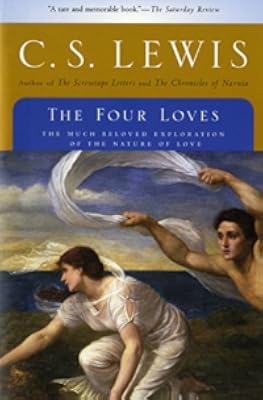
The Four Loves
by C. S. Lewis
On This Page
Description
A remarkable audio edition of C.S. Lewis' beloved classic—the only existing recording of Lewis reading his own work.C.S. Lewis—the great British writer, scholar, theologian, broadcaster, Christian apologist, and bestselling author of Mere Christianity, The Screwtape Letters, The Great Divorce, The Chronicles of Narnia, and many other beloved classics—explores the essence of love and how it works in our daily lives in one of his most famous works of nonfiction based on his series of show more radio talks from 1958.
With penetrating logic and charming wit, Lewis explores the four aspects of love: affection, the most basic form; friendship, the rarest and perhaps most insightful; Eros, passionate love; and charity, the greatest and least selfish.
Lewis exposes the pitfalls in our loves, leading us to the agape love that God has for humankind and the type of love we must develop to nurture our relationships. Throughout this compassionate and methodical study, he encourages readers to open themselves to all forms of love—the key to understanding that brings us closer to God.
Tags
Recommendations





Member Reviews
“The alternative to tragedy, or at least to the risk of tragedy, is damnation. The only place outside Heaven where you can be perfectly safe from all the dangers and perturbations of love is Hell.”
What a fantastic read. I highly recommend this for anyone who is human and around other humans. I was convicted and consoled in equal measure.
What a fantastic read. I highly recommend this for anyone who is human and around other humans. I was convicted and consoled in equal measure.
At his best Lewis can be very good (Screwtape Letters, Mere Christianity), but at other times he can be a bit frustrating. He has an excellent mind overstuffed with knowledge of many fine things, he’s often insightful, and he’s able to write engagingly and accessibly while fleshing out a carefully conceived and detailed plan. But when he’s not at his best there can be too much wordplay and other cleverness combined with an over-certain pedagogy, or at least that’s how it comes off for me. It’s particularly frustrating when there are a lot of good ideas and connections that you know could be deepened with more reflection and care. While clearing out the underbrush. You might say someone with his gifts has kind of an obligation show more to use them carefully and well for the greater good. Of course you might not say that, but let’s assume you might. At times this book feels like it was tossed off by an unusually gifted journalist. It’s a good book, but you get the sense that it could have been much better. At least I get that sense. And the material is important - it merits the best effort. Lewis wrote about the psychic and spiritual drain that Screwtape caused him, getting into the skin of a senior demon for the duration of its writing, and how he could never do that again to write a sequel despite many requests. I’m grateful that he put himself through that, and maybe he didn’t really have an obligation to sweat more to make this book better. But I do wish he had. show less
Before I die, I hope to read everything Lewis ever published. Every time I begin one of his works, I feel I'm shaking hands with a dear old professor who welcomes me back to a chair beside his fire and offers me tea (and then we laugh as I show him the Panera frozen caramel drink I brought with me, knowing he would offer tea). Then he speaks, and I listen. I know I could ask questions; he wouldn't mind. But he's going to get to his point eventually, and if I rush him, I'll miss something. So I hold my peace.
The homesick reality is that I'm only holding a book, not visiting the author. But what dear books Lewis gave the world. I'm highlighting on every other page. I'm smiling at his honesty and his humility. I'm learning, even when I show more don't fully agree (sometimes with his conclusion, sometimes with the validity of the analogy that got him there). He diverges sometimes from what I thought was the topic, but always there's a reason for the rabbit trail. He analyzes things I never bothered analyzing before. He challenges and teaches and writes with such accessible scholarship. And with every new read, I'm richer inside.
A few lesser known but, I thought, notable quotes from The Four Loves:
Mere is always a dangerous word.
Nature never taught me that there exists a God of glory and of infinite majesty. I had to learn that in other ways. But nature gave the word glory a meaning for me.
The truly wide taste in reading is that which enables a man to find something for his needs on the sixpenny tray outside any secondhand bookshop. The truly wide taste in humanity will similarly find something to appreciate in the cross-section of humanity whom one has to meet every day.
The rivalry between all natural loves and the love of God is something a Christian dare not forget.
The very condition of having Friends is that we should want something else besides Friends. [...] Those who have nothing can share nothing; those who are going nowhere can have no fellow travelers.
I have no duty to be anyone's Friend and no man in the world has a duty to be mine. No claims, no shadow of necessity. Friendship is unnecessary, like philosophy, like art, like the universe itself (for God did not need to create). It has no survival value; rather it is one of those things which give value to survival.
Christ, who said to the disciples "Ye have not chosen me, but I have chosen you," can truly say to every group of Christian friends "You have not chosen one another but I have chosen you for one another." The Friendship is not a reward for our discrimination and good taste in finding one another out. It is the instrument by which God reveals to each the beauties of all the others. show less
The homesick reality is that I'm only holding a book, not visiting the author. But what dear books Lewis gave the world. I'm highlighting on every other page. I'm smiling at his honesty and his humility. I'm learning, even when I show more don't fully agree (sometimes with his conclusion, sometimes with the validity of the analogy that got him there). He diverges sometimes from what I thought was the topic, but always there's a reason for the rabbit trail. He analyzes things I never bothered analyzing before. He challenges and teaches and writes with such accessible scholarship. And with every new read, I'm richer inside.
A few lesser known but, I thought, notable quotes from The Four Loves:
Mere is always a dangerous word.
Nature never taught me that there exists a God of glory and of infinite majesty. I had to learn that in other ways. But nature gave the word glory a meaning for me.
The truly wide taste in reading is that which enables a man to find something for his needs on the sixpenny tray outside any secondhand bookshop. The truly wide taste in humanity will similarly find something to appreciate in the cross-section of humanity whom one has to meet every day.
The rivalry between all natural loves and the love of God is something a Christian dare not forget.
The very condition of having Friends is that we should want something else besides Friends. [...] Those who have nothing can share nothing; those who are going nowhere can have no fellow travelers.
I have no duty to be anyone's Friend and no man in the world has a duty to be mine. No claims, no shadow of necessity. Friendship is unnecessary, like philosophy, like art, like the universe itself (for God did not need to create). It has no survival value; rather it is one of those things which give value to survival.
Christ, who said to the disciples "Ye have not chosen me, but I have chosen you," can truly say to every group of Christian friends "You have not chosen one another but I have chosen you for one another." The Friendship is not a reward for our discrimination and good taste in finding one another out. It is the instrument by which God reveals to each the beauties of all the others. show less
As usual with Lewis, excellent analysis of the finer shadings of a topic. Among other things, the discussion of friendship, as opposed to affection, is personally helpful.
I'm on my third copy of this book. I lost the first in college, the next eventually fell apart from use, and the new one awaits fresh underlinings after twenty years of rereading.
I'm on my third copy of this book. I lost the first in college, the next eventually fell apart from use, and the new one awaits fresh underlinings after twenty years of rereading.
Lewis is generally wise about how humans behave and what obstacles they tend to put in the way of being good to one another, even if you don't share his Christianity. The places where he fails to convince, however, are spectacularly large, because his social conservatism and his bigotry against other faiths can't help but come out, being much of what define his thinking. But he belongs to a small group of English conservative writers--Evelyn Waugh and Saki are the others--whose levels of insight and talent keep me reading them, even if their condescension (extending, of course, towards "liberated" women) is unpalatable.
This book is meant to be an essay on how and why we (the readers... and humanity in general) should only give our unconditional affection to God, while everyone receives a very limited amount of it. C.S. Lewis then goes the scientific route in trying to prove that such a mentality is in fact not only the natural order of things, but also a very healthy.
Things start out well, with the first two parts debating parental affection and friendship vs love for God. Specifically, the need for a fine line to be drawn between loyalty and healthy critcism. Granted, I did skip the part where C.S. Lewis goes on and on about keeping the ultimate expression of love for God, but I liked his overall reasoning of not putting anyone on a pedestal.
The 3rd show more part was meant to talk about the limitations to be put on Eros (romantic love), but instead got bogged down in how it is not sex. A sound plan in theory, but in practice it never moves past what Eros isn't. Sort of like me, when I tried to BS my way though literary analyses in high school: ramble a lot about tangential topics and hope for the best.
The final part of the book, arguably the most important of all, was meant to explain how (and why?) our love for God is meant to surpass every other type of love. Unfortunately it completely missed its target audience, ending up preaching to the choir. I'm sure that all the poetic waxing about ultimate rewards and such would've hit great for a true believer. As a very skeptical atheist however, none of the arguments presented here seemed even marginally appealing to me.
I consider myself fairly simple-minded when it comes to spirituality, but if the argument for Heaven being great doesn't even include reuniting with loved ones, I'm out.
Score: 2.6/5 stars
It started great, giving me hope for an intriguing debate. Unfortunately, as the concepts got more complicated the arguments failed to keep up, resorting instead to lofty praises. Might as well have just gone all "trust me, I know what I'm talking about" with a few Hallelujah-s thrown in for good measure. show less
Things start out well, with the first two parts debating parental affection and friendship vs love for God. Specifically, the need for a fine line to be drawn between loyalty and healthy critcism. Granted, I did skip the part where C.S. Lewis goes on and on about keeping the ultimate expression of love for God, but I liked his overall reasoning of not putting anyone on a pedestal.
The 3rd show more part was meant to talk about the limitations to be put on Eros (romantic love), but instead got bogged down in how it is not sex. A sound plan in theory, but in practice it never moves past what Eros isn't. Sort of like me, when I tried to BS my way though literary analyses in high school: ramble a lot about tangential topics and hope for the best.
The final part of the book, arguably the most important of all, was meant to explain how (and why?) our love for God is meant to surpass every other type of love. Unfortunately it completely missed its target audience, ending up preaching to the choir. I'm sure that all the poetic waxing about ultimate rewards and such would've hit great for a true believer. As a very skeptical atheist however, none of the arguments presented here seemed even marginally appealing to me.
I consider myself fairly simple-minded when it comes to spirituality, but if the argument for Heaven being great doesn't even include reuniting with loved ones, I'm out.
Score: 2.6/5 stars
It started great, giving me hope for an intriguing debate. Unfortunately, as the concepts got more complicated the arguments failed to keep up, resorting instead to lofty praises. Might as well have just gone all "trust me, I know what I'm talking about" with a few Hallelujah-s thrown in for good measure. show less
I was introduced to this book during a C. S. Lewis class taught by Jerry Root in 2006. It quickly became one of my favourite Lewis works -- and I have gone through three or four copies simply because I keep giving them away to people that I know will greatly enjoy it as well. My copies tend to be full of underlined paragraphs and phrases, and I have clippings from this book in blogs, on post-its, snuck into essays, in letters, tucked into journals, jotted down in cards. And this too is one that I reread every year or two, and each time, I find something new and relevant in it.
Members
- Recently Added By
Lists

Christianity Books You've Read
179 works; 19 members

One Book, Many Authors
441 works; 40 members

Five star books
1,757 works; 108 members

Blue Pyramid 1,276 Best Books of All Time
1,248 works; 32 members

Ambleside Books
459 works; 18 members

Recommended Non-Fiction Books
26 works; 2 members

Books Read in 2015
3,299 works; 126 members

Best Audiobooks
240 works; 114 members

Reading Glasses Podcast
410 works; 3 members

1001 Books You Must Read Before You Die
1,448 works; 1,134 members

Books That Changed Our Perspective
423 works; 168 members
Talk Discussions
Past Discussions
The Four Loves in Friends of Jack (C.S. Lewis) (December 2016)
Author Information

534+ Works 523,763 Members
C. S. (Clive Staples) Lewis, "Jack" to his intimates, was born on November 29, 1898 in Belfast, Ireland. His mother died when he was 10 years old and his lawyer father allowed Lewis and his brother Warren extensive freedom. The pair were extremely close and they took full advantage of this freedom, learning on their own and frequently enjoying show more games of make-believe. These early activities led to Lewis's lifelong attraction to fantasy and mythology, often reflected in his writing. He enjoyed writing about, and reading, literature of the past, publishing such works as the award-winning The Allegory of Love (1936), about the period of history known as the Middle Ages. Although at one time Lewis considered himself an atheist, he soon became fascinated with religion. He is probably best known for his books for young adults, such as his Chronicles of Narnia series. This fantasy series, as well as such works as The Screwtape Letters (a collection of letters written by the devil), is typical of the author's interest in mixing religion and mythology, evident in both his fictional works and nonfiction articles. Lewis served with the Somerset Light Infantry in World War I; for nearly 30 years he served as Fellow and tutor of Magdalen College at Oxford University. Later, he became Professor of Medieval and Renaissance English at Cambridge University. C.S. Lewis married late in life, in 1957, and his wife, writer Joy Davidman, died of cancer in 1960. He remained at Cambridge until his death on November 22, 1963. (Bowker Author Biography) show less
Some Editions
Awards and Honors
Distinctions
Series
Belongs to Publisher Series
Work Relationships
Is contained in
The Four Loves / Surprised by Joy / A Grief Observed / The Screwtape Letters / The Great Divorce / Mere Christianity by C. S. Lewis
Surprised by Joy / Reflections on the Psalms / The Four Loves / The Business of Heaven by C. S. Lewis
Has as a reference guide/companion
Has as a student's study guide
Common Knowledge
- Canonical title
- The Four Loves
- Original title
- The Four Loves
- Original publication date
- 1960
- People/Characters
- Augustine of Hippo (saint 354-430)
- Epigraph
- That our affection kill us not, nor dye. -- Donne
- Dedication
- to Chad Walsh
- First words
- "God is love," says St. John. When I first tried to write this book I thought that his maxim would provide me with a very plain highroad through the whole subject.
- Quotations
- But very few modern people think Friendship a love of comparable value or even a love at all.
(p. 87) - Last words
- (Click to show. Warning: May contain spoilers.)To know that one is dreaming is to be no longer asleep. But for news of the fully wakening world you must go to my betters.
- Blurbers
- D'Arcy, Martin; Harris, Sydney J.; Novak, Michael
Classifications
- Genres
- Religion & Spirituality, Nonfiction, Philosophy, General Nonfiction
- DDC/MDS
- 241 — Religion Christian practice & observance Christian ethics
- LCC
- BV4639 .L45 — Philosophy, Psychology and Religion Practical Theology Practical Theology Practical religion. The Christian life Moral theology Virtues
- BISAC
Statistics
- Members
- 9,369
- Popularity
- 1,123
- Reviews
- 53
- Rating
- (4.02)
- Languages
- 15 — Catalan, Chinese, Czech, Danish, Dutch, English, Finnish, French, German, Hungarian, Italian, Polish, Spanish, Swedish, Portuguese (Brazil)
- Media
- Paper, Audiobook, Ebook
- ISBNs
- 66
- UPCs
- 1
- ASINs
- 67