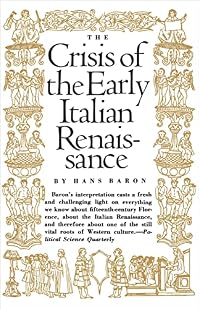
The Crisis of the Early Italian Renaissance: Civic Humanism and Republican Liberty in an Age of Classicism and Tyranny
by Hans Baron
On This Page
Description
Hans Baron was one of the many great German émigré scholars whose work Princeton brought into the Anglo-American world. His Crisis of the Early Italian Renaissance has provoked more discussion and inspired more research than any other twentieth-century study of the Italian Renaissance.Baron's book was the first historical synthesis of politics and humanism at that momentous critical juncture when Italy passed from medievalism to the thought of the Renaissance. Baron, unlike his peers, show more married culture and politics; he contended that to truly understand the Renaissance one must understand the rise of humanism within the political context of the day. This marked a significant departure for the field and one that changed the direction of Renaissance studies. Moreover, Baron's book was one of the first major attempts of any sort to ground intellectual history in a fully realized historical context and thus stands at the very origins of the interdisciplinary approach that is now the core of Renaissance studies.Baron's analysis of the forces that changed life and thought in fifteenth-century Italy was widely reviewed domestically and internationally, and scholars quickly noted that the book "will henceforth be the starting point for any general discussion of the early Renaissance." The Times Literary Supplement called it "a model of the kind of intensive study on which all understanding of cultural process must rest." First published in 1955 in two volumes, the work was reissued in a one-volume Princeton edition in 1966. show lessTags
Recommendations


















Member Recommendations
proximity1 There are few books I'd place along side Hans Baron's The Crisis of the Early Italian Renaissance: Civic Humanism and Republican Liberty in an Age of Classicism and Tyranny but Carlin Barton's Roman Honor is one such.
Member Reviews
Marvelous book, actually. Although it was academic, and at times its prose could be described as serpentine, I found myself reading fairly quickly and making good progress. I was actually trying to use the book as an introduction to the Italian Renaissance. In that, it was helpful in that it introduced me to historical figures such as Leonardo Bruni (and others) that I had never heard of. For the early Renaissance, especially, it seemed a good intro, and a treatise on why this period around 1402 was so critical for the development of humanism, as well as for political ideas. Those two strains, humanism and the new political ideas, grew together in tandem and combined in what the author called “civic humanism.” In some ways, the book show more didn’t act well as an introduction to the Renaissance, though, too. Very little is here about art or literature, as the main emphasis is on political writings. It’s a great introduction to those, however, and I should be thinking a lot about this book as I continue to read books on European political thought. show less
This is a landmark text in its field. Published in 1955, it represented a major and then-fresh reinterpretation of standard scholarly views of the politics and society of Italy--and particularly Florence and northern Italy--of the late 14th and early 15th ceturies. By this time, neither Hans Baron nor his major work stands in need of any reader's praise--least of all one who comes to his work as a beginner. Read this book; it is its own reward for the effort expended on it, Its author's clarity and insight are things we rarely find in scholarship today.
Ratings
Members
- Recently Added By
Lists

Bibliography of How the Old World Ended by Jonathan Scott
308 works; 1 member
Author Information

Some Editions
Series
Belongs to Publisher Series
Common Knowledge
- Canonical title
- The Crisis of the Early Italian Renaissance: Civic Humanism and Republican Liberty in an Age of Classicism and Tyranny
- Original title
- The crisis of the early Italian Renaissance
- Original publication date
- 1955; Princeton (N J), Princeton University Press, 1955 (N J) (N J | N J); 2. rev. ed. 1964
- People/Characters
- Leonardo Bruni; Giangaleazzo Visconti; Coluccio Salutati
- Important places
- Florence, Tuscany, Italy
- Important events
- Victory of Florence over Milan (1402); Renaissance
- Dedication
- A DANTE DELLA TERZA
AMICO SAVIO, E INSTANCABILE
DURANTE LA PREPARAZIONE
DI QUESTA EDIZIONE ITALIANA
DELLA «CRISI»
CON GRATO ANIMO - First words
- Nella prima pagina della versione italiana della The crisis of the early Italian Renaissance ritengo dovrso citare il nome di Delio Cantimori, sena il cui energico intervento questo mio lavoro non apparirebbe ora in it... (show all)aliano.
PRESENTAZIONE AL LETTORE ITALIANO - Original language
- Inglese
Classifications
- Genres
- History, Nonfiction, General Nonfiction, Politics and Government
- DDC/MDS
- 945.05 — History & geography History of Europe Italy Italy Renaissance 1300-1494
- LCC
- DG537 .B37 — History of Europe, Asia, Africa and Oceania City History of Italy Medieval and modern Italy, 476- History By period Medieval, 476-1492 1268-1492 Renaissance
- BISAC
Statistics
- Members
- 133
- Popularity
- 239,655
- Reviews
- 2
- Rating
- (3.81)
- Languages
- English, Italian
- Media
- Paper, Ebook
- ISBNs
- 3
- ASINs
- 6