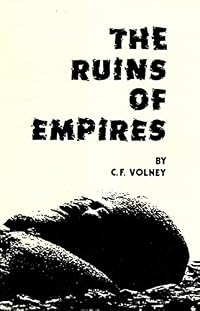
The Ruins; or, Meditation on the Revolutions of Empires; and, The Law of Nature
by C. F. Volney
On This Page
Description
Written in 1793 by Count Volney, this book was considered somewhat controversial. Volney had little problem establishing from firsthand observations and study that early Nile Valley Africans had in fact provided a basis for the civilization of his time. This book remains a profound and helpful reference for those who are trying to gain undistorted access to the African past.Tags
Recommendations






















Member Recommendations

Member Reviews
I could write a book as long about how awesome this book is. Only pissed that no one shoved it in my paws at 15 instead of finding it by chance up in King Library at 35. A book that I sincerely wish all residents of purportedly democratic western societies were MADE to read, as young as intellectually possible. It gives me the same thrill now that Morning of the Magicians gave me at 20 and Cosmic Trigger at 30: the thrill of having found a voice that both has the scholarship (and in Volney's case the damned language chops, having learned Arabic as his contemporaries firmly refused to) and the ETHICS to pull off that kind of work of history, intending for the audience to better itself in reading. I'm happy that I otherwise learned so show more much of the stuff he found in the 780s by myself, and that made the book a fun treasure hunt, but if only I'd known sooner. May we all be as sharp as Volney in everything we consider. NOTICE I read the Black Classics reprint, which is clean and elegant, not the 2018 facsimile. show less
Originally published in 1797, Count Volney, an extremely educated and well-read man, proposes his thesis that religion accompanies the rise and fall of civilizations, while the natural ethical behavior of all people is the true source of the goodness (or evil) of mankind.
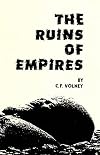
This 1950 hardback edition from Truth Seeker Press is an excellent reprint of the Jefferson-Barlow translation. To my knowledge it's the first reprint of the J-B translation since Peter Eckler's last edition in 1926--what a long strange trip the world took in those intervening years!
A relatively thin single volume with quality boards, colored in their signature red, and most often sold in a still fresh mylar wrapper. Some of my copies look brand new even though they are alomost sixty years old. A great buy, if you can find it, at 20-50 USD. Just like the 1991 Black Classic Press edition, these Truth Seeker folks (who might be related to Eckler's Truth Seeker Co.) did not realize Gilbert Chinard had discovered Jefferson's role back in show more 1923. Strange that even people who really like this book were never aware of this very salient factoid. In all, this 1950 Truth Seeker edition is of very high quality; makes both a great collector's item and a great reading copy.
This edition also includes Law of Nature and Volney's Response to Dr. Priestly (sic). show less
A relatively thin single volume with quality boards, colored in their signature red, and most often sold in a still fresh mylar wrapper. Some of my copies look brand new even though they are alomost sixty years old. A great buy, if you can find it, at 20-50 USD. Just like the 1991 Black Classic Press edition, these Truth Seeker folks (who might be related to Eckler's Truth Seeker Co.) did not realize Gilbert Chinard had discovered Jefferson's role back in show more 1923. Strange that even people who really like this book were never aware of this very salient factoid. In all, this 1950 Truth Seeker edition is of very high quality; makes both a great collector's item and a great reading copy.
This edition also includes Law of Nature and Volney's Response to Dr. Priestly (sic). show less
While in Paris, Thomas Jefferson seriously imperiled his political future by secretly joining with the noted anti- slavery poet and founder of ''the[ American Mercury]", [[Joel Barlow]] to provide his friend [[Constantin-Francois Volney]] with an English translation of The Ruins: Or a Survey of the Revolutions of Empires, a translation from the French Les Ruines ou Meditations sur les Revolutions des Empires, published in 1796 by William A. Davis, in New York. This is an admittedly radical work even by today's Liberal standards. Maybe that is why it took the[[ University of Virginia]] 185 years to remember that Jefferson had given it not one, but two copies of his personally selected translations of Volney's work.
One copy was presented show more to the [[Library of Congress]] just in time for it's 200th birthday. This translation of Volney's work is the same edition as the one Jefferson had sold to [[The Library of Congress]] in 1815, but which was sadly lost to flames in 1851.
Mark Dimunation, chief of the [[Rare Book and Special Collections division at the Library of Congress]], has called Volney's work an “important source,..”, “that influenced Jefferson's thinking”. Just think, “Afro-Centric Scholars” (Not an oxymoron) have been teaching for decades that this particular translation of this work is an important primary source. Its taken almost 200 years, but thanks to the ongoing deification of Thomas Jefferson, more mainstream scholars may finally work up the nerve to examine Volney's message in the exact words that President Jefferson chanced so much to pass along.
Rememember that [[George Washington]], [[Thomas Jefferson]],and [[Abraham Lincoln]] all had this work in their libraries.
"Those piles of ruins which you see in that narrow valley watered by the Nile, are the remains of opulent cities, the pride of the ancient kingdom of Ethiopia. Behold the wrecks of her metropolis, of Thebes with her hundred palaces, the parent of cities and the monument of the caprice of destiny. There a people, now forgotten, discovered while others were yet barbarians, the elements of the arts and sciences. A race of men now rejected from society for their sable skin and frizzled hair, founded on the study of the laws of nature , those civil and religious systems which still govern the universe. Lower down those dusky points are the pyramids whose masses have astonished you. Beyond that, the coast, hemmed in between the sea and a narrow ridge of mountains was the habitation of the Phoenicians. These were the famous cities of Tyre, of Sidon, of Ascalon, of Gaza, and of Berytus. "
Count Constantine Francis Chassebeuf De Volney - 1793 Thomas Jefferson, trans show less
One copy was presented show more to the [[Library of Congress]] just in time for it's 200th birthday. This translation of Volney's work is the same edition as the one Jefferson had sold to [[The Library of Congress]] in 1815, but which was sadly lost to flames in 1851.
Mark Dimunation, chief of the [[Rare Book and Special Collections division at the Library of Congress]], has called Volney's work an “important source,..”, “that influenced Jefferson's thinking”. Just think, “Afro-Centric Scholars” (Not an oxymoron) have been teaching for decades that this particular translation of this work is an important primary source. Its taken almost 200 years, but thanks to the ongoing deification of Thomas Jefferson, more mainstream scholars may finally work up the nerve to examine Volney's message in the exact words that President Jefferson chanced so much to pass along.
Rememember that [[George Washington]], [[Thomas Jefferson]],and [[Abraham Lincoln]] all had this work in their libraries.
"Those piles of ruins which you see in that narrow valley watered by the Nile, are the remains of opulent cities, the pride of the ancient kingdom of Ethiopia. Behold the wrecks of her metropolis, of Thebes with her hundred palaces, the parent of cities and the monument of the caprice of destiny. There a people, now forgotten, discovered while others were yet barbarians, the elements of the arts and sciences. A race of men now rejected from society for their sable skin and frizzled hair, founded on the study of the laws of nature , those civil and religious systems which still govern the universe. Lower down those dusky points are the pyramids whose masses have astonished you. Beyond that, the coast, hemmed in between the sea and a narrow ridge of mountains was the habitation of the Phoenicians. These were the famous cities of Tyre, of Sidon, of Ascalon, of Gaza, and of Berytus. "
Count Constantine Francis Chassebeuf De Volney - 1793 Thomas Jefferson, trans show less
This hardback edition from James Miller of New York looks similar in cover design and size to the Josiah Mendum editions of the mid-1880s. There is no date on my copy, but the LT search engine says James Miller published his edition in 1900. Even though the publisher eliminated the phrase "under the imediate inspection of the author" from the title page, this is the Jefferson-Barlow translation. Includes Law of Nature, the Daru biosketch, and the Response to Dr. Priestly (sic). No images. The publisher also took the traditional Preface from Law of Nature and placed it at the front of the book as the Preface for Ruins of Empires--strange, but I guess it works. The Invocation is also located in front of the biosketch--another bizarre show more feature...Overall this is a very rare and ideosyncratic edition. Small print. A collector's item but not a reading copy. show less
This rare single-volume edition published by Dixon and Sickels of New York in 1828 is the first edition of the Jefferson-Barlow translation printed in the United States. Also includes Law of Nature and the biosketch of Volney by Count Daru.
Appears to be the first edition to use a new rendering of the classic "philosopher on the hillside overlooking the ruins of Palmyra" image. In subsequent decades this particular image became the "standard" for both English and French language editions, replacing the original image drawn by Pierre Tardieu in 1791. The artist signs his work: Sam-l Maverick, SC. Not sure if this is the same person but check out this link:
http://en.wikipedia.org/wiki/Samuel_Augustus_Maverick
Appears to be the first edition to use a new rendering of the classic "philosopher on the hillside overlooking the ruins of Palmyra" image. In subsequent decades this particular image became the "standard" for both English and French language editions, replacing the original image drawn by Pierre Tardieu in 1791. The artist signs his work: Sam-l Maverick, SC. Not sure if this is the same person but check out this link:
http://en.wikipedia.org/wiki/Samuel_Augustus_Maverick
These Eckler editions (1890-1926) are probably the most commonly found hardback edition of the Jefferson-Barlow translation on the internet and in bookstores. Most include a Translator's Preface which reveals the history of the so-called Paris Translation, but does not acknowledge Jefferson's role. They also include the Law of Nature, Volney's Response to Dr. Priestly (sic), and the Life of Volney biosketch.
Large, easy-to-read format; high quality binding. All editions (except 1926) have goldleaf lettering at the top of spine which can read either: "Ruins of Empires, C.F. Volney" or "Volney's Ruins." Expected price range: $20-100 depending on book condition as well as the seller's knowledge of what they are holding in their hands. The show more 1913 editions are identified as "The Truth Seeker Co. of New York" but this publisher appears to be none other than "Peter Eckler Publishing."
Eckler's last edition appears to be 1926. After that, a long fallow period ensued--the end of the Roaring Twenties, the stagnation of the Great Depression, the devastation of World War II--all three events attributable to our species' ignorance of Volney's general principles described in Ruins of Empires and Law of Nature. Truth Seeker Press published the next edition of the Jefferson-Barlow translation in 1950.
1890 edition: high quality dark brown boards; mid-spine can read: "Library of Liberal Classics" or nothing; bottom of spine can read "Eckler" or have no printing at all.
1913 edition: dark brown to black boards; title page and bottom of spine reads: "Truth Seeker Press"
1915 edition: red boards; title page and bottom of spine reads: "Peter Eckler Publishing Co." and "Eckler" respectively.
1920 edition: light brown boards, slightly thinner edition than the other Ecklers; title page and bottom of spine reads: "Peter Eckler Publishing Co." and "Eckler" respectively.
1926 edition: green boards, black lettering at top of spine reads: "Volney's Ruins"; bottom of spine can read either: "ECKLER" or "The Truth Seeker Co." show less
Large, easy-to-read format; high quality binding. All editions (except 1926) have goldleaf lettering at the top of spine which can read either: "Ruins of Empires, C.F. Volney" or "Volney's Ruins." Expected price range: $20-100 depending on book condition as well as the seller's knowledge of what they are holding in their hands. The show more 1913 editions are identified as "The Truth Seeker Co. of New York" but this publisher appears to be none other than "Peter Eckler Publishing."
Eckler's last edition appears to be 1926. After that, a long fallow period ensued--the end of the Roaring Twenties, the stagnation of the Great Depression, the devastation of World War II--all three events attributable to our species' ignorance of Volney's general principles described in Ruins of Empires and Law of Nature. Truth Seeker Press published the next edition of the Jefferson-Barlow translation in 1950.
1890 edition: high quality dark brown boards; mid-spine can read: "Library of Liberal Classics" or nothing; bottom of spine can read "Eckler" or have no printing at all.
1913 edition: dark brown to black boards; title page and bottom of spine reads: "Truth Seeker Press"
1915 edition: red boards; title page and bottom of spine reads: "Peter Eckler Publishing Co." and "Eckler" respectively.
1920 edition: light brown boards, slightly thinner edition than the other Ecklers; title page and bottom of spine reads: "Peter Eckler Publishing Co." and "Eckler" respectively.
1926 edition: green boards, black lettering at top of spine reads: "Volney's Ruins"; bottom of spine can read either: "ECKLER" or "The Truth Seeker Co." show less
Members
- Recently Added By
Author Information

43 Works 298 Members
Work Relationships
Common Knowledge
- Canonical title
- The Ruins; or, Meditation on the Revolutions of Empires; and, The Law of Nature
- Alternate titles
- The ruins of empires
- Original publication date
- 1791
- Important events
- French Revolution
Classifications
Statistics
- Members
- 105
- Popularity
- 307,067
- Reviews
- 13
- Rating
- (4.08)
- Languages
- English, Spanish
- Media
- Paper, Ebook
- ISBNs
- 15
- ASINs
- 8