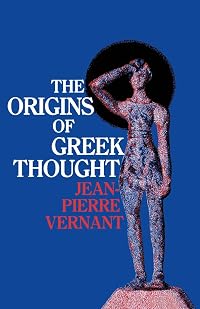
The Origins of Greek Thought
by Jean-Pierre Vernant, Husen Portakal
On This Page
Description
Jean-Pierre Vernant's concise, brilliant essay on the origins of Greek thought relates the cultural achievement of the ancient Greeks to their physical and social environment and shows that what they believed in was inseparable from the way they lived. The emergence of rational thought, Vernant claims, is closely linked to the advent of the open-air politics that characterized life in the Greek polis. Vernant points out that when the focus of Mycenaean society gave way to the agora, the show more change had profound social and cultural implications. "Social experience could become the object of pragmatic thought for the Greeks," he writes, "because in the city-state it lent itself to public debate. The decline of myth dates from the day the first sages brought human order under discussion and sought to define it. . . . Thus evolved a strictly political thought, separate from religion, with its own vocabulary, concepts, principles, and theoretical aims." show lessTags
Recommendations













Member Reviews
100 VERN 1
Una reflexión de como el pensamiento mágico y mitológico se fue convirtiendo en científico filosófico, pero con las prevenciones del caso y no queriendo transpolar categorías actuales, la tesis es que más que científico duro , el desarrollo pretendía explicar el justo medio en la polis, no física si política en definitiva
Dec 16, 2015Spanish
Jedna z nejzajímavějších, nejpřínosnějších a nejfundovanějších knih, kterou jsem kdy četl o kořenech základních evropských charakteristik a hodnot. Rozhodně doporučuji k pozornému přečtení!
Sep 17, 2009Czech
Vernant, estudioso de la antropología histórica en la Grecia antigua, recibió una educación laica: su abuelo y su padre fueron directores del diario "Le Briard", de Provins. Hizo una agregación en filosofía en 1937. Pero sus maestros fueron dos grandes figuras: el helenista Louis Gernet y el psicólogo e historiador Ignace Meyerson, con quienes trabajó tras haber seguido sus enseñanzas.
Dirigió la resistencia contra la ocupación nazi en el sur de Francia. Inmediatamente después, fue profesor de instituto (1945-1948), en Toulouse y París. Luego, comienza ya su carrera como investigador, trabaja entre en el CNRS (1948-1957), y en la École Pratique des Hautes Études. Entró en diciembre de 1975, con su lección inaugural show more Religion grecque, religions antiques (París, Maspero, 1976); en el Collège de France, donde, hasta 1984, hizo estudios comparados de religiones antiguas.
Vernant muere unos días después de su 93º cumpleaños, en Sèvres. show less
Dirigió la resistencia contra la ocupación nazi en el sur de Francia. Inmediatamente después, fue profesor de instituto (1945-1948), en Toulouse y París. Luego, comienza ya su carrera como investigador, trabaja entre en el CNRS (1948-1957), y en la École Pratique des Hautes Études. Entró en diciembre de 1975, con su lección inaugural show more Religion grecque, religions antiques (París, Maspero, 1976); en el Collège de France, donde, hasta 1984, hizo estudios comparados de religiones antiguas.
Vernant muere unos días después de su 93º cumpleaños, en Sèvres. show less
Nov 15, 2017Spanish
Ratings
Members
- Recently Added By
Author Information

69+ Works 2,626 Members
Jean-Pierre Vernant is a leading French scholar of ancient Greece who attempts to elucidate Greek religions, especially mythology, through the development of a historical anthropology. In 1984 he retired from his position as professor of the comparative study of ancient religion at the College de France. Among his earlier accomplishments, Vernant show more received the Croix de Guerre and the Croix de la Liberation for his service in the French army in World War II; he was also made an officer in the French Legion of Honor. Vernant is a writer of essays more than of books. As anthropologist James Redfield (see Vol. 3) puts it, "His forte . . . has been the informal, slightly rambling essay. . .; he does not collect evidence in order to make a case but rather cites the material in order to illustrate his ideas."Vernant's career has been distinguished by his collaboration with other scholars, most notably with Marcel Detienne and Pierre Vidal-Naquet. His interest in applying anthropological study to ancient Greece derives from his teacher, Louis Gernet, a member of Emile Durkheim's (see Vol. 3) school of L'Annee Sociologique. Vernant also adapts ideas from structuralist anthropology, without, however, surrendering a historical perspective. He works most often on materials from Greece of the fifth century b.c. Classicists often resist Vernant's approach because it is so heavily informed by theory. Nevertheless, it provides a wonderfully rich and complex vision of the ancient world and is worth serious and prolonged consideration. (Bowker Author Biography) show less
2 Works 343 Members
Common Knowledge
Classifications
Statistics
- Members
- 341
- Popularity
- 92,982
- Reviews
- 4
- Rating
- (3.57)
- Languages
- 11 — Czech, English, Finnish, French, German, Italian, Polish, Portuguese, Romanian, Spanish, Turkish
- Media
- Paper
- ISBNs
- 31
- UPCs
- 1