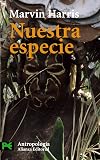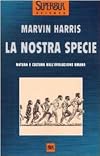
Our Kind: Who We Are, Where We Came From, Where We Are Going
by Marvin Harris
On This Page
Description
Writing with the same wit, humor, and style of his earlier bestsellers, noted anthropologist Marvin Harris traces our roots and views our destiny.Tags
Recommendations































Member Reviews
With this book, Harris accomplished an undertaking that few could achieve. He produced an overview of human biological and cultural evolution up to the present day that duly incorporates evidence from every field of anthropology in a way that is both entertaining and comprehensible for the general and academic reader.
After covering the biological evolution of modern humans from the earliest hominins, Harris begins presenting his case that after a certain point he calls "cultural takeoff" (35-40,000 years ago) cultural selection began serving as a proxy for natural selection in most facets of social life. He argues that many widespread human behaviors do not serve to maximize individual reproductive success, and it is actually minimized show more by such universal practices as female infanticide, abortion, contraception. His explanation for the shift is that, through cultural selection, the sexual instinct has been "decoupled" from the reproductive instinct, so investment in reproductive success is no longer a priority.
As one might expect, who is familiar with his work, Harris restricts his discussion of culture to functional explanations of why diverse traditions are best suited to given ecological and social environments. His theoretical perspective is decidedly evolutionary though not in the narrow sociobiological sense. Since the theme of the book is the evolution of culture, Harris is in his element, and the explanation he gives for the transition from redistributive chiefdoms to states, though admittedly anecdotal, has me completely convinced.
One of my favorite sections is titled "Was there life before chiefs?" Harris describes a few of countless examples of hunting and gathering societies which functioned without permanent positions of authority. Granting that societies with reciprocal exchange are economically egalitarian, Harris does not romanticize arguing that, in at least some of these, women are subordinate to men. He attributes this to the slight physical advantage of males over females.
The book ends on a dark note, reminding readers that, while human choice has been involved in every moment of the process of cultural selection, the major transformations of human societies have not been chosen as the big picture has always seemed to elude us. The last century has demonstrated this failure of foresight as new technologies have managed to threaten human and non-human life in new more acute ways than ever before. He poses the problem of how humans might gain some control over the process of cultural evolution before it kills us. show less
After covering the biological evolution of modern humans from the earliest hominins, Harris begins presenting his case that after a certain point he calls "cultural takeoff" (35-40,000 years ago) cultural selection began serving as a proxy for natural selection in most facets of social life. He argues that many widespread human behaviors do not serve to maximize individual reproductive success, and it is actually minimized show more by such universal practices as female infanticide, abortion, contraception. His explanation for the shift is that, through cultural selection, the sexual instinct has been "decoupled" from the reproductive instinct, so investment in reproductive success is no longer a priority.
As one might expect, who is familiar with his work, Harris restricts his discussion of culture to functional explanations of why diverse traditions are best suited to given ecological and social environments. His theoretical perspective is decidedly evolutionary though not in the narrow sociobiological sense. Since the theme of the book is the evolution of culture, Harris is in his element, and the explanation he gives for the transition from redistributive chiefdoms to states, though admittedly anecdotal, has me completely convinced.
One of my favorite sections is titled "Was there life before chiefs?" Harris describes a few of countless examples of hunting and gathering societies which functioned without permanent positions of authority. Granting that societies with reciprocal exchange are economically egalitarian, Harris does not romanticize arguing that, in at least some of these, women are subordinate to men. He attributes this to the slight physical advantage of males over females.
The book ends on a dark note, reminding readers that, while human choice has been involved in every moment of the process of cultural selection, the major transformations of human societies have not been chosen as the big picture has always seemed to elude us. The last century has demonstrated this failure of foresight as new technologies have managed to threaten human and non-human life in new more acute ways than ever before. He poses the problem of how humans might gain some control over the process of cultural evolution before it kills us. show less
I remember reading this book when I was 15, and it explained to me so many questions I had - that I was dazzled. Of course, later I found out many theories were shoddy, but the idea that there could be an explanation to all of this without the need of involving God - left its marks on my belief system to date.
Fantastic book full of rare insights. A thinker's book which makes you think. Something in it for everyone.
Obra fundamental de Marvin Harris en la que explora la evolución biológica, social y cultural del ser humano. Desde una perspectiva materialista cultural, el autor analiza los orígenes del lenguaje, la religión, la guerra y la organización social, ofreciendo una visión integral de lo que significa pertenecer a “nuestra especie”.
Nov 6, 2025Spanish
Nuestra especie es una suerte de compendio en forma de artículos breves (de no más de 4 o 5 páginas) que recoge las reflexiones e informaciones más relevantes de todas las obras publicadas por Harris. Leer Nuestra especie es como leer todo Harris.
El sexo, la homosexualidad, las costumbres gastronómicas, la gramática de la lengua, los memes, los genes, las modas, la violencia, el altruismo, el amor, la creencia en Dios, el arte, la diferencia entre sexos, la diferencia entre etnias… todos estos y muchos más asuntos son tratados por Harris en cada uno de los capítulos de este voluminoso libro (por hechuras y por cantidad de información contenida en él).
En definitiva, un manual de la vida, del ser humano, de la especie. Un show more radiografía que cualquiera debería inspeccionar antes de osar verter una opinión sobre cualquier tema terrenal. Un apropiado prólogo que luego puede abrir sendas hacia libros más técnicos y complejos
`Font: [http://www.papelenblanco.com/divulgacion/nuestra-especie-de-marvin-harris] show less
El sexo, la homosexualidad, las costumbres gastronómicas, la gramática de la lengua, los memes, los genes, las modas, la violencia, el altruismo, el amor, la creencia en Dios, el arte, la diferencia entre sexos, la diferencia entre etnias… todos estos y muchos más asuntos son tratados por Harris en cada uno de los capítulos de este voluminoso libro (por hechuras y por cantidad de información contenida en él).
En definitiva, un manual de la vida, del ser humano, de la especie. Un show more radiografía que cualquiera debería inspeccionar antes de osar verter una opinión sobre cualquier tema terrenal. Un apropiado prólogo que luego puede abrir sendas hacia libros más técnicos y complejos
`Font: [http://www.papelenblanco.com/divulgacion/nuestra-especie-de-marvin-harris] show less
Aug 3, 2011Catalan
Ratings
Members
- Recently Added By
Lists

Atheism, humanism, freethought, &c. — Best nonfiction books in favour of
167 works; 14 members
Author Information

30+ Works 4,164 Members
Marvin Harris is an American anthropologist who was educated at Columbia University, where he spent much of his professional career. Beginning with studies on race relations, he became the leading proponent of cultural materialism, a scientific approach that seeks the causes of human behavior and culture change in survival requirements. His show more explanations often reduce to factors such as population growth, resource depletion, and protein availability. A controversial figure, Harris is accused of slighting the role of human consciousness and of underestimating the symbolic worlds that humans create. He writes in a style that is accessible to students and the general public, however, and his books have been used widely as college texts. (Bowker Author Biography) show less
Work Relationships
Common Knowledge
- Canonical title*
- Menschen: Wie wir wurden, was wir sind
- Original publication date
- 1989
- First words
- In the beginning was the foot.
- Last words
- (Click to show. Warning: May contain spoilers.)We must recognize the degree to which we are not yet in control of cultural selection and we must struggle to gain control over it through objective studies of the human condition and the recurrent processes of history.
*Some information comes from Common Knowledge in other languages. Click "Edit" for more information.
Classifications
- Genres
- Anthropology, Science & Nature, Nonfiction, General Nonfiction, History
- DDC/MDS
- 573.2 — Natural sciences & mathematics Biology Specific physiological systems in animals, regional histology and physiology in animals Origin of man
- LCC
- GN31.2 .H37 — Geography, Anthropology and Recreation Anthropology Anthropology
- BISAC
Statistics
- Members
- 396
- Popularity
- 79,083
- Reviews
- 6
- Rating
- (4.04)
- Languages
- English, German, Italian, Spanish
- Media
- Paper
- ISBNs
- 11
- ASINs
- 4