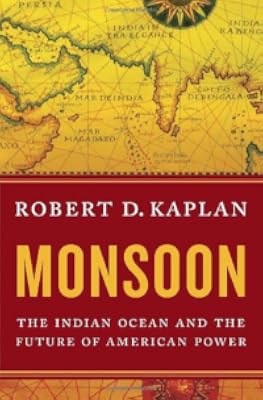
Monsoon: The Indian Ocean and the Future of American Power
by Robert D. Kaplan
On This Page
Description
In "Monsoon," a pivotal examination of the Indian Ocean region and the countries known as "Monsoon Asia," bestselling author Robert D. Kaplan deftly shows how crucial this dynamic area has become to American power in the twenty-first century. Kaplan also offers riveting insights into the economic and naval strategies of China and India and how they will affect U.S. interests, while also providing an on-the-ground perspective on the more volatile countries in the region.Tags
Recommendations



























Member Recommendations

Member Reviews
Robert Kaplan’s Monsoon borrows a format from his earlier popular and very influential book Balkan Ghosts: part history, part travelogue, part geography lesson, and part political analysis. Here he broadens his scope from a European peninsula to the Indian Ocean littoral. His overall theme is that the United States no longer has the power to be the world’s only hegemon, and so it must adapt to sharing power in this theater with China and India. Moreover, the Indian Ocean littoral is the locus of some of the most unstable regimes in the world, and thus is likely to be a place where radical changes in the political status quo will occur.
While the geography of the Indian Ocean determines the scope of the book, that area’s show more characteristic wind patterns (the monsoons) unify its history from early medieval times to the advent of steam power. Because the winds blow like clockwork from southwest to northeast part of the year and then reverse themselves in April and October, Arab traders were able to sail to India and farther east to Indonesia with the wind at their backs, and then return home, also with favorable winds. From the east, Chinese traders were able to sail to India and East Africa, and then return home with favorable winds.
The spread of Islam is another principal theme of the book. Where Islam spread by conquest (its usual modus operandi)—in Persia and Northwest India (modern Pakistan)—it retained its intolerant, close-minded character. Where it expanded through trade and voluntary conversion—Indonesia—it absorbed many of the local religious beliefs and practices, and became much more tolerant and open minded. In India, where Islam’s spread by conquest was stopped by Hindu civilization, the history of the country is still suffused with the confrontation of Muslim and Hindu belief systems.
The coming of the Portuguese with Vasco da Gama in the late 16th century disrupted trading patterns that had prevailed for over 500 years in the area. The Dutch and British followed soon thereafter, and Europeans dominated the area until World War II.
Kaplan’s narrative takes us on a chapter-by-chapter tour of Oman, Baluchistan and Sindh (Pakistan), Gujarat (western India), Delhi (central India), Kolkata (eastern India), Bangladesh, Burma, and Indonesia. Oman is prosperous, but not remotely democratic. India is a thriving democracy. Pakistan and Bangladesh are atrociously-ruled basket cases. Burma is a mixture of rival ethnicities ruled by an oppressive dictatorship. Indonesia practices a remarkably tolerant form of Islam, and is fairly democratic. Kaplan’s descriptions of these countries is much more detailed and nuanced than my thumb nail sketches, so you will have to read the book for a full appreciation of his careful and detailed analysis.
Hovering over the entire area is the rapidly growing power of China, which seeks to expand its navy to protect its vital interests in oil from Arabia. At present, China, India, and the United States all have significant naval presences in the Indian Ocean. The three have been able to cooperate in such matters as suppressing piracy. However, as U.S. power wanes and Chinese and Indian power wax, the situation must be handled deftly and carefully by all involved to avoid confrontation and possible military conflict.
Evaluation: Monsoon is a lucid analysis of the complexity of the issues presented in this potentially troublesome portion of the globe that accounts for a third of the world’s population. Kaplan contends that just as Europe defined the geopolitics of the 20th Century, the Indian Ocean will define the 21st. For those interested in global power relationships, this book is essential. A helpful glossary as well as a number of maps are included. show less
While the geography of the Indian Ocean determines the scope of the book, that area’s show more characteristic wind patterns (the monsoons) unify its history from early medieval times to the advent of steam power. Because the winds blow like clockwork from southwest to northeast part of the year and then reverse themselves in April and October, Arab traders were able to sail to India and farther east to Indonesia with the wind at their backs, and then return home, also with favorable winds. From the east, Chinese traders were able to sail to India and East Africa, and then return home with favorable winds.
The spread of Islam is another principal theme of the book. Where Islam spread by conquest (its usual modus operandi)—in Persia and Northwest India (modern Pakistan)—it retained its intolerant, close-minded character. Where it expanded through trade and voluntary conversion—Indonesia—it absorbed many of the local religious beliefs and practices, and became much more tolerant and open minded. In India, where Islam’s spread by conquest was stopped by Hindu civilization, the history of the country is still suffused with the confrontation of Muslim and Hindu belief systems.
The coming of the Portuguese with Vasco da Gama in the late 16th century disrupted trading patterns that had prevailed for over 500 years in the area. The Dutch and British followed soon thereafter, and Europeans dominated the area until World War II.
Kaplan’s narrative takes us on a chapter-by-chapter tour of Oman, Baluchistan and Sindh (Pakistan), Gujarat (western India), Delhi (central India), Kolkata (eastern India), Bangladesh, Burma, and Indonesia. Oman is prosperous, but not remotely democratic. India is a thriving democracy. Pakistan and Bangladesh are atrociously-ruled basket cases. Burma is a mixture of rival ethnicities ruled by an oppressive dictatorship. Indonesia practices a remarkably tolerant form of Islam, and is fairly democratic. Kaplan’s descriptions of these countries is much more detailed and nuanced than my thumb nail sketches, so you will have to read the book for a full appreciation of his careful and detailed analysis.
Hovering over the entire area is the rapidly growing power of China, which seeks to expand its navy to protect its vital interests in oil from Arabia. At present, China, India, and the United States all have significant naval presences in the Indian Ocean. The three have been able to cooperate in such matters as suppressing piracy. However, as U.S. power wanes and Chinese and Indian power wax, the situation must be handled deftly and carefully by all involved to avoid confrontation and possible military conflict.
Evaluation: Monsoon is a lucid analysis of the complexity of the issues presented in this potentially troublesome portion of the globe that accounts for a third of the world’s population. Kaplan contends that just as Europe defined the geopolitics of the 20th Century, the Indian Ocean will define the 21st. For those interested in global power relationships, this book is essential. A helpful glossary as well as a number of maps are included. show less
In Monsoon, Robert Kaplan brings the reader on a crash course through the history and politics of the whole Indian Ocean region, from Zanzibar off Tanzania's coast to the deep water ports of Indonesia. Though relatively small in relation to its Atlantic and Pacific neighbors, the Indian Ocean has served as a unifying network for a vast array of cultures over the past thousand years. The reliable and regular monsoon winds made this ocean a major hub of trade in ages past, and as Kaplan explains, the growing power of its coastal nations promise to make it a center of political and economic power in the coming decades. Kaplan jumps from one region to the next, briefly covering its history and framing the potential for growth and change in show more the future. From tiny Oman, living under a benevolent sultanate in control of the Persian Gulf, to vast India and its constant maneuvers in Burma to counter Chinese influence, Monsoon covers a huge amount of territory in a very few pages, but still captures the visceral reality of the people working to bring this region to the forefront of world politics.
Kaplan has a long list of books under his belt, dealing with a range of topics from the US military to the aftermath of the Cold War and the development of the third world. The level of scholarship and sensitivity he shows his subjects in this book are a testament to what must be in those works. He clearly spent a lot of time on the ground getting to understand the world of the Indian Ocean and the paths of progress it takes today. He writes rather beautifully of the crumbling ancient cities living in the shadows of new foreign-built commercial ports and the rich cultural heritage of all his subjects. Globalization is everywhere in the region, but Kaplan makes it clear that this is not necessarily new. Though he makes no statements as to his politics, his contempt for the human-rights abuses in many of these states is clear (he refuses to refer to Burma as Myanmar, the name give it by the current ruling junta), giving time to the opposition figures in order to provide a historical and social context to the violence. His thesis, that the Indian Ocean will soon become a major center of world power, is somewhat subtle but pervasive; however, he spends very little time with the sub-titular topic of American power. Largely, the world he sees is a multi-polar one where the Indian Ocean is patrolled by Indian, Chinese, and Indonesian fleets as well as American carrier groups. The power in his posited future is a soft one of trade, aid, and mutual support. One of the blurb-writers on the back cover stated that he hoped Kaplan was wrong in his theories this time, but I feel he must have not read the whole book. Kaplan does suggest that there are risks of failed states and extremism, but ultimately the only really successful nations in the region are the democracies. As the Indian Ocean coast becomes a greater cast of players on the world stage, it seems that the whole human race will benefit from their resurgence as a heart of world exchange. show less
Kaplan has a long list of books under his belt, dealing with a range of topics from the US military to the aftermath of the Cold War and the development of the third world. The level of scholarship and sensitivity he shows his subjects in this book are a testament to what must be in those works. He clearly spent a lot of time on the ground getting to understand the world of the Indian Ocean and the paths of progress it takes today. He writes rather beautifully of the crumbling ancient cities living in the shadows of new foreign-built commercial ports and the rich cultural heritage of all his subjects. Globalization is everywhere in the region, but Kaplan makes it clear that this is not necessarily new. Though he makes no statements as to his politics, his contempt for the human-rights abuses in many of these states is clear (he refuses to refer to Burma as Myanmar, the name give it by the current ruling junta), giving time to the opposition figures in order to provide a historical and social context to the violence. His thesis, that the Indian Ocean will soon become a major center of world power, is somewhat subtle but pervasive; however, he spends very little time with the sub-titular topic of American power. Largely, the world he sees is a multi-polar one where the Indian Ocean is patrolled by Indian, Chinese, and Indonesian fleets as well as American carrier groups. The power in his posited future is a soft one of trade, aid, and mutual support. One of the blurb-writers on the back cover stated that he hoped Kaplan was wrong in his theories this time, but I feel he must have not read the whole book. Kaplan does suggest that there are risks of failed states and extremism, but ultimately the only really successful nations in the region are the democracies. As the Indian Ocean coast becomes a greater cast of players on the world stage, it seems that the whole human race will benefit from their resurgence as a heart of world exchange. show less
This interesting book is several things: part travelogue, part history, part geo-politics and geo-economics. And, the author puts it all together in an informative and engaging way.
India, China and the other countries who rely on the Indian Ocean and South China Sea for trade and transport are examined in this book. It is clear that Mr. Kaplan has done a lot of reserach, and spent time visiting all the places he talks about. He displays a deep understanding of the cultures and realities of the people he writes about. I learned a lot about this part of the world. Some of the themes explored were how Islam took different forms when it arrived via traders vs. crusaders; how social institutions are needed to support governance models, show more especially democracy; how China provides economic development assistance in search of access without preaching about human rights; how so much trade depends on two or three narrow straits. The one topic I thought wasn't fully explored was the subtitle: what all this means for American power.
I was able to reflect on parallels to Canada's system of Indian reserves, our insistence that foreign aid be linked to human rights, how some issues become social causes while other similar situations go virtually unheard of.
A great introduction to this part of the world. I hope I am now better able to put current events in a context. show less
India, China and the other countries who rely on the Indian Ocean and South China Sea for trade and transport are examined in this book. It is clear that Mr. Kaplan has done a lot of reserach, and spent time visiting all the places he talks about. He displays a deep understanding of the cultures and realities of the people he writes about. I learned a lot about this part of the world. Some of the themes explored were how Islam took different forms when it arrived via traders vs. crusaders; how social institutions are needed to support governance models, show more especially democracy; how China provides economic development assistance in search of access without preaching about human rights; how so much trade depends on two or three narrow straits. The one topic I thought wasn't fully explored was the subtitle: what all this means for American power.
I was able to reflect on parallels to Canada's system of Indian reserves, our insistence that foreign aid be linked to human rights, how some issues become social causes while other similar situations go virtually unheard of.
A great introduction to this part of the world. I hope I am now better able to put current events in a context. show less
A brisk and rousting journey through the nations on the Indian Ocean, from east Africa to Indonesia. masterful and well crafted, based on history and personal familiarity. The grace of this work is that the chpters are focused and concise. A number of elegant maps. A great work!
Classic Kaplan. Informative and historically deep while explaining the various possibilities that the future may hold for power in the western Pacific and Indian Oceans. More like his previous works than his last two love affairs w the American military.
An interesting analysis of how the whole region straddled by the Indian Ocean and home to nearly 25% of humanity (50% if you include china) will evolve vis a vis the ascendary of the two primary powers in this region, India and China. The outlook is generally bright across the board barring the dark clouds brought on by the vagaries of two failed states, Somalia and Pakistan.
An interesting analysis of how the whole region straddled by the Indian Ocean and home to nearly 25% of humanity (50% if you include china) will evolve vis a vis the ascendary of the two primary powers in this region, India and China. The outlook is generally bright across the board barring the dark clouds brought on by the vagaries of two failed states, Somalia and Pakistan.
Members
- Recently Added By
Published Reviews
ThingScore 100
Kaplan is at his best when he describes the “new Great Game” that is now unfolding across the Indian Ocean. As he correctly notes, it is China that is primarily responsible for setting this game in motion. Since the turn of this century, that country’s explosive economic growth has propelled it outward in search of markets, materials and, above all, energy.
added by lorax
Kaplan’s expectations are surprisingly upbeat. Asian investment may develop Africa, ethnic conflicts in Sri Lanka and Myanmar may soften as democracy takes hold, Indonesian democracy is strong, China and India will compete more with soft than with hard power since territorial expansion is an option for neither, and the U.S. Navy can engineer an “elegant decline” from hegemony by show more fostering cooperation with other navies to protect the maritime commons. The more China and India rise, the more welcome U.S. power will be in the region as a counterbalance to both. show less
added by mercure
Author Information

36+ Works 10,068 Members
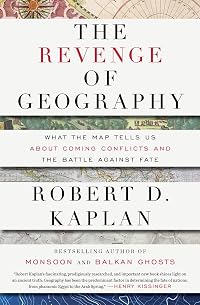
Journalist Robert D. Kaplan is a contributing editor The Atlantic Monthly. He has traveled extensively, and his journeys through Yugoslavia and America have produced, respectively, Balkan Ghosts (which was nominated for a Pulitzer Prize) and An Empire Wilderness. Kapan is also the author of Monsoon: The Indian Ocean and the Future of American show more Power (Random House, 2010) and The Revenge of Geography (Random House, 2012) Kaplan has lectured at the FBI, the National Security Agency, the Pentagon's Joint Staff, major universities, the CIA, and business forums. (Bowker Author Biography) show less
Awards and Honors
Awards
Notable Lists
Common Knowledge
- Original publication date
- 2010-10-19
- People/Characters
- George Nathaniel Curzon
- Important places
- Indian Ocean; Asia; Eurasia; Sri Lanka; India; Bangladesh (show all 16); Indonesia; China; Zanzibar; Burma; Oman; Baluchistan, Pakistan; Sindh, Pakistan; Gujarat, India; Delhi, India; Kolkata, India
- Epigraph
- Gradual, inexorable, and fundamental changes...are...occurring in the balances of power among civilizations, and the power of the West relative to that of other civilizations will continue to decline.
-Samuel P Hunting... (show all)ton, 'The clash of civilizations and the remaking of world order' (1996) - Dedication
- To Grenville Byford
- Blurbers
- Brzezinski, Zbigniew; Theroux, Paul; Meacham, Jon; Hoagland, Jim; Rashid, Ahmed; Chua, Amy (show all 7); Burns, Nicholas
- Original language
- English
Classifications
- Genres
- Politics and Government, Nonfiction, General Nonfiction, History
- DDC/MDS
- 327.7301824 — Society, government, & culture Political science International Relations: Spies North America United States
- LCC
- DS341.3 .U6 .K374 — History of Europe, Asia, Africa and Oceania Asia History of Asia Southern Asia. Indian Ocean Region
- BISAC
Statistics
- Members
- 552
- Popularity
- 53,773
- Reviews
- 12
- Rating
- (3.85)
- Languages
- Dutch, English, Russian, Spanish
- Media
- Paper, Audiobook, Ebook
- ISBNs
- 13
- ASINs
- 8